
Pulp Fiction, 1882 · page 19 of 32
Beadle's Dime Library No. 211 — page 19: what you’re looking at
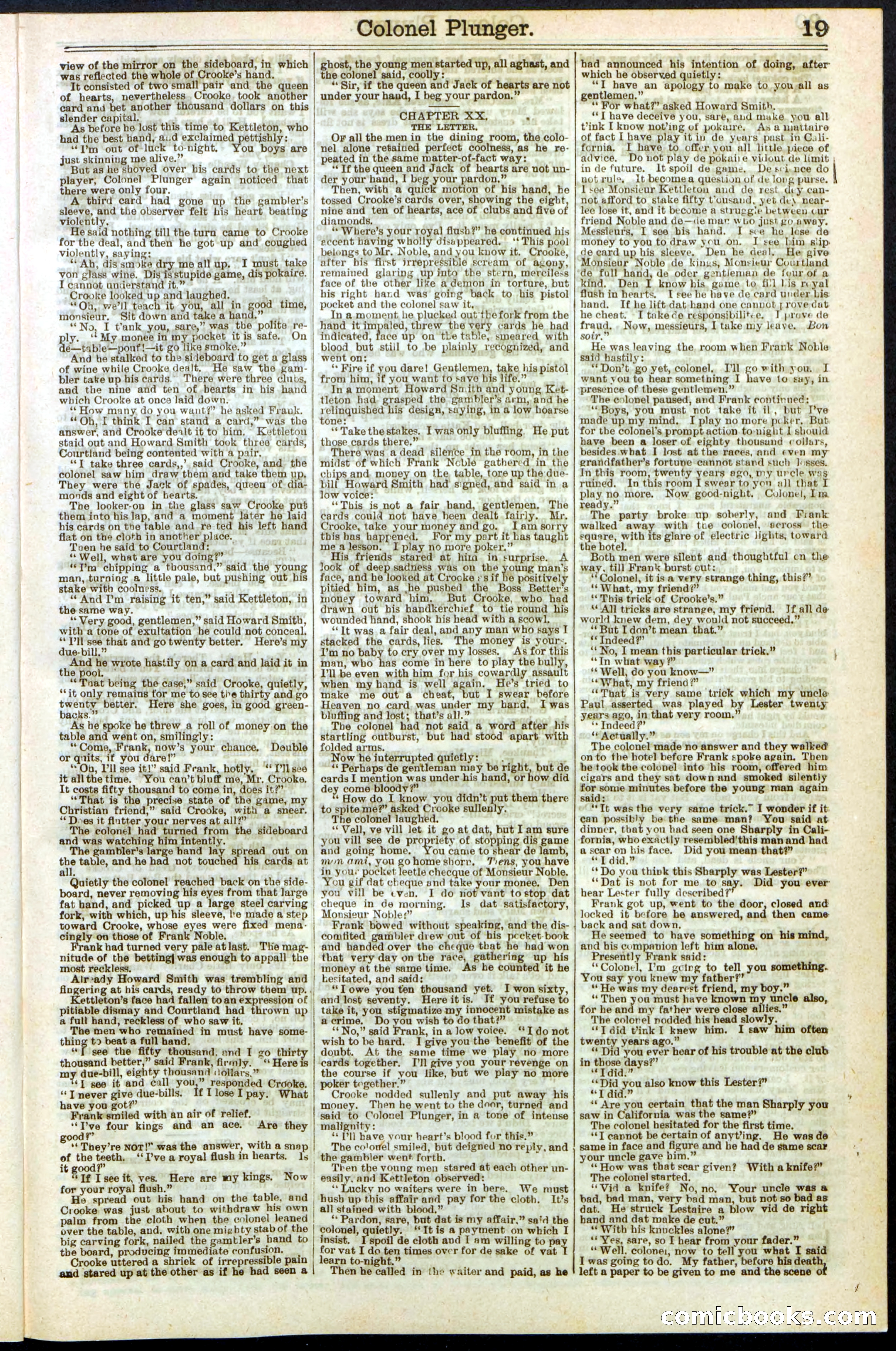
A restored page from Pulp Fiction, 1882. Page through the whole issue in the reader above.
📄 Transcribed text from this page (OCR, searchable)
Machine-transcribed from the original scan — historical spelling and the odd misread are preserved.
Colonel Plunger. view of the mirror on the sideboard, in which was reflected the whole of Crooke’s hand. It consisted of two small pair and the queen of hearts, nevertheless Crooke. took another card and bet another thousand dollars on this slender capital, r As before he lost this time to Kettleton, who had the best hand, aud exclaimed pettishly: “1m out of luck to-night, ou boys are just skinning me alive.” But as he shoved over bis cards to the next player, Colonel Plunger again noticed that there were only four. A third card had gone up the gambler’s sleeve, and the observer felt his heart beating violently. He said nothing till the turn came to Crooke for the deal, and then he got up and cougbed violently, saying: “Ab, dis smoke dry me all up. I must take von glass wine. Dis isstupide game, dis pokaire. I cannot anderstand it.” Crooke looked up and laughed. | “Oh, we'll teach it. you, all in good time, monsieur. Sit down and take a hand,” — “No, I t’ank you, sare,” was the polite re- ly. d My monee in my pocket itis safe. On é—table—ponf!—it go like smoke.” And he stalked to the sideboard to get a glass of wine while Crooke dealt. He saw the gam- bler take up his cards. There were three clubs, and the nine and ten of.bearts in his hand | which Crooke at once laid down. ** How many do you want?” he asked Frauk. “Oh, I think I can stand a card,” was the answer, and Crooke dealt it to him. Kettleton staid out and Howard Smith took three cards, Courtland being contented with a pair, ‘‘T take three cards,,’. said Crooke, and the colonel saw him draw them and take them up, They were the Jack of spades, queen of dia- monds and eight of hearts. The looker-on in the glass saw Crooke put them into his lap, and a moment later he laid his cards on the table and re ted his left hand flat on the cloth in another place. ~ Tnen he said to Courtland: ; ‘* Well, what are you doing?” “I’m chipping a thousand,” said the young man,.turniog a little pale, but pushing out his stake with coolness. the same way. “Very good, gentlemen,” said Howard Smith, with a tone of exultation he could not conceal, ** Pil see that and go twenty better. due-bill,” ) And he wrote hastily on a card and laid it in the pool. ° ““Toat being the case,” said Crooke, quietly, **it only remains tor me to see tie thirty and go twenty better. Here she goes, in good green- backs.” As he spoke he threw a roll of money on the table and went on, smilingly: “Come, Frank, now’s your chance, Deuble or quits, if you dare!” . * Ob, Dll see it!” said Frank, hotly. “‘Tllsee it allthe time. "You can’t bluff me, Mr, Crooke, It costs fifty thousand to come in, does it?” “That is the precise state of the game, my Christian friend,” said Crooke, with a sneer. “‘ Does it flutter your nerves at all?” The colonel had turned from the sideboard and was watching him intently. The sage ye e band lay spread out on oe table, and he had not touched his cards at all. Quietly the colonel reached back on the side- board, never removing his eyes from that large fat band, and picked up a large steel carving fork, with which, up his sleeve, le made a step toward Crooke, whose eyes were fixed mena- cingly on those of Frank Noble. nk had turned very pale atlast. Tlie mag- nitude of the betting| was enough to appall the most reckless. Already Howard Smith was trembling and ingens at his cards, ready to throw them up. . ttleton’s face had fallen toan expression of pitiable dismay and Courtland had thrown up a full hand, reckless of who saw it. The men who remained in must have some- thing t> beata fullhand, | “f see the fifty thousand, and I go thir thousand better,” said Frank, firmly. “ Here my due-bill, eighty thousand :lollars,” ‘*T gee it and call you,” responded Crooke. ‘“‘T never give due-bills. itt lose I pay. What have you got?” j Frank smiled with an air of relief. ‘‘I’ve four kings and an ace. Are they y Here’s my ‘‘They’re Not!” was the answer, with a snap of the ? | | } “And I’m raising it ten,” said Kettleton, in ————— a | teeth. ‘‘ I’ve a royal flush in hearts. 1s _ it good | Rie I see it, ves. Here are my kings. Now for your royal flush.” He spread out his hand on the table, and Crooke was just about to withdraw his own palm from the cloth when the colonel leaned over the table, and, with one migbty stab of the big carving fork, nailed the gambler’s hand to the board, producing immediate confusion. Crooke uttered a shriek of irrepressible pain and stared up at the other as if he had seen a ghost, the young men started up, all aghast, and the colonel said, coolly: = “Sir, if the queen and Jack of hearts are not under your hand, I beg your pardon.” CHAPTER XX, or THE LETTER. OF all the menin the dining room, the colo- nel alone retained perfect coolness, as he re- peated in the same matter-of-fact way: ‘Tf the queen and Jack of hearts are not un- der your hand, I beg your pardon,” Then, with a quick motion of his hand, he tossed Crooke’s cards over, showing the eight nine and ten of hearts, ace of clubs and five o diamonds, *'Where’s your royal flush?” he continued his eccent having wholly disappeared. ‘‘ This pool belongs to Mr. Noble, and you know it. Crooke, | after his first irrepressible scream of agony, remained glaring up into the stern, merciless face of the other like a demon in torture, but | his right hand was going back to his pistol pocket and the colonel saw it, In a. moment he plucked out the fork from the hand it impated, threw the very cards he had indicated, face up on the table, smeared with blood but stiil to be plainly recognized, and went on: * Fire if you dare! Gentlemen, take his pistol from him, if you want to save his life.” In a moment Howard Sn.ith and young Ket- tleton had. grasped the gambler’s arm, and he | relinquished his design, saying, in a low hoarse tone: ‘Take the stakes. I was only bluffing. He put those cards there.” There was a dead silence in the room, in the midst of which Frank Ncble gathered in the chips and. money on tke, table, tore up the due- bill Howard Smith had signed, and said in a low voice: “This is not a fair hand, gentlemen, The cards could not have heen dealt fairly. Crooke, take your money and go. Iam sorry this has happened. For my part it has taught me a lesson. I play no more poker.” His friends stared at hita in surprise. A look of deep sadness was on the young man’s face, and be looked at Crooke ysif he positive! pitied him, as he pusbed the Boss Better’s money toward him. But Crooke, who had drawn out his handkerchief to tie round his wounded hand, shook his head with a scowl, “It was a fair deal, and any man who says I stacked the cards, lies. The money is yours, I’m no baby to cry over my losses. As for this man, who has come in here to play the bully, I'll be even with him for his cowardly assault when my hand is well again. He’s tried to make me out a cheat, but I swear before Heaven no card. was under my hand, I was bloffing and lost; that’s all.” pti Tbe colonel had not said a word after his startling outburst, but had stood apart with folded arms. Now he interrupted quietly: _. ae ‘‘ Perhaps de gentleman may be right, but de cards I mention was under his hand, or how did dey come bloody ?” “ How do I know you didn’t put them there to spite me?” asked Crooke sullenly, The colonel laughed. ‘‘ Vell, ve vill let it go at dat, but Iam sure you vill see de ug saa of stopping dis game and going home, ou canie to shear de lamb, mon ami, you gohomeshorr, Tens, you have in yous pocket leetle checque of Monsieur Noble, You gif dat cheque and take your monee, Den you vill be «ven. I do not vant tostop dat cheque in de morning. Is dat satisfactory, Monsieur Noble?” Frank bowed without speaking, and the dis- comfited gambler drew out of bis pecket- book and handed over the cheque that he had won that very day on the race, gathering up his money at the same time. As he counted it he hesitated, and said: *“T owe you ten thousand yet. I won i ae and lost seventy. Hereitis. If you refuse take it, you stigmatize my innocent mistake as acrime. Do you wish to do that?” ‘* No,” said Frank, in a low voice. “Ido not wish to be bard. I give you the benefit of the doubt. At the same time we play no more ecards together. [ll give you your revenge on the course if you like, but we play no more poker together.” Crooke nodded sullenly and put away his money. Then he went to the door, turned and said to Colonel Plunger, in a tone of intense malignity: ‘* 11] bave your heart’s blood for this.” The co'ovel smiled, but deigned no reply, and the gambler went forth. Then the voung men stared at each other un- easily. and Kettleton observed: ‘* Lucky no waiters were in bere. We must husb up this effair and pay for the cloth. It’s all stained with blood,” ** Pardon, sare, but dat is my affair,” said the colonel, quietly. ‘It is a payment on which I insist. I spoil de cloth avd I am willing to pa for vat I do ten times over for de sake of vat y learn to-night.” Then he called in the waiter and paid, as he had announced his intention of doing, after which he observed Guat a> ool “T have an apology to make to you.all as gentlemen.” “For what?” asked Howard Smith. “I have deceive you, sare, and muke you all tink I know not’ing of pokaire, As a mattaire of fact [have play it in de years past in Gali- fornia, I have to offer you all little piece of advice, Do not play de pokai)e vidout de limit , in de future. It spoil de game, Desci.nce do notruls, 1t becomea question of de long purse. I see Monsicur Kettleton and de rest. dey can- not afford to stake fifty t’ousand, yet de\ near- lee lose it, and it become a strugg'e between cur friend Noble and de—de mar who just go away. Messieurs, I see bis hand. I sce he lose de money to you to draw you on. I see bim slip de ecard up his sleeve. Den he deal, He give Monsieur Noble de kings, Monsieur Courtland de fall hand, de oder gentieman de four of a kind. Den I know his. gome to fil Lis rmyal flush in hearts, I sree he have de card under bis hand. If he lift-dat hand one cannot prove dat he cheat. I takede responsibilitee. IJ prove de fraud. Now, messieurs, I take my leave. Lon soir, He was leaving the, room when Frank Noble said hastily: “Don’t go yet, colonel, I'll go with you. I want vou to hear something I have to swy, in presence of these gentlemen.” The eolonel paused, and Frank continued: “Boys, you must not take it il, but I’ve made up my mind, I play no more poker, But for the colonel’s prompt action tonight 1 should have been a loser of eighty thousund coiJars, besides what I lost at the races, and even my grandfather’s fortune cannot stand such Josses. In this room, twenfy years ago, my urcle was ruined. In this room I swesr to you all that I play no more. Now good-night, Culonel, Im ready.” The party broke up soberly, and Prank walked away with tne colonel, seross the equare, with its glare of electric lights, toward the hotel. Both men were silent and thoughtful cn the way, till Frank burst out: ‘Colonel, it is a very strange thing, this?” ‘*What, my friend?’ ‘This trick of Crooke’s.” “All tricks are strange, my friend. Jf all de world knew dem, dey would not succeed.” “But [don’t mean that.” ** Indeed?” ‘* No, I mean this particular trick.” “Tn what way ?” ** Well, do you know—” ‘“What, my friend?” — “That is very same trick which my uncle Paul asserted. was played by Lester twenty years ago, in that very room,” ‘** Indeed?” ‘¢ Actually.” : The colonel made no answer and they walked on to the hotel before Frank spoke again. Then he took the colopel into his room, offered him cigars and they sat down and smoked silentiy oo pep minutes before the young man again said: “‘Tt was the very same trick.” I wonder if it can sage be the same man? You said at dinner, that you had seen one Sharply in Cali- fornia, who exactly resembled'this man and had a —o his face. Did you mean that?” 7 i 4 ‘*Do you think this Sharply was Lester?” ‘Dat is not for me to say. Did you ever hear Lester fully deseribed? Frank got up, went to the door, closed and locked it before he answered, and then came back and sat down, He seemed to have something on his mind, and his companion left him alone, Presently Frank said: “Colonel, Um going to tell you something. You say you knew my father?’ “ He was my dearest friend, my boy.” “Then you must have known my uncle also, for he and my father were close allies.” The colonel nodded his head slowly. _ : “T did vink I knew him. I saw him often twenty years ago.” “‘ Did you ever hear of his trouble at the club in those days?” “T did.” “Did PAS) also know this Lester?” “aur” ‘** Are you certain that the man Sharply you saw in California was the same?” The colonel hesitated for the first time. ‘‘T cannot be certain of anyt?ing. He was de same in face and figure and he had de same scar your uncle gave bim.” ‘How was that scar given? With a knife?” The colonel started. ‘Vid a knife? No, no, Your uncle w bad, bad man, very bad man, but not so dat. He struck Lestaire a blow vid de band and dat make de cut.” “With his knuckles alone?” “Yes, sare, so T hear from your fader.” | “Well, colonei, now to tell you what I said I was going todo. My father, befvre his death, left a paper to be given to me and the scene as ht AMIE LOCC) (eo) (C <S (E (0)