
Pulp Fiction, 1882 · page 13 of 32
Beadle's Dime Library No. 211 — page 13: what you’re looking at
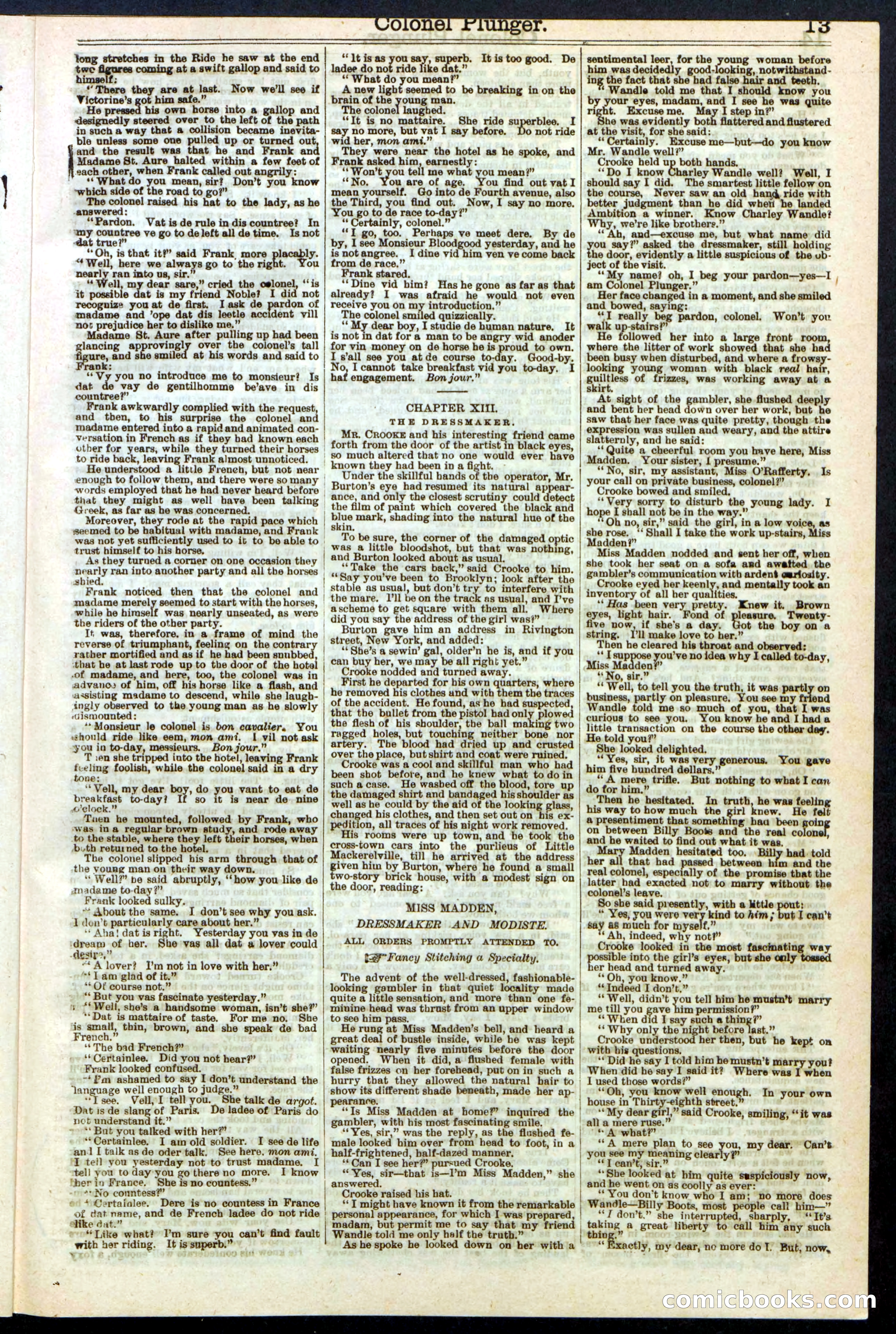
A restored page from Pulp Fiction, 1882. Page through the whole issue in the reader above.
📄 Transcribed text from this page (OCR, searchable)
Machine-transcribed from the original scan — historical spelling and the odd misread are preserved.
long stretches in the Ride he saw at the end twe coming at a swift gallop and said to himself; “There they are at last. Now we'll seo if Victorine’s got him safe.” He p his own horse into a op and designedly steered over to the left of the path in such a way that a collision became inevita- ble unless some one pulled up or turned out and the result was that he and Frank an Madame St. Aure halted within a few feet of each other, when Frank called out angrily: ' *Whatdo you mean, sir? Don’t you know *~which side of the road to go?” The colonel raised his hat to the lady, as he answered: “Pardon. Vat is de rule in dis countree? In my countree ve go to de left all detime. Is not dat true?” “Oh, is that it?’ said Frank more pl ly. “Well, here we always go to the right. You — ran into us, sir.” “Well, my dear sare,” cried the celonel, ‘is it possible t is my friend Noble? I did not recognize you at de first, I ask de on of madame and ’ope dat dis leetle accident vill not prejudice her to dislike me.” Madame 8t. Aure after pulling up had been lancing ap pes og over the colonel’s tall ure, and she smiled at his words and said to rank: Pil Pdi no introduce me to monsieur? Is dat vay de gentilhomme be’ave in dis countree?”’ Frank awkwardly complied with the request, and tben, to his surprise the colonel and madame entered into a rapid and animated con- versation in French as if they bad known each other for years, while they turned their horses to ride back, leaving Frank almost unnoticed. He understood a little Freneh, but not near enough to follow them, and there were so many words employed that he had never heard before that they might as well have been talking Greek, as far as he was concerned. Moreover, they rode at the rapid pace which | seemed to be habitual with madame, and Frank | was not yet sufficiently used to it to be able to. trust himself to his horse, As they turned a corner on one occasion they nearly ran into another party and all the horses shied. Frank noticed then that the colonel and | madame merel y seemed to start with the horses, while he himself was nearly unseated, as were the riders of the other party. It was, therefore, in a frame of mind the | reverse of triumphant, feeling on the contrar | ratber mortified and as if he had been snubbed, | ‘that be at last rode up to the door of the hote .of madame, and here, too, the colonel was in advanes of him, off his horse like a flash, and assisting madame to descend, while she laugb- ingly observed to the young man as he slowly cismounted: ‘*Monsieur le colonel is bon cavalier. You whould ride like eem, mon ami. I vil not ask you in to-day, messieurs. Bon jour.” T .en she tripped into the hotel, leaving Frank tveling foolish, while the colonel said in a dry tone: ‘* Vell, my dear breakfast to-day? &’elock.” Tuaen he mounted, followed by Frank, who ‘was ina regular brown study, and rode away to the stable, where they left their horses, when ‘bvuth returned to the hotel. The colonel slipped his arm through that of the voung man on their way down, ‘* Well?” be said abruptly, ‘“‘how you like de anadame to-day?” Frank looked sulky. “’ About the same. I don’t see why you ask. 1 don’t particularly care about her.” * Aha! datis right. Yesterday you vas in de he vas all dat a lover could bey do you vant to eat de If s o it is near de nine ‘dream of her. -desiy2,” “*A lover? I’m not in love with her.” *“* Lam glad of it.” ‘*Of course not.” ** But you vas fascinate yesterday.” 4» ** Well, she’s a handsome woman, isn’t she?’ _ Dat is mattaire of taste. For me no, She is smali, thin, brown, and she speak de bad French,” ‘*The bad French?” ‘*Certainlee. Did you not hear?” Frank looked confused. ~* Pm ashamed to say I don’t understand the age well enough to judge.” see. Vell, I tell Sem She talk de argot. Dat is de slang of P not understand it.” *‘ Bat you talked with her?” **Certainlee. I am old soldier. I see de life an-1 [ talk as de oder talk. See here. mon ami. ‘I tell you yesterday not to trust madame. I I know | an De ladee of Paris do tel] you to day'you go there no more. ther in France. She is no countess.” » **No conntess?” © 4 @ertaialee. Dere is no countess in France of dat neme, and de French ladee do not ride ' alike dat.” ~ “Like what? I’m sure you can’t find fault with her riding. It issuperb.” Wr g * jou) Bir ¥ ejleds unser, “lt isas you say, superb. Itis too good. De ladee do not ride like dat.” ‘What do aoe mean?” A new light seemed to be breaking in on the brain of the young man. The colonel laughed. “It is no mattaire. She ride su say no more, but vat I say before. wid her, mon ami.” They were near the hotel as he spoke, and Frank asked him, earnestly: ‘*Won’t you tell me what you mean?” ‘““No, You are of age. You find out vat I mean yourself. Go into de Fourth avenue, also the Third, yon find out. Now, I say no more. You BO to de race to-day?’ “‘ Certainly, colonel.” “TI go, too. Perhaps ve meet dere. By de by, I see Monsieur Bloodgood yesterday, and he is notangree. I dine vid him ven ve come back from de race,” blee, I not ride Frank stared. ‘*Dine vid bim? Has he gone as far as that already? I was afraid he would not even receive you on my introduction,” The colonel smiled quizzically. ‘* My dear boy, I studie de human nature. It is not in dat for a man to be angry wid anoder for vin money on de horse he is proud to own. I s’all see you at de course to-day. Good-by. No, I cannot take breakfast vid you today. I haf engagement. Bon jour.” CHAPTER XIII, THE DRESSMAKER. Mr. CROOKE and his interesting friend came forth from the door of the artist in black eyes, so much altered that no one would ever have known they had been in a fight. Under the skillful bands of the operator, Mr. Burton’s eye had resumed its natural appear- ance, and only the closest scrutiny could detect the film of paint which covered the black and nee mark, shading into the natural hue of the skin. To be sure, the corner of the damaged optic was a little bloodshot, but that was nothing, and Burton looked about as usual. ‘*Take the cars back,” said Crooke to him. “Say you've been to Brooklyn; look after the stable as usual], but don’t try to interfere with the mare. I'll be on the t as usual, and I’ve ascheme to get square with them all. Where did you say the address of the girl was?” Burton gave him an address in Rivington street, New York, and added: ‘“*She’s a sewin’ gal, older’n he is, and if you can buy her, we may be all right yet.” Crooke nodded and turned away. First he departed for his own quarters, where he removed his clothes und with them the traces of the accident. He found, as he had suspected, that the bullet from the pistol had only plowed the flesh of his shoulder, the ball making two ragged holes, but touching neither bone nor artery. The blood had dried up and crusted over the place, but shirt and coat were ruined. Crooke was a cool and skillful man who had been shot before, and he knew what to doin such acase. He wasbed off the blood, tore u the damaged shirt and bandaged his shoulder as well as he could by the aid of the lookin changed his clothes, and then set out on his ex- pedition, all traces of his night work removed. His rooms were up town, and he took the cross-town cars into the purlieus of Little Mackerelville, till he arrived at the address een him by Burton, where he found a small lass, wo-story brick house, with a modest sign on the door, reading: MISS MADDEN, DRESSMAKER .AND MODISTE. ALL ORDERS PROMPTLY ATTENDED TO. tar" Fancy Stitching a Specialty, The advent of the well-dressed, fashionable- looking gambler in that quiet locality made quite a little sensation, and more than one fe- miuine head was thrust from an upper window to see him pass. He rung at Miss Madden’s bell, and heard a great deal of bustle inside, while he was kept waiting nearly five minutes before the door opened. When it did, a flushed female with false frizzes on her forehead, put on in such a hurry that they allowed the natural hair to show its different shade beneath, made her ap- pearance. “Is Miss Madden at home?” inquired the gambler, with his most fascinating smile. ‘Yes, sir,” was the reply, as the flushed fe- male looked him over from head to foot, in a half-frightened, balf-dazed manner, ‘*Can I see her?’ pursued Crooke, “Yes, sir—that is—l’m Miss Madden,” she answered. Crooke raised his hat. “‘T might have known it from the remarkable personal appearance, for which yep hs arb , en madam, but permit me to say that my Wandle told me only half the truth.” As he spoke he looked down on her with a | | | thip age me for the peas ie Stee 1 was Gec y good-looking, notwithstand- ing the fact that she had false hair and teeth. ‘Wandle told me that I should know you by ur eyes, madam, and I see he was quite ght. Excuse me. May I step in?” he was evidently both flattered and flustered at the visit, for she said: “Certainly. Excuse me—but—do you know Mr. Wandle well?” Crooke held wy Rees hands. “Do I know rley Wandle well? Well, I should say I did. The smartest little fellow on the course, Never saw an old hang ride with better judgment than he did wher he landed Ambition a winner. Know Charley Wandle? Why, we're like brothers.” “Ah, and—excuse me, but what name did you say?’ asked the dressmaker, still holding he door, evidently a little suspicious of the ub- ject = the visit. am Colonel Plunger. Her face changed in a moment, and she smiled arth penile ter yard lonel. Won't ‘I really on, colon on’t you walk u wtsiret® He followed her into a large front where the litter of work showed that she ha been busy when disturbed, and where a aeey- looking young woman with black real hair, = a of frizzes, was working away at a skir At sight of the gambler, she flushed deeply and bent her head down over her work, but he saw that her face was quite pretty, though the expression was sullen aud weary, and the attire slatternly, and he said: ‘Quite a cheerful room you have here, Miss Madden, Your sister, | presume.” “No, sir, my assistant, Miss O’Rafferty, Is your call on private business, colonel?” Ss bowed end souleey . Rae “Very so isturb the youn ; hope I shall ye be in the wes Sore **Ohb no, sir,” said the girl, in a low voice, as she rose. ‘‘ Shall I take the work up-stairs, Miss Madden?” Miss Madden nodded and sent her off, when she took her seat on a sofa and awaetted the gambler’s communication with ardent ourfosity. Crooke eyed her keenly, and mentally took an inventory of all her qualities. ff n very pretty. Knew it. Brown eyes, light hair. Fond of pleasure. Twenty- ve now, if she’s a day. t the boy on a string. I'll make love to her.” ie he cleared his “proah ond cbeuneds ** Tsup ou've no idea why I called to-day, Miss Ma den?” 4 ‘“ No, sir.” ** Well, to tell you the truth, it was partly on business, partly on pleasure, You see my friend Wandle told me so much of you, that I was curious to see you. You know he and I hada little transaction on the course the other day. He told you?” tee a 9g celenied, x * Yes, sir, was V erous. ZOU gave him five bundred della Ly “A mere trifle. But nothing to what I can do for bim.” yout Then he hesitated. In truth, he was feelin his way to how much the girl knew. He fel a presentiment that something haa been goin on between Billy Boots and the real colonel and he waited to find out what it was. Madden hesitated too. Billy had. told nae _ had < eaten ~e and ne real colonel, especially o promise that the latter had exacted not to marry without the colonel’s leave. So she said presently, with a hittle ut | “ Yes, you were very kind to him; but I can’t say a8 much for myself.” ‘Ah, indeed, why not?” r Crooke looked in the most fascinating way eo into the girl’s eyes, but she caily ome er head and turned away. * Oh, you know,” “Indeed I don’t.” ‘* Well, didn’t you tell him he mustn’t marry me till you gave him permission?” “When did I say such a thing?” ** Why only the night before last.” Crooke unders her then, but he kept on with bis questions, | ‘Did he say I told him he mustn’t When did he say I said it? Where was I when I used those nel . acl ‘Oh, you know well enough. In your own house in Thirty-eighth street.” ‘Ai ‘My dear girl,” said Crooke, smiling, “it was all a mere ruse.” / '* A owhat?”’ ‘*A mere plan to see you, my dear “Can’s you see my meaning clearly?” * **T can’t, sir.” “She looked at him quite suspiciously now, and he went. on as coolly as ever: _ ** You don’t know who I am; no more does Wandle—Billy Boots, most people call him—” “1 don’t.” she interrupted, sharply, ‘*It’s taking a great liberty call him any such : Bxactly, my dear, ne more do T. But; now, ‘ name? oh, I beg your pardon—yes—I , r ’ Eomicboo (C <S Cc (0)