
Pulp Fiction, 1882 · page 12 of 32
Beadle's Dime Library No. 211 — page 12: what you’re looking at
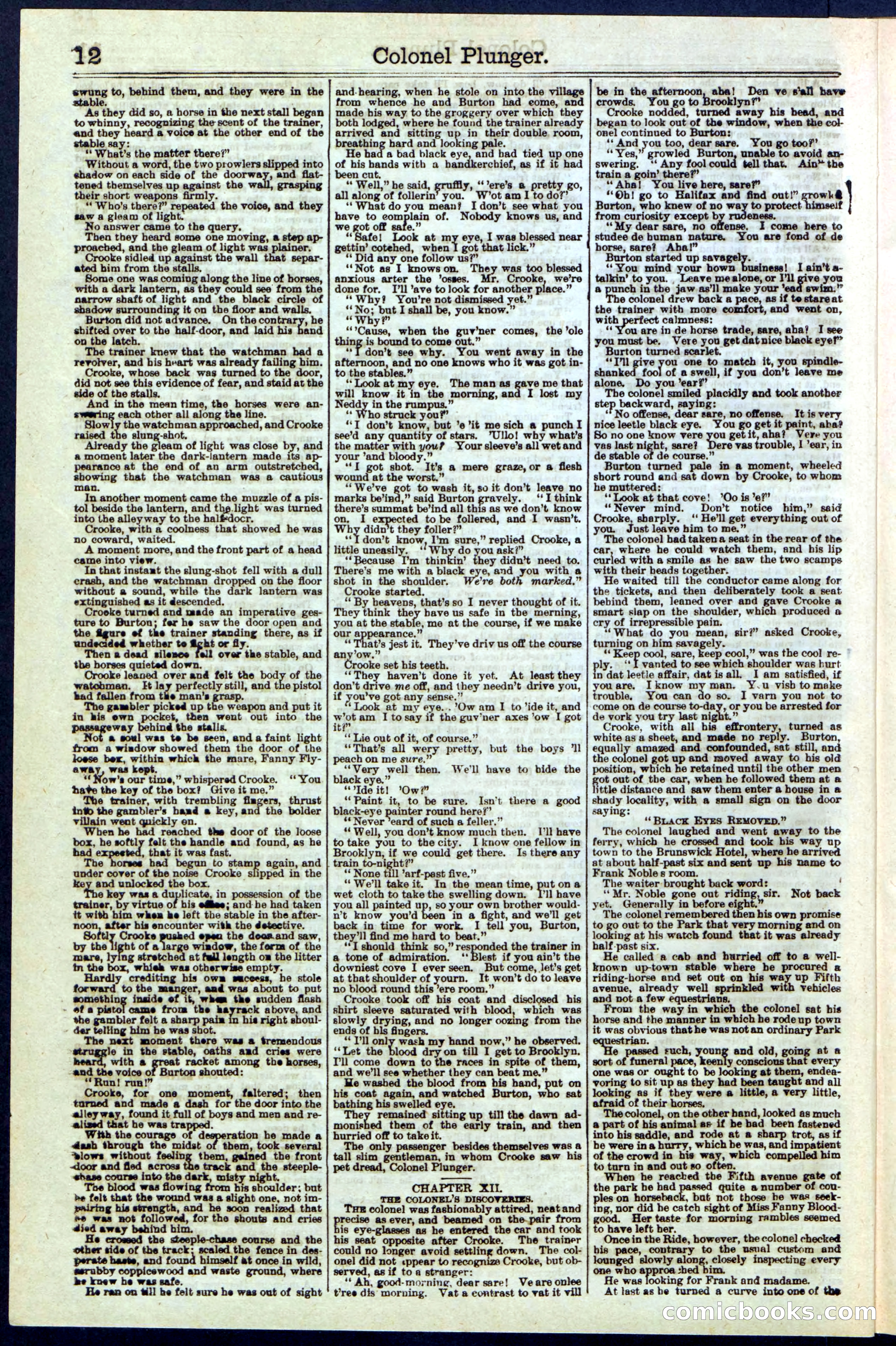
A restored page from Pulp Fiction, 1882. Page through the whole issue in the reader above.
📄 Transcribed text from this page (OCR, searchable)
Machine-transcribed from the original scan — historical spelling and the odd misread are preserved.
at swung to, behind them, and they were in the stable As they did so, a horse in the next stall began to whinny, recognizing the scent of the trainer, and they heard a voice at the other end of the stable say: ‘* What’s the matter there?” Without a word, the two prowlers slipped into shadow on each side of the doorway, and flat- tened themselves up against the wall, grasping their short weapons firmly. “Who's there?” repeated the voice, and they saw a gleam of light. No answer came to the query. Then they heard some one moving, a step ap- proached, and the gleam of light was plainer. Crooke sidled up against the wall that separ- ated him from the stalls. Some one was coming along the line of horses, with a dark lantern, as they could see from the narrow shaft of light and the black circle of shadow surrounding it on the floor and walls. Burton did not advance. On thecon , he shifted over to the half-door, and laid his band on the latch. The trainer knew that the watchman had a revotver, and bis heart was ——— failing him. Crooke, whose back wags to the door, did not see this evidence of fear, and staid at the side of the stalls. ' And in the mean time, the horses were an- ongring each other all along the line. Slowly the watchman approached, and Crooke raised the slung-shot. Already the gleam of light was close by, and a moment later the dark-lantern made its ap- pearance at the end of an arm outstretched, showing that the watchman was a cautious man. In another moment came the muzzle of a pis- tol beside the lantern, and the.light was turned into the alleyway to the half&docr. Crooke, with a coolness that showed he was no coward, waited. A moment more, and the front part of a head came into view. In that instamt the slung-shot fell with a dull erash, and the watchman dropped on the floor without a sound, while the dark lantern was extinguished as it descended. Crooke turned and made an imperative ges- ture to Burton; fer he saw the door open and the ef the trainer standing there, as if undecided whether te i AT} or fly. Then a dead silence fell over the stable, and the horses quieted down. Crooke leaned over and felt the body of the watebman. It la y perfectly still, and the pistol bad fallen from the man’s grasp. The gambler picked up the weapon and put it in his own pocket, then went out into the Bamageway behind the stalls. Not a soul was te be seen, anda faint light from a wiadow showed them the door of the loese bex, within which the mare, Fanny Fly- away, was kept. , ** Now’s our time,” whispered Crooke. ‘You hate the key of the box? Give it me.” The trainer, with trembling flagers, thrust int the gambler’s baad a key, and the bolder villain went quickly en. When he had reached ths door of the loose box, he rites | felt the handle and found, as he had e , that it was fast. The horses had begun to stamp again, and under cover of the noise Crooke slipped in the key and unlocked the box. @ key was a duplicate, in possession of the trainer, by virtue of his efffee; and be had taken tt with him whenu ke left the stable in the after- noon, after his encounter with the detective. Softy Crooke ed epen the doon.and saw, by the ight ofa window, the form of the mare, lying stretched at full length om the litter tn the box, whieh was otherwise empty. Hardly crediting his owm suceess, he stole forward to the pg and was about to put e of something insid t, whem the sudden flash - #fa pistol came from the ha k above, and the gambler felt a sharp pais in his right shoul- - der telling him he was shot. The next moment there was a tremendous le in the stable, oaths amd cries were with a t racket among the horses, and the voice of Burton shouted: “Run! run!” Crooke, for one moment, faltered; then tarned and made a dash for the door into the alley way, found it full of boys and men and re- alized that he was trapped. With the courage of deeperetim he made a @asbh through the midst of them, took several ‘lows without feeling them, gained the front «door and fled across track and the steeple- s*hase course into the d pam Boe The blood was flowing bis shoulder, but Sehtes Waaiceintn apd ne atts canto tha’ g ’ soon rea that *® was not followed, for the shouts and eries died away behind bim. He crossed the steeple-chase course and the other side of the track; scaled the fence in des- perete haste and found himself at once in wild, esru coppicewood and waste ground, where he knew he was safe. He ran on till be felt sure he was out of sight Colonel Plunger. and- hearing, when he stole on into the village from whence he and Burton had come, and made his way to the groggery over which they both lodged, where he found the trainer already arrived and sitting up in their double, room, breathing hard and looking pale. He had a bad black eye, and bad tied up one of his bands with a bandkerchief, as if it had oe wel,” b d, 4) b/ tt ae e sai gruffly, * ere’s a pretty go, all along of follerin’ you. W’ot am I todo?’ ‘What do you mean! I don’t see what you have to complain of. Nobody knows us, and we got off safe.” “‘Bafe! Look at my eye, I was blessed near gettin’ cotehed, when I got that lick.” ** Did any one follow us?” ‘Not as I knowson. They was too blessed anxious arter the ‘osses. r. Crooke, we're done for. I'll ’ave to look for another place. 4 ‘Why? You're not dismissed yet.” ‘*No; but I shall be, you know.” “Why?” “Cause, when the guv’ner comes, the ’ole thing is bound to come out.” “T don’t see why. You went away in the afternoon, and no one knows who it was got in- to the stables.” ‘Look at my eye. The man as will know it in the morning, an Neddy in the rumpus.” ** Who struck you?’ “‘T don’t know, but ’e’it me sich a punch I see’d any quantity of stars. "Ullo! why what’s the matter with you? Your sleeve’s all wet and your ’and bloody.” “I got shot. It’s a mere graze,or a flesh wound at the worst.” “We've got to wash it, so it don’t leave no marks be’ind,” said Burton gravely. ‘I think there’s summat be’ind all this as we don’t know on, I expected to be follered, and I wasn’t. bed didn’t they foller?” **T don’t know, I’m sure,” replied Crooke, a little uneasily. ‘*‘ Why do you ask?” a use I’m thinkin’ they didn’t need to. There’s me with a black eye, and you with a shot in the shoulder. ere both marked,” Crooke started. “ By beavens, that’s so I never thought of it. They think they bave us safe in the merning, you at the stable, me at the course, if we make our Spacemance.: “That’s jest it. They’ve driv us off the course any’ow,” ke set his teeth. ‘They haven’t done it yet. At least they don't drive me off, and they needn’t drive you, if you've got any sense.” ‘Look at my eye... ’Ow am I to ’ide it, and My am I tosay if the guv’ner axes ’ow I got it?” ‘“‘ Lie out of it, of course.” “That's all wery pretty, but the boys ‘ll peach on me sure,” ‘Very well then. We'll have to bide the black eye.” “Ide it! ‘Ow? “Paint it, to be sure. Isn't there a good black-eye painter round here!’ ** Never ’eard of such a feller.” ** Well, you don’t know much then. I'll have to take you to thecity. I know one fellow in Brooklyn, if we could get there. Is there any train to-night?” ve me that I lost my ‘‘ None till ’arf-past five.” ‘We'll take it. In the mean time, put ona wet cloth to take the swelling down. I'll have you all painted up, so your own brother would- n’t know you'd been in a fight, and we'll get back in time for work. I tell you, Burton, they’ll find me hard to beat.” ‘*I should think so,” responded the trainer in a tone of admiration. ‘ Blest if you ain’t the downiest cove I ever seen. But come, let’s get at that shoulder of yourn. It won’t do to leave no blood round this ’ere room.” Crooke took off his coat and disclosed his shirt sleeve saturated with blood, which was slowly drying, and no longer oozing from the ends of bls fingers. beg paly wach my hand now,” he observed. ‘‘Let the blood dry on till I get to Brooklyn. Tll come down to the races in spite of them, and we’ll see whether they can beat me.” Me washed the blood from his hand, - on his coat again, and watched Burton, who sat bathing his swelled eye. They remained sitting up till the dawn ad- monished them of the early train, and then hurried off to take it. The only passenger besides themselves was a tall slim gentleman, in whom Crooke saw his pet dread, Colonel Plunger. CHAPTER XIL THE COLONEL’S DISCOVERIES. THE colonel was fashionably attired, neatand as ever, and beamed on the.pair from is eye-glasses ag he entered the car and took his seat opposite after Crooke. The trainer could no longer avoid settling down. The col- onel did not «ppear to recognize Crooke, but ob- served, as if to a stranger: ‘* Ah, good-morning, dear sare! Ve are onlee tree dis morning. Vata contrast to vat it vill be in the afternoon, aba! Den ve s’all have crowds. You go to Brooklyn?” Crooke nodded, turned away his head, and began to look out of the window, when the col- onel continued to Burton: ‘‘ And you too, dear sare. You go too?’ “Yes,” growled Burton, unable to avoid an- swering. ‘‘ Any fool could tell that. Ain“ the train a goin’ there?” “Aha! You live here, sare?” ‘“‘Ob! go to Halifax and find out!” gone Burton, who knew of no way to protect f from curiosity except b eas. ‘My dear sare, no offense. I come here to studee de human nature. You are fond of de horse, sare? Aha!” Burton started up save . ‘You mind your hown business! talkin’ to you. , ve mealone, or I'll give you @ punch in the jaw as’l] make your ‘ead swiz.” colonel drew back a pace, as if te stare at the trainer with more comfort, went on, with perfect calmness: ‘You are in de horse trade, sare, aha! I see you must be. Vere you get dat nice black eye” Burton turned scarlet. “T’ll give '% one to match it, you spindle- shanked fool of a swell, if you don’t leave me alone. Do you ’ear?’ The colonel smiled placidly and took another step backward, saying: ‘‘ No offense, dear sare, no offense. It is very nice leetle black eye. You go get it paint, aba? So no one know vere yee getit,aha? Vere you vas last night, sare? Dere vas trouble, | ear, in de stable of de course.” Burton turned pale in a moment, wheeled short round and sat down by Crooke, to whom he muttered: ‘Look at that cove! °Oo is ef’ ‘“*Never mind. Don’t notice him,” said Crooke, sharply. ‘ He’ll get everything out of you. Just leave bim to me.” The colonel had taken a seat in the rear of the car, where he could watch them, and his lip curled with a smile as he saw the two scamps with their heads together. He waited till the conductor came along for the tickets, and then deliberately took a seat bebind them, leaned over and gave Crooke a smart slap on the shoulder, which produced a ery of irrepressible pain. “What do you mean, sir?’ asked Crooke, turning on him savagely. ‘Keep cool, sare, keep cool,” was the cool re- ly. ‘'I vanted to see which shoulder was hurt n dat leetle affair, datisall. I am satisfied, if youare. I[know my man. Y-.u visb to make trouble. You can do so. I varn you not to come on de course to-day, or you be arrested for de vork you iy last night.” Crooke, with all his effrontery, turned as white as a sheet, and made no reply. Burton, equally amazed and confounded, sat still, and the colonel got up and moved away to his old position, which he retained until the other men t out of the car, when he followed them at a ittle distance and saw them enter a house in a shady locality, with a smal] sign on the door saying: Se hdl Buack Eyes REMOVED.” The colonel laughed and went away to the ferry, which he crossed and took his way up town to the Brunswick Hotel, where he arrived at about half-past six and sent up his name to Frank Nobles room. The waiter brought back word: ‘‘Mr. Noble gone out ridin , Sir. Not back yet. Generally in before eigh The colonel remembered then his own promise to go out to the Park that very morning and on looking at his watch found that it was already half-past six. He called a cab and hurried off to a well- known uptown stable where he a riding-horse and set out on his — Fifth avenue, already well sprinkled with vehicles and not a few equestrians. From the way in which the colonel sat his horse and the manner in which he rode up town it was obvious that he was notan ordinary Park I ain’t a- estrian. * passed such, young and old, going at a sort of funeral nly ome contiolena ia every one was or ought to be looking at them, endea- voring to sit up as they had been taught and all looking as if they were a little, a very little, afraid of their horses. The colonel, on the other hand, looked as much a part of his animal as if he bad been fastened into his saddle, and rode at # sharp trot, as if he were ina hurry, which he was, and impatient of the crowd in his way, which compelled him to turn in and out so often. When he reached the Fifth avenue gate of the park he had quite a number of cou- ples on horseback, but not those he was seek- ing, nor did he catch sight of Miss Fanny Blood- good. Her taste for morning rambles seemed to have left her. Once in the Ride, however, the colone] checked bis pace, contrary to the usual custom and lounged slowly elong, closely inspecting every one whoa shed bim. He was looking for Frank and madame. At last as be turned a curve into one of the ~~ MIELOCOLKS (E(0) (E(0)