
Pulp Fiction, 1882 · page 7 of 28
Beadle's New York Dime Library, No. 196 — page 7: what you’re looking at
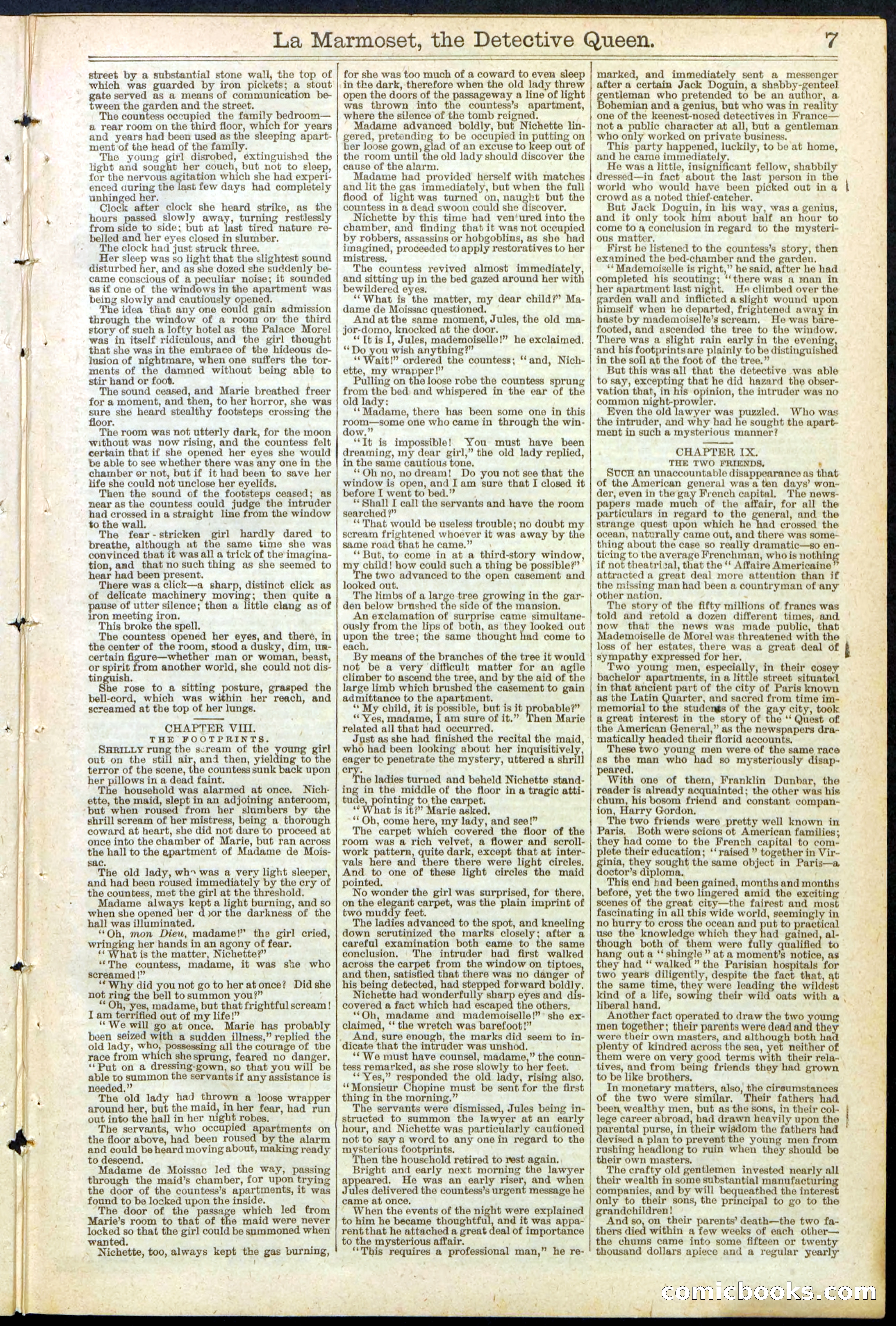
A restored page from Pulp Fiction, 1882. Page through the whole issue in the reader above.
📄 Transcribed text from this page (OCR, searchable)
Machine-transcribed from the original scan — historical spelling and the odd misread are preserved.
La Marmoset, the Detective Queen. fs ee +. street by a substantial stone wall, the top of which was guarded by iron pickets; a stout gate served as a means of communication be- tween the garden and the street. The countess occupied the family bedroom— @ rear room on the third floor, which for years and years had been used as the sleeping apart- ment of the head of the family. _ The young girl disrobed, extinguished the light and sought her couch, but not to sleep, for the nervous agitation which she had experi- enced during the last few days had completely unhinged her. Clock after clock she heard strike, as the hours passed slowly away, turning restlessly from side to side; but at last tired nature re- belled and her eyes closed in slumber. The clock had just struck three. Her sleep was so light that the slightest sound disturbed her, and as she dozed she suddenly be- came conscious of a peculiar noise; it sounded asif one of the windows in the apartment was being slowly and cautiously opened. The idea that any one could gain admission through the window of a room on the third story of such a lofty hotelas the Palace Morel was in itself ridiculous, and the girl thought that she was in the embrace of the hideous de- jusion of nightmare, when one suffers the tor- ments of the damned without being able to stir hand or foot. The sound ceased, and Marie breathed freer for a moment, and then, to her horror, she was sure she heard stealthy footsteps crossing the floor. The room was not utterly dark, for the moon without was now rising, and the countess felt certain that if she opened her eyes she would be able to see whether there was any one in the chamber or not, but if it had been to save her life she could not unclose her eyelids. Then the sound of the footsteps ceased; as near as the countess could judge the intruder had crossed in a straight line from the window to the wall. The fear-stricken girl hardly dared to breathe, although ut the same time she was convinced that it was all a trick of the imagina- tion, and that no such thing as she seemed to hear had been present. There was a click—a sharp, distinct click as of delicate machinery moving; then quite a pause of utter silence; then a little clang as of iron meeting iron. This broke the spell. The countess opened her eyes, and theré, in the center of the room, stood a dusky, dim, un- certain figure—whether man or woman, beast, or oe rom another world, she could not dis- tinguish. he rose to a sitting posture, grasped the bell-cord, which was within her reach, and screamed at the top of her lungs. CHAPTER VII. THE FOOTPRINTS. SHRILLY rung the scream of the xoane girl out on the still air, and then, yielding to the terror of the scene, the countess sunk back upon her pillows in a dead faint. The household was alarmed at once. Nich- ette, the maid, slept in an adjoining anteroom, but when roused from her slumbers by the shrill scream of her mistress, being a thorough coward at heart, she did not dare to proceed at once into the chamber of Marie, but ran across the hall to the epartment of Madame de Mois- sac. The old lady, wh” was a very light sleeper, and had been roused immediately by the ery of the countess, met the girl at the threshold. Madame always kept a light burning, and so when she opened her dor the darkness of the hall was illuminated. ‘Oh, mon Dieu, madame!” the girl cried, wringing her hands in an agony of fear. ‘* What is the matter, Nichette?”’ “The countess, madame, it was she who screamed |” “Why did you not go to her atonce? Didsh not ring the bell tosummon you?” ** Oh, yes, madame, but that frightful scream ! I am terrified out of my life!” ‘We will go at once. Marie has probably been seized with a sudden illness,” replied the |. old lady, who, ae tcp all the courage of the race from which shesprung, feared no danger. ‘Put on a dressing-gown, so that you will be able to summon the servantsif any assistance is needed.” The old lady had thrown a loose wrapper around her, but the maid, in her fear, had run out into the hall in her night robes. The servants, who occupied apartments on the floor above, had been roused by the alarm and could be heard moving about, making ready to descend. Madame de Moissac led the way, passing through the maid’s chamber, for upon trying the door of the countess’s apartments, it was found to be locked upon the inside. The door of the passage which led from Marie’s room to that of the maid were never locked so that the girl could be summoned when wanted. ‘ . Nichette, too, always kept the gas burning, for she was too much of a coward to even sleep in the dark, therefore when the old lady threw open the doors of the passageway a line of light was thrown into the countess’s apartment, where the silence of the tomb reigned. Madame advanced boldly, but Nichette lin- gered, pretending to be occupied in putting on her loose gown, glad of an excuse to keep out of the room until the old lady should discover the cause of the alarm. Madame had provided herself with matches and lit the gas immediately, but when the full flood of light was turned on, naught but the countess in a dead swoon could she discover. Nichette by this time had ven‘ured into the chamber, and finding that it was not occupied by robbers, assassins or hobgoblins, as she had imagined, proceeded to apply restoratives to her mistress, The countess revived almost immediately, and sitting up in the bed gazed around her with bewildered eyes. **What is the matter, my dear child?’ Ma- dame de Moissac questioned. And atthe same moment, Jules, the old ma- jor-domo, knocked at the door. ‘Tt is 1, Jules, mademoiselle!” he exclaimed. “Do you wish anything?” a Wait!” ordered the countess; “‘and, Nich- ette, my wrapper!” Pulling on the loose robe the countess sprung from the bed and whispered in the ear of the old lady: ‘* Madame, there has been some one in this room—some one who came in through the win- dow.” ‘*It is impossible! You must have been dreaming, my dear girl,” the old lady replied, in the same cautious tone. **Oh no, no dream! Do you not see that the window is open, and Iam sure that I closed it before I went to bed.” ‘Shall I call the servants and have the room searched ?” ‘That would be useless trouble; no doubt my scream frightened whoever it was away by the same road that he came.” ** But, to come in at a third-story window, my. child! how could such a thing be possible?” he two advanced to the open casement and looked out. The limbs of a large tree growing in the gar- den below brushed the side of the mansion. An exclamation of surprise came simultane- ously from the lips of both, as they looked out Gne the tree; the same thought had come to each, By means of the branches of the tree if would not be a very difficult matter for an agile climber to ascend the tree, and by the aid of the large limb which brushed the casement to gain admittance to the apartment. ** My child, it is possible, but is it probable?” ** Yes, madame, I am sure of it.” Then Marie related all that had occurred. Just as she had finished the recital the maid, who had been looking about her inquisitively, eager to penetrate the mystery, uttered a shrill ery. The ladies turned and beheld Nichette stand- ing in the middle of the floor in a tragic atti- tude, pointing to the carpet. ‘*'W hat is it?” Marie asked, ‘Ob, come here, my lady, and see!” The carpet which covered the floor of the room was a rich velvet, a flower and scroll- work pattern, quite dark, except that at inter- vals here and there there were light circles. And to one of these light circles the maid pointed, No wonder the girl was surprised, for there, on the elegant carpet, was the plain imprint of two muddy feet. The ladies advanced to the spot, and kneeling down scrutinized the marks closely; after a careful examination both eame to the same conclusion. The intruder had first walked across the carpet from the window on tiptoe and then, satisfied that there was no danger o his being detected, had stepped forward boldly. Nichette had wonderfully sh eyes and dis- covered a fact which had escaped the others. ‘*Oh, madame and mademoiselle!”’ she ex- claimed, “the wretch was barefoot!” And, sure enough, the marks did seem to in- dicate that the intruder was unshod. ‘* We must have counsel, madame,” the coun- tess remarked, as she rose slowly to her feet. ‘*'Yes,” hy, eevee the old lady, rising also. ‘*Monsieur Chopine must be sent for the first thing in the morning.” The servants were dismissed, Jules being in- structed to summon the lawyer at an early hour, and Nichette was particularly cautioned not to say a word to any one in regard to the mysterious footprints. : Then the household retired to rest again. Bright and early next morning the wohl ba 2 see He was an early riser, and when Jules delivered the countess’s urgent message he came at once, When the events of the night were explained to him he became thoughtful, and it was appa- rent that he attached a great deal of importance to the mysterious affair. “‘This requires a professional man,” he re- marked, and immediately sent a messenger after a certain Jack Doguin, a shabby-genteel entleman who pretended to be an author, a hemian and a genius, but who was in reality one of the keenest-nosed detectives in France— not a public character at all, but a gentleman who only worked on private business. This party happened, luckily, to be at home, and he came immediately. He was a little, insignificant fellow, shabbily dressed—in fact about the last person in the world who would have been picked out in a crowd as a noted thief-catcher. But Jack Doguin, in his way, was a genius, and it only took him about half an hour to come to a conclusion in regard to the mysteri- ous matter. First he listened to the countess’s story, then examined the bed-chamber and the garden, ** Mademoiselle is right,” he said, after he had completed his scouting; ‘‘there was a man in her apartment last night. He climbed over the garden wall and inflicted a slight wound upon himself when he Site bt frightened away in haste by mademoiselle’s scream. He was bare- footed, and ascended the tree to the window. There was a slight rain early in the evening ‘and his footprints are plainly to be distinguished in the soil at the foot of the tree.” But this was all that the detective was able to say, excepting that he did hazard the obser- vation that, in his opinion, the intruder was no common night-prowler. Even the old lawyer was puzzled. Who was the intruder, and why had he sought the apart- ment in such a mysterious manner? CHAPTER IX. THE TWO FRIENDS. ‘ Such an unaccountable disappearance as that of the American general was a ten days’ won- der, even in the gay French capital, The news- papers made much of the affair, for all the particulars in regard to the general, and the strange quest upon which he had crossed the ocean, naturally came out, and there was some- thing about the case so really dramatic—so en- ticing to the average Frenchman, whois nothing if not theatrizal, that the ‘‘ Affaire Americaine attracted a great deal more attention than if the missing man had been a countryman of any other nation, . The story of the fifty millions of francs was told and retold a dozen different times, and. now that the news was made public, that Mademoiselle de Morel was threatened with the loss of her estates, there was a great deal of } sympathy expressed for her. Two young men, especially, in their cosey bachelor apartments, in a little street situated in that ancient part of the city of Paris known as the Latin Quarter, and sacred from time im- memorial to the studengs of the gay city, tool a great interest in the story of the ‘Quest of the American General,” as the newspapers dra- matically headed their florid accounts, These two young men were of the same race as re man who had so mysteriously disap- peared. With one of thern, Franklin Dunbar, the reader is already acquainted; the other was his chum, his bosom friend and constant compan- ion, Harry Gordon. The two friends were pretty well known in Paris, Both were scions ot American families; they had come to the French capital to com- plete their education; ‘‘ raised ” together in Vir- inia, they sought the same object in Paris—a octor’s diploma. This end had been gained, months and months before, yet the two lingered amid the exciting scenes of the great city—the fairest and most fascinating in all this wide world, seemingly in no hurry to cross the ocean and put to practical use the knowledge which the had gained, al- though both of them were fully qualified to g outa “shingle” at a moment’s notice, as they had “‘ walked” the Parisian hospitals for two years diligently, despite the fact that, at the same time, they were leading the wildest kind of a life, sowing their wild oats with a liberal hand, Another fact operated to draw the two young men together; their parents were dead and choy were their own masters, and although both ha plenty of kindred across the sea, yet neither of them were on very good terms with their rela- tives, and from being friends they had grown to be like brothers. In monetary matters, also, the cireumstances of the two were similar. Their fathers had been wealthy men, but as the sons, in their col- lege career abroad, had drawn heavily upon the ed purse, in their wisdom the fathers had evised a plan to prevent the young men from rushing headlong to ruin when they should be their own masters. The crafty old gentlemen invested nearly all their wealth in some substantial mane Sonos companies, and by will ueathed the inte only to their sons, the principal to go to the grandchildren! — And so, on their parents’ death—the two fa- thers died within a few weeks of each other— the chums came into some fifteen or twenty thousand dollars apiece and a regular yearly —_- er Gomicbooks hy a —_