
Pulp Fiction, 1882 · page 6 of 28
Beadle's New York Dime Library, No. 196 — page 6: what you’re looking at
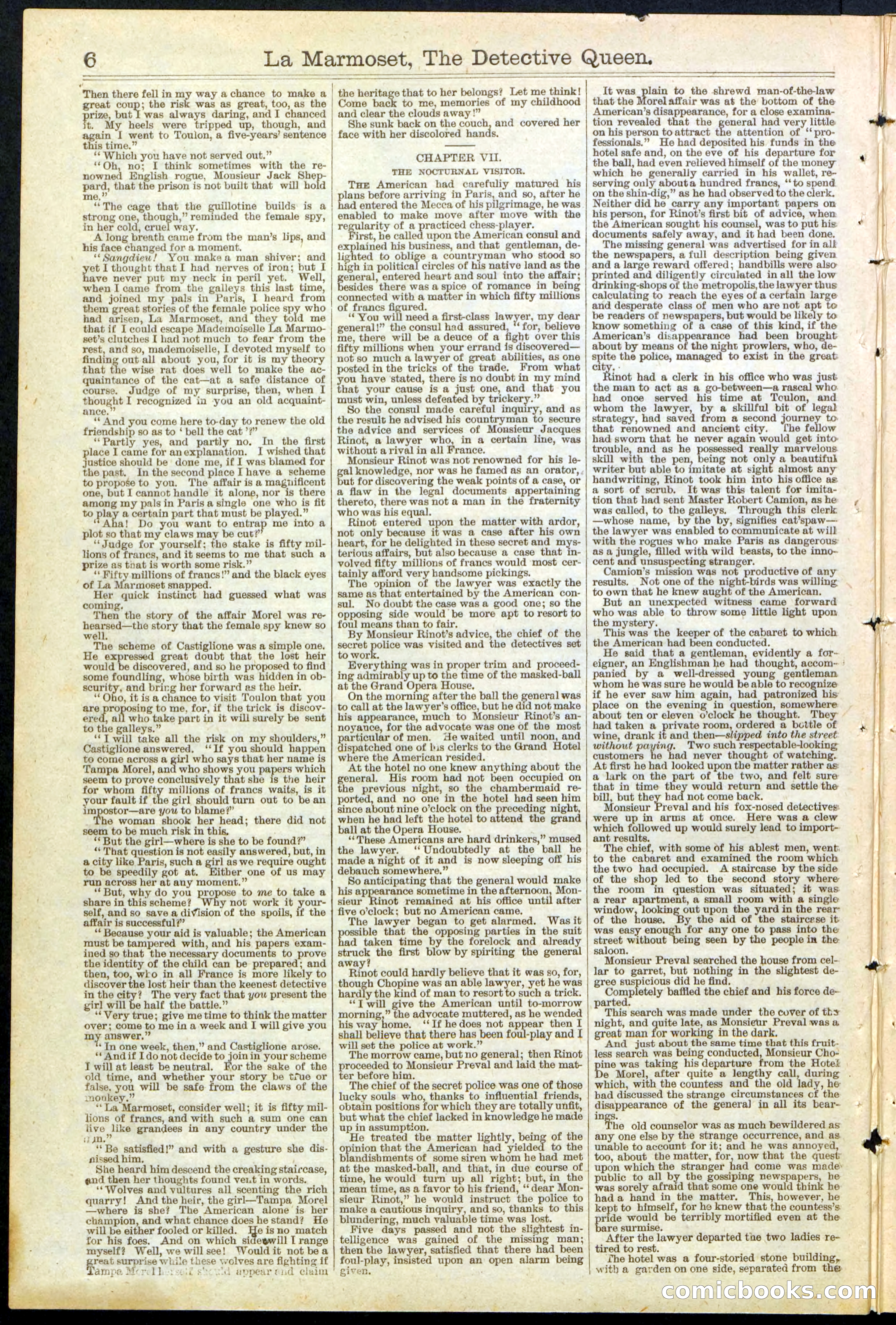
A restored page from Pulp Fiction, 1882. Page through the whole issue in the reader above.
📄 Transcribed text from this page (OCR, searchable)
Machine-transcribed from the original scan — historical spelling and the odd misread are preserved.
6 — ee Then there fell in my way a chance to make a great coup; the risk was as great, too, as the rize, but I was always daring, and I chanced it. My heels were tripped up, though, and again I went to Toulon, a five-years’ sentence this time.” ** Which you have not served out.” ‘*Oh, no; I think sometimes with the re- nowned English rogue, Monsieur Jack Shep- pard, that the prison is not built that will hold me,” “The cage that the guillotine builds is a strong one, though,” reminded the female spy, in her cold, cruel way. A long breath came from the man’s lips, and his face changed for a moment. ‘* Sangdieu! You makea man shiver; and et I thought that I had nerves of iron; but I ave never put my neck in peril yet. Well, when I came from the galleys this last time, and joined my pals in Paris, I heard from them great stories of the female police spy who had arisen, La Marmoset, and they told me that if I could escape Mademoiselle La Marmo- set’s clutches I had not much to fear from the rest, and so, mademoiselle, I devoted myself to finding out all about you, for it is my theory that the wise rat does well to make the ac- quaintance of the cat—at a safe distance of course. Judge of my surprise, then, when I thought I recognized in -you an old acquaint- ance.” ‘* And you come here to-day to renew the old friendship so as to ‘ bell the cat ’?” ‘Partly yes, and partly no. Im the first lace I came for anexplanation. I wished that justice should be done me, if I was blamed for the past. In the second place Ihave a scheme to propose to you. The affair is a magnificent one, but I cannot handle it alone, nor is there among my palsin Parisa single one who is fit to play a certain part that must be played.” ‘Aha! Do you want to entrap me into a plot so that my claws may be cut?’ “Judge for yourself; the stake is fifty mil- lions of franes, and it seems to me that such a prize as that is worth some risk.” ‘‘ Fifty millions of francs!” and the black eyes of La Marmoset snapped. Her quick instinct had guessed what was coming. Then the story of the affair Morel was re- a a story that the female spy knew so well. The scheme of Castiglione was a simple one. He expressed great doubt that the lost heir would be discovered, and so he proposed to find some foundling, whose birth was hidden in ob- ee and brirg her forward as the heir. “Oho, it is a chance to visit Toulon that you are proposing to me, for, if the trick is discov- ered, all who take part in it will surely be sent to the galleys.” ‘‘T will take all the risk on my shoulders,” Castiglione answered, ‘‘If you should happen to come across a ak who says that her name is Tampa Morel, and who shows you papers which seem to prove conclusively that she is the heir for whom fifty millions of francs waits, is it your fault if the girl should turn out to be an ig Sia you to blame?’ he woman shook her head; there did not seem to be much risk in this, ‘* But the girl—where is she to be found?” “That question is not easily answered, but, in a city like Paris, such a girl as we require ought to be speedily got at. Either one of us may run across her at any moment.” ‘* But, why do you propose to me to take a share in this scheme? y not work it your- self, and so save a diVision of the spoils, if the affair is successful?” ‘“* Beeause your aid is valuable; the American must be tampered with, and his papers exam- ined so that the necessary documents to prove the identity of the child can be prepared; and then, too, wko in all France is more likely to discover the lost heir than the keenest detective in the city? The very fact that you present the girl will be half the battle.” ‘Very true; give me time to think the matter over; come to me in a week and I will give you my answer,” ‘In one week, then,” and Castiglione arose. **Andif Ido not decide to joinin your scheme T will at least be neutral. For the sake of the old time, and whether your story be true or ie you will be safe from the claws of the monkey. **La Marmoset, consider well; it is fifty mil- lions of francs, and with such a sum one can live like grandees in any country under the 3n. ‘* Be satisfied!” and with a gesture she dis- nissed him, | She heard him descend the creaking staircase, end then her thoughts found veut in words. ‘* Wolves and vultures all scenting the rich quarry! And the heir, the girl—Tampa Morel —where is she? The American alone is her champion, and what chance does he stand? He will be either fooled or killed. ige isno match for his foes. And on which sidegwill I range myself? Well, we willsee! Wouldit not bea great surprise while these wolves are fighting if Dampe Merilhorseid should appear sud claim ~ «? Sc ; | the herita | Come bac ' and clear the clouds away!” | She sunk back on the couch, and covered her face with her discolored hands. CHAPTER VII. THE NOCTURNAL VISITOR. Tae American had carefuliy matured his plans before arriving in Paris, and so, after he had entered the Mecca of his pilgrimage, he was | enabled to make move after move with the | regularity of a practiced chess-player. irst, he called wpon the American consul and | explained his business, and that gentleman, de- lighted to ve oe a countryman who s so high in political circles of his native land as the general, entered heart and soul into the affair; besides there was a spice of romance in being connected with a matter in which fifty millions of frances figured. ‘‘- You will need a first-class lawyer, my dear general!” the consul had assured, “‘ for, believe me, there will be a deuce of a fight over this fifty millions when your errand is discovered— not so much a lawyer of great abilities, as one posted in the tricks of the trade. From what you have stated, there is no doubt in my mind that your cause is a just one, and that you | must win, unless defeated by trickery.” So the consul made careful inquiry, and as the result he advised his countryman to secure the advice and services of Monsieur Jacques Rinot, a lawyer who, in a certain line, was without a rival in all France. Monsieur Rinot was not renowned for his le- gal knowledge, nor was he famed as an orator, but for discovering the weak points of a case, or a flaw in the legal documents appertaining thereto, there was not a man in the fraternity who was his equal. Rinot entered upon the matter with ardor, not only because it was a case after his own heart, for he delighted in these secret and mys- terious affairs, but also because a case that in- volved fifty millions of francs would most cer- tainly afford very handsome pickings. The opinion of the lawyer was exactly the same as that entertained by the American con- sul. No doubt the case was a good one; so the opposing side would be more apt to resort to foul means than to fair. By Monsieur Rinot’s advice, the chief of the secret poles was visited and the detectives set to work. Everything was in proper trim and proceed- ing admirably up to the time of the masked-ball at the Grand Opera House, On the morning after the ball the general was to call at the lawyer's office, but he did not make his appearance, much to Monsieur Rinot’s an- noyance, for the advocate was one of the most particular of men. He waited until noon, and dispatched one of bis clerks to the Grand Hotel where the American resided. At the hotel no one knew anything about the general. His room had not been occupied on the previous night, so the chambermaid re- ported, and no one in the hotel had seen him since about nine o’clock on the preceding night, when he had left the hotel to attend the grand ball at the Opera House. ‘‘These Americans are hard drinkers,” mused the lawyer. ‘‘ Undoubtedly at the ball he made a night of it and is now sleeping off his debauch somewhere.” So anticipating that the general would make his appearance sometime in the afternoon, Mon- sieur Rinot remained at his office until after five o’clock; but no American came. The lawyer began to get alarmed. Was it ossible that the opposing parties in the suit had taken time by the forelock and already struck the first blow by spiriting the general away? Rinot could hardly believe that it was so, for, though Chopine was an able lawyer, yet he was hardly the kind of man to resort to such a trick. ““T will give the American until to-morrow morning,” the advocate muttered, as he wended his way home. ‘‘If hedoes not appear then I shall believe that there has been foul-play and I will set the police at work.” The morrow came, but no general; then Rinot proceeded to Monsieur Preval and laid the mat- ter before him. The chief of the secret police was one of those lucky souls who, thanks to influential friends, obtain positions for which they are totally unfit, but what the chief lacked in knowledge he made up in assumption. He treated the matter lightly, being of the opinion that the American had yielded to the blandishments of some siren whom he had met at the masked-ball, and that, in due course of time, he would turn up all right; but, in the mean time, as a favor to his friend, “ dear Mon- sieur Rinot,” he would instruct the police to make a cautious inquiry, and so, thanks to this blundering, much valuable time was lost. Five days passed and not the slightest in- telligence was gained of the missing man; then the lawyer, satisfied that there had been foul-play, insisted upon an open alarm being given. : It was plain to the shrewd man-of-the-law that the Morelaffair was at the bottom of the American’s disappearance, for a close examina- tion revealed that the general had very little on his person toattract the attention of ‘‘ pro- fessionals.” He had deposited his funds in the hotel safe and, on the eve of his departure for the ball, had even relieved himself of the money which he generally earried in his wallet, re- serving only abouta hundred frances, ‘‘ to spend on the shin-dig,” as he had observed to the clerk. Neither did he carry any important papers on his person, for Rinot’s first bit of advice, when the American sought his counsel, was to put his documents safely away, and it had been done. The missing general was advertised for in alk the newspapers, a full description being given and a large reward offered; handbills were also printed and diligently circulated in all the low drinking-shops of the metropolis,the lawyer thus calculating to reach the eyes of a certain large and desperate class of men who are not apt to be readers of newspapers, but would be likely to know something of a case of this kind, if the American’s disappearance had been brought about by means of the night prowlers, who, de- spite the police, managed to exist in the great city, - Rinot had a clerk in his office who was just the man to act as a go-between—a rascal who had once served his time at Toulon, and whom the lawyer, by a skillful bit of legal strategy, had saved from a second journey to that renowned and ancient city. [he fellow had sworn that he never again would get into trouble, and as he possessed really marvelous skill with the pen, being not only a beautifuh writer but able to imitate at sight almost any handwriting, Rinot took him into his office as a sort of scrub. It was this talent for imita- tion that had sent Master Robert Camion, as he was called, to the galleys. Through this clerk. —whose name, by the by, signifies cat’spaw— the lawyer was enabled to communicate at will with the rogues who make Paris as dangerous as a jungle, filled with wild beasts, to the inno- cent and unsuspecting stranger. Camion’s mission was not productive of any results. Not one of the night-birds was willing to own that he knew aught of the American. But an unexpected witness came forward who was able to throw some little light upon the mystery. This was the keeper of the cabaret to which the American had been conducted. He said that a gentleman, evidently a for- eigner, an Englishman he had thought, accom~ ’ panied by a well-dressed young gentleman whom he was sure he would be able to recognize if he ever saw him again, had patronized his place on the evening in question, somewhere about ten or eleven o’clock he thought. They had taken a private room, ordered a bottle of wine, drank if and then—slipped into the street without pa ne: Two such respectable-looking customers he ad never thought of watching. At first he had looked upon the matter rather as: a lark on the part of the two, and felt sure that in time they would return and settle the bill, but they bad not come back. Monsieur Preval and his fox-nosed detectives: were up in arms at once. Here was a clew which followed up would surely lead to import- ant results. The chief, with some of his ablest men, went: to the cabaret and examined the room which the two had occupied. A staircase by the side of the shop led to the second story where the room in question was situated; it was a rear apartment, a small room with a single window, looking out upon the yard in the rear of the house. y the aid of the staircese it was easy a for any one to pass into the nine without being seen by the people in the saloon. Monsieur Preval searched the house from cel- lar to garret, but nothing in the slightest de- gree suspicious did he find. ete etely baffled the chief and his force de- arted. : This search was made under the cover of thy night, and i late, as Monsieur Preval was a great man for working in the dark. And just about the same time that this fruit- less search was being conducted, Monsieur Cho- — was taking his departure from the Hotel e Morel, after quite a lengthy call, during . which, with the countess and the old lady, he bad discussed the strange circumstances of the disappearance of the genera) in all its bear- ings. Tie old counselor was as much bewildered as any one else by the strange occurrence, and as unable to account for it; and he was annoyed, too, about the matter, for, now that the quest upon which the stranger had come was made’ ublic to all by the gossiping newspapers, he wad sorely afraid that some one would think he had a hand in the matter. This, however, he kept to himself, for ho knew that the countess’s ride would be terribly mortified even at the re surmise. : ‘ After the lawyer departed the two ladies re- tired to rest. prc The hotel was a four-storied stone building, with a garden on one side, separated from the Eomichoo % . ’ x j ~ — F . ol Reis YF = Yi dibia® Ys S€O i et >