
Pulp Fiction, 1882 · page 3 of 28
Beadle's New York Dime Library, No. 196 — page 3: what you’re looking at
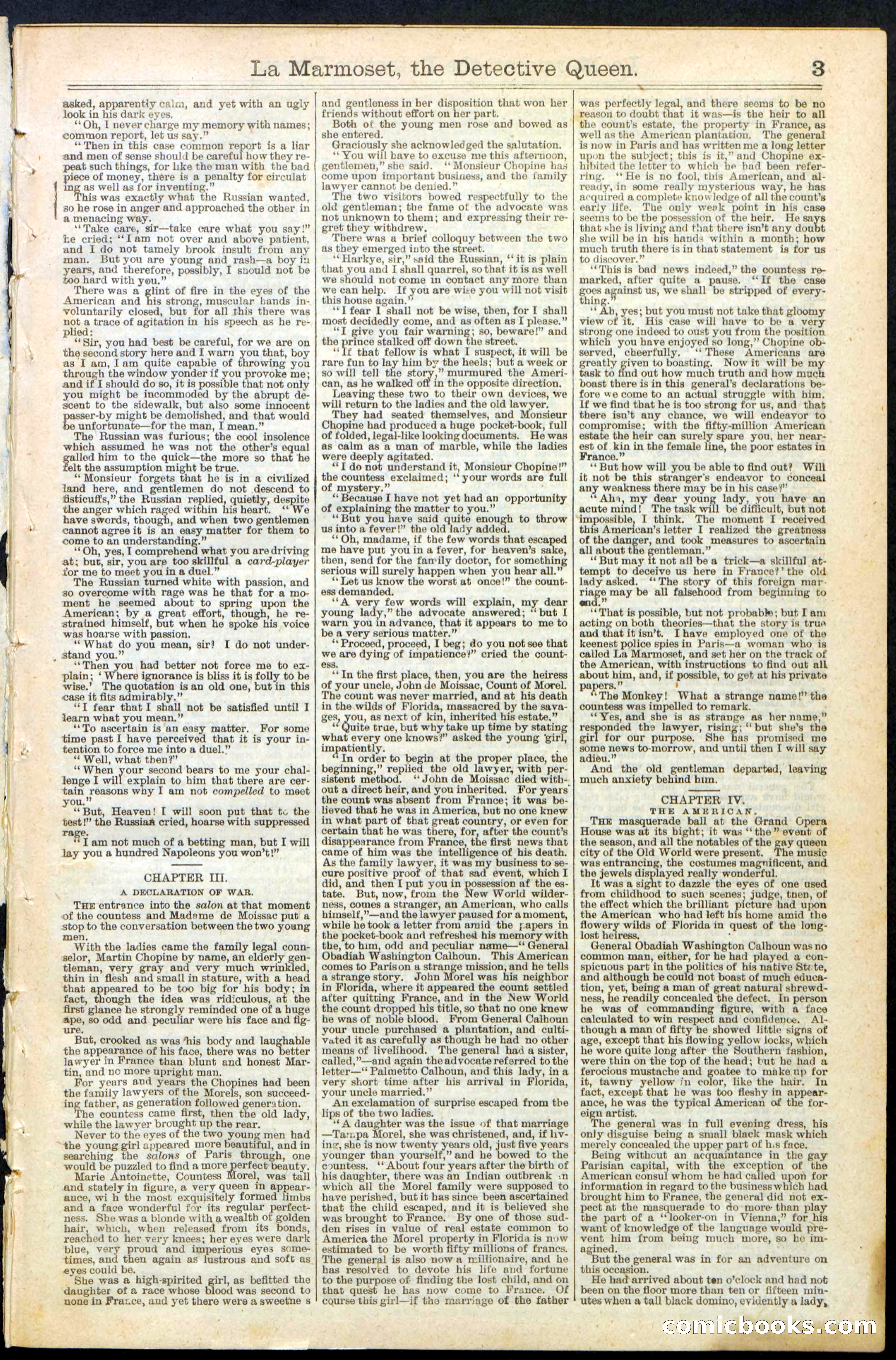
A restored page from Pulp Fiction, 1882. Page through the whole issue in the reader above.
📄 Transcribed text from this page (OCR, searchable)
Machine-transcribed from the original scan — historical spelling and the odd misread are preserved.
LLL ee eee st tt ~~ senses r~ asked, apparentiy calm, and yet with an ugly look in his dark eyes. ‘*Oh, I never charge my memory with names; common report, let us say.” ‘Then in this case common report is a liar and men of sense should be rn how they re- peat such things, for hke the man with the bad piece of money, there is a penalty for circulat ing as well as for inventing.” his was exactly what the Russian wanted, 30 he rose in anger and approached the other in a menacing way. ‘‘Take care, sir—take care what you say!” te cried; ‘Lam not over and above patient, and I do not tamely brook insult from any man, But you are young and rash—a boy in years, and therefore, possibly, I should not be too hard with you.” There was a glint of fire in the eyes of the American and his strong, muscular bands in- voluntarily closed, but for all this there was not a trace of agitation in his speech as he re- plied: “Sir, you had best be careful, for we are on the second story here and I warn you that, boy as I am, lam quite capable of throwing you through the window yonder if you provoke me; and if I should do so, it is possible that not only you might be incommoded by the abrupt de- scent to the sidewalk, but also some innocent asser-by might be demolished, and that would ba unfortunate—for the man, I mean.” The Russian was furious; the cool insolence which assumed he was not the other’s equal et him to the quick—the more so that ‘he elt the assumption might be true. ** Monsieur forgets that he is in a civilized land here, and gentlemen do not descend to fisticuffs,” the Russian replied, quietly, despite the anger which raged within his heart. ‘We have swords, though, and when two gentlemen eannot agree it is an easy matter for them to come to an yeep 2 ‘*Oh, yes, I comprehend what you are driving at; but, sir, you are too skillful a card-player tor me to meet you in a duel,” The Russian turned white with passion, and 830 overcome with rage was he that for a mo- ment he seemed about to spring upon the American; by a great effort, though, he re- strained himself, but when he spoke his voice was hoarse with passion. ‘What do you mean, sir? I do not under- _ Stand you.” ‘‘Then you had better not force me to ex- plain; ‘ Where ignorance is bliss it is folly to be wise.’ The quotation is an old one, but in this case it fits admirably.” “TI fear that I shall not be satisfied until I learn what you mean.” ‘*To ascertain is an easy matter. For some time past I have perceived that it is your in- tention to force me into a duel.” ‘Well, what then?” “When \ Gea second bears to me your chal- lenge I will explain to him that there are cer- ‘tain reasons why I am not compelled to meet rou. - ‘‘But, Heaven! [ will soon put that to the test!” the Russiaa& cried, hoarse with suppressed rage. ey am not much of a betting man, but I will lay you a hundred Napoleons you won’t?!” CHAPTER ITI. A DECLARATION OF WAR. Tuer entrance into the salon at that moment of the countess and Mademe de Moissac put a stop to the conversation between the two young men. With the ladies came the family legal coun- selor, Martin Chopine by name, an elderly gen- tleman, very gray and very much wrinkled, thin in flesh and small in stature, with a head that appeared to be too big for his body; in fact, though the idea was ridiculous, at the first glance he strongly reminded one of a huge ape, so odd and peculiar were his face and fig- ure. But, crooked as was “his body and laughable the appearance of his face, there was no better lawyer in France than blunt and honest Mar- tin, and no more upright man. For years and years the Chopines had been the family lawyers of the Morels, son succeed- ing father, as generation followed generation. The countess came first, then the old lady, while the lawyer brought up the rear. Never to the eyes of the two young men had “the young girl appeared more beautiful, and in searching the salons of Paris through, one would be puzzled to find a more perfect beauty. Marie Antoinette, Countess Morel, was tall and stately in figure, a very queen Im appear- ance, wi h the most exquisitely formed limbs and a face wonderful for its regular perfect- ness. She was a blonde with a wealth of golden hair, which, when released from its bonds, reached to her very knees; her eyes were dark blue, very proud and imperious eyes scme- times, and then again as lustrous and soft as eyes could be. She was a high-spirited girl, as befitted the daughter of a race whose blood was second to none in Fraxce, and yet there were a sweetne s ‘> ' | La Marmoset, the Det Ne — Ne and gentleness in her disposition that won her friends without effort on her part. Both of the young men rose and bowed as she entered. Graciously she acknowledged the salutation. ‘** You will have to excuse me this afternoon, gentlemen,” she said. ‘* Monsieur Chopine bas come upon important business, and the family lawyer cannot be denied.” The two visitors bowed respectfully to the old gentleman; tbe fame of the advocate was not unknown to them; and expressing their re- gret they withdrew, There was a briet colloquy between the two as they emerged into the street. ‘*Harkye, sir,” said the Russian, ‘it is plain that you and I shall quarrel, so that it is as well we should not come in contact any more than we can help. If you are wise you will not visit this house again.” ‘*} fear L shall not be wise, then, for I shall most decidedly come, and as often as I please.” “Tf give you fair Mga 5 80, beware!” and the rg stalked off down the street. “Tf that fellow is what I[ suspect, it will be rare fun to lay him by the heels; but a week or so will tell the story,” murmured the Ameri- can, as he walked off in the opposite direction, Leaving these two to their own devices, we will return to the ladies and the old lawyer. They had seated themselves, and Monsieur Chopine bad produced a huge pocket-book, full of folded, legal-like looking documents. He was as calm as a man of marble, while the ladies were deeply agitated. “I do not understand it, Monsieur Chopine!” the countess exclaimed; ‘‘ your words are full of mystery.” ** Because [ have not yet had an opportunity of explaining the matter to you.” ‘“But you have said quite enough to throw us into a fever!” the old lady added. **Oh, madame, if the few words that agi me have put you ina fever, for heaven’s sake, then, send for the family doctor, for something serious will surely happen when you hear all.” ** Let us know the worst at once!” the count- ess demanded. ‘‘A very few words will explain, my dear young lady,” the advocate answered; *‘ but [ warn you in advances, that it appears to me to be a very serious matter.” ‘** Proceed, proceed, I beg; do you not see that we are dying of impatience?” cried the count- ess. ‘* In the first place, then, you are the heiress of your uncle, John de Moissac, Count of Morel. The count was never married, and at his death in the wilds of Florida, massacred by the sava- ges, you, as next of kin, inherited his estate,” ** Quite true, but why take up time by stating what every one knows?” asked the young girl, impatiently. > “In order to begin at the proper place, the beginning,” replied the old lawyer, with per- sistent method. ‘John de Moissac died with-. out a direct heir, and you inherited, For years the count was absent from France; it was be- lieved that he was in America, but no one knew in what part of that great country, or even for certain that he was there, for, after the count’s disappearance from France, the first news that came of him was the intelligence of his death. As the family lawyer, it was my business to se- cure positive proof of that sad event, which I did, and then [ put you in possession af the es- tate. But, now, from the New World wilder- ness, comes a stranger, an American, who calls himself,”—and the lawyer paused for amoment, while he took a letter from amid the papers in the pocket-book and refreshed his memory with the, to him, odd and liar name—‘‘ General Obadiah Washington Calhoun. comes to Parison a strange mission, and he tells a strange story. John Morel was his neighbor in Florida, where it appeared the count settled after quitting France, and in the New World the count dropped his title, so that no one knew he was of noble blood. From General Calhoun your uncle purchased a plantation, and culti- vated it as Leake | as though he had no other means of livelihood. The general had a sister, called,”—and again the advocate referred to the letter—‘t Palmetto Calhoun, and this lady, ina very short time after his arrival in Florida, your uncle married.” An exclamation of surprise escaped from the lips of the two ladies. ‘‘ A daughter was the issue of that marriage —Tar:pa Morel, she was christened, and, if hv- ing, she is now twenty years old, just five years younger than yourself,” and he bowed to the countess. ‘‘ About four years after the birth of his daughter, there was an Indian outbreak im which all the Morel family were supposed to have perished, but it has since been ascertained that the child escaped, and it is believed she was brought to France. By one of those sud- den rises in value of real estate common to America the Morel Si ands in Florida is now estimated to be worth fifty millions of francs. The general is also nowa millionaire, and he has resolyed to deyote his life and fortune to the purpose of finding the lost child, and on that quest he has now come to France. Of course this girl—if tho marriage of the father This American ective Queen. 3 SS PLES EE PT was perfectly legal, and there seems to be no reason to doubt that it was—is the heir to all the count’s estate, the property in France, as well as the American plantation, The general is now in Paris and has written me a long letter upon the subject; this is it,” and Chopine ex- hibited the letter to which he had been refer- ring. ‘* He is no fool, this American, and al- ready, in some really mysterious way, he has acquired a complete knowledge of all the count’s early life. The only week point in his case seems to be the possession of the heir. He says that she is living and that there isn’t any doubt she will be in his hands within a month; how much truth there is in that statement is for us to discover.” ‘This is bad news indeed,” the countess re- marked, after quite a pause. “If the case see against us, we shall be stripped of every- thing. ‘* Ab, yes; but you must not take that gloomy view of it. His case will have to be a very strong one indeed to oust you from the position which you have enjoyed so long,” Chopine ob- served, cheerfully, ‘*‘ These Americans are greatly given to boasting. Now it will be m task to find out how much truth and how arti boast there is in this general's declarations be- fore we come to an actual struggle with bim. If we find that he is too strong for us, and that there isn’t any chance, we will endeayor to compromise; with the fifty-million American estate the heir can surely spare you, her near- est of kin in the female line, the poor estates in France.” ‘* But how will you be able to find out? Will it not be this stranger's endeavor to conceal any weakness there may be in his case?” ‘“*Aha, my dear young lady, you have an acute mind! The task will be diflicult, but not ‘impossible, I think, The moment I received this American’s letter I realized the greatness of the danger, and took measures to ascertain all about the gentleman.” “But may it not all be a trick—a skillful at- tempt to deceive us here in France?’ the old lady asked. ‘‘The story of this foreign mar- sag | may be all falsehood from beginning to as “That is possible, but not probable; but I am acting on both theories—that the story is true and that itisn’t. Ihave employed one of the keenest police spies in Paris—a woman who is called La Marmoset, and set her on the track of the American, with instructions to find out all about him, and, if possible, to get at his private papers.” ' ‘The Monkey! What a strange name!” the countess was impelled to remark. ‘*Yes, and she is as strange as her name,” ph reap the lawyer, rising “but she’s the girl for our purpose, She bas promised me some news to-morrow, and until then I will say cet he old tl de d, leaving nd the old gentleman parted, lea much anxiety behind him. CHAPTER IV. THE AMERICAN. THE masquerade ball at the Grand Opera House was at its bight; it was ‘‘ the” event of the season, and all the notables of the gay queen city of the Old World were present. The music was entrancing, the costumes magnificent, and the jewels viz ayed really wonderful. It was a sight to dazzle the eyes of one used from childhood to such scenes; judge, tnen, of the effect which the brilliant picture had upon the American who had left his home amid the flowery wilds of Florida in quest of the long- lost heiress, : General Obadiah Washington Calhoun was no common man, either, for he had played a con- spicuous part in the politics of his native Stete, and although he could not boast of much educa- tion, yet, being a man of great natural shrewd- ness, he readily concealed the defect. In person he was of commanding figure, with a face calculated to win respect and confidence. Al- though a man of fifty he showed little signs of age, except that his flowing yellow locks, which he wore quite long after the Southern fashion, were thin on the top of the head; but he had a ferocious mustache and goatee to make up for it, tawny yellow in color, like the hair. In fact, except that he was too fleshy in appear- ance, he was the typical American of the for- iyo artist. he general was in full evening dress, his only disguise being a small black mask which merely concealed the upper part of his face. Being withcut an acquaintance in the gay Parisian capital, with the exception of the American consul whom he had called upon for information in regard to the business which had brought him to France, the general did not ex- pect at the masquerade to cdo more than play the part of a ‘‘looker-on in Vienna,” for want of sy hes fa of the language would pre- vent pee from being much more, so he im- agined. . ut the general was in for an adventure on this occasion. He had arrived about ten o’clock and had not been on the floor more than ten or fifteen min- utes when a tall black domino, evidently a lady, com