
Pulp Fiction, 1882 · page 2 of 28
Beadle's New York Dime Library, No. 196 — page 2: what you’re looking at
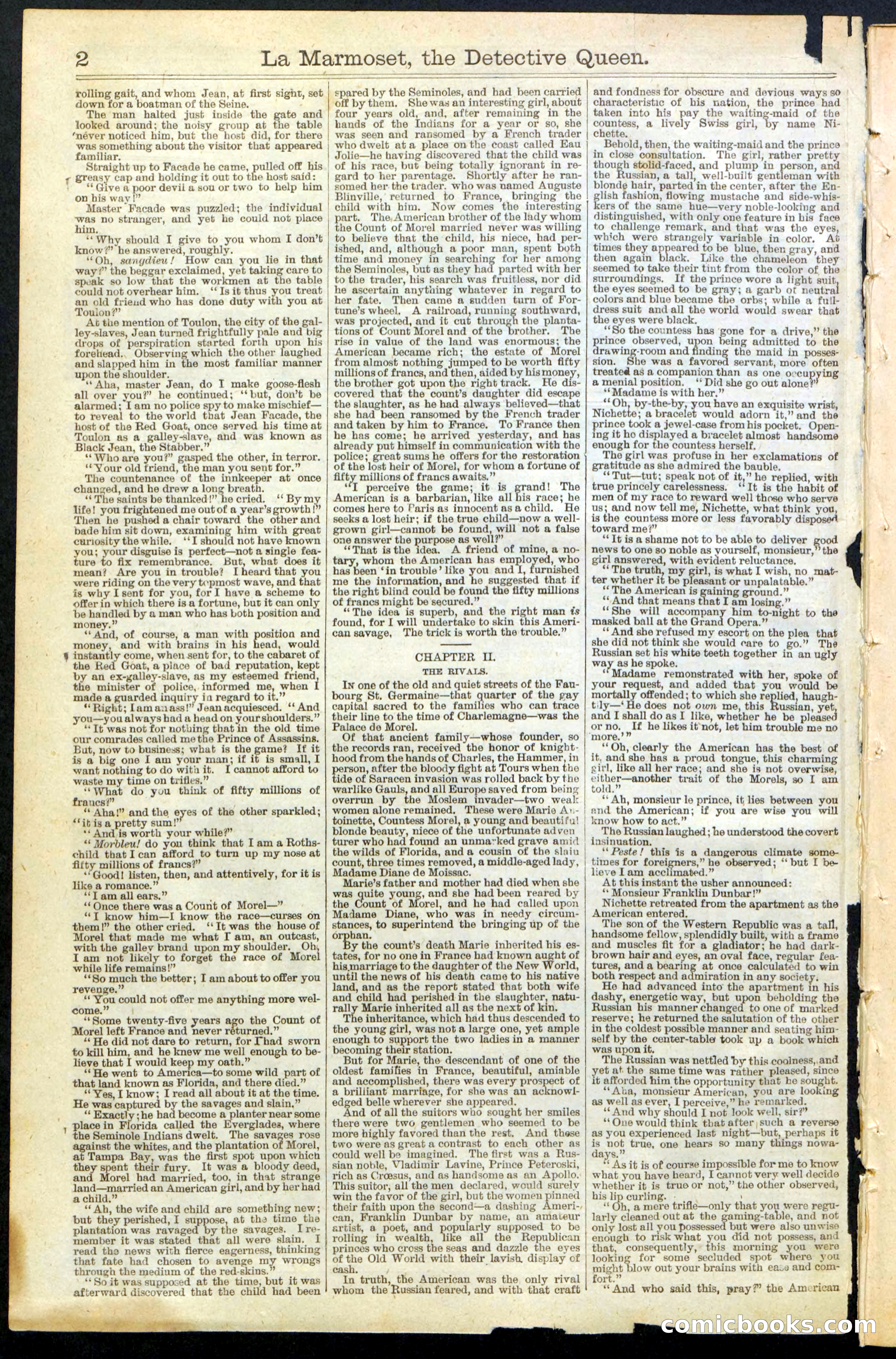
A restored page from Pulp Fiction, 1882. Page through the whole issue in the reader above.
📄 Transcribed text from this page (OCR, searchable)
Machine-transcribed from the original scan — historical spelling and the odd misread are preserved.
-=4 = 2 —> ~~ -- ae ee rolling gait, and whom Jean, at first sight, set down for a boatman of the Seine. The man halted just inside the gate and looked around; the noisy group at the table ‘néver noticed him, but the host did, for there | about the visitor that appeared | was something familiar. Straight up to Facade he came, pulled off his greasy cap and holding it out to the host said: ** Give a poor devil a sou or two to help him | sor | Blinville, returned to France, on his way!” Master Facade was puzzled; the individual Ane no stranger, and yet he could not place im. ‘‘Why should I give to you whom I don’t know?’ he answered, roughly. “Oh, sangdieu! How can you lie in that way?’ the beggar exclaimed, yet taking care to speak so low that the workmen at the table could not overhear him. ‘‘Isit thus you treat an old friend who has done duty with you at | Toulon?’ At the mention of Toulon, the city of the gal- ley-slaves, Jean turned frightfully pale and big drops of perspiration started forth upon his forehead,. Observing which the other laughed and slapped him in the most familiar manner upon the shoulder. ‘* Aha, master Jean, do I make goose-flesh all over you?” he continued; ‘‘ but, don’t be alarmed; I am no police spy to make mischief— to reveal to the world that Jean Facade, the host of the Red Goat, once served his time at Toulon as a galley-slave, and was known as Black Jean, the Stabber.” ‘*Who are you?” gasped the other, in terror. ‘Your old triend, the man you sent for.” The countenance of the innkeeper at once changed, and he drew a long breath. ‘‘ The saints be thanked!” he cried. ‘‘ By my life! you frightened me out of a year’s growth!” Then he pushed a chair toward the other and bade him sit down, examining him with great curiosity the while. ‘‘I should not have known you; your disguise is perfect—not a single fea- ture to fix remembrance. But, what does it mean? Are you in trouble? [heard that you were riding on the very topmost wave, and that is why I sent for you, for I have a scheme to offer in which there is a fortune, but it can only be handled by a man who has both position and money.” ‘And, of course, a man with position and money, and with brains in his head, would instantly come, when sent for, to the cabaret of the Red Goat, a piace of bad reputation, kept by an ex-ygalley-slave, as my esteemed friend, the minister of police, informed me, when I made a guarded inquiry ia regard to it.” “Right; lam anass!” Jean acquiesced. ‘‘ And you—y ou always had a head on yourshoulders.” “Tt was not for nothing that in the old time our comrades called me the Prince of Assassins. But, now to business; what is the game? If it is a big one I am your man; if it is small, I want nothing to do withit. I cannot afford to waste my time on trifles.” ‘‘What do you think of fifty millions of francs?” | ** Aha!” and the eyes of the other sparkled; “itis a pretty sum!’ — ** Andis worth your while?” «‘ Morbleu! do you think that I am a Roths- child that Ican afford to turn up my nose at fifty millions of francs?” ; ‘Good! listen, then, and attentively, for it is like a romance.” ‘“‘T am all ears,” “Once there was a Count of Morel—” **T know him—I know the race—curses on them!” the other cried. ‘‘It was the house of Morel that made me what I am, an outcast, with the galley brand upon my shoulder. Oh. Iam not likely to forget the race of Morel while life remains!” **So much the better; I am about to offer you revenge.” “You could not offer me anything more wel- come.” | ‘‘Some twenty-five years ago the Count of Morel left France and never réturned.” “« He did not dare to return, for Thad sworn to kill him, and he knew me well enough to be- lieve that I would keep my oath.” ‘‘He went to America—to some wild part of that land known as Florida, and there died.” “Yes, [ know; I read all about it at the time. He was captured by the savages and slain,” “Exactly ;he had become a ee near some place in Florida called the Everglades, where the Seminole Indians dwelt. The savages rose ps the whites, and the plantation of Morel, at Tampa Bay, was the first spot upon which sone + am their fury. It was a bloody deed, an orel had married, too, in that strange land—married an American girl, and by her had a child.” ** Ah, the wife and child are something new; but they perished, I 4 yose, at the time the plantation was ravage oe the savages. I re- member it was stated that all were slain. I read the news with fierce eagerness, thinking that fate had chosen to avenge my wrongs through the medium of the red-skins.” ‘So it was supposed at the time, but it was terward discovered that the child had been - ——— --— spared by the Seminoles, and had been carried off by them. She was an interesting girl, about four years old, and, after remaining in the hands of the Indians for a year or so, she was seen and ransomed by a French trader who dwelt ata place onthe coast called Eau Jolie—he having discovered that the child was | of his race, but being totally ignorant in re- gard to her parentage. Shortly after he ran- somed her the trader. who was named Auguste bringing the child with him. Now comes the interesting part. The,American brother of the lady whom the Count of Morel married never was willing to believe that the child, his niece, had per- ished, and, although a poor man, spent both time and money in searching for her among the Seminoles, but as they had parted with her to the trader, his search was fruitless, nor did he ascertain anytuing whatever in regard to her fate. Then came a sudden turn of For- tune’s wheel, A railroad, running southward, was projected, and it cut through the planta- tions of Count Morel and of the brother. The rise in value of the land was enormous; the American became rich; the estate of Morel from almost nothing jumped to be worth fifty millions of franes, and then, aided by hismoney, the brother got upon the right track. He dis- covered that the count’s daughter did escape the slaughter, as he had always believed—that she had been ransomed by the French trader and taken by him to France. To France then he has come; he arrived yesterday, and has already put himself in communication with the police; great sums he offers for the restoration of the lost heir of Morel, for whom a fortune of fitty millions of francs awaits,” ‘IT perceive the game; it is grand! The American is a barbarian, like all his race; he comes here to Paris as innocent asa child. He seeks a lost heir; if the true child—now a well- grown girl—cannot be found, will not a false one answer the purpose as well?” “That isthe idea. A friend of mine, a no- tary, whom the American has employed, who has been ‘in trouble’ like you and I, furnished me the information, and he suggested that if the right blind could be found the fifty millions of francs might be secured.” “The idea is superb, and the right man ts found, for I will undertake to skin this Ameri- can savage, The trick is worth the trouble.” CHAPTER II. THE RIVALS. In one of the old and quiet streets of the Fau- bourg St. Germaine—that quarter of the gay capital sacred to the families who can trace their line to the time of Charlemagne—was the Palace de Morel. Of that ancient family—whose founder, so the records ran, received the honor of knight- hood from the hands of Charles, the Hammer, in person, after the bloody fight at Tours when the La Marmoset, the Detective Queen. — S] S —_— tide of Saracen invasion was rolled back by the | warlike Gauls, and all Europe saved from being overrun by the Moslem invader—two weal: women alone remained, These were Marie A:.- toinette, Countess Morel, a young and beautiful! blonde beauty, niece of the unfortunate adven turer who had found an unmarked grave amid the wilds of Florida, and a cousin of the slaiu count, three times removed, a middle-aged lady, Madame Diane de Moissac. Marie’s father and mother had died when she was ae young: and she had been reared by the Count of Morel, and he had called upon Madame Diane, who was in needy circum- Pity to superintend the bringing up of the orphan, y the count’s death Marie inherited his es- tates, for no one in France had known aught of his marriage to the daughter of the New World, until the news of his death came to his native land, and as the report stated that both wife and child had perished in the slaughter, natu- rally Marie inherited all as the next of kin, The inheritance, which had thus descended to the young girl, was not a large one, yet ample enough to support the two ladies in a manner becoming their station. But for Marie, the descendant of one of the oldest famifies in France, beautiful, amiable and accomplished, there was every prospect of a brilliant marriage, for she was an acknowl- edged belle wherever she appeared. nd of all the suitors who sought her smiles there were two gentlemen who seemed to be more highly favored than the rest. And these two were as great a contrast to each other as could well be imagined. The first was a Rus- sian noble, Vladimir Lavine, Prince Peteroski, rich as Croesus, and as handsome as an Apollo, This suitor, all the men declared, would surely win the favor of the girl, but the women Si ned their faith upon the second—a dashing can, Franklin Dunbar by name, an amateur artist, a poet, and popularly supposed to be rolling in wealth, like all the Republican princes who cross the seas and dazzle the eyes of the Old World with their lavish, display of cash, In truth, the American was the only rival whom the Russian feared, and with that craft meri-, SS and fondness for obscure and devious ways so characteristic of his nation, the prince had taken into his pay the waiting-maid of the countess, a lively Swiss girl, by name Ni- chette. : _ Behold, then, the waiting-maid and the prince in close consultation. The girl, rather pretty though stolid-faced, and plump in person, and the Russian, a tall, well-built gentleman with blonde hair, parted in the center, after the En- glish fashion, flowing mustache and side-whis- kers of the same hue—very noble-looking and distinguished, with only one feature in his face to challenge remark, and that was the eyes, which were strangely variable in color. At times they appeared to be blue, then gray, and then again black. Like the chameleon’ they seemed to take their tint from the color of the surroundings. If the prince wore a light suit the eyes seemed to be gray; a garb of neutra colors and blue became the orbs; while a full- dress suit and all the world would swear that the eyes were black. ‘So the countess has gone for a drive,” the prince observed, upon being admitted to the drawing-room and finding the maid in posses- sion. She was a baveead servant, more often treated as a companion than as one ovcupying a menial position. ‘* Did she go out alone? ‘* Madame is with her.” **Oh, by-the-by, you have an exquisite wrist, Nichette; a bracelet would adorn it,” and the rince took a jewel-case from his pocket. Open- ing it ho displayed a bracelet almost handsome enough for the countess herself, The girl was profuse in her exclamations of gratitude as she admired the bauble. “*Tut—tut; speak not of it,” he replied, with true princely carelessness. ‘It is the habit of men of my race to reward well those who serve us; and now tell me, Nichette, what think you, is the countess more or less favorably disposed toward me?” ‘It is a shame not to be able to deliver news to one so noble as yourself, monsieur, girl answered, with evident reluctance, The truth, my girl, is what I wish, no mat- ter whether it be pleasant or unpalatable.” ‘The American is gaining ground.” ** And that means that I am losing.” “She will accompany him to-night to the masked ball at the Grand Opera.” ‘* And she refused my escort on the plea that she did not think she would care to go.” The Russian set his white teeth together in an ugly way as he spoke. ‘“Madame remonstrated with her, spoke of your request, and added that you would be mortally offended; to which she replied haugh- tily—‘ He does not own me, this ussian, yet and I shall do as I like, whether he be pleased or no, If he likes itnot, let him trouble me no more.’” _ “Oh, clearly the American has the best of it, and she has a proud tongue, this charming girl, like all her race; and she is not overwise, PAT ge ir trait of the Morels, so I am told, ** Ah, monsieur le prince, it lies between you end the American; if you are wise you will know how to act.” The Russian laughed ; he understood the covert insinuation, _** Peste! this is a dangerous climate some- times for foreigners,” he observed; ‘‘ but I be- lieve Lam acclimated.” At this instant the usher announced: ** Monsieur Franklin Dunbar!” Nichette retreated from the apartment as the American entered. The son of the Western Republic was a tall, handsome fellow, splendidly built, with a frame and muscles fit for a gladiator; he had dark- brown hair and eyes, an oval face, regular fea- tures, and a bearing at once calculated to win both respect and admiration in any society. He had advanced into the apartment in his dashy, energetic way, but upon beholding the Russian his manner changed to one of marked reserve; he returned the salutation of the other in the coldest possible manner and seating him- self by the center-table took up a book which was upon it, The Russian was nettled by this coolness,.and yet at the same time was rather pleased, since it afforded him the opportunity that he sought. *“‘Aba, monsieur American, you are looking as well as ever, I perceive,” he remarked. ‘*And why should I not look well, sir?” **One would think that after;such a reverse as you experienced last night—but, perhaps it nob true, one hears so many things nowa- ays. ‘ As it is of course impossible for me to know what you have heard, I cannot very well decido whether it is true or not,” the other observed, his lip curling. - ‘“Oh, a mere trifle—only that you were regu- larly cleaned out at the gaming-table, and not only lost all you possessed but were also unwise enough to risk what you did not possess, and that, consequently, this morning you were looking for some secluded spot where you puigh? low out your brains with ease and com- ort. “And who said this, pray? the American ood 5 the 700) mn C |