
Pulp Fiction, 1882 · page 24 of 28
Beadle's New York Dime Library, No. 196 — page 24: what you’re looking at
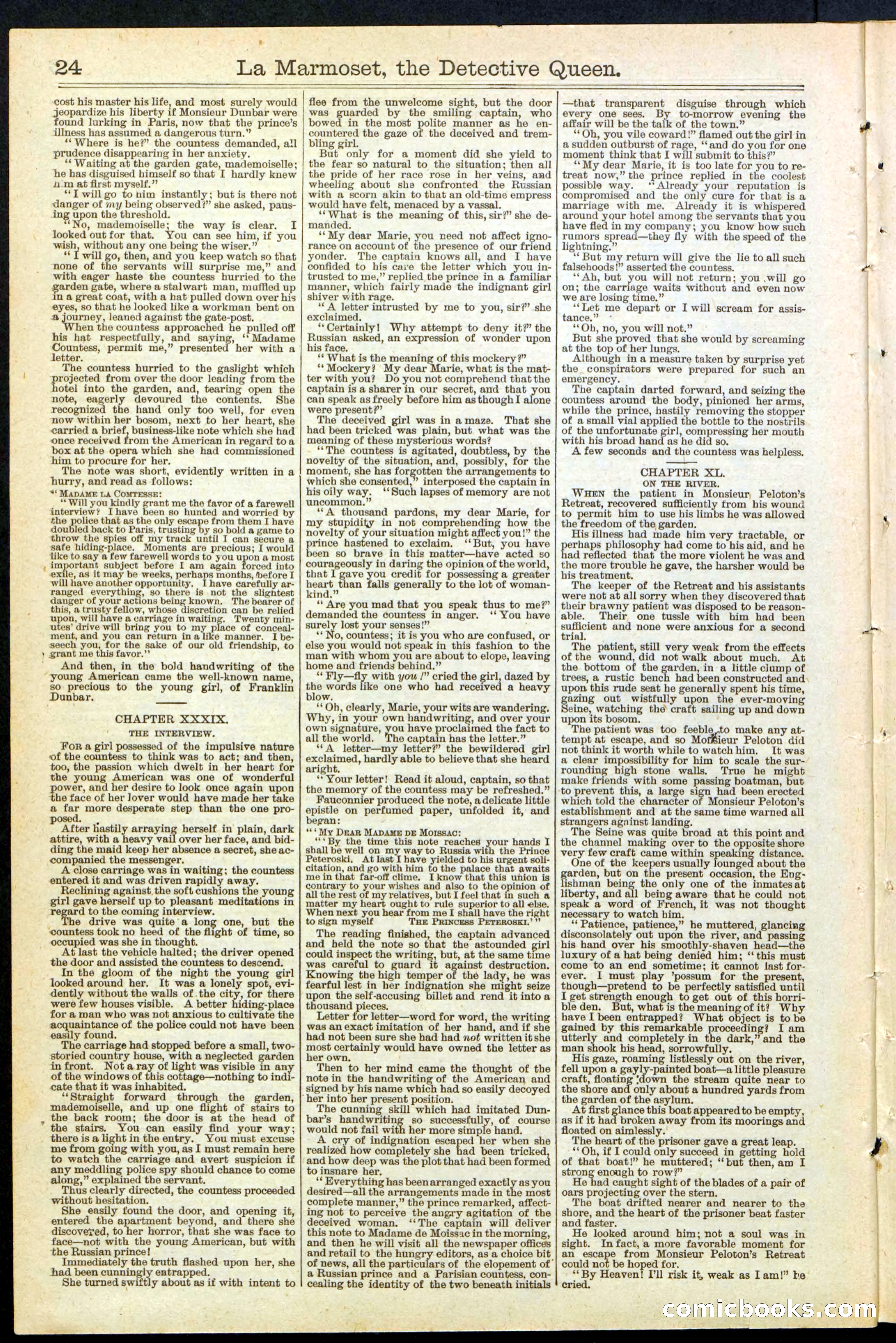
A restored page from Pulp Fiction, 1882. Page through the whole issue in the reader above.
📄 Transcribed text from this page (OCR, searchable)
Machine-transcribed from the original scan — historical spelling and the odd misread are preserved.
-_ ’ La Marmoset, the Detective Queen. 24 cost his master his life, and most surely would jeopardize his liberty if Monsieur Dunbar were found lurking in Paris, now that the prince’s Ulness has assumed a dangerous turn.” ‘Where is he?” the countess demanded, a!l prudence disappearing in her anxiety. ‘Waiting at the garden gate, mademoiselle; he has disguised bimself so that I hardly knew h.m at first myself.” **] will go to him instantly; but is there not danger of my being observed?” she asked, paus- ing upon the threshold. “No, mademoiselle; the way is clear. I looked out for that. You can see him, if you wish, without any one being the wiser.” ** ] will go, then, and you keep watch so that none of the servants will surprise me,” and with eager haste the countess hurried to the arden gate, where a stalwart man, muffled up in a great coat, with a hat pulled down over his eyes, so that he looked like a workman bent on &@ journey, leaned against the gate-post. hen the countess approached he pulled off his hat respectfully, and saying, ‘*‘ Madame Countess, permit me,” presented her with a letter. The countess hurried to the gaslight which ea from over the door leading from the otel into the garden, and, tearing open the note, ste gr devoured the contents. She recognized the hand only too well, for even now within her bosom, next to her heart, she carried a brief, business-like note which she had once received from the American in regard toa box at the opera which she had commissioned him to procure for her. The note was short, evidently written in a hurry, and read as follows: ** MADAME LA COMTESSE: ** Will you kindly grant me the favor of a farewell interview? Ihave been so hunted and worried by the police that as the only escape from them I have doubled back to Paris, trusting by so bold a game to throw the spies off my track until I can secure a safe hiding-place. Moments are precious; I would like to say a few farewell words to you upon a most be jae subject before I am again forced into exile, as it vem 4 be weeks, perhaps months, before I will have another opportunity, I have carefully ar- ranged everything, so there is not the slightest danger of your actions being known. The bearer of this, a trusty fellow, whose discretion can be relied upon, will have a carriage in bhaeniger Twenty min- utes’ drive will bring you to my place of conceal- ment, and you can return ina like manner. I be- seech you, for the sake of our old friendship, to grant me this favor.” And then, in the bold handwriting of the “young American came the well-known name, “ Dunbar. so precious to the young girl, of Franklin CHAPTER XXXTIX. THE INTERVIEW. For a girl possessed of the impulsive nature of the countess to think was to act; and then, too, the passion which dwelt in her heart for the young American was one of wonderful wer, and her desire to look once again upon he face of her lover would have made her take a far more desperate step than the one pro- After beatily arraying herself in plain, dark attire, with a heavy vail over her face, and bid- ding the maid keep her absence a secret, she ac- companied the messenger. A close carriage was in waiting; the countess entered it and was driven rapidly away. Reclining against. the soft cushions the young girl gave herself up to pleasant meditations in d to the coming interview. Th e drive was quite a long one, but the ‘countess took no heed of the flight of time, so occupied was she in thought. At last the vehicle halted; the driver opened the door and assisted the countess to descend. In the gloom of the night the young girl looked around her. It was a lonely spot, evi- dently without the walls of. the city, for there were few houses visible. A better hiding-place for a man who was not anxious to cultivate the uaintance of the police could not have been y found. The carriage had stopped before a small, two- storied country house, with a neglected garden in front. Nota ray of light was visible = of the windows of this cottage—nothing to indi- cate that it was inhabited. “Straight forward through the garden, mademoiselle, and up one flight of stairs to the back room; the door is at the head of the stairs. You can easily find your way; _ there isa lightin the entry. You must excuse me from going with you, as I must remain here to watch the carriage and avert suspicion if any meddling police spy should chance to come along,” explained the servant. Thus clearly directed, the countess proceeded without hesitation. She easily found the door, and opening it, entered the a ent beyond, and there she discoveyed, to her horror, that she was face to face—not with the young American, but with the Russian prince! Immediately the truth flashed upon her, she had been cunningly entrapped. She turned swiftly about as if with intent to flee from the unwelcome sight, but the door was guarded by the smiling captain, who bowed in the most polite manner as he en- countered the gaze of the deceived and trem- bling girl. But only for a moment did she yield to the fear so natural to the situation; then all the pride of her race rose in her veins, and wheeling about she confronted the Russian with a scorn akin to that an old-time empress would have felt, menaced by a vassal. ‘What is the meaning of this, sir?” she de- manded. ‘My dear Marie, you need not affect igno- rance on account of the presence of our friend yonder. The captain knows all, and I have confided to his caie the letter which you in- trusted to me,” replied the prince in a familiar manner, which fairly made the indignant girl shiver with rage. “A letter intrusted by me to you, sir?’ she exclaimed. “Certainly! Why attempt to deny it?’ the Russian asked, an expression of wonder upon his face. ** What is the meaning of this mockery?” ** Mockery? My dear Marie, what is the mat- ter with you? Do you not comprehend that the captain is a sharer in our secret, and that you can speak as freely before him as thoughI alone were present?” The deceived girl was in amaze. That she had been tricked was plain, but what was the meaning of these mysterious words? ‘*The countess is agitated, doubtless, by the novelty of the situation, and, possibly, for the moment, she has forgotten the arrangements to which she consented,” interposed the captain in his oily way. ‘‘Such lapses of memory are not uncommon.” ‘*A thousand pardons, my dear Marie, for my stupidity in not comprehending how the novelty of your situation might affect you!” the prince hastened to exclaim. ‘‘But, you have been so brave in this matter—have acted so courageously in daring the opinion of the world, that 1 gave you credit for possessing a greater heart t an falls generally to the lot of woman- kind. ‘** Are you mad that you speak thus to me?” demanded the countess in anger. ‘‘ You have surely lost your senses!” ‘** No, countess; it is you who are confused, or else you would not speak in this fashion to the man with whom you are about to elope, leaving home and friends behind.” “ Fly—fly with you /” cried the girl, dazed by a words like one who had received a heavy blow. ‘Oh, clearly, Marie, your wits are wandering. Why, in your own handwriting, and over your own signature, you have proclaimed the fact to all the world. The captain has the letter.” ‘*A letter—my letter?’ the bewildered girl nim a a hardly able to believe that she heard aright. ‘** Your letter! Read it aloud, captain, so that the memory of the countess may be refreshed.” Fauconnier produced the note, a delicate little epistle on perfumed paper, unfolded it, and began: *** My Dear MADAME DE Morssac: ‘*** By the time this note reaches pour hands I shall be well on my way to Russia with the Prince Peteroski, At last I have yielded to his urgent soli- citation, and go with him to the palace that awaits me in that far-off clime. I know that this uhion is contrary to your wishes and also to the opinion of all the rest of my relatives, but I feel that in such a matter my heart ought to rule superior to all else. When next you hear from me I shall have the right to sign myself Tue Princess PETEROSKI,’” The reading finished, the captain advanced and held the note so that the astounded girl could inspect the writing, but, at the same time was careful to guard it against destruction. Knowing the high temper of the lady, he was fearful lest in her indignation she might seize upon the self-accusing billet and rend it intoa thousand Pegs Letter for letter—word for word, the writing was an exact imitation of her hand, and if she had not been sure she had had not written it she most certainly would have owned the letter as her own. Then to her mind came the thought of the note in the handwriting of the American and signed by his name which had so easily decoyed ‘her into her present position. The cunning skill which had imitated Dun- bar’s handwriting so wont oA of course would not fail with her more simple hand. A cry of indignation escaped her when she realized how completely she had been tricked and how deep was the plot that had been forme to insnare her. ‘* Everything has been arranged exactly as you desired—all the arrangements made in the most complete manner,” the prince remarked, affect- ing not to perceive the angry agitation of the deceived woman. ‘‘The captain will deliver this note to Madame de Moissac in the morning, and then he will visit all the newspaper offices and retail to the pry ot Benge hr as a choice bit of news, all the particu a Russian prince and a Parisian countess, con- cealing the identity of the two beneath initials sof the elopement of —that transparent disguise through which every one sees. By to-morrow evening the affair will be the talk of the town.” ‘Oh, you vile coward!” flamed out the girl in a sudden outburst of rage, ‘‘and do you for one moment think that I will submit to this?’ **My dear Marie, it is too late for you to re- treat now,” the prince replied in the coolest possible way. ‘Already your reputation is compromised and the only cure for that is a marriage with me, Already it is whispered around your hotel among the servants that you have fled in my company; you know how such rumors spread—they fly with the speed of the lightning.” ‘* But my return will give the lie to all such falsehoods!” asserted the countess. ‘‘Ah, but you will not return; you ,will go on; the carriage waits Without and even now we are losing time.” ‘‘Let me depart or I will scream for assis- tance.” ° ‘**Oh, no, you will not.” But she proved that she would by screaming at the top of her lungs. Although in a measure taken by surprise yet the conspirators were prepared for such an emergency. The captain darted forward, and seizing the countess around the body, pinioned her arms, while the prince, hastily removing the stopper of a small vial applied the bottle to the nostrils of the unfortunate girl, compressing her mouth with his broad hand as he did so. A few seconds and the countess was helpless. CHAPTER XL. ON THE RIVER. WHEN the patient in Monsieur, Peloton’s Retreat, recovered sufficiently from his wound to permit him to use his limbs he was allowed the freedom of the garden. His illness had made him very tractable, or rhaps philosophy had come to his aid, and he nad reflected that the more violent he was and the more trouble he gave, the harsher would be his treatment. The keeper of the Retreat and his assistants were not at all sorry when they discovered that their brawny patient was disposed to be reason- able. Their one tussle with bim had been rae and none were anxious for a second trial. The patient, still very weak from the effects of the wound, did not walk about much. At the bottom of the garden, in a little clump of trees, a rustic bench had been constructed and. upon this rude seat he generally spent his time, azing out wistfully upon the ever-moving eine, watching the craft sailing up and down upon its bosom. The patient was too feeble,to make any at- tempt at escape, and so Mofthi ieur Peloton did not think it worth while to watchhim. It was a clear impossibility for him to scale the sur- rounding high stone walls, True he might make friends with some passing boatman, but to prevent this, a large sign had been erected which told the character of Monsieur Peloton’s establishment and at the same time warned all strangers against landing. The Seine was quite broad at this point and the channel making over to the opposite shore very few craft came within speaking distance. One of the keepers usually ounged about the arden, but on the present occasion, the Eng- ishman being the only one of the inmates at liberty, and all being aware that he could not speak a word of French, it was not thought necessary to watch bim. ‘“* Patience, patience,” he muttered, glancing disconsolately out upon the river, and passing his hand over his smoothly-shaven head—the luxury of a hat being denied him; ‘this must come to an end sometime; it cannot last for- ever. 1 must ee ‘possum for the present, though—pretend to be perfectly satisfied until I get ate enough to get out of this horri- ble den. But, what is the meaning of it? Why have I been entrapped? What object is to be gained by this remarkable proceeding? I am utterly and completely in the dark,” and the man shook his head, sorrowfully. His gaze, roaming listlessly out on the river, fell upon a gayly-painted boat—a little pleasure craft, floating ‘down the stream quite near to the shore and only about a hundred yards from the garden of the asylum. At first glance this boat appeared to be empty, as if it had broken away from its moorings and floated on aimlessly. The heart of the prisoner gave a great leap. ‘Oh, if I could only succeed in getting hold of that boat!” he muttered; “but then, am I strong enough to row?” He had caught sight of the blades of a pair of oars projecting over the stern. The boat drifted nearer and nearer to the shore, and the heart of the prisoner beat faster and faster. He looked around him; not a soul was in sight. Infact, a more favorable moment for an escape from Monsieur Peloton’s Retreat could not be ho for. oat Heaven! [ll risk it, weak as Iam!” he cri (E % oh = Eomichboo S:G