
Pulp Fiction, 1882 · page 23 of 28
Beadle's New York Dime Library, No. 196 — page 23: what you’re looking at
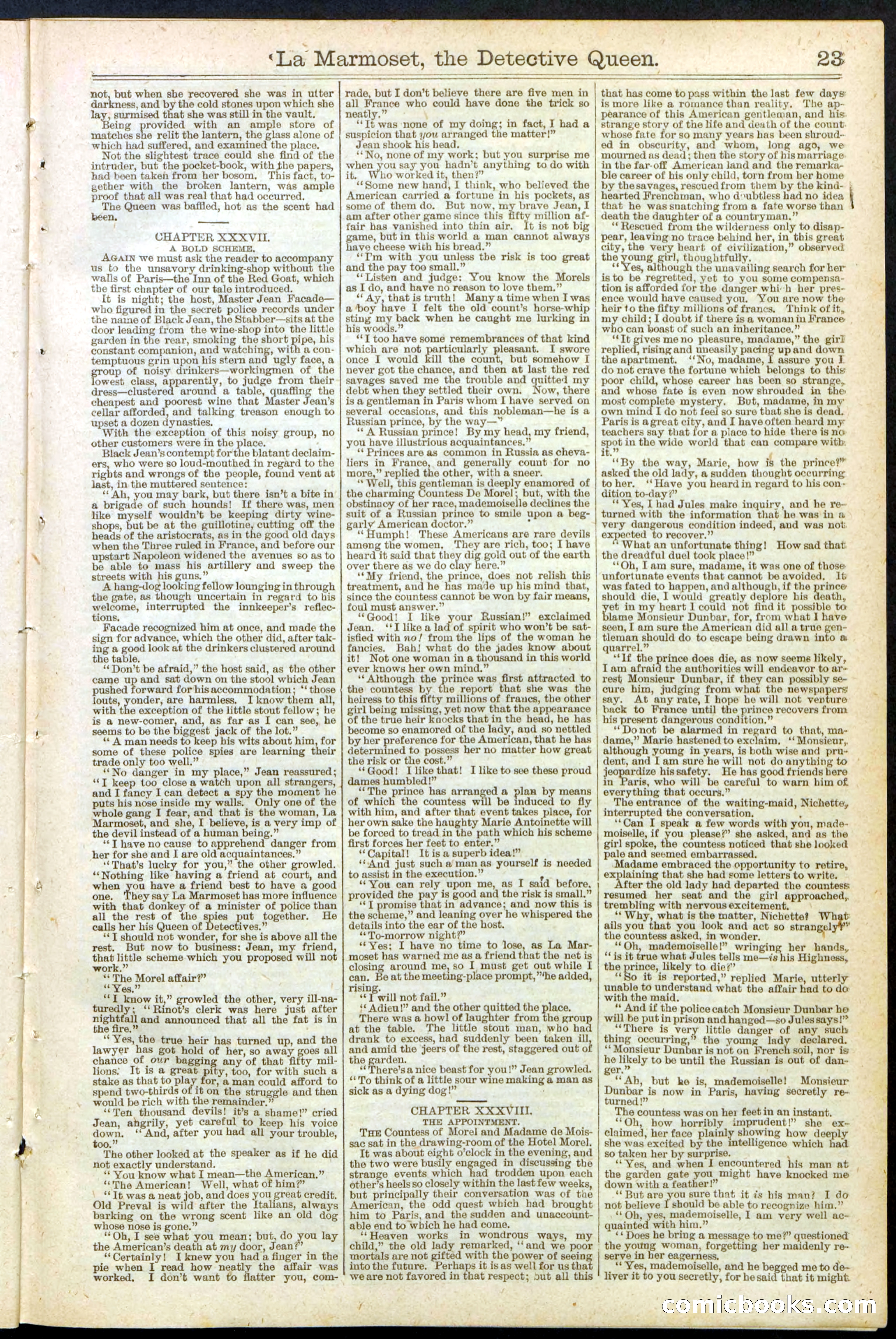
A restored page from Pulp Fiction, 1882. Page through the whole issue in the reader above.
📄 Transcribed text from this page (OCR, searchable)
Machine-transcribed from the original scan — historical spelling and the odd misread are preserved.
—— a ae ‘La Marmoset, the Detective Queen. not, but when she recovered she was in utter darkness, and by the cold stones upon which she lay, surmised that she was still in the vault. Being provided with an ample store of matches i relit the lantern, the glass alone of which had suffered, and examined the place. Not the slightest trace could she find of the intruder, but the pocket-book, with fhe papers, had been taken from her bosom, This fact, to- gether with the broken lantern, was ample proof that all was real that had occurred. The Queen was baffled, hot as the scent had been. CHAPTER XXXVIL. A BOLD SCHEME, AGAIN we must ask the reader to accompany us to the unsavory drinking-shop without the walls of Paris—the Inn of the Red Goat, which the first chapter of our tale introduced. It is night; the host, Master Jean Facade— who figured in the secret police records under the naine of Black Jean, the Stabber—sits at the door leading from the wine-shop into the little garden in the rear, smoking the short pipe, his constant companion, and watching, with a con- temptuous grin upon his stern and ugly face, a rroup of noisy drinkers—workingmen of the owest class, apparently, to judge from their dress—clustered around a table, quaffing the cheapest and poorest wine that Master Jean’s cellar afforded, and talking treason enough to upset a dozen dynasties. With the exception of this noisy group, no other customers were in the place. Black Jean’s contempt for the blatant declaim- ers, who were so loud-mouthed in regard to the rights and wrongs of the people, found vent at last, in the muttered sentence: ‘Ah, you may bark, but there isn’t a bite in a brigade of such hounds! If there was, men like myself wouldn’t be keeping dirty wine- shops, but be at the guillotine, cutting off the heads of the aristocrats, as in the good old days when the Three ruled in France, and before our upstart Napoleon widened the avenues so as to be able to mass his artillery and sweep the streets with his guns.” A hang-dog looking fellow lounging in through the gate, as though uncertain in regard to his welcome, interrupted the innkeeper’s reflec- tions. Facade recognized him at once, and made the sign for advance, which the other did, after tak- ing a good look at the drinkers clustered around the table, ‘‘ Don’t be afraid,” the host said, as the other came up and sat down on the stool which Jean pushed forward for his accommodation; ‘‘ those louts, yonder, are harmless. I know them all, with the exception of the little stout fellow; he is a new-comer, and, as far as I can see, he seems to be the biggest jack of the lot.” ‘* A man needs to keep bis wits about him, for some of these police spies are learning their trade only too well.” ‘‘No danger in my place,” Jean reassured; ‘‘T keep too close a watch upon all strangers, and I fancy I can detect a spy the moment he puts his nose inside my walls. Only one of the whole gang I fear, and that is the woman, La Marmoset, and she, I believe, is a very imp of the devil instead of a human being.” ‘‘T have no cause to apprehend danger from her for she and I are old acquaintances.” ‘‘That’s lucky for you,” the other growled. ‘“‘Nothing like having a friend at court, and when you have a friend best to have a good one. They say La Marmoset has more influence with that donkey of a minister of police than all the rest of the spies put together. He calls her his Queen of Detectives.” ‘*T should not wonder, for she is above all the rest. But now to business: Jean, my friend, that little scheme which you proposed will not work.” “The Morel affair?” “Yes,” , “TI know it,” growled the other, very ill-na- turedly; ‘‘Rinot’s clerk was here just after nightfall and announced that all the fat is in the fire.” ‘Yes, the true heir has turned up, and the lawyer has got hold of her, so away goes all chance of our bagging any of that fifty mil- lions; It is a great pity, too, for with such a stake as that to play for, a man could afford to spend two-thirds of it on the struggle and then would be rich with the remainder,” ‘(Ten thousand devils! it’s a shame!” cried Jean, ahgrily, yet careful to keep his voice down, ‘And, after you had all your trouble, The other looked at the speaker as if he did not exactly understand. ‘‘- You know what I mean—the American.” “The American! Well, what of him?’ “It was a neat job, and does you great credit. Old Preval is wild after the Italians, always barking on the wrong scent like an old dog whose nose is gone.” ‘Oh, I see what you mean; but, do you lay the American’s death at my door, Jean?” ‘Certainly! I knew you had a finger in the pie when I read how neatly the affair was worked. I don’t want to flatter you, com- rade, but I don’t believe there are five men in all France who could have done the trick so neatly.” ‘‘Té was none of my doing; in fact, I had a suspicion that you arranged the matter!” Jean shook his head. ‘*No, none of my work; but you surprise me when you say you hadn’t anything to do with it. Who worked it, then?’ ‘‘Some new hand, I think, who believed the American carried a fortune in his pockets, as some of themdo. But now, my brave Jean, I am after other game since this fifty million af- fair has vanished into thin air. It is not big game, but in this world a man cannot always have cheese with his bread.” ‘Pm with you unless the risk is too great and the pay too small.” ‘Listen and judge: You know the Morels as I do, and have no reason to love them.” ‘‘ Ay, that is trnth! Manya time when I was a ‘boy have I felt the old count’s horse-whip sting my back when he caught me lurking in his woods.” ‘*T too have some remembrances of that kind which are not particularly pleasant. I swore once I would kill the count, but somehow I never got the chance, and then at last the red savages saved me the trouble and quitted my debt when they settled their own. Now, there is a gentleman in Paris whom I have served on several occasions, and this nobleman—he is a Russian prince, by the way—” ‘* A Russian prince! By my head, my friend, you have illustrious acquaintances.” ‘* Princes are as common in Russia as cheva- liers in France, and generally count for no more,” replied the other, with a sneer. ‘Well, this gentleman is deeply enamored of the charming Countess De Morel; but, with the obstinacy of her race, mademoiselle declines the suit of a Russian prince to smile upon a beg- garly American doctor.” 3 ‘‘Humph! These Americans are rare devils among the women, They are rich, too; I have heard it said that they dig gold out of the earth over there as we do aay 1ere.” ‘*My friend, the prince, does not relish this treatment, and he has made up his mind that, since the countess cannot be won by fair means, foul must answer.” “Good! I like your Russian!” exclaimed Jean. ‘'I like a lad of spirit who won’t be sat- isfied with no! from the lips of the woman he fancies. Bah! what do the jades know about it! Not one woman in a thousand in this world ever knows her own mind.” ‘* Although the prince was first attracted to the countess by the report that she was the heiress to this fifty millions of frances, the other girl being missing, yet now that the appearance of the true heir kaocks that in the head, he has become so enamored of the lady, and so nettled by her preference for the American, that he has detertiined to possess her no matter how great the risk or the cost.” ‘Good! I like that! I like to see these proud dames humbled!” ‘The prince has arranged a plan by means of which the countess will be induced to fly with him, and after that event takes place, for her own sake the haughty Marie Antoinette will be forced to tread in the path which his scheme first forces her feet to enter.” ‘Capital! It is a superb idea!” ‘‘And just such @ man as yourself is needed to assist in the execution.” : ‘‘You can rely upon me, as I said before, provided the pay is good and the risk is small.” ‘‘T promise that in advance; and now this is the scheme,” and leaning over he whispered the details into the ear of the host. ‘To-morrow night?” ‘¢Yes: I have no time to lose, as La Mar- moset has warned me as a friend that the net is closing around me, so I must get out while I can. Be at the meeting-place prompt,’“he added, rpeing. ; «7 will not fail.” ‘¢ Adieu!” and the other quitted the pince. There was a howl of laughter from the group at the table. The little stout man, who had drank to excess, had suddenly been taken ill and amid the jeers of the rest, staggered out of the garden. “'There’s a nice beast for you!” Jean growled. ‘No think of a little sour wine making @ man as sick as a dying dog!” : CHAPTER XXXVIII. THE APPOINTMENT. Tre Countess of Morel and Madame de Mois- sac sat in the drawing-room of the Hotel Morel. It was about eight o’clock in the evening, and the two were busily engaged in discussing the strange events which had trodden upon each other’s heels so closely within the lastfew weeks, but principally their conversation was of toe American, the odd quest which had brought him to Paris, and the sudden and unaccount- able end to which he had come, ‘‘Heaven works in wondrous ways, my child,” the old lady remarked, ‘‘and we poor mortals are not gifted with the power of seein into the future. Perhaps it is as well for us tha we are not favored in that respect; Dut all this f © 2 Ee eeeEOE eee - —EE se ie LL LL LL LL LL LLL LLL ~ cr ’ that has come to pass within the last few days is more like a romance than reality, The ap- pearance of this American gentleman, and his. strange story of the life and death of the count: whose fate for so many years has been shroud- ed in obscurity, and whom, long ago, we mourned as dead; then the story of his marriage in the far-off American land and the remarka- ble career of his only child, torn from ber home by thesavages, rescuedfrom them by the kind- hearted Frenchman, who dubtiless had no idea that he was snatching from a fate worse than death the daughter of a countryman,” “* Rescued from the wilderness only to disap- pear, leaving no trace behind her, in this great city, the very heart of civilization,” observed the young girl, thoughtfully. _ Yes, although the unavailing search for her isto be regretted, yet to you some compensa- tion is afforded for the danger whivh her pres- ence would have caused you. You are now the heir to the fifty millions of francs. Think of it, my child; I doubt if there is a womanin France who can boast of such an inheritance.” “*Tt gives me no pleasure, madame,” the girl replied, rising and uneasily pacing up and down the apartment. ‘‘No, madame, : assure you I do not crave the fortune which belongs to this poor child, whose career has been so strange, and whose fate is even now shrouded in the most complete mystery. But, madame, in my own mind I do not feel so sure that she is dead. Paris is agreat city, and I have often heard my teachers say that for a place to hide there is no spot in the wide world that can compare with ‘By the way, Marie, how is the prince?” asked the old lady, a sudden thought occurring toher. ‘‘Have you heard in regard to his con- dition to-day?” “Yes, I had Jules make inquiry, and he re~ turned with the information that he was in a very dangerous condition indeed, and was not. expected to recover.” * What an unfortunate thing! How sad that. the dreadful duel took place!” ‘‘Oh, Lam sure, madame, it was one of those unfortunate events that cannot be avoided, It was fated to happen, and although, if the prince should die, Il would greatly deplore his death, MA in my heart 1 could not find it possible ta lame Monsieur Dunbar, for, from what I have seen, I am sure the American did all a true gen- tleman should do to escape being drawn into & quarrel.” ‘If the pence does die, as now seems likely, Tam afraid the authorities will endeavor to ar- rest Monsieur Dunbar, if they can possibly se- cure him, judging from what the mn epepere say. At any rate, I hope be will not venture back to France until the prince recovers from his present dangerous condition,” ‘“Donot be alarmed in regard to that, ma- dame,”’ Marie hastened to exclaim, ‘‘ Monsieur,. although young in years, is both wise and pru- dent, and [ am sure he will not do anything to a a hissafety. He has good friends bere in Paris, who will be careful to warn him of everything that occurs.” _ The entrance of the waiting-maid, Nichette, interrupted the conversation. . ‘‘Can I speak a few words with you, made- moiselle, if hen please?” she asked, and as the girl spoke, the countess noticed that she looked pale and seemed embarrassed. Madame embraced the opportunity to retire, explaining that she had some letters to write. fter the old lady had departed the countess resumed her seat and the girl approached,. trembling with nervousexcitement. Hy Why, as is - “eet af Nichette? my ails you t you look and act so strangel the countess asked, in wonder, 5 ““Oh, mademoiselle!” wringing her hands, “is it true what Jules tells me—is his Highness, the prince, likely to die?” “So it is reported,” replied Marie, utterly unable to understand what the affair had to do with the maid. ‘* And if the police catch Monsieur Dunbar he will be put in prison and hanged—so Jules says!” “There is very little danger of any such thing occurring,” the young lady declared. ‘* Monsieur Dunbar is not on French soil, nor is he likely to be until the Russian is out of dan- ger. ; ‘‘Ah, but ke is, mademoiselle! Monsieur Dunbar is now in Paris, having secretly re- turned!” The countess was on her feet in an instant. ‘‘Oh, how horribly imprudent!” she ex- claimed, her face Diainiy showing how deeply she was excited by the intelligence which had so taken her by surprise. ‘‘'Yes, and when I encountered his man at the garden gate you might have knocked me down with a feather!” ‘But are you sure that it is his man? I do not believe I should be able to recognize him.” quainted with him.” ‘* Does he bring a message to me?” questioned the young woman, forgetting her maidenly re- serve in her eagerness. _ Yes, mademoiselle, and he begged me to de~ liver it to you secretly, for hesaid that it might 23 Ee ~ ‘* Oh, yes, mademoiselle, I am very well ac~ — os." = <<" : 4 COM ~~ chooks-com 3