
Pulp Fiction, 1882 · page 9 of 28
Beadle's New York Dime Library, No. 195 — page 9: what you’re looking at
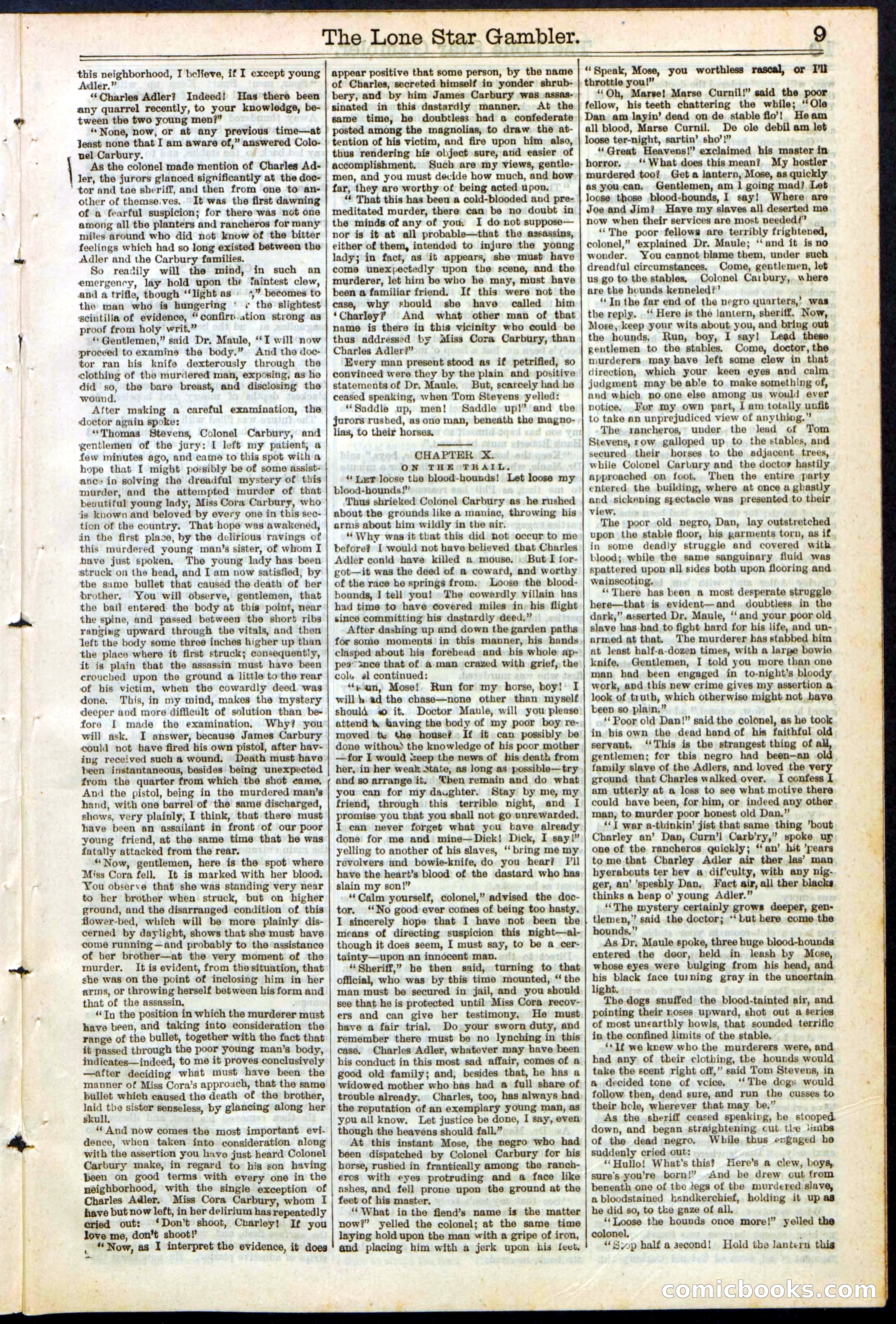
A restored page from Pulp Fiction, 1882. Page through the whole issue in the reader above.
📄 Transcribed text from this page (OCR, searchable)
Machine-transcribed from the original scan — historical spelling and the odd misread are preserved.
i el this neighborhood, I belfeve, if I except young Adler.” ‘“‘Qharles Adler? Indeed! Has there been any quarrel recently, to your knowledge, be- tween the two young men?” ‘None, now, or at any previous time—at Jeast none that I am aware of,” answered Colo- vel Carbury. As the colonel made mention of Charles Ad- ler, the jurors glanced significantly at the doc- tor and toe sberiff, and then from one to an- other of themse.ves.. It was the first dawning of a fearful suspicion; for there was not one among all the planters and rancheros for many miles around who did not know of the bitter feelings which had so long existed between the Adler and the Carbury families. So readily will the mind, in such an emergency, lay hold upon the faintest clew, and a trifle, though “‘light as © +,” becomes to the man who is hungering ‘ ¢ the slightest scintilia of evidence, “confirn. ation strong as proof from holy writ.” ‘*Gentlemen,” said Dr, Maule, ‘TI will now proceed to examine the body.” And the doc- tor ran his knife dexterously through the clothing of the murdered man, exposing, as he did so, the bare breast, and disclosing the wound. After making a careful examination, the doctor again spoke: ‘“‘Thomas Stevens, Colonel Carbury, and gentlemen of the jury: | left my patient, a few minutes ago, and came to this spot with a hope that I might possibly be of some assist- ance in solving the dreadful mystery of this murder, and the attempted murder of that beautiful young lady, Miss Cora Carbury, who is known and beloved by every one in this sec- tion of the country. That hope was awakened, in the first place, by the delirious ravings of this murdered young man’s sister, of whom I bave just spoken, The young lady has been struck on the bead, and I am now satisfied, by the same bullet that caused the death of her brother. You will observe, gentlemen, that the batl entered the body at this point, near the spine, and passed between the short ribs ranging upward through the vitals, and then left the body some three inches higher up than the place where it first struck; consequently, it is plain that the assassin must have been crouched upon the ground a little to the rear of his victim, when the cowardly deed. was done. This, in my mind, makes the mystery deeper and more difficult of solution than be- fore [| made the examination. Why? you will ask. I answer, because James Carbury could not have fired his own pistol, after hav- ing received such a wound. Death must have been instantaneous, besides being unexpected from the quarter from which the shot came, And the pistol, being in the murdered man’s hand, with one barrel of the same discharged, shows, very plainly, I think, that there must have been an assailant in front of our poor young friend, at the same time that he was fatally attacked from the rear. “Now, gentlemen, here is the spot where Miss Cora fell. It is marked with her blood. ‘You observe that she was standing very near to her brother when struck, but on higher ground, and the disarranged condition of this flower-bed, which will be more plainly dis- cerned by daylight, shows that she must have come running—and probably to the assistance of her brother—at the very moment of the murder. It is evident, from the situation, that she was on the point of inclosing him in her arms, or throwing herself between his form and that of the assassin, ‘Tn the position in which the murderer must have been, and taking into consideration the range of the bullet, together with the fact that it passed tbrough the poor young man’s body, indicates—indeed, to me it proves conclusively —after deciding what must have been the manner of Miss Cora’s approach, that the same bullet which caused the death of the brother, pees the sister senseless, by glancing along her skull. ‘* And now comes the most important evi- dence, when taken into consideration along with the assertion you have just heard Colonel Carbury make, in regard to his son having been on good terms with every one in the neighborhood, with the single exception of Charles Adler, Miss Cora Carbury, whom I have but now left, in her delirium has repeatedly cried out: ‘Don’t shoot, Charley! If you love me, don’t shoot!’ “Now, as I interpret the evidence, it does -_ The Lone Star.Gambler. appear positive that some person, by the name of Charles, secreted himself in yonder shrub- bery, and by him James Carbury was assas- sinated in this dastardly manner. At the same time, he doubtless had a confederate among the magnolias, to draw the at- tention of his victim, and fire upon him also, thus rendering his object sure, and easier of accomplishment. Such are my views, gentle- men, and you must decide how much, and bow far, they are worthy of being acted upon. “‘ That this has been a cold-blooded and pre- meditated murder, there can be no doubt in the minds of any of you. I do not suppose— nor is it at all probable—that the assassins, either of them, intended to injure the young lady; in fact, as it appears, she must have coms unexpectedly upon the scene, and the murderer, let him be who he may, must have been a familiar friend. If this were not the case, why sbould she have called him ‘Charley? And what other man of that name is there in this vicinity who could be thus addressed by Miss Cora Carbury, than Charles Adler?” Every man present stood as if petrified, so convinced were they by the plain and positive statements of Dr. Maule. But, scarcely had he ceased speaking, when Tom Stevens yelled: “Saddle up, men! Saddle up!” and the jurors rushed, as one man, beneath the magno- lias, to their horses. CHAPTER X. ON THE TRAIL. ‘‘ Let loose the blood-hounds! Let loose my blood-hounds!’’ Thus shrieked Colonel Carbury as he rushed about the grounds like a maniac, throwing his arms about him wildly in the air. “Why was it that this did not occur to me before? I would not bave believed that Charles Adler conld have killed a mouse. . But I for- got—it was the deed of a coward, and worthy of the race he springs from. Loose the blood- hounds, I tell you! The cowardly villain bas had time to have covered miles in» his flight since committing his dastardly deed.” After dashing up and down the garden paths for some moments in this manner, his hands clasped about his forebead and his whole ap- pea ance that of a man crazed with grief, the colu al continued: ‘un, Mose!. Run for my horse, boy! I will ».ad the chase—none other than myself should # it. Doctor Maule, will you please attend & Saving the body of my poor boy re- moved ts: the house? If it can possibly be done withou) the knowledge of his poor mother —for L would ixeep the news of his death from her, in her weak Mate, as long as possible—try and so arrange it. ‘ben remain and do what you can for my daughter. Stay by me, my friend, through this terrible night, and I promise you that you shall not go unrewarded. I can never forget what you bave already done for me and mine—Dick! Dick, I say!” yelling to another of his slaves, ‘‘ bring me my revolvers and bowie-knife, do you hear? Tl have the heart’s blood of the dastard who has slain my son!” ‘‘Calm yourself, colonel,” advised the doc- tor. ‘No good ever comes of being too hasty. I sincerely hope that I have not been the means of directing suspicion this night—al- though it does seem, I must say, to be a cer- tainty—upon an innocent man. “Sheriff,” be then said, turning to that official, who was by this time mounted, “ the man must be secured in jail, and you should see that he is protected until Miss Cora recov- ers and can give her testimony. He must have a fair trial. Do your sworn duty, and remember there must be no lynching in this case. Charles Adler, whatever may have been his conduct in this most sad affair, comes of a good old family; and, besides that, he has a widowed mother who bas had a full share of trouble already. Charles, too, has always had the reputation of an exemplary young man, as you all know. Let justice be done, I say, even though the heavens should fall.” At this instant Mose, the negro who had been dispatched by Colonel Carbury for his horse, rushed in frantically among the ranch- eros with eyes protruding and a face like ashes, and fell prone upon the ground at the feet of his master. ‘‘ What in the fiend’s name is the matter now?” yelled the colonel; at the same time laying hold upon the man with a gripe of iron, and placing him with a jerk upon his feet, 9 “Speak, Mose, you worthless rascal, or T’ll throttle you!” ‘‘Oh, Marse! Marse Curnil!” said the poor fellow, his teeth chattering the while; ‘‘Ole Dan am layin’ dead on de stable flo’! Heam all blood, Marse Curnil. De ole debil am let loose ter-night, sartin’ sho’!” ‘Great Heavens!” exclaimed his master in horror. ‘‘ What does this mean? My hostler murdered too? Get a lantern, Mose, as quickly as youcan. Gentlemen, am 1 going mad? Let loose those blood-bounds, 1 say! Where are Joe and Jim? Have my slaves all deserted me now when their services are most needed?” “The poor fellows are terribly frightened, colonel,” explained Dr. Maule; ‘‘and it is no wonder. ‘You cannot blame them, under such dreadful circumstances. Come, gentlemen, let us go to the stables, Colonel Carbury, where are the hounds kenneled?” ‘‘In the far end of the negro quarters,’ was the reply. ‘‘ Here is the Jantern, sheriff. Now, Mose, keep your wits about you, and bring out the hounds, Run, boy, I say! Lead these gentlemen to the stables. Come, doctor, the murderers may have left some clew in that direction, which your keen eyes and calm judgment may be able to make something of, and which no one else among us would ever notice. For my own part, Il am totally unfit to take an unprejudiced view of anything.” The rancheros, under the lead of Tom Stevens, row galloped up to the stables, and secured their horses to the adjacent trees, while Colonel Carbury and the doctor hastily approached on foot, Then the entire party entered the building, where at once a ghastly and sickening spectacle was presented to their view, The poor old negro, Dan, lay outstretched upon the stable floor, his garments torn, as if in some deadly struggle and covered with blood; while the same sanguinary fluid was spattered upon all sides both upon flooring and wainscoting. ‘‘There has been a most desperate struggle here—that is evident—and doubtless in the dark,” asserted Dr. Maule, ‘‘ and your poor old slave has had to fight hard for his life, and un- armed at that. The murderer bas stabbed bim at least half-a-dozen times, with a large bowie knife, Gentlemen, I told you more than one man had been engaged in to-night’s bloody work, and this new crime gives my assertion a look of truth, which otherwise might not have been so plain.” ‘‘ Poor old Dan!” said the colonel, as he took in his own the dead hand of his faithful old servant, ‘This is the strangest thing of gentlemen; for this negro had been—an 0. family slave of the Adlers, and loved the ver ground that Charles walked over. I confess am utterly at a loss to see what motive there could have been, for him, or indeed any other man, to murder poor honest old Dan,” ‘‘T war a-thinkin’ jist that same thing ’bout Charley an’ Dap, Curn’] Carb’ry,” spoke up one of the rancheros quickly; ‘‘an’ hit ’pears tome that Charley Adler air ther las’ man hyerabouts ter hev a dif’culty, with any nig- ger, an’ ’speshly Dan, Fact air, all ther blacks thinks a heap o’ young Adler.” ‘‘The mystery certainly grows deeper, gen- tlemen,” said the doctor; *‘ but here come the hounds,” ‘ As Dr, Maule spoke, three huge blood-hounds entered the deor, held in leash by Mose, whose eyes were bulging from his head, and his black face tuining gray in the uncertain light. The dogs snuffed the blood-tainted air, and pointing their noses upward, shot out a series of most unearthly howls, that sounded terrific in the confined limits of the stable. ‘*If we knew who the murderers were, and had any of their clothing, the hounds would take the scent right off,” said Tom Stevens, in a decided tone of voice, ‘‘The dogs would follow then, dead sure, and run the cusses to their hole, wherever that may be.” As the sheriff ceased speaking, he stooped down, and began straightening cut tle Jimbs of the dead negro. While thus engaged he suddenly cried out: ‘‘ Hullo! What's this? Here’s a clew, boys, sure’s you're born!” And be drew cut from beneath one of the Jegs of the murdened slave, a bloodstained handkerchief, holding it up as he did so, to tke gaze of all. ‘Loose the hounds once more!” yelled the colonel. “3 5yp half a second! Hold the lantern this COMMICLIOOLES (E(0) titi