
Pulp Fiction, 1882 · page 8 of 28
Beadle's New York Dime Library, No. 195 — page 8: what you’re looking at
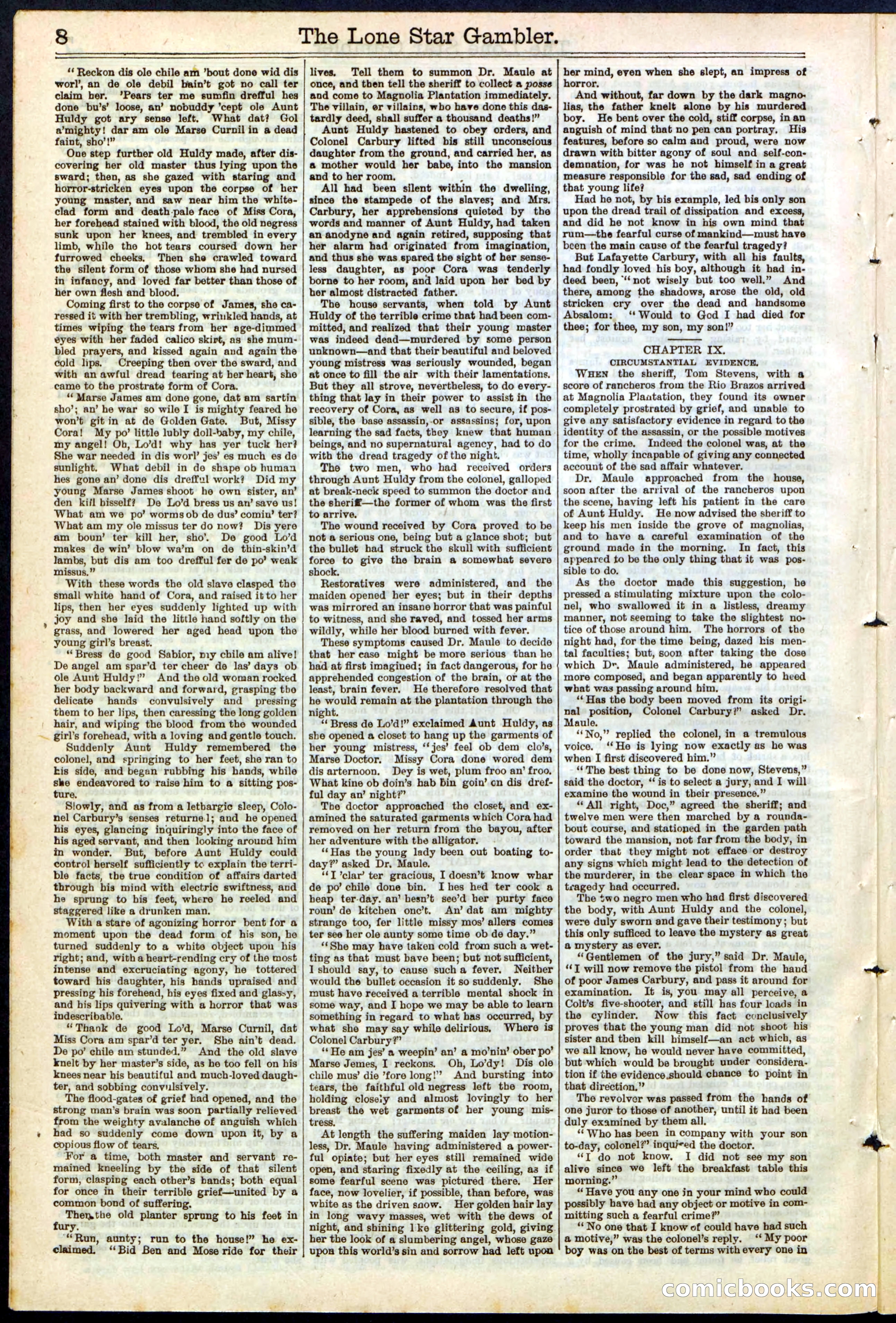
A restored page from Pulp Fiction, 1882. Page through the whole issue in the reader above.
📄 Transcribed text from this page (OCR, searchable)
Machine-transcribed from the original scan — historical spelling and the odd misread are preserved.
; a oe —— 8 The Lone Star Gambler. ‘* Reckon dis ole chile am ’bout done wid dis worl’, an de ole debil bain’t got no call ter claim ber. ’Pears ter me sumfin drefful hes done bu’s’ loose, an’ nobuddy ’cept ole Aunt Huldy got ary sense left. What dat? Gol a’mighty! dar am ole Marse Curnil in a dead faint, sho’!” One step further old Huldy made, after dis- covering her old master thus lying upon the sward; then, as she gazed with staring and horror-stricken eyes upon the corpse of her young master, and saw near him the white- clad form and death-pale face of Miss Cora, her forehead stained with blood, the old negress sunk upon her knees, and trembled in every limb, while the hot tears coursed down her furrowed cheeks. Then she crawled toward the silent form of those whom she had nursed in infancy, and loved far better than those of her own flesh and blood. Coming first to the corpse of James, she ca- ressed it with her trembling, wrinkled hands, at times wiping the tears from her age-dimmed eyes with her faded calico skirt, as she mum- bled prayers, and kissed again and again the cold lips. Creeping then over the sward, and with an awful dread tearing at ber heart, she came to the prostrate form of Cora. **Marse James am done gone, dat am sartin sho’; an’ he war so wile I is mighty feared he won’t gitin at de Golden Gate. But, Missy Cora! My po’ little lubly doll-baby, my chile, my angel! Ob, Lo’d! why has yer tuck her? She war needed in dis worl’ jes’ es much es do sunlight. What debil in de shape ob human hes gone an’ done dis drefful work? Did my young Marse James shoot he own sister, an’ den kifl bisself? De Lo’d bress us an’ save us! What am we po’ wormsob de dus’ comin’ ter? What am my ole missus ter do now? Dis yere am boun’ ter kill her, sho’. De good Lo’d makes de win’ blow wa’m on de thin-skin’d lambs, but dis am too drefful fer de po’ weak missus.” With these words the old slave clasped the small white hand of Cora, and raised it to her lips, then her eyes suddenly lighted up with joy and she laid the little hand softly on the grass, and lowered her aged head upon the young girl’s breast. “Bress de good Sabior, my chile am alive! De angel am spar’d ter cheer de las’ days ob ole Aunt Huldy!” And the old woman rocked her body backward and forward, grasping tho delicate hands convulsively and pressing them to her lips, then caressing the long golden hair, and wiping the blood from the wounded girl’s forehead, with a loving and gentle touch. Suddenly Aunt Huldy remembered the colonel, and springing to her feet, she ran to kis side, and began rubbing his hands, while she endeavored to raise him to a sitting pos- ture. Slowly, and as from a letbargic sleep, Colo- nel Carbury’s senses returnel; and he opened his eyes, glancing inquiringly into the face of his aged servant, and then looking around him in wonder. But, before Aunt Huldy could control herself sufficiently tc explain the terri- ble facts, the true condition of affairs darted through bis mind with electric swiftness, and he sprung to his feet, where he reeled and staggered like a drunken man. With a stare of agonizing horror bent for a moment upon the dead form of his son, he turned suddenly to a white object upon his right; and, with a heart-rending cry of the most intense and excruciating agony, he tottered toward his daughter, his hands upraised and pressing his forehead, his eyes fixed and glassy, and his lips quivering with a horror that was indescribable. “Thank de good Lo’d, Marse Curnil, dat Miss Cora am spar’d ter yer. She ain’t dead. De po’ chile am stunded.” And the old slave knelt by her master’s side, as he too fell on his knees near his beautiful and much-loved daugh- ter, and sobbing convulsively. The flood-gates of grief had opened, and the strong man’s brain was soon partially relieved from the weighty avalanche of anguish which had so suddenly come down upon it, by a copious flow of tears. For a time, both master and servant re- mained kneeling by the side of that silent form, clasping each other’s bands; both equal for once in their terrible grief—united by a common bond of suffering. Then the old planter sprung to his feet in in Run, aunty; run to the house!” he ex- claimed. ‘Bid Ben and Mose ride for their lives, Tell them to summon Dr. Maule at once, and then tell the sheriff to collect a posse and come to Magnolia Plantation immediately. The villain, er villains, who have done this das- tardly deed, shall suffer a thousand deaths!” Aunt Huldy hastened to obey orders, and Colonel Carbury lifted his still unconscious daughter from the ground, and carried her, as a mother would her babe, into the mansion and to her room, : All had been silent within the dwelling, since the stampede of the slaves; and Mrs. Carbury, her apprebensions quieted by the words and manner of Aunt Huldy, had taken an anodyne and again retired, supposing that her alarm had originated from imagination, and thus she was spared the sigbt of her sense- less daughter, as poor Cora was tenderly borne to her room, and Jaid upon her bed by ber almost distracted father. The house servants, when told by Aunt Huldy of the terrible crime that had been com- mitted, and realized that their young master was indeed dead—murdered by some person unknown—and that their beautiful and beloved young mistress was seriously wounded, began at once to fill the air with their lamentations. But they all strove, nevertheless, to do every- thing that Jay in their power to assist in the recovery of Cora, as well as to secure, if pos- sible, the base assassin,-or assassins; for, upon learning the sad facts, they knew that human beings, and no supernatural agency, had to do with the dread tragedy of the night. The two men, who had received orders through Aunt Huldy from the colonel, galloped at break-neck speed to summon the doctor and the sherif—the former of whom was the first to arrive. The wound received by Cora proved to be not a serious one, being but a glance shot; but the bullet had struck the skull with sufficient force to give the brain a somewhat severe shock. Restoratives were administered, and the maiden opened her eyes; but in their depths was mirrored an insane horror that was painful to witness, and she raved, and tossed her arms wildly, while her blood burned with fever. These symptoms caused Dr. Maule to decide that her case might be more serious than he had at first imagined; in fact dangerous, for he apprehended congestion of the brain, or at the least, brain fever. He therefore resolved that he would remain at the plantation through the night. ‘‘ Bress de Lo’d!” exclaimed Aunt Huldy, as she opened a closet to hang up the garments of her young mistress, ‘jes’ feel ob dem clo’s, Marse Doctor. Missy Cora done wored dem dis arternoon. Dey is wet, plum froo an’ froo, What kine ob doin’s hab bin goin’ on dis dref- ful day an’ night?’ The doctor approached the closet, and ex- amined the saturated garments which Cora had removed on her return from the bayou, after her adventure with the alligator. ‘‘Has the young lady been out boating to- day?’ asked Dr, Maule. ‘*T ’clar’ ter gracious, I doesn’t know whar de po’ chile done bin. Ihes hed ter cook a heap ter-day. an’ besn’t seoe’d ber purty face roun’ de kitchen onc’t. An’ dat am mighty strange too, fer little missy mos’ allers comes ter see her ole aunty some time ob de day.” ‘She may have taken cold from such a wet- ting as that must bave been; but not sufficient, I should say, to cause such a fever. Neither would the bullet occasion it so suddenly. She must have received a terrible mental shock in some way, and I hope we may be able to learn something in regard to what has occurred, by what she may say while delirious, Where is Colonel Carbury?’ ‘‘He am jes’ a weepin’ an’ a mo’nin’ ober po’ Marse Jemes, I reckons. Oh, Lo’dy! Dis ole chile mus’ die ’fore long!’ And bursting into tears, the faithful old negress left the room, holding close:y and almost lovingly to her breast the wet garments of her young mis- tress. At length the suffering maiden lay motion- less, Dr. Maule having administered a power- ful opiate; but her eyes still remained wide open, and staring fixedly at the ceiling, aa if some fearful scene was pictured there. Her face, now lovelier, if possible, than before, was white as the driven saow. Her golden hair lay in long wavy masses, wet with the dews of night, and shining 1 ke glittering gold, giving her the look of a slumbering angel, whose gaze upon this world’s sin and sorrow had left upon her mind, eyen when she slept, an impress of horror. And without, far down by the dark magno- lias, the father knelt alone by his murdered boy. He bent over the cold, stiff corpse, in an anguish of mind that no pen can portray, His features, before so calm and proud, were now drawn with bitter agony of soul and self-con- demnation, for was he not himself in a great measure responsible for the sad, sad ending of that young life? Had he not, by bis example, led bis only son upon the dread trail of dissipation and excess, and did he not know in his own mind that rum—the fearful curse of mankind—wmust have been the main cause of the fearful tragedy? But Lafayette Carbury, with all his faults, had fondly loved his boy, although it had in- deed been, “‘not wisely but too well.” And there, among the shadows, arose the old, old stricken cry over the dead and handsome Absalom: ‘Would to God I had died for thee; for thee, my son, my son!” CHAPTER IX. CIRCUMSTANTIAL EVIDENCE, Wuen the sheriff, Tom Stevens, with a score of rancheros from the Rio Brazos arrived at Magnolia Plaatation, they found its owner completely prostrated by grief, and unable to give any satisfactory evidence in regard to the identity of the assassin, or the possible motives for the crime, Indeed the colonel was, at the time, wholly incapable of giving any connected account of the sad affair whatever. Dr. Maule approached from the house, soon after the arrival of the rancheros upon the scene, having left his patient in the care of Aunt Huldy. He now advised the sheriff to keep his men inside the grove of magnolias, and to have a careful examination of the ground made in the morning. In fact, this appeared to be the only thing that it was pos- sible to do. As the doctor made this suggestion, he pressed a stimulating mixture upon the colo- nel, who swallowed it in a listless, dreamy manner, not seeming to take the slightest no- tice of those around him. The horrors of the night had, for the time being, dazed kis men- tal faculties; but, soon after taking the dose which Dr. Maule administered, he appeared more composed, and began apparently to heed what was passing around him. ‘Has the body been moved from its origi- nal position, Colonel Carbury?” asked Dr. Maule. ‘‘No,” replied the colonel, in a tremulous voice. ‘‘He is lying now exactly as he was when I first discovered him.” ‘The best thing to be done now, Stevens,” said the doctor, “‘ is to select a jury, and I will examine the wound in their presence.” “All right, Doc,” agreed the sheriff; and twelve men were then marched by a rounda- bout course, and stationed in the garden path toward the mansion, not far from the body, in order that they migbt not efface or destroy any signs which might lead to the detection of the murderer, in the clear space in which the tragedy had occurred. The ¢wo negro men who had first discovered the body, with Aunt Huldy and the colonel, were duly sworn and gave their testimony; but this only sufficed to leave the mystery as great a mystery as ever. “Gentlemen of the jury,” said Dr. Maule, ‘‘T will now remove the pistol from the hand of poor James Carbury, and pass it around for examination. It is, you may all perceive, a Colt’s five-shooter, and still has four loads in the cylinder. Now this fact conclusively proves that the young man did not shoot his sister and then kill bimself—an act which, as we all know, he would never have committed, but which would be brought under considera- tion if the evidence.should chance to point in that direction.” The revolver was passed from the hands of one juror to those of another, until it had been duly examined by them all. ‘“ Who has been in company with your son to-day, colonel?” inquied the doctor. “TI do not know. I did not see my son alive since we left the breakfast table this morning.” “ Have you any one jn your mind who could possibly have had any object or motive in com- mitting such a fearful crime?’ ‘No one that I know of could have had such a motive,” was the colonel’s reply. ‘‘ My poor boy was on the best of terms with every one in Eomicboo S (E(0) < ' ' ' i]