
Pulp Fiction, 1882 · page 3 of 28
Beadle's New York Dime Library, No. 195 — page 3: what you’re looking at
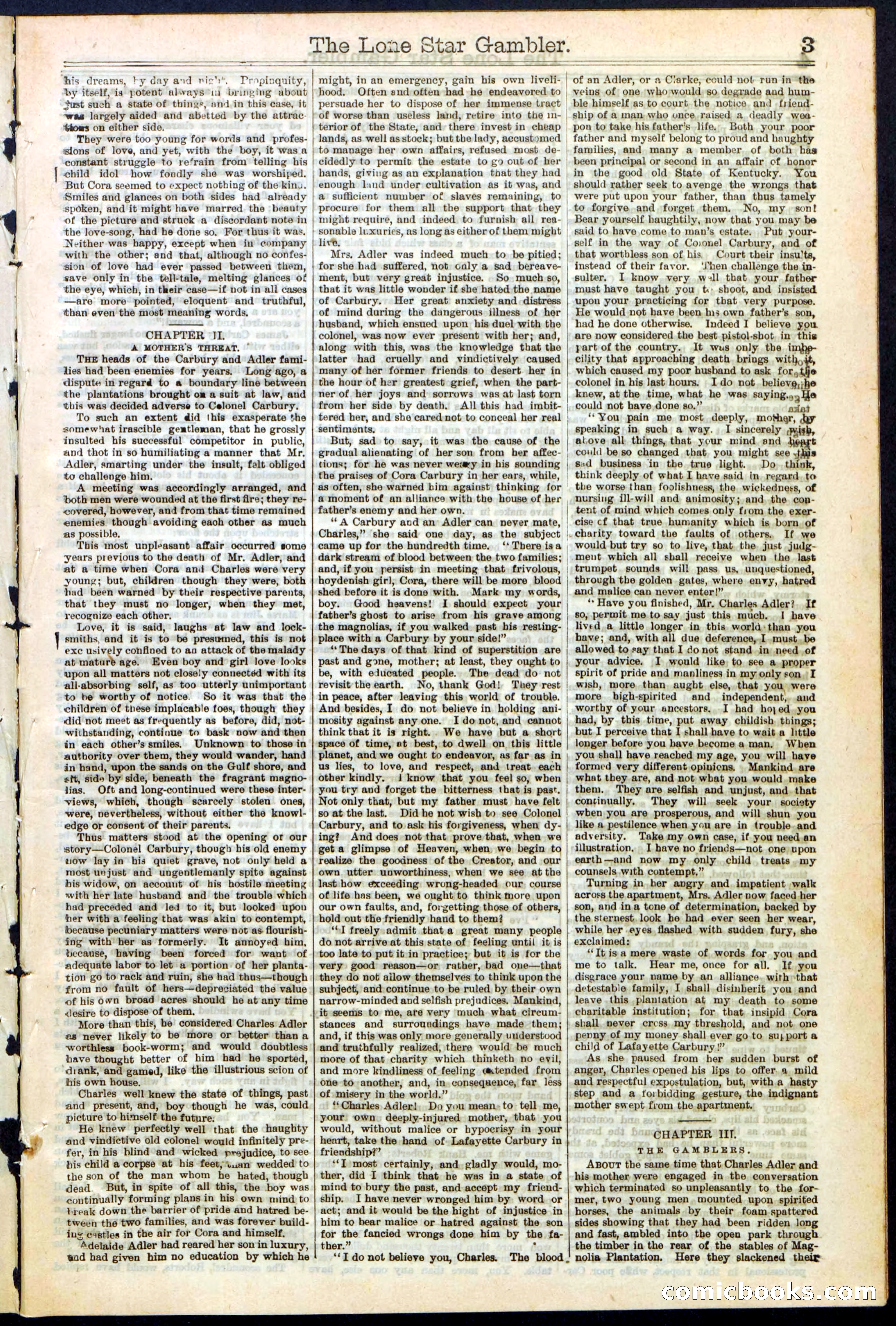
A restored page from Pulp Fiction, 1882. Page through the whole issue in the reader above.
📄 Transcribed text from this page (OCR, searchable)
Machine-transcribed from the original scan — historical spelling and the odd misread are preserved.
—s —_ ‘his dreams, by day and nic’. — —— Propingnity, by itself, is potent always ‘iu bringing about sust such a state of things, and in this case, it wes largely aided and abetted by the attrac. taows on either side. They were too young for words and profes- sions of love, and yet, with the boy, it wasa constant struggle to refrain from telling his child idol how fondly she was worshiped. But Cora seemed to expect nothing of the kinu. Smiles and glances on both sides had already spoken, and it might have marred the beauty of the picture and struck a discordant note in the love-song, had he done so, For thus it was, Neither was happy, except when in company with the other; and that, although no confes- sion of love had ever passed between them, save only in the tell-tale, melting glances of the eye, which, in their case—if not in all cases —are more pointed, eloquent and truthful, than even the most meaning words, CHAPTER JI. A MOTHER'S THREAT. © THE heads of the Carbury and Adler fami- lies had been enemies for years. Long ago, a dispute in regard to a boundary line between the plantations brought om a suit at law, and this was decided adverse to Celonel Carbury. To such an extent did this exasperate the somewhat irascible geutleman, that he grossly insulted his successful competitor in public, and thot in so humiliating a manner that Mr. Adler, smarting under the insult, felt obliged to challenge him. A meeting was accordingly arranged, and both men were wounded at the first fire; they re- covered, however, and from that time remained enemies though avoiding eaoh other as much as possible, This most unpleasant affair occurred some ‘years previous to the death of Mr. Adler, and at a time when Cora anid Charles were very young; but, children though they were, both had been warned by their respective parents, that they must no longer, when they met, recognize each other. Love, it is said, laughs at law and lock- smiths, and it is to be presumed, this is not exc usively confined to ao attack of the malady at maturt age. Even boy and girl love looks upon all matters not closely connectéd with its all-absorbing self, as too utterly unimportant to be worthy of notice. So it was that the children of these implacable foes, though they did not meet as frequently as before, did, not- withstanding, continue to bask now and then in each other’s smiles. Unknown to those in authority over them, they would wander, hand in hand, upon the sands on the Gulf shore, and sit, side by side, beneath the fragrant magno- lias, Oft and long-continued were these inter- views, which, though scarcely stolen ones, ‘were, nevertheless, without either the knowl- edge or consent of their parents. Thus matters stood at the opening or our story—Colonel Carbury, though his old enemy wow lay in his quiet grave, not only held a most unjust and ungentlemanly spite against his widow, on accouut of his hostile meeting with her late husband and the trouble which had preceded and led to it, but looked upon her with a feeling that was akin to contempt, because pecuniary matters were not as flourish- ing with her as formerly. It annoyed him, because, having been forced for want of adequate labor to let a portion of her planta- tion go to rack and ruin, she had thus—though from no fault of hers—depreciated the value of his own broad acres should he at any time desire to dispose of them. More than this, be considered Charles Adler es never likely to be more or better than a worthless book-worm; and would doubtless have thought better of him had he sported, drank, and gamed, like the illustrious scion of his own house. Charles well knew the state of things, past and present, and, boy though he was, could picture to himself the future; He knew perfectly well that the haughty and vindictive old colonel would infinitely pre- fer, in his blind and wicked prejudice, to see his child a corpse at his feet; vuan wedded to the son of the man whom he hated, though dead. But, in spite of all this, the boy was continually forming plans in his own mind to ttreak down the barrier of pride and hatred be- tween the two families, and was forever build- ing ¢4etles in the air for Cora and himself, Adelaide Adler had reared her son in luxury, wod had given him no education by which he might, in an emergency, gain bis own liveli- hood. persuade her to dispose of her immense tract of worse than useless land, retire into the in- lands, as well as stock; but the lady, accustomed The Lone Star Gambler. Often end often bad he endeavored to. a — of an Adler, or a Clarke, could not run in “the veins of one who would so degrade and hum- ble himself as to court. the notice. and friend- ship of a man who once, raised a deadly .wea- terior of the State, and there invest in cheap to manage her own affairs, refused most de- | cidedly to permit the estate to go out of ber hands, giving as an explanation that they had enough land under cultivation as it was, and a sufficient number of slaves remaining, to | procure for them all the support that they might require, and indeed to furnish all rea- sonable luxuries, as long as either of them might live. Mrs, Adler was indeed much to. be pitied; for she had suffered, not caly a sad bereave- ment, but very great injustice. So much so, that it was little wonder if she hated the name of Carbury. Her great anxiety and. distress of mind during the dangerous illness of her husband, which ensued upon his duel with the colonel, was now ever present with her; and, along with this, was the knowledge that the latter had cruelly and vindictively caused many of her former friends to desert her in the hour of her greatest grief, when the part- ner of her joys and sorrows was at last torn from her side by death. All this had imbit- tered her, and she cared not to conceal her real sentiments, But, sad to say, it was the cause of the gradual alienating of her son from her affec- tions; for he was never weary in his sounding the praises of Cora Carbury in her ears, while, as often, she warned bim against thinking for a moment of an alliance with the house of her father’s enemy and her own. ‘‘A Carbury aod an’ Adler can never mate, Charles,” she said one day, as the subject came up for the hundredth time. ‘* There isa dark stream of blood between the two families; pon to take his father’s life. . Both your poor father and myself belong to proud and haughty families, and many a member of both has been principal or second in an affair of bonor in the good old State of Kentucky. You should rather seek to avenge the wrongs that were put upon your father, than thus tamely to forgive and forget them. No, my son! Bear yourself haughtily, now that you may be said to have come to man’s estate. Put your- _self in the way of Coionel Carbury, and of that wortbless son of his, Court their insu!ts, instead of their favor. ‘Then challenge the in- sulter, I know very well that your father must have taught you t: shoot, and insisted upon your practicing for tbat very purpose. He would not bave been hs; own father’s son, had he done otherwise. Indeed I believe you are now considered the best pistol-sbot. in this part of the country. It wus only the imbp- cility that approaching death brings with,4 which caused my poor husband to ask tor the colonel in his last hours. Ido not_believg,; knew, at the time, what he was ee could not have done so,” slat “You pain me most deeply, mother, dy speaking in such a way. I sincerely qyisb, alove all things, that your mind and could be so changed that. you might see his sd business in the true light. Do think, think deeply of what I have said in regard. to the worse than foolishness, the wickedness, of nursing ill-will and animosity; and the con- tent of mind which comes only f1om the exer- cise cf that true humanity which is born, of Charity toward the faults of others. If we and, if you persist in meeting that frivolous, | hoydenish girl, Cora, there will be more blood shed before it is dons with. Mark my words, boy. Good heavens! I should expect your father’s ghost to arise from his grave among the magnolias, if you walked past his resting- place with a Carbury by your side!” “The days of that kind of superstition are past and gone, mother; at least, they ought to be, with educated people. The dead do not revisit the earth. No, thank God! They rest in peace, after leaving this world of trouble. And besides, I do not believe in holding ani- mosity against any one. I donot, and cannot think that it is right.. We have but a short space of time, at best, to dwell on this little planet, and we ought to endeavor, as far as in us lies, to love, and respect, and treat. each other kindly. i know that you feel so, when you try and forget the bitterness that is past, Not only that, but my father must have felt so at the last. Did he not wish to see Colonel Carbury, and to ask his forgiveness, when dy- ing? And does not that prove that, when we get a glimpse of Heaven, when we begin to realize the goodness of the Creator, and our own utter unworthiness, when we see at the last how exceeding wrong-headed our course of life has been, we ought to think more upon our own faults, and, forgetting those of others, hold out the friendly hand to them? ‘“T freely admit that a great many people do not arrive at this state of feeling until it is too late to put it in practice; but it is for the very good reason—or rather, bad one—that they do not allow themselves to think upon the subject, and continue to be ruled by their own narrow-minded and selfish prejudices, Mankind, it seems to me, are very much what circum- stances and surroundings have made them; and, if this was only more generally understood and truthfully realized, there would be much more of that charity which thinketh no eyil, and more kindliness of feeling @tended from one to another, and, in consequence, far less of misery in the world.” **Charles Adler!, Do you mean, to tell me, your own deeply-injured mother, that you would, without malice or hypocrisy in your heart, take the hand of. Lafayette Carbury in friendship?” ‘*T most certainly, and gladly would, mo- ther, did I think that he was in a state of mind to bury the past, and accept my friend- ship. I have never wronged him by word or act; and it would be the hight of injustice in him to bear malice or hatred against the son for the fancied wrongs done him by the fa- ther.” **I do not believe you, Charles. The blood would but try so to live, that the just judg- ment which all sball receive when the last trumpet sounds will pass us, unquestioned, through the golden gates, where envy, hatred and malice can never enter!” , ‘Have you finished, Mr. Charles Adler? If 80, permit me to say just this much. I have lived a little longer in this world: than you have; and, with all due deference,.I must. be allowed to say that I donot stand in need of your advice. I would like to see a proper spirit of pride and manliness in my only son, I wish, more than augbt else, that you were more high-spirited and _ independent, and worthy of your ancestors, I had hoyed.you had, by this time, put away childish things; but I perceive that I shall have to wait a little longer before you bave become a man. When you shall have reached my age, you will haye formed very different opinicns. Mankind. are what they are, and not what you would make them. They are selfish and unjust, and. that continually, They will seek your socisty when you are prosperous, and will shun you like a pestilence when you are in trouble and adversity. Take my own case, if you need an illustration, I have no friends—not one upon earth—and now my only child treats. my counsels with contempt,” | Turning in her angry and impatient walk across the apartment, Mrs. Adler now faced her son, and ina tone of determination, backed by the sternest. look he had ever seen her wear, while her eyes flashed with sudden fury, she exclaimed: " “Tt isa mere waste of words for you and me to talk. Hear me, once for all. If you disgrace your name by an alliance. with that detestable family, I shall disinberit you and leave this plantation at my death to some cbaritable institution; for that insipid Cora shall never cress my threshold, and not. one penny of my money shall ever go to su, port a child of Lafayette Carbury !” As she paused from her sudden burst of anger, Charles opened bis lips to offer. a mild and respectful expostulation, but, with a hasty step and a forbidding gesture, the indignant mother swept from the apartment, ie CHAPTER IIT. THE GAMBLERS, Axovut the same time that Charles Adler and his mother were engaged in the conversation which terminated so unpleasantly to the for- mer, two young men mounted upon spirited horses, the animals by their foam spattered sides showing that they had been ridden lang and fast, ambled into the open park throug the timber in the rear of the stables of Mag- nolia Plantation. Here they slackened their (ENNIO KS (C (E(0)