
Pulp Fiction, 1882 · page 2 of 28
Beadle's New York Dime Library, No. 195 — page 2: what you’re looking at
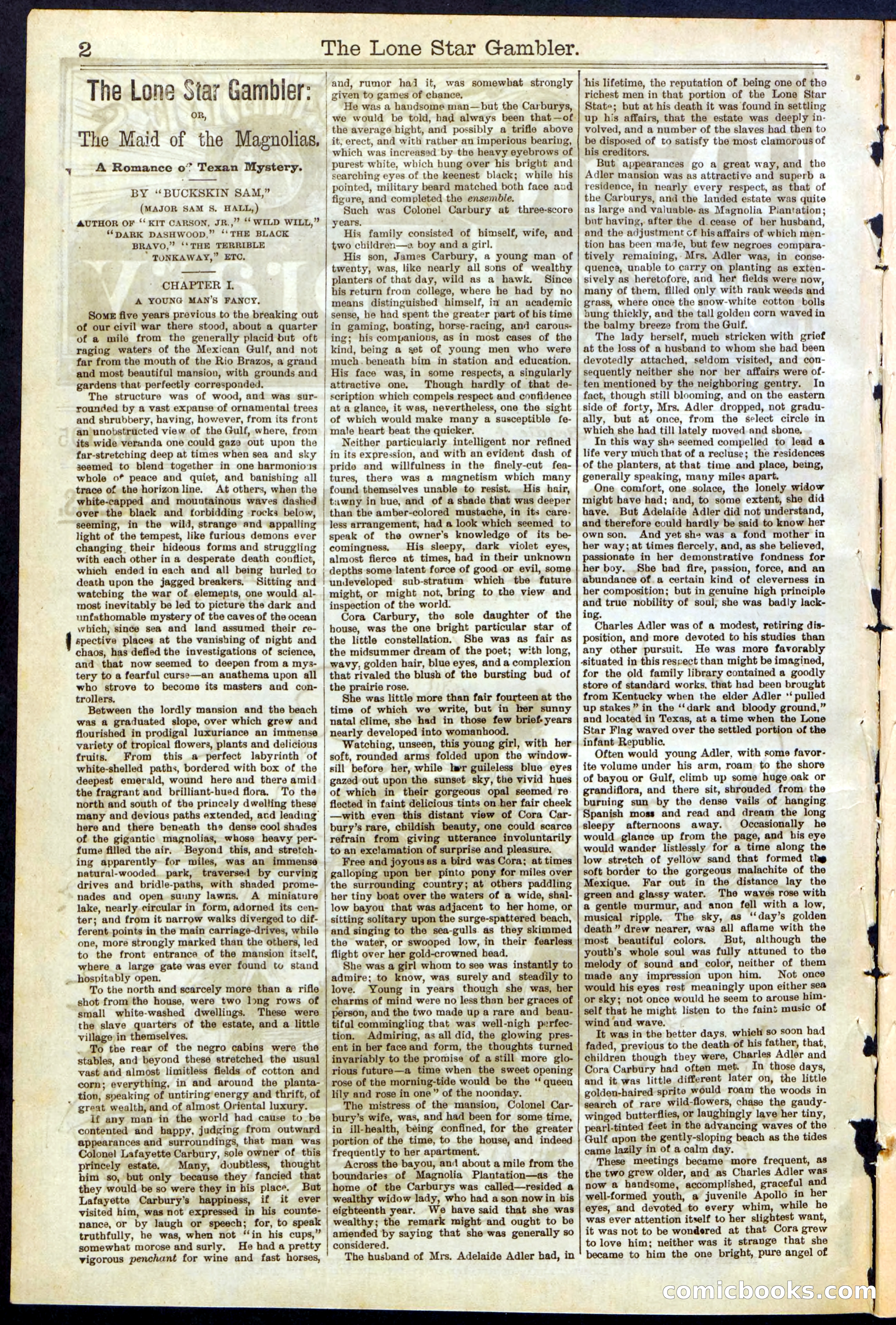
A restored page from Pulp Fiction, 1882. Page through the whole issue in the reader above.
📄 Transcribed text from this page (OCR, searchable)
Machine-transcribed from the original scan — historical spelling and the odd misread are preserved.
2 The Lone Star Gambler: OR, The Maid of the Magnolias, | A Romance o*” Texan Mystery. BY “BUCKSKIN SAM,” (MAJOR SAM 8S. HALL,) AUTHOR OF ‘‘ KIT CARSON, JR.,’’ ‘* WILD WILL,” “DARK DASHWOOD,” ‘‘ THE BLACK BRAVO,” ‘*THE TERRIBLE TUNKAWAY,” ETC, CHAPTER I. A YOUNG MAN’S FANCY. Some five years previous to the breaking out of our civil war there stood, about a quarter of a mile from the generally placid but oft raging waters of the Mexican Gulf, and not far from the mouth of the Rio Brazos, a grand and most beautiful mansion, with grounds and gardens that perfectly corresponded. The structure was of wood, and was sur- rounded by a vast expanse of ornamental trees and shrubbery, having, however, from its front an unobstructed view of the Gulf, where, from its wide veranda one could gaze out upon the | far-stretching deep at times when sea and sky 3eemed to blend together in one harmonious | whole of peace and quiet, and banishing all trace of the horizonline. At others, when the | white-capped and mountainous waves dashed over the black and torbidding rocks below, | seeming, in the wild, strange and appalling | light of the tempest, like furious demons ever changing their hideous forms and struggling | with each other in a desperate death conflict, | which ended in each and all being hurled to | death upon the jagged breakers, Sitting and | watching the war of elements, one would al- most inevitably be led to picture the dark and unfathomable mystery of the caves of the ocean which, since sea and land assumed their re- spective places at the vanishing of night and chaos, has defied the investigations of science, and that now seemed to deepen from a mys- tery to a fearful curse—an anathema upon all who strove to become its masters and con- trollers, Between the lordly mansion and the beach was a graduated slope, over which grew and flourished in prodigal luxuriance an immense variety of tropical flowers, plants and delicious fruits. From this a perfect labyrinth of white-shelled paths, bordered with box of the deepest emerald, wound here and there amid the fragrant and brilliant-hued flora. To the north and south of the princely dwelling these many and devious paths extended, acd leading here and there beneath the dense cool shades of the gigantic magnolias, whose heavy per- fume filled the air. Beyond this, and stretch- ing apparently for miles, was an immense natural-wooded. park, traversed by curving drives and bridle-paths, with shaded prome- nades and open suuny lawns. A miniature lake, nearly circular in form, adorned its cen- ter; and from it narrow walks diverged to dif- ferent points in the main carriage-drives, while one, more strongly marked than the others, led to the front entrance of the mansion itself, where a large gate was ever found tow stand hospitably open. To the north and scarcely more than a rifle shot from the house, were two long rows of small white-washed dwellings. These were the slave quarters of the estate, and a little vil in themselves. _ To the rear of the negro cabins were the stables, and beyond these stretched the usual vast and almost limitless fields of cotton and corn; everything, in and around the planta-— tion, speaking of untiring’energy and thrift, of eee * great wealth, and of almost Oriental luxury. if any man in the world had cause to_be contented and bappy, judging from outward appearances and surroundings, that man was Colonel Lafayette Carbury, sole owner of this princely estate. Many, dvubtless, thought him so, but only because they fancied that they would be so were they in his place. But Lafayette Carbury’s happiness, if it ever visited him, was not expressed in his counte- nance, or by laugh or speech; for, to speak truthfully, he was, when not “in his cups,” somewhat morose and surly. He had a pretty vigorous penchant for wine and fast horses, The Lone Star Gambler. and, rumor had it, was somewhat strongly given to games of chance, He was a handsome man—but the Carburys, we would be told, had always been that—of the average hight, and possibly a trifle above it, erect, and with ratber an imperious bearing, which was increased by the heavy eyebrows of purest white, which bung over his bright and ' searching eyes of the keenest black; while his pointed, military beard matched both face aud figure, and completed the ensemble. Such was Colonel Carbury at three-score years. His family consisted of himself, wife, and two children—e boy and a girl. His son, James Carbury, a young man of twenty, was, like nearly all sons of wealthy planters of that day, wild as a hawk. Since his return from college, where he had by no means distinguished himself, ia an academic sense, he had spent the greater part of his time in gaming, boating, horse-racing, and carous- ing; his companions, as in most cases of the | kind, being a set of young men who were much. beneath him in station and education. His face was, in some respects, a singularly attractive one. Though hardly of that de- scription which compels respect and confidence at a glance, it was, nevertheless, one the sight _of which would make many a susceptible fe- male heart beat the quicker. Neither particularly intelligent nor refined | in its expression, and with an evident dash of pride and willfulness in the finely-cut fea- ‘tures, there was a magnetism which many found themselves unable to resist. .His bair, tuwny in bue, and of a shade that was deeper than the amber-colored mustache, in its care- less arrangement, had a look which seemed to speak of the owner's knowledge of its be- comingness. His sleepy, dark violet eyes, almost fierce at times, had in their unknown depths some latent force of good or evil, some undeveloped sub-stratum which the future might, or might not, bring to the view and inspection of the world. Cora Carbury, the sole daughter of the house, was the one bright particular star of the little constellation. Sbe was as fair as the midsummer dream of the poet; with long, wavy, golden hair, blue eyes, and a complexion that rivaled the blush of the bursting bud of the prairie rose. She was little more than fair fourteen at the time of which we write, but in her sunny natal clime, she had in those few brief- years nearly developed into womanhood. Watching, unseen, this young girl, with her soft, rounded arms folded upon the window- sill before her, while lwr guileless blue eyes gazed out upon the sunset sky, the vivid hues ot which in their gorgeous opal seemed re flected in faint delicious tints on her fair cheek —with even this distant view of Cora Car- bury’s rare, childish beauty, one could scarce refrain from giving utterance involuntarily to an exclamation of surprise and pleasure. oyous as a bird was Cora; at times on ber pinto pony for miles over the surrounding country; at others paddling her tiny boat over the waters of a wide, shal- low bayou that was adjacent to her home, or sitting solitary upon the surge-spattered beach, and singing to the sea-gulls as they skimmed the water, or swooped low, in their fearless flight over her gold-crowned head. She was a girl whom to see was instantly to admire; to know, was surely and steadily to love. Young in years though she was, ber charms of mind were no less than ber graces of person, and the two made up a rare and beau- tiful commingling that was well-nigh perfec- tion. Admiring, as all did, the glowing pres- ent in ber face and form, the thoughts turned invariably to the promise of a still more glo- rious future—a time when the sweet opening rose of the morning-tide would be the ‘‘ queen lily and rose in one” of the noonday. The mistress of the mansion, Colonel Car- bury’s wife, was, and had been for some time, in ill-health, being confined, for the greater portion of the time, to the house, and indeed frequently to her apartment. Across the bayou, and about a mile from the boundaries of Magnolia Plantation—as the home of the Carburys was called—resided a wealthy widow lady, who had ason now in bis eighteenth year. We have said that she was wealthy; the remark might and ought to be amended by saying that she was generally so considered. The husband of Mrs. Adelaide Adler bad, in his lifetime, the reputation of being one of tho richest men in that portion of the Lone Star State; but at his death it was found in settling up his affairs, that the estate was deeply in- volved, and a number of the slaves had then to be disposed of to satisfy the most clamorous of his creditors. But appearances go a great way, and the Adler mansion was as attractive and superb a residence, in nearly every respect, as that of the Carburys, and the landed estate was quite as large and valuable: as Magnolia Piantation; but having, after the d.cease of her husband, and the adjustment cf his affairs of which men- tion has been made, but few negroes compara- tively remaining, Mrs, Adler was, in conse- quence, unable to carry on planting as exten- sively as heretofore, and her fields were now, many of them, filled only with rank weeds and grass, where once the snow-white cotton bolls bung thickly, and the tall golden corn waved in the balmy breeze from the Gulf. The lady herself, much stricken with grief at the loss of a husband to whom she bad been devotedly attached, seldom visited, and con- sequently neither she nor ber affairs were of- ten mentioned by the neighboring gentry. In fact, though still blooming, and on the eastern side of forty, Mrs. Adler dropped, not gradu- ally, but at once, from the select circle in which she had till lately moved and shone, In this way she seemed compelled to lead a life very much that of a recluse; the residences of the planters, at that time and place, being, generally speaking, many miles apart. One comfort, one solace, the lonely widow might bave had; and, to some extent, she did have. But Adelaide Adler did not understand, and therefore could hardly be said to know her own son, And yet she was a fond mother in her way; at times flercely, and, as she believed, passionate in her demonstrative fondness for her boy. She bad fire, passion, force, and an abundance of a certain kind of cleverness in her composition; but in genuine high principle and true nobility of soul, she was badly lack- ing. Charles Adler was of a modest, retiring dis- position, and more devoted to his studies than any other pursuit. He was more favorably situated in this resvect than might be imagined, for the old family library contained a goodly store of standard works, that had been brought from Kentucky when the elder Adler * pulled up stakes” in the ‘‘dark and bloody ground,” and located in Texas, at a time when the Lone Star Flag waved over the settled portion of the infant Republic. Often would young Adler, with some favor- ite volume under his arm, roam to the shore of bayou or Gulf, climb up some huge oak or grandiflora, and there sit, shrouded from the burning sun by the dense vails of hanging Spanish moss and read and dream the long sleepy afternoons away. Occasionally he would glance up from the page, and his eye would wander listlessly for a time along the low stretch of yellow sand that formed tl» soft border to the gorgeous malachite of the Mexique. Far out in the distance lay the green and glassy water. The waves rose with a gentle murmur, and anon fell with a low, musical ripple. The sky, as ‘‘day’s golden death” drew nearer, was all aflame with the most beautiful colors. But, although the youth’s whole soul was fully attuned to the melody of sound and color, neither of them made any impression upon him. Not once would his eyes rest meaningly upon either sea or sky; not once would he seem to arouse him- self that he might listen to the faint music of wind and wave. It was in the better days, whieli so soon had faded, previous to the death of his father, that, children though they were, Charles Adler and Cora Carbury had often met. In those days, and it. was little different later on, the little golden-haired sprite would roam the woods in search of rare wild-flowers, chase the gaudy- winged butterflies, or laughingly lave her tiny, pearl-tinted feet in the advancing waves of the | Gulf apon the gently-sloping beach as the tides came lazily in of a calm day. These meetings became more frequent, as the two grew older, and as Charles Adler was now @ handsome, accomplished, graceful well-formed youth, a juvenile Apollo in her eyes, and devoted to every whim, while he was ever attention itself to her slightest want, it was not to be wondered at that Cora grew to love him: neither was it strange that she became to him the one bright, pure angel of Gomicboo (E cS Re tain (Glo) Sa a .