
Pulp Fiction, 1881 · page 2 of 24
Beadle's New York Dime Library, No. 156 — page 2: what you’re looking at
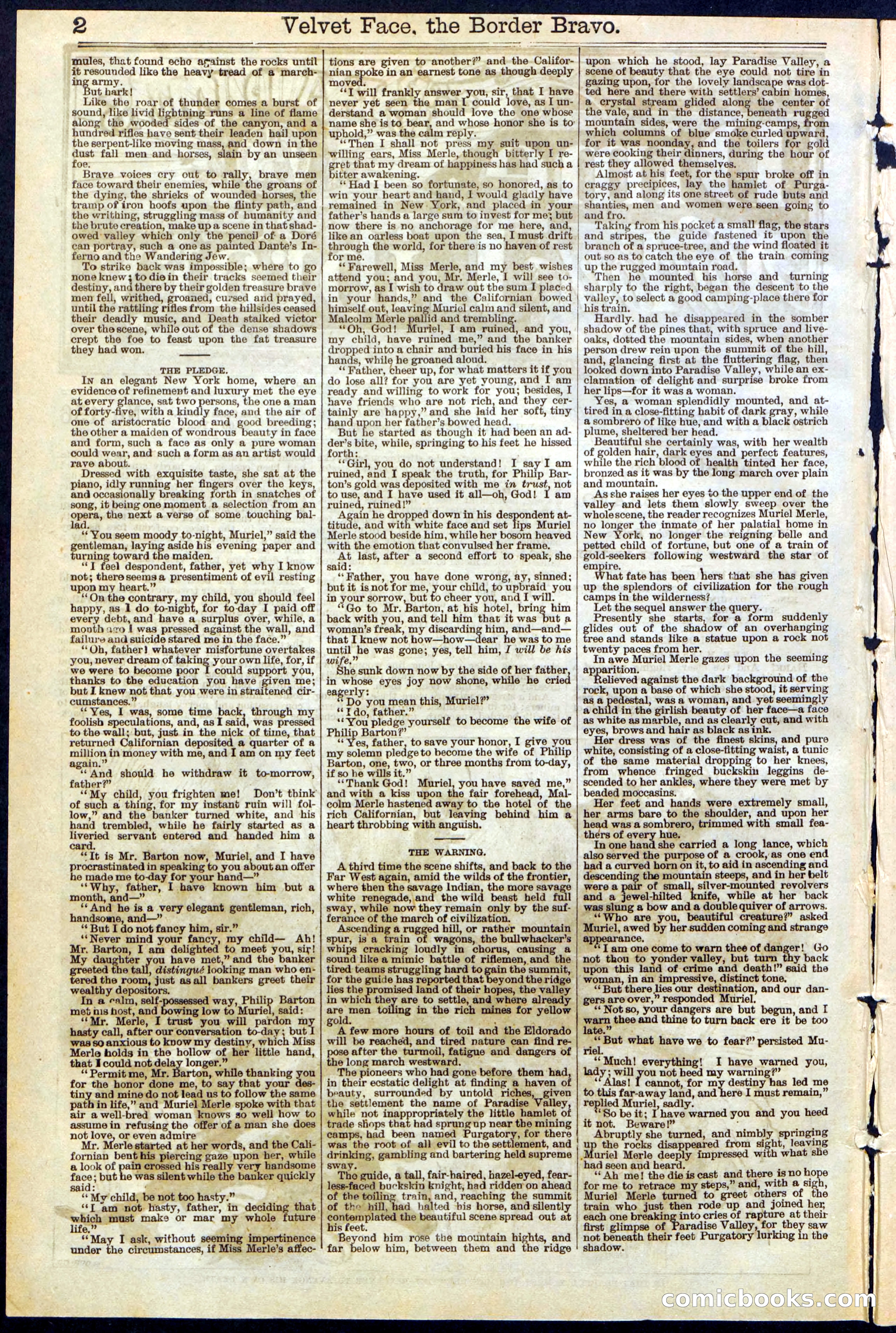
A restored page from Pulp Fiction, 1881. Page through the whole issue in the reader above.
📄 Transcribed text from this page (OCR, searchable)
Machine-transcribed from the original scan — historical spelling and the odd misread are preserved.
oe 2 ing army. . But hark! Like the roar of thunder comes a burst of | never yet seen the man I could Velvet Face, the B mules, that found echo apainst the rocks until} tions are given to-another?” and. the-Califor- it resounded like the heavy»tread of a march- nian spoke in an earnest tone as though deeply moved. ‘*T will frankly answer you, sir, that I have love, as I un- sound, like livid lightning runs a line of flame | derstand a woman should love the one whose along the woode the serpent-like moving mass, and down in the pont fall men and horses, slain oe. Brave voices cry out to rally, face toward their enemies, while the groans of the dying, the shrieks of wounded horses, the sides of the canyon, and a | name she is to bear, and whose honor she is to hundred rifles have sent their leaden hail upon | uphold,” was the cal m reply. nt . “Then I shall not press my suit upon un- by an unseen | willing ears, Miss Merle, though bitterly I re- et that my dream of happiness has had such a brave men bitter awakening. ‘‘Had I been so fortunate, so honored, as to win your heart and hand, I would gladly have tramp of iron hoofs upon the flinty path, and | remained in New York, and placed in your the writhing, struggling mass of humanity and the brute creation, make up a scene in that shad- owed valley which only the penci) of a Doré can portray, such a one as painted Dante’s In- ferno and the Wandering Jew. To strike back was impossible; where to go none knew; todiein their tracks seemed their destiny, and there by their golden treasure brave men fell, writhed, groaned, cursed and prayed, until the rattling rifles from the hillsides ceased their deadly music, and Death stalked victor over thescene, while out of the dense shadows crept the foe to feast upon the fat treasure they had won. THE PLEDGE. In an elegant New York home, where an evidence of refinement and luxury met the eye at every glance, sat two persons, the one a man of forty-five, with a kindly face, and the air of one of aristocratic blood and good breeding; the other a maiden of Sondrctl Det! y in face and form, such a face as only a pure woman could wear, and such a form as an artist would rave about. Dressed with exquisite taste, she sat at the piano, idly running her fingers over the keys, and occasionally breaking forth in snatches of song, it being one moment a selection from an pn the next a verse of some touching bal- “You seem moody to-night, Muriel,” said the ; gent omens laying aside his evening paper and Tape toward the maiden. ‘“‘T feel despondent, father, yet why I know not; there seemsa presentiment of evil resting upon my heart.” “On the contrary, a child, you should feel happy, as I do to-night, for to-day I paid off every debt, and have a surplus over, while, a month avo I was pressed against the wall, and failure ana suicide stared me in the face.” ‘Oh, father! whatever misfortune overtakes you, never dream of taking your own life, for, if we were to become poor I could support you, thanks to the education you have given me; but I knew not that you were in straitened cir- cumstances.” “Yes, I was, some time back, through my foolish speculations, and, as I said, was pressed to the wall; but, just in the nick of time, that returned Californian deposited a quarter of a million in money with me, and I am on my feet ” ain. ‘And should he withdraw it to-morrow, father?” ‘‘My child, you frighten me! Don’t think of such a thing, for my instant ruin will fol- low,” and the banker turned white, and his hand trembled, while he fairly started as a liveried servant entered and ded him a card, : “Tt is Mr. Barton now, Muriel, and I have procrastinated in speaking to you aboutan offer | A third time the scene shifts, and back to the he made me ly for your alt Far West agein, amid the wilds of the frontier, ‘‘Why, father, I have known him but a | where then the savage Indian, the more sav month, and—” white renegade, and the wild beast held full ‘* And he is a very elegant gentleman, rich, | sway, while they remain only by the suf- ‘tut Tao not fancy him, sir.” eae cece Lik a eaanck paige ' But Ido no »y him, sir. t or ra mo " af aver mind your fancy, my child— Ah! is a of wagons, the bullwhacker’s | Mr. Barton, I am d d to meet you, sir! | ack in chorus, ca a My daughter you have met,” and the banker | sound like nets 3 riflemen, and the ed th the g rted that bey In G ly ‘ ¥ self-possessed ’ ' ch are to settle, and | , randori | ee tlie Yate in a, I you w. n gold. ne ‘et hasty call, a te our conversation t2-dny: but I | A few more hours of toil and the Eldorado was s0 anxious to know my v, which Miss | will be reached, and tired nature can find re- Merle holds in the hollow of her little hand, | pose after the turmoil, fatigue aud Oenigers of Ico ot dela : | the long march w r longer.” n, Vv 1@ me, to say that your des ot Teel i us to follow the same Mr. Merle started ath fornian bent his | ahoinate a look of pain erosse face; but ne we 3 si OF t while t anke} € rich Ly said: LA wee Be: pled eta “* My chi not too hasty.” Paes -« hasty, father, in d “May I ask, without nonieiae: teavertipanice under the circumstances, , Merle’s | ile ‘Yhahking you ¥ in life,” an iel Mer air a well-bred woman knows so well how to assume in refusing the offe! ofa man she does not loge, orevenadmire = —_ ew Se make or mar my whet: pare: father’s hands a large sum to invest for me; but now there is no anchorage for me here, and, like an oarless boat upon the sea, I must drift Syetugh the world, for there is no haven of rest or me. ‘Farewell, Miss Merle, and my best wishes attend you; and you, Mr, Merle, I will see to- morrow, as I wish to draw out the sum I placed | in your hands,” and the Californian bowed himself out, leaving Muriel calm and silent, and Malcolm Merle pall and trembling. “Oh, God! Muriel, I am ruined, and you, my child, have ruined me,” and the banker dropped into a chair and buried his face in his hands, while he groaned aloud. ‘Father, cheer up, for what matters it if you do lose all? for you are yet young, and I am ready and willing to work for you; besides, I have friends who are not rich, and they cer- tainly are happy,” and she laid her soft, tiny hand upon her father’s bowed head. But he started as though it had been an ad- eat bite, while, springing to his feet he hissed orth: ‘**Girl, you do not understand! I say I am ruined, and I speak the truth, for Philip Bar- ton’s gold was deposited with me in trust, not to use, and I have used it all—oh, God! 1 am ruined, ruined!” Again he pe down in his despondent at- titude, and with white face and set lips Muriel Merle stood beside him, while her bosom heaved with the emotion that convulsed her frame. ae last, after a second effort to speak, she said: ‘‘Wather, you have done wrong, ay, sinned; but it isnot for me, your child, to upbraid you in your sorrow, but to cheer you, and I will. “Go to Mr. Barton, at bis hotel, bring him back with you, and tell him that it was but a woman’s freak, my discarding him, and—and— that I knew not how—how—dear he was to me until he was gone; yes, tell him, J will be his wife, he sunk down now by the side of her father in whose eyes joy now shone, while he cri eagerly: : Do you mean this, Muriel?’ **¥ do, father.” ‘ ‘* You pledge yourself to become the wife of Philip Barton?’ ; ‘‘ Yes, father, to save your honor, I give you my solemn pledge to become the wife of Philip Barton, one, two, or three months from to-day, if so he wills it.” ‘Thank God! Muriel, you have saved me,” and with a kiss upon the fair forehead, Mal- colm Merle hastened away to the hotel of the rich Californian, but leaving behind him a heart throbbing with anguish. THE WARNING. The pioneers who had gone before them had in their ecstatic delight at finding a haven of beauty, surrounded by untold riches, given the settlement the name of P. Valley while not we alg pas oo the little hamlet of ‘trade shops that had sprung up near the mining camps, had been named Purgatory, for there was the root of all evil to the se , and gambling and bartering held supreme 6 guide, a tall, fair-haired, hazel-eyed, fear- s-faced buckskin knight, had riddem on ahead e to train, and, reaching the summit of the hil halted bis horse, and silently his feet te the beautiful scene spread out at s feet. aS gh ‘Beyond him rose the mountain hights, and far Solow him, between them and the ridge ee ‘yf ‘ | upon this order Bravo. upon which he stood, lay Paradise Valley, a scene of beauty that the eye could not tire in gazing upon, for the lovely landscape was dot- ted here and there with settlers’ cabin homes, a erystal stream glided along the center of the vale, and in the distance, beneath rugged mountain sides, were the mining-camps, Sah, which columns of blue smoke curled upward for it was noonday, and the toilers for gol were cooking their dinners, during the hour of rest they allowed themselves. . Almost at his feet, for the spur broke off in craggy precipices, lay the hamlet of Purga- tory, and along its one street of rude buts and shanties, men and women were seen going to and fro. Takiny from his pocket a small flag, the stars and stripes, the guide fastened it upon the branch of a spruce-tree, and the wind floated it out so as to catch the eye of the train. coming up the rugged mountain road, Then he mounted his horse and turning sharply to the right, began the descent to the valley, to select a good camping-place there for his train. Hardly. had he disappeared in the somber shadow of the pines that, with spruce and live- oaks, dotted the mountain sides, when another person drew rein upon the summit of the bill, and, glancing first at the fluttering flag, then looked down into Paradise Valley, while an ex- clamation of delight and surprise broke from her lips—for it was a woman. Yes, a woman splendidly mounted, and at- tired in a close-fitting habit of dark gray, while a sombrero of like hue, and with a black ostrich plume, sheltered her head. Beautiful she certainly was, with her wealth of golden hair, dark eyes and perfect features, while the rich blood of health tinted her face, bronzed as it was by the long march over plain and mountain. As she raises her eyes to the upper end of the valley and lets them slowly sweep over the wholescene, the reader recognizes Muriel Merle, no longer the inmate of her palatial home in New York, no longer the reigning belle and petted child of fortune, but one of a train of gold-seekers following westward the star of empire. hat fate has been hers that she has given up the splendors of civilization for the rough camps in the wilderness? Let the sequel answer the query. Presently she starts, for a form suddenly lides out of the shadow of an overhanging ree and stands like a statue upon a rock not twenty paces from her. } In awe Muriel Merle gazes upon the seeming apparition. Relieved inst the dark background of the rock, upon a of which she stood, it serving asa , was a woman, and yet seemingly a child in the girlish beauty of her face—a face as white as marble, and as clearly cut, and with eyes, brows and hair as black as ink. Her dress was of the finest skins, and pure white, consisting of a close-fitting waist, a tunic of the same material dropping to her knees, from whence fringed buckskin leggins de- scended to her ankles, where they were met by beaded moccasins. Her feet and hands were extremely small, her arms bare to the shoulder, and upon her wee was a sombrero, trimmed with small fea- thers of every hue, In one aan the carried a long lance, which also served the purpose of a crook, as one end a curved horn on it, to aid in ascending and ing the mountain steeps, and in her belt were a pair of small, silver-mounted revolvers and a jewel-hilted e, while at her back Was slung & bow and a double quiver of arrows. ae are you, beautiful creature?” asked Muriel, awed by her sudden coming and strange “T am one come to warn thee ot Gamger | Go y back { | not thou to yonder valley, but af land of Yana death Ant crime and death!” said the woman, in an impressive, distinct tone. ‘¢ But there lies our destination, and our dan- e , | gers are over,” responded Muriel. “‘ Not so, your dangers are but begun, and I ‘ thee and shine to turn back ero it ‘be too Mee “But what have we to fear?’ persisted Mu- riel. . ‘Much! everything! I have warned you, lady; will re not oad my Mean a ‘* Alas! I cannot, for my destiny has led me to this far-away land, and here I must remain,” replied Muriel, sadly. x So be it; I have warned you and you heed it not. Beware!” si Abruptly she turned, and nimbly springing up the rocks disappeared from sight, leaving uriel Merle deeply impressed with what she had seen and heard, “Ah me! the die is cast and there is no hope for me to retrace wy steps,” and, with a sigh, Muriel Merle turned to greet others of the train who just then rode up and joined her, each one wae gs: pew cries of rapture at their first glimpse of Paradise Valley, for they saw not beneath their feet Purgatory lurking ‘4 the shadow. . ln emt EOMIEDOOKS (6 (0) ————S al