
Pulp Fiction, 1881 · page 7 of 32
Beadle's Dime Library No. 152 — page 7: what you’re looking at
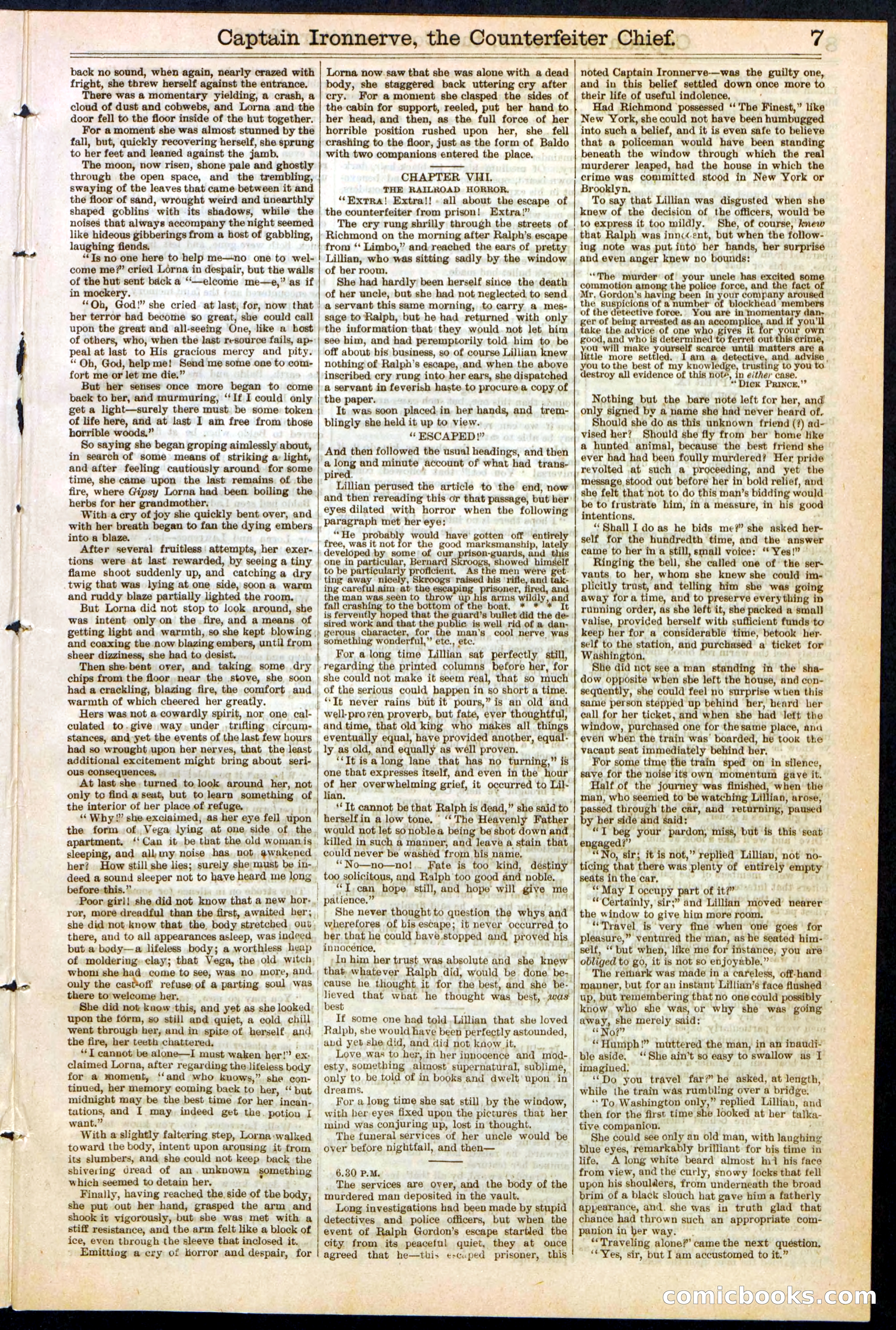
A restored page from Pulp Fiction, 1881. Page through the whole issue in the reader above.
📄 Transcribed text from this page (OCR, searchable)
Machine-transcribed from the original scan — historical spelling and the odd misread are preserved.
e Captain Ironnerve, the Counterfeiter Chief. back no sound, when again, nearly crazed with fright, she threw herself against the entrance. There was a momentary yielding, a crash, a cloud of dust and cobwebs, and Lorna and the door fell to the floor inside of the hut together. For a moment she was almost stunned by the fall, but, quickly recovering herself, she sprung to her feet and leaned against the jamb. The moon, now risen, shone pale and ghostly through the open space, and the trembling, swaying of the leaves that came between it and the floor of sand, wrought weird and unearthly shaped goblins with its shadows, while the noises that always accompany the night seemed like hideous gibberings from a host of gabbling, laughing fiends. “Ts no one here to help me—no one to wel- come me?’ cried Lorna in despair, but the walls of the hut sent back a “elcome me—e,” as if in mockery. ‘Oh, God!” she cried at last, for, now that her terror had become so great, she could call upon the great and all-seeing One, like a host of others, who, when the last resource fails, ap- peal at last to His gracious mercy and pity. “ Oh, God, help me! Send me some one to com- fort me or let me die.” But her senses once more began to come back to ber, and murmuring, “If I could only get a light—surely there must be some token of life here, and at last I am free from those horrible woods,” : So saying she began groping aimlessly about, in search of some means of striking a: light, and after feeling cautiously around for some time, she came upon the last: remains of the fire, where Gipsy Lorna had been boiling the herbs for her grandmother, With a cry of joy she quickly bent over, and with her breath began to fan the dying embers into a blaze. After several fruitless attempts, her exer- tions were at last rewarded, by seeing a tiny flame shoot suddenly up, and catching a dry twig that was lying at one side, soona warm and ruddy blaze partially lighted the room, But Lorna did not stop to look around, she was intent only on the fire, and a means of getting light and warmth, so she kept blowing | and coaxing the now blazing embers, until from sheer dizziness, she had to desist. Then she:bent over, and taking, some dry | chips from the floor near the stove, she soon | had a crackling, blazing fire, the comfort and warmth of which cheered her greatly. Hers was not a cowardly spirit, nor one cal- culated to.give way under trifling circum- stances, and yet the events of the last few hours | had so wrought upon ber nerves, that the least additional excitement might bring about seri- ous consequences, ! : At last she. turned to look around her, not only to find a seat, but to learn something of the interior of her place of refuge, ' “Why!” she exclaimed, as her eye fell upon | the form of Vega lying at one side of the. apartment. ‘‘Can it be that the old womanis sleeping, and allmy noise bas not. awakened her? How still she lies; surely she must be in-., deed a sound sleeper not to have heard me long before:this.”.. Poor girl! she,did not know that a new hor- | ror, more dreadful than the first, awaited her, , she did not know that the, body stretched out, there, and to all appearances asleep, was indeed but a body—a lifeless body; a worthless heap of moldering. clay; that Vega, the old witch, whoni she had come to see, was no more, and only the castoff refuse of a parting soul was there to welcome her, She did not know this, and yet as she looked upon the form, so still and quiet, a cold chill went through her, and im spite of herself. and the fire, her teeth chattered, : “I cannot be alone—I must waken her!” ex- claimed Lorna, after regarding the lifeless body for @ moment, ‘‘and who knows,” she con- tinued, her memory coming back to her, “ but midnight may be the best time for her incan- tations, and I may indeed get the. potion I want.” With a slightly faltering step, Lorna: walked toward the body, intent upon arousing it trom its slumbers, and she could not keep back the shivering dread of an. unknown something which seemed to detain her, Finally, having reached the, side of the body, she put out her hand, grasped the arm and shook it vigorously, but she was met with a stiff resistance, and the arm felt like a block of ice, even through the sleeve that inclosed it. Emittiog a cry of Korror and despair, for —————$—KLKKKKSKS a——-ueeeseseeeeeeese a Lorna now saw that she was alone with a dead body, she staggered back uttering cry after cry. For a moment she clasped the sides of the cabin for support, reeled, put her hand to her head, and then, as the full force of her horrible position rushed upon her, she. fell crashing to the floor, just as the form of Baldo with two companions entered the place. CHAPTER VHI. THE RAILROAD HORROR. ‘“‘Exrra! Extra!!. all about the escape of the counterfeiter from prison! Extra!” The cry rung shrilly through the streets of Richmond on the morning after Ralph’s escape from ** Limbo,” and reached the ears of pretty Lillian, who was sitting sadly by the window of her room. She had hardly been herself since the death of her uncle, but she had not neglected to send a servant this same morning, to carry a mes- sage to Ralph, but he had returned with only the information that they would. not let. him see him, and had peremptorily told him to be off about bis business, so of course Lillian knew nothing of Ralph’s escape, and when the above inscribed cry rung into her ears, she dispatched a servant in feverish haste to procure a copy of the paper. It was soon placed. in her hands, and trem- blingly she held it up to view. ‘‘ ESCAPED!” And then followed the usual headings, and then a long and minute account of what had trans- pired. Lillian perused the article to the end, now and then rereading this or that passage, but her eyes dilated with horror when the following paragraph met her eye: “He probably would have gotten off entirely free, was it not for the good marksmanship, lately developed by some of cur prison-guards, and 8 one in particular, Bernard 5 7s, Showed himéelf to be particularly proficient, As the men were get: ting away nicely, Skroogs raised his rifle, and - ing careful aim at the escaping soner, and the man was seen to throw up his arms wildly, and fall crashing to the bottom of the boat, * * * It is fervently ho that the guard’s bullet did the de- sired work and that the public is well rid of a dan- gerous Character, for the man’s cool nerve was something wonderful,” ete., etc. For along time Lillian sat perfectly still, regarding the printed columns before her, for she could not make it seem real, that so much of the serious could bappen in so short a time. “It never rains but it pours,” is an old and well-proven proverb, but fate, ever thoughtful, and time, that old king who makes all things eventually equal, have provided another, equal- ly as old, and equally as well proven. ‘‘It isa long lane that has no turning,” is one that expresses itself, and even in the hour of her overwhelming grief, it occurred to Lil- lian, ‘Tt cannot be that Ralph is dead,” she said to herselfin a low tone, ' “‘ The Heavenly Father would not let so noblea being be shot down and killed in such a manner, and leave a stain that could never be washéd from bis name. ‘““No—no—no!.. Fate is too kind, destiny too solicitous, and Ralph too good and noble. “T-can hope still, and hope’ will give me patience.” a She never thought to question the whys and wherefores of bis escape; it never occurred to her that he could bave stopped and proved his innocence, ‘In him her trust was absolute and she knew that, whatever Ralph did, would be done be- cause he thought it for the best, and she be- en that what he thought was best, .2vas est If some one had told. Lillian that she loved Ralph, she would have been perfectly astounded, apd yeb she did, and did not know it, : Love was to her, in her innocence and mod- esty, something almost supernatural, sublime, only to be told of in books and dwelt’ upon in dreams. For a long time she sat still, by the window, with ber eyes fixed upon the pictures that her mind was conjuring up, lost in thought. The funeral services of her uncle would be over before nightfall, and then— 6.80 P.M. iy _ The services are over, and the body of the murdered man deposited in the vault. ; Long investigations had been made by stupid detectives and police officers, but when the event of Ralph Gordon’s escape startled the city from its peaceful quiet, they at once agreed that he—this ¢-c«ped prisoner, this ee NN, ooo noted Captain Ironnerve-—was the guilty one, and in this belief settled down once more to their life of useful indolence, Had Richmond possessed ‘‘ The Finest,” like New York, she could not have been humbugged into such a belief, and it is even safe to believe that a policeman would have been standing beneath the window through which the real murderer leaped, had the house in which the crime was committed stood in New York or Brooklyn. To say that Lillian was disgusted when she knew of the decision of the officers, would be to express it too mildly. She, of course, knew that Ralph was inn«<ent, but when the follow- ing note was put into ber hands, her surprise and even anger knew no bounds: ‘The murder of your uncle has excited some commotion among the police force, and the fact of Mr, Gordon’s having been in your company aroused the suspicions of a number of blockhead members of the detective force. You are in momentary dan- ger of being arrested as an accomplice, and if you'll e the advice of one who gives it t good, and who is determined to ferret out ou will make yourself scarce until is crime, matters are a you tothe best of my knowledge destroy all evidence of this note, in either case, “Dick Prince,”’ Nothing but the bare note left for her, and only signed by a name she had never heard of. Should she do as this unknown friend (?) ad- vised her? Should she fly from ber home like a hunted animal, because the best friend she ever had had been foully murdered? Her pride revolted at such a proceeding, and yet the message stood out before her in bold relief, and be to frustrate him, in a measure, in his good intentions. “Shall I do as he bids me?’ she asked her- self for the hundredth time, and the answer came to her in a still, small voice: “Yes!” Ringing the bell, she called one of the ser- vants to her, whom she knew she could im- plicitly trast, and telling him she was going away fora time, and to preserve everything in running order, as she left it, she packed a small valise, provided berself with sufficient funds to keep her for a considerable time, betook her- self to the station, and purchased a ticket for Washington. : She did not see a man standing in the sha- dow opposite when she left the house, and con- sequently, she could feel no surprise when this same person stepped up behind her, heard her eall for her ticket, and when she had left the window, purchased one for the same place, and even when the train was boarded, he took the vacant seat immediately behind her. For some time the train sped on in silence, save for the noise its own momentum gave it. Half of the journey was finished, when the man, who seemed to be watching Lillian, arose, through the car, and returning, paused by her side and said: | but is this seat “T beg your pardon, miss, engaged?” Bese “No, sir; it is not,” replied Lillian, not no- seats in the car, *“ May I occupy part of it?” em the window to give him more room. . “Travel, is very fine when one goes for pleasure,” ventured the man, as he seated him- self, “but when, like me for instance, you are obliged to go, it is not so enjoyable.” ” know, who she was, or why she was going away, she merely said: ' " “No?” : imagined, ‘Do you travel far? he asked, at length, while the train was rumbling over a bridge. ‘To Washington only,” replied Lillian, and then for the first time she looked at her talka- tive companion. __ ' She could see only an old man, with laughing blue eyes, remarkably brilliant for bis time in life. A long white beard almost hii his face from view, and the curly, snowy locks that fell upon his shoulders, from underneath the broad brim of a black slouch hat gave him a fatherly appearance, and. she was in truth glad that chance had thrown such an appropriate com- panion in ber way. “Traveling alone?’ came the next quéstion, ‘“Yes, sir, but I am accustomed to it.” ; 7 or your Own - tle more settled. I am a detective, and advise . trusting to you to. she felt that not to do this man’s bidding would ticing that there was plenty of entirely empty — “Certainly, sir;” and Lillian moved’ neare The remark was made in a careless, off-hand manner, but for an instant Lillian’s face flushed ° up, but remembering that no one could possibly, “Humph!” muttered the man, in an inaudi- ble aside, ‘She ain’t so easy to swallow as I “com S Cc G JOO Or