
Pulp Fiction, 1881 · page 6 of 32
Beadle's Dime Library No. 152 — page 6: what you’re looking at
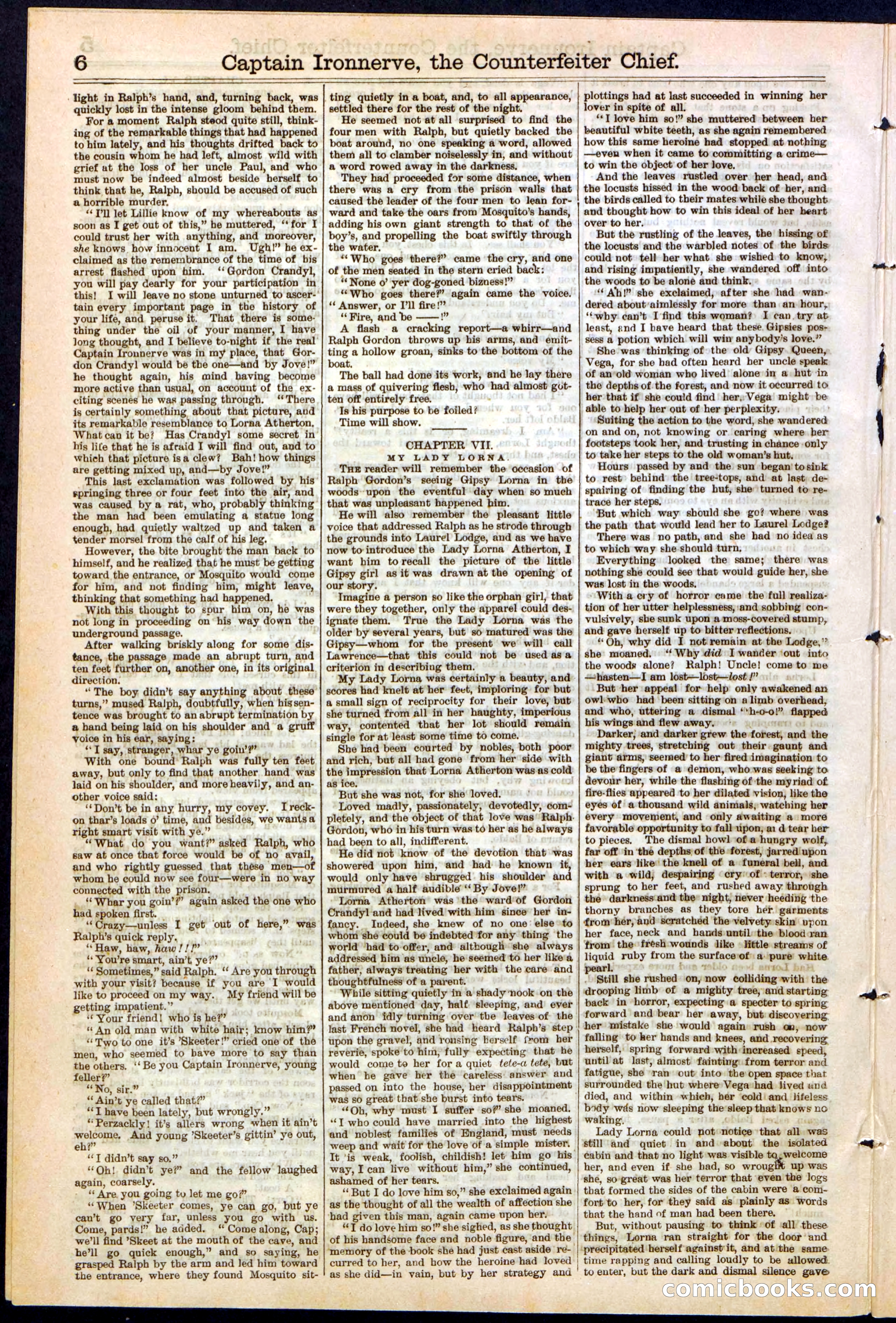
A restored page from Pulp Fiction, 1881. Page through the whole issue in the reader above.
📄 Transcribed text from this page (OCR, searchable)
Machine-transcribed from the original scan — historical spelling and the odd misread are preserved.
# ¥ f : # 4H ay ae a ee sane Ya eS Se a i ide ~~ Sweat oe 6 Captain Ironnerve, the Counterfeiter Chief. light in Ralph’s hand, and, turning back, was quickly lost in the intense gloom behind them. For a moment Ralph steod quite still, think- ing of the remarkable things that had happened to him lately, and his thoughts drifted back to the cousin whom he had left, almost wild with grief at the loss of her uncle Paul, and who must now be indeed almost beside herself to think that he, Ralph, should be accused of such a horrible murder, “1'l) let Lillie know of my whereabouts as soon as I get out of this,” he muttered, “for I could trust her with anything, and moreover, she knows how innocent I am. Ugh!” he ex- claimed as the remembrance of the time of bis arrest flashed upon him. ‘‘Gordon Crandyl, you will pay dearly for your participation in this! I will leave no stone unturned to ascer-' tain every important page in the history of your life, and peruse it. That there is some- thing under the oil of your manner, I have long thought, and I believe to-night if the real’ Captain Ironnerve was in my place, that Gor- don Crandy! would be the one—and by Jove!” he thought again, his mind having become more active than usual, on account of the ex- citing scenes he was passing through. ‘There is certainly something about that picture, and its remarkable resemblance to Lorna Atherton, What can it be? Has Crandyl some secret in’ his life that he is afraid I will find out, and to Which that picture isa clew? Bah! how things are getting mixed up, and—by Jove!” This last exclamation was followed by his springing three or four feet into the air, and was caused by a rat, who, probably thinking the man had been emulating a statue long enough, had quietly waltzed up and taken a tender morsel from the calf of his leg. However, the bite brought the man back to himself, and he realized that he must be getting toward the entrance, or Mosquito would come for him, and not finding him, might leave, thinking that something had happened. ‘ With this thought to sour him on, he was not long in proceeding on his way down the underground passage. After walking briskly along for some dis- tance, the passage made an abrupt turn, and ten feet further on, another one, in its original direction. “The boy didn’t say anything about these’ turns,” mused Ralph, doubtfully, when his sen- tence was brought to an abrupt termination by a band being laid on his shoulder and a gruff voice in his ear, saying: . ‘*T say, stranger, whar ye goiu’?” With one bound Ralph was fully ten feet away, but only to find that another hand was laid on his shoulder, and more heavily, and an- other voice said: ‘‘Don’t be in any hurry, my covey. L[reck- on thar’s loads 0’ time, and besides, we wants a right smart visit with ye.” “What do you want?’ asked Ralph, who saw at once that force would be of no avail, and who rightly guessed that thése men—of whom he could now see four—were in no way connected with the prison, : j “Whar you goin’?’” again asked the one who bad spoken first. , ‘“Crazy—unless I get ‘out of here,” was Ralph’s quick reply. “Haw, haw, haw!!!” * You’re smart, ain’t ye?’ ‘« Sometimes,” said Ralph. ‘‘ Are you through with your visit? because if you are I would like to proceed on my way. My friend will be getting impatient.” | ; ‘©-Your friend! who is he?’ ~ * An old man with white hair; know him “Two to one it’s Skeeter!” cried one of the men, who seemed to bave more to say than the others, ‘‘ Be you Captain Ironnerve, young feller?” ‘*No, sir.” “ Ain’t ye called that?” “IT have been lately, but wrongly.” “Perzackly! it’s allers wrong when it ain’t welcome, And young ’Skeeter’s gittin’ ye out, eh?” — ““T didn’t say so.” . ‘‘Oh! didn’t ye?” and the fellow laughed again, coarsely. “ Are. you going tu let me go?” “When ’Skeeter comes, ye can go, but ye can’t go very far, unless you go with us. Come, pards!” he added. “ Come along, Cap; we'll find ’Skeet at the mouth of the cave, and he’ll go quick enough,” and so saying, he grasped Ralph by the arm and Jed him toward the entrance, where they found Mosquito sit- ting quietly in a boat, and, to all appearance, | plottings had at last succeeded in winning her settled there for the rest of the night. He seemed not at all surprised to find the four men with Ralph, but quietly backed the boat around, no one speaking a word, allowed them all to clamber noiselessly in, and without a word rowed away in the darkness. They had proceeded for some distance, when there was a cry from the prison walls that caused thé leader of the four men to lean for- ward and take the oars from Mosquito’s hands, adding his own giant strength to that of the boy’s, and propelling the boat swiftly through the water. ““Who goes there?” came the cry, and one of the men seated in the stern cried back: “None 0’ yer dog-goned bizness!” “Who goes there?’ again came the voice. ‘* Answer, or lll fire!” ‘Fire, and be ——!” A flash a cracking report—a whirr—and Ralph Gordon throws up bis arms, and emit- ting a hollow groan, sinks to the bottom of the boat. The ball had done its work, and he lay there a mass of quivering flesh, who had almost got- ten off entirely free. Is his purpose to be foiled? Time will show. CHAPTER VII. MY LADY LORNA. Tne reader will remember the occasion of Ralph Gordon’s seeing Gipsy Lorna in the woods upon the eventful day when so much that was unpleasant happened him. He will also remember the pleasant little voice that addressed Ralph as he strode through the grounds into Laurel Lodge, and as we have now to introduce the Lady Lorna Atherton, I want him torecall the picture of the little Gipsy girl as it was drawn at the opening of our story. Imagine a person so like the orphan girl, that were they together, only the apparel could des- ignate them. True the Lady Lorna was the older by several years, but so matured was the Gipsy—whom for the present we will call Lawrence—that this could not be used asa criterion in describing them. My Lady Lorna was certainly a beauty, and scores had knelt at her feet, imploring for but a small sign of reciprocity for their love, but she turned from all in her haughty, imperious way, contented that her lot should remain single for at least some time to come. She had been courted by nobles, both poor and rich, but all had gone from her side with the impression that Lorna Atherton was as cold as ice. But she was not, for she loved. oat Loved madly, passionately, devotedly, com- pletely, and the object of that love was’ Ralph. Gordon, who in his turn was to her as he always had been to all, indifferent. He did not know of the devotion that was showered upon him, and had he known it, would only have shrugged his shoulder and murmured a half audible ‘‘ By Jove!” : Lorna Atherton was the ward of Gordon Crandyl and had lived with him since her in- fancy. Indeed, she knew of no one else to whom shé could be indebted for any thing the world ‘had to offer, and although she always addressed him as uncle, he seemed to her like'a father, always treating her with the care and thoughtfulness of a parent. ! oJ While sitting quietly in a shady nook on the above mentioned day, half sleeping, and ever and anon idly turning over the leaves of the last French novel, she had heard Ralph’s step upon the gravel, and ronsing Herself from her reverie, spoke to him, fully expecting that he would come te her for a quiet tete-a tete, but when he gave her the careless: answer and passed on into the house, her disappointment was so great that. she burst into tears. “Oh, why must I suffer so?’ she moaned. “TI who could have married into the highest and noblest families of England, must needs weep and wait for the love of a simple mister. It ‘is weak, foolish, childish! let him go his’ way, I can live without him,” she continued, ashamed of her tears. ‘But I do love him so,” she exclaimed again as the thought of all the wealth of affection she ‘had given this man, again came upon ber. “T do love him so!” she sighed, as she thought of his handsome face and noble figure, and the ‘memory of the book she had just cast aside re- curred to her, and how the heroine had loved as she did—in vain, but by her strategy and lover in spite of all. **T love him so!” she muttered between her beautiful white teeth, as she again remembered how this same heroine had stopped at nothing —even when it came to committing a crime— to win the object of her love. And the leaves rustled over her head, and the locusts hissed in the wood back of her, and the birds called to their mates while she thought and thought how to win this ideal of her heart over to her. But the rustling of the leaves, the hissing of the locusts and the warbled notes of the birds could not tell her what she wished to know, and rising impatiently, she wandered off into the woods to be alone and think. ‘“ Ah!” she exclaimed, after she had wan- dered about‘aimlessly for more than an hour, ‘‘why can’t Ifind this woman? I can. try at least, and I bave heard that these. Gipsies pos- sess a potion which will win anybody’s love.” She was thinking of the old Gipsy. Queen, Vega, for she bad often heard ber uncle speak of an’old woman who lived alone in a hut in the depths of the forest, and now it occurred to her that if she could find her, Vega might be able to help her out of her perplexity. } Suiting the action to the word, she wandered on and on, not knowing or caring where her footsteps took her, and trusting in chance only to take her steps to the old woman’s hut, Hours passed by and the sun began’ tosink to rest behind the tree-tops, and at last de- spairing of finding the but, she turned to re- trace her steps. But which way should she go? where was the path that would lead her to Laurel Lodge? There was no path, and she had no idea as to which way she-should turn, Everything looked the same; there was nothing she could see that would guide her, she was lost in the woods, With a ery of horror came the full realiza- tion of her utter helplessness, and sobbing con- vulsively, she sunk upon a moss-covered stump, and gave herself! up to bitter reflections. “Oh, why did I not remain at the Lodge,” she moaned. ‘“ Why did I wander ‘out into the woods alone? Ralph! Uncle! come to me —hasten—I am lost—lost—lost !” But ‘her appeal for help only awakened an owl who had been sitting on a limb overhead, and who, uttering a dismal ‘*h-o-o!” flapped his wings and flew away. — Ont Oo Darker, and darker grew the forest, and the mighty trees, stretching out their gaunt and giant arms, seemed to her fired imagination to be the fingers of a demon, who-was seeking to devour her, while the flashing of the myriad of fire-flies appeared to her dilated ‘vision, like the eyes of a thousand wild animals; watching her every movement, and only awaiting a more favorable opportunity to fall upon; a d tear ber to pieces. The dismal howl ofa hungry wolf, far off in ‘the depths of the forest, jarred’ upon her ears like’ the knell of a funeral bell, and with a wild, despairing cry of: terror, she sprung to her feet, and rushed away through the darkness and the: night, never heeding ‘the thorny branches as they tore her garments from hér, and scratchéd the velvety skin’ upon her face, neck and hands untilthe blood ran from the fresh wounds like — little streams of liquid ruby from the surface‘of a pure’ white. pearl. fun t9hlo mood angal bad Still she rushed on, now colliding with the drooping limb of a mighty tree, and starting back in horror, expecting a specter to spring forward and bear her away, but: discovering | her mistake she would again rush on, now falling to ker hands and knees, and recovering herself, spring forward with increased speed, until at last, almost fainting: from terror and fatigue, she ran out into the open space that surrounded the hut where Vega‘had lived und | died, and within which, ber ‘cold’ and lifeless body wds now sleeping the’sleep that knows no waking. | i ied Lady Lorna could pot notice ‘that all was still and quiet in and about the isolated eabin and that no light was visible ta,welcome her, and even if she had, so wrought up was she, so great was her terror that even the logs that formed the sides of the cabin were a conm- fort to her, for they said as piainly as words that the hand of man had been there, But, without pausing to think ‘of ‘all these things, Lorna ran straight for the door and ‘precipitated herself against it, and at the same time rapping and calling loudly to be allowed. ' to enter, but the dark and dismal silence gave * (EO) m ,OO (E cS (E(0) me /