
Pulp Fiction, 1877 · page 32 of 40
Beadle's New York Dime Library, Vol. II, No. 15 — page 32: what you’re looking at
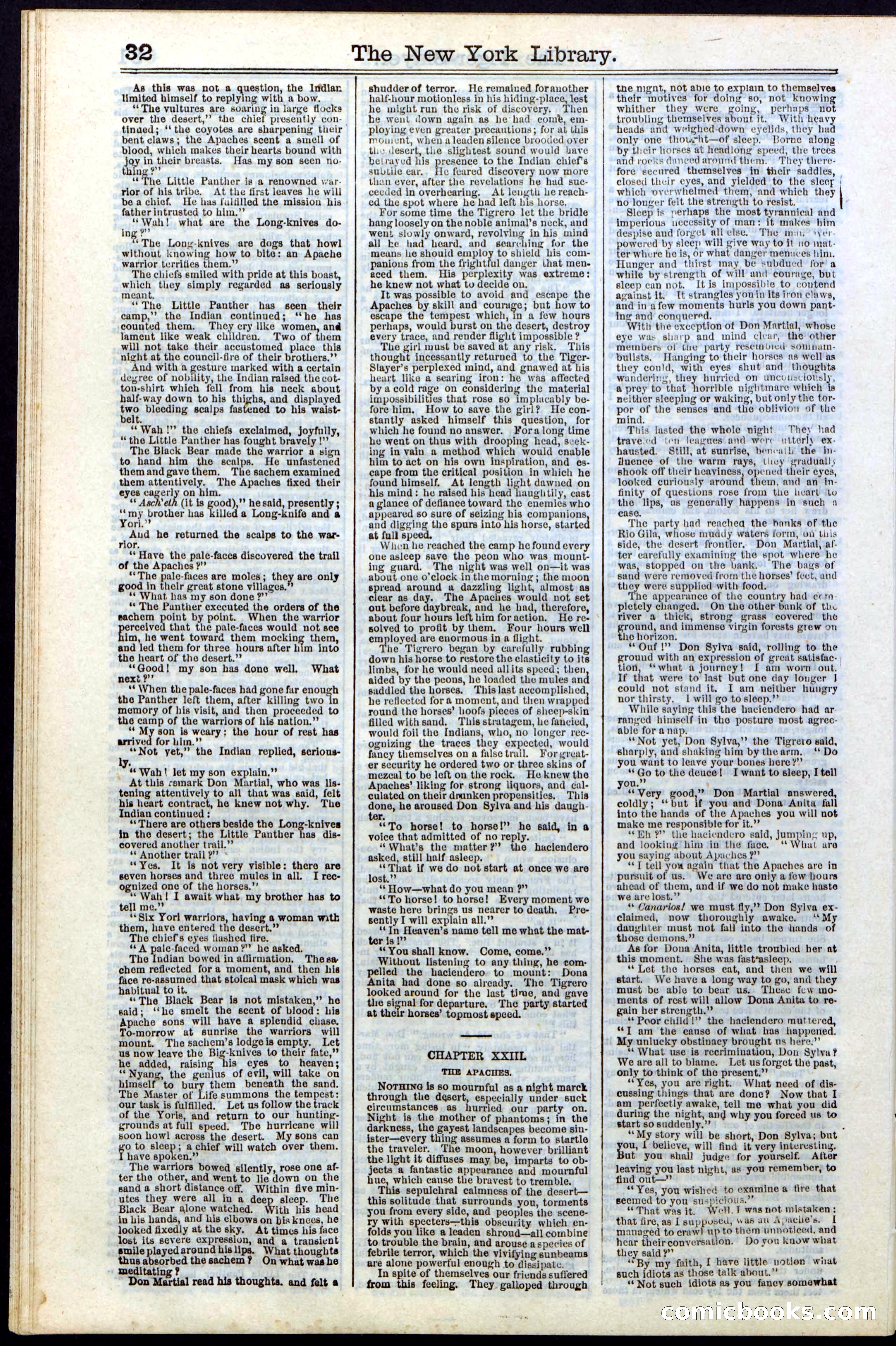
A restored page from Pulp Fiction, 1877. Page through the whole issue in the reader above.
📄 Transcribed text from this page (OCR, searchable)
Machine-transcribed from the original scan — historical spelling and the odd misread are preserved.
oT eee Se ee ae eee apt 32 As this was not a question, the Indian limited himself to replying with a bow. “The vultures are soaring in large flocks over the desert,’’ the chief presently con- tinued; ‘‘ the coyotes are sharpening their bent claws; the Apaches scent a smell of blood, which makes their hearts bound with joy in their breasts. Has my son seen no- thing ?”’ ‘The Little Panther is a renowned war- rior of his tribe. At the first leaves he will be a chief. He has fulfilled the mission his father intrusted to him.” ‘““Wah! what are the Long-knives do- ing ?”’ ““The Lony-knives are dogs that howl without knowing how to bite: an Apache warrior terrifies them.” The chiefs smiled with pride at this boast, which they simply regarded as seriously meant, “The Little Panther has seen their camp,”’ the Indian continued; “the has counted them. They cry like women, and lament like weak children. Two of them will not take their accustomed place this night at the council-fire of their brothers.’’ And with a gesture marked with a certain deyree of nobility, the Indian raised the cot- ton-shirt which fell from his neck about half-way down to his thighs, and displayed bey bleeding scalps fastened to his waist- elt. “Wah !’’ the chiefs exclaimed, joyfully, “the Little Panther has fought bravely !”’ The Black Bear made the warrior a sign to hand him the scalps. He unfastened themandgavethem. The sachem examined them attentively. The Apaches fixed their eyes cagerly on him. ** Asch’ eth (it is good),’’ hesaid, presently ; m, brother has killed a Long-knife and a ori.’ yaa he returned the scalps to the war- or. ‘*Have the pale-faces discovered the trail of the Apaclies ?” **The pale-faces are moles; they are only good in their great stone villages.” ** What has my son done ?”’ “The Panther executed the orders of the sachem poet by point. When the warrior reeived that the pale-faces would not sce im, he went toward them mocking them, and led them for three hours after him into the heart of the desert.”’ **Good! my son has done well, What next ?”’ ** When the pale-faces had gone fur enough the Panther left them, after killing two in memory of his visit, and then proceeded to the camp of the warriors of his nation.” “* My son is weary; the hour of rest has arrived for lilin.”’ **Not yet,”’ the Indian replied, serious- ¥ “Wah! let my son explain.”’ At this comark Don Martial, who was lis- tening attentively to all that was said, felt his heart contract, he knew not why. The Indian continued : ‘There are others beside the Long-knives in the desert; the Little Panther has dis- covered another trail.” ** Another trail ?”’ ° “Yes. It is not very visible: there are seven horses and three mules in all. I ree- ognized one of the horses.’’ “Wah! I await what my brother has to tell me.” **Six Yori warriors, having a woman with them, have entered the desert.” The chief's eyes flushed fire. ‘* A pale-faced woman?” he asked. The [ndian bowed in affirmation, These chem reflected fora moment, and then his face re-assumed that stoical mask which was habitual to it. “The Black Bear is not mistaken,” he said; ‘‘he smelt the scent of blood: his Apache sons will have a splendid chase, To-morrow at sunrise the warriors will mount. The sachem’s lodgeisempty. Let us now leave the Big-knives to their fate,” he added, raising his eyes to heaven; ‘“‘Nyang, the genius of evil, will take on himself to bury them beneath the sand. The Master of Life summons the tempest: our tusk is fulfilled. Let us follow the track of the Yoris, and return to our hunting- grounds at full speed. Tbe hurricane will soon howl across the desert. My sons can o to sleep; a chief will watch over them. have spoken.’ The warriors bowed silently, rose one af- ter the other, and went to lie down on the sand a short distance off Within five min- utes they were all in a deep sleep. The Black Bear alone watched. ith his head in Lis hands, and his elbows on pis knees, he looked fixedly at the sky. At times his face lost its severe expression, and a transient smile played around hislips. What thoughts thus absorbed the sachem? On whut was he meditating ? Martial read his thoughts. and felt a shudder of terror. He remained foranother half-hour motionless in his hiding-place, lest he might run the risk of discovery. Then he went down again as he'had com, em- ploying even greater precautions; for at this mouient, when a leaden silence brooded over tle desert, the slightest sound would have betrayed his presence to the Indian chief's subtile ear.. He feared discovery now more than ever, after the revelations he had suc- cecded in overhearing. At length le reach- ed the spot where he bad left his horse, For some time the Tigrero let the bridle hang loosely on the noble animal’s neck, and went slowly onward, revolving in his mind all ke had heard, and searching for the means he should ey to shield his com- panions from the frightful danger that men- aced them. His perplexity was extreme: he knew not what to decide on, It was possible to avoid and escape the Apaches by skill and couruge; but how to escape the tempest which, in a few hours perhaps, would burst on the desert, destroy every trace, and render flight impossible ? The girl must be saved at any risk. This thought incessantly returned to the Tiger- Slayer’s perplexed mind, and gnawed at his heart like a searing iron: he was affected by a cold rage on considering the material impossibilities that rose so implacably be- fore him, How to save the girl? He con- stantly asked himself this question, for which he found no answer. Fora long time he went on thus with drooping head, seek- ing in vain a method which would enable him to act on his own inspiration, and es- cape from the critical position in which he found himself. At length light dawned on his mind: he raised his head haughtily, cast a glance of defiance toward the enemies who appeared so sure of seizing his companions and digging the spurs into his horse, started at full sp W hen he reached the camp he found every one asleep save the peon who was mount- ing guard. The night was well on—it was about one o'clock in the morning ; the moon spread around wa dazzling light, almost as clear as day. The Apaches would not set out before daybreak, and he had, therefore, about four hours left him foraction. He re- solved to profit by them. Four hours well employed are enormous in a flight. he Tigrero began by carefully rubbing down his horse to restore the elasticity to its limbs, for he would need allits speed; then aided by the peons, he loaded the mules and suddled the horses. This last accomplished he reflected for a moment, and then wrapped round the horses’ hoofs pieces of sheep-skin filled withsand. This stratagem, he fancied, would foil the Indians, who, no longer rec- ognizing the traces they expected, would fancy themselves on a false trail. Forgreat- er security he ordered two or three skins of mezcal to be left on the rock. He knew the Apaches’ liking for strong liquors, and cal- culated on their dnanken propensities, This done, he aroused Don Sylva and his daugh- “To horse! to horse!’ he said, in a voice that admitted of no reply. ‘“What’s the matter?” the haciendero asked, still half asleep. “That if we do not start at once we are lost.”” ** How—what do you mean ?” **To horse! to horse! Every moment we waste here brings us nearer to death. Pre- sently I will explain all.” . ‘*In Heaven’s name tell me what the mat- ter is!” “You shall know. Come, come.”’ Without listening to any thing, he com- led the haciendero to mount: Dona ita had done so already. The Tigrere looked around for the last time, and gave the signal for departure. The party started at their horses’ topmost speed. CHAPTER XXIIL THE APACHES. NorTuHine is s0 mournful as a night marck through the dgsert, especially under suck circumstances as hurried our party on. Night is the mother of phantoms; in the darkness, the gayest landscapes become sin- ister—every thing assumes a form to startle the traveler. The moon, however brilliant the light it diffuses may be, imparts to ob- ng a fantastic appearance and mournful ue, which cause the bravest to tremble. This sepulchral calmness of the desert— this solitude that surrounds you, torments you from every side, and peoples the scene- ry with specters—this obscurity which en- folds you like a leaden shroud—all combine to trouble the brain, and arouse aspecies of febrile terror, which the vivifying sunbeams are alone powerful enough to dissipate. In spite of themselves our friends suffered from this feeling. They galloped through The New York Library. the nignt, not abie to explain to themselves their motives for doing so, not knowing whither they were going, perhaps not troubling themselves about it. With heavy heads and weighed-down eyelids, they had only one thousht—of sleep. Borne along by their horses at headlong speed, the trees and rocks danced around them. They there- fore secured themselves in their saddles, closed their eyes, and yielded to the slecy | which overwhelmed them, and which they no longer felt the strength to resist. Sleep is perhaps the most tyrannical and imperious uecessity of man: it makes him despise and forget all else. The min ‘ye owered by sleep will give way to it no mat- er Where be is, or what danger menuces him. Hunger and thirst may be subducd for a while by strength of will and courage, but sleep can not. Itis impossible to contend against it. Tt strangles youin its iron claws, and in afew moments hurls you down pant- ing and conquered. With the exception of Don Martial, whose eye was sharp and mind clear, the other members of the party resembied sonminain- bulists. Hanging to their horses as well as they could, with eyes shut and thoughts wandering, ee hurried on veg bcd a prey to that horrible nightmare which is neither sleeping or waking, but only the tor- por of the senses und the oblivion of the mind. This lasted the whole night) They had travecd ten leagues and were utterly ex- hausted. Still, at sunrise, beneath the in- uence of the warm rays, a rraduall shook off their heaviness, opened their eyes, looked curiously around them, and an’ in: finity of questions rose from the heart to the lips, us generally happens in such 4 case. The party had reachea the hanks of the Rio Gila, whose muddy waters form, of this side, the desert frontier. Don Martial, af- ter carefully examining the spot where he was, stopped on the bank. The bays of sund were removed from the horses’ fect, and On were supplied with food. he appearance of the country bad ecra pletely changed. On the other bank of the river a thick, strong grass covered the round, and immense virgin forests grew on he horizon. * Ouf !? Don Sylva said, rolling to the ground with an expression of great satisfac- tion, *“‘what a journey! I[ am worn out. If that were to last but one day louger J could not stand it. I am neither hungry nor thirsty, 1 will go to sleep.” While saying this the haciendero had ar ranged himself in the posture most agrec- able for a nap. “Not yet, Don Sylva,’’ the Tigrero said, sharply, and shaking him by thearm. ‘ Do you want to leave your bones here ?”’ “ Go to the deuce! I want to sleep, I tell ou. ‘*Very good,” Don Martial answered, coldly; “but if you and Dona Anita fall into the hands of the Apaches you will not make me responsible for it.” “Eh ?” the haciendcro said, Jumping up, and looking him in the fuee. ‘‘ What ure you saying about Apaches ?” “7 tell you again that the Apaches are in pursuit of us. We are are only a few hours ahead of them, and if we do not make haste we are lost.” ** Canarios/ we must fly,’”? Don Sylva ex- claimed, now ihevenghty awake. “My daughter must not fall into the lands of those demons.” As for Dona Anita, little troubied her at this moment. She was fast*asleep. ‘Let the horses eat, and then we will start. We have a long way to go, and they must be able to beur us, These few mo- ments of rest will allow Dona Anita to re- n her strength.” ** Poor child !’’ the haciendero muttered, *T am the cause of what has happened. My unlucky obstinacy brought us here.” ““ What use is recrimination, Don Sylva? We are all to blame. Let us forget the past, only to think of the present.”’ “Yes, you are right. What need of dis- cussing things that are donc? Now that I am perfectly awake, tell me what you did during the night, and why you forced us to start so suddenly,” ‘My story will be short, Don Sylva; but oe { believe, will find it very interesting. ut you shall judge for yourself. After leaving you last night, as you remember, to find out—”’ ““Yes, you wished to examine a fire that secmed to you suspicious.” “That was it. Well. 7 was not mistaken; that fire, as I supposed, was au Ajacie’s. manaved to craw! up to them unnoticed, and hear their Sborereatiols Do you know what they said?” ‘By my faith, [ have little notion what such idiots as those talk about.” ‘“Not such idiots as you fancy somewhat “S Gomilcboo (E(O)