
Pulp Fiction, 1877 · page 31 of 40
Beadle's New York Dime Library, Vol. II, No. 15 — page 31: what you’re looking at
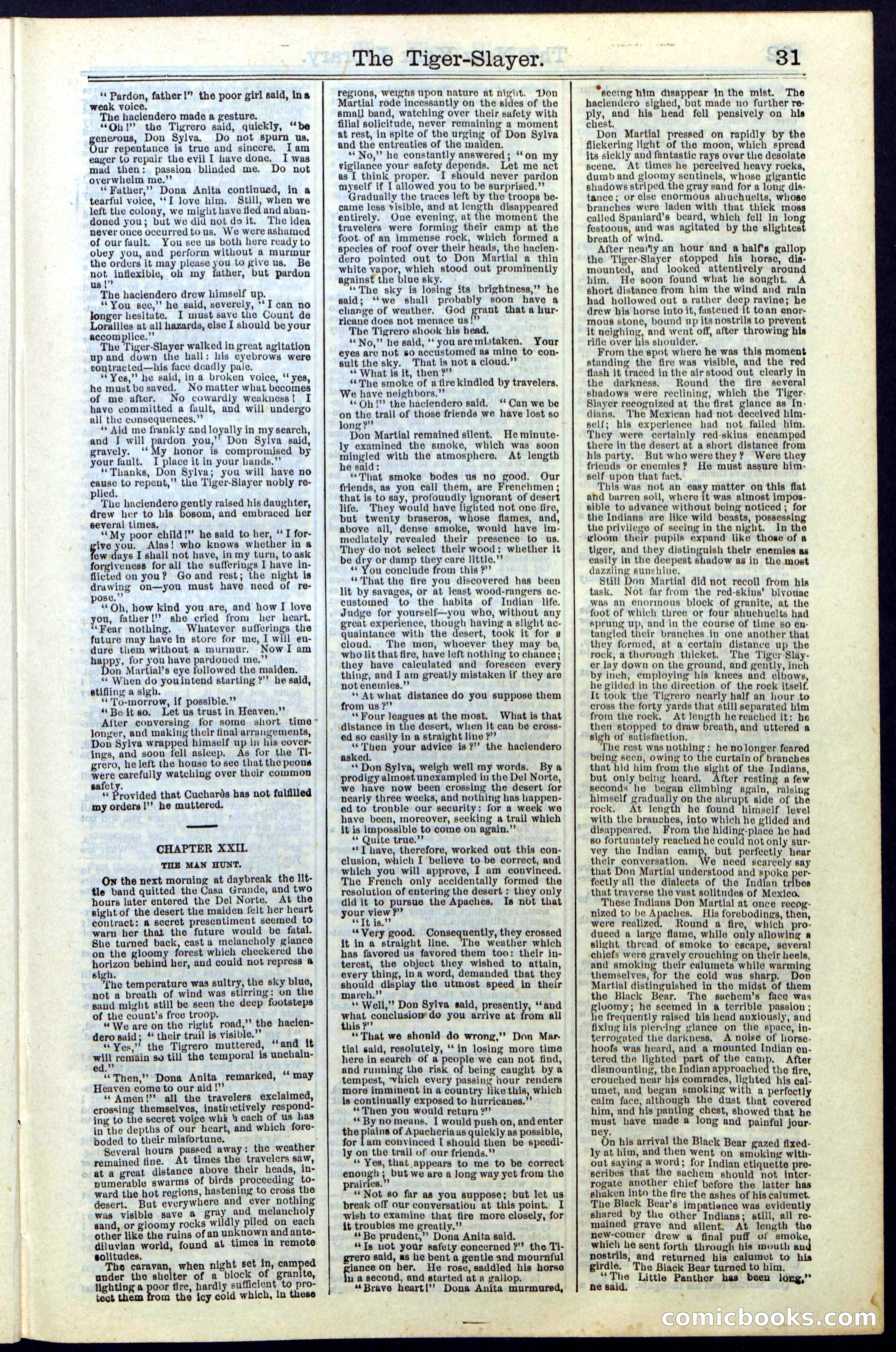
A restored page from Pulp Fiction, 1877. Page through the whole issue in the reader above.
📄 Transcribed text from this page (OCR, searchable)
Machine-transcribed from the original scan — historical spelling and the odd misread are preserved.
‘‘ Pardon, father!” the poor girl said, ina weak voice, The haciendero made a gesture. “Ohl the Tigrero said, quickly, ‘‘be enerous, Don Sylva. Do not spurn us, Sur repentunce is true and sincere. Iam eager to repair the evil [ have done, I was mad then: passion blinded me. Do not overwhelm me.’’ ‘‘ Father,’ Dona Anita continued, in a tearful voice, ‘‘I love him. Still, when we left the colony, we might have fled and aban- doned you; but we did not doit. The idea never once occurred tous. We were ashamed of our fault. You see us both here ready to obey you, and perform without a murmur the orders it may please you to give us. Be not inflexible, oh my father, but pardon us |” The haciendero drew himself up. ‘‘You see,’ he said, severely, ‘‘I can no longer hesitate. I must save the Count de Lorailles at all hazards, else I should be your ay trad The Tiger-Slayer walked in great agitation up and down the hall: his eyebrows were contracted—his face deadly pale. ‘‘ Yes,’’ he said, in a broken voice, ‘ yes, he must be saved. No matter what becomes of me after. No cowardly weakness! I have committed a fault, and will undergo all the consequences.” ‘* Aid me frankly and loyally in my search, and J will rebar you,’’ Don Sylva said, gravely. ‘‘My honor is compromised by your fault. I place it in your hands,”’ ‘Thanks, Don Sylva; you will have no cause to repent,’ the Tiger-Slayer nobly re- lied, ? The haciendero gently raised his daughter, drew her to his bosom, and embraced her several times. ‘‘My poor child!” he said to her, ‘‘I for- ive you. Alas! who knows whether in a ew days I shall not have, in my turn, to ask forgiveness forall the sufferings I have in- flicted on you? Goand rest; the night is drawing on—you must have need of re- pose,” ‘Oh, how kind you are, and how I love ou, father!’ she cried from her heart. ‘Fear nothing. Whatever sufferings the future may have in store for me, I will en- dure them without a murmur. NowI am happy, for you have pardoned me,” Don Martial’s eye followed the maiden. ‘* When do youintend starting ?”’ he said, stifling a sigh. ‘« To-morrow, if possible.”’ “Beit so, Let us trust in Heaven.” After conversing for some short time’ longer, and wont their final arrangements, Don Sylva wrapped himself up i his cover- ings, and soon fell asleep, As for the Ti- grero, he left the house to see that the peons were carefully watching over their common fety. me Provided that Cuchards has not fulfilled my orders |’ he muttered, CHAPTER XXIL THE MAN HUNT. On the next morning at daybreak the Iit- tle band quitted the Casa Grande, and two hours later entered the Del Norte, At the sight of the desert the maiden felt her heart contract: a secret prescntiment seemed to warn her that the future would be fatal. She turned back, cast a melancholy glance on the gloomy forest which checkered the horizon behind her, and could not repress & bigh. The temperature was sultry, the sky blue, not a breath of wind was stirring: on the sand might still be seen the deep footsteps he count’s free troop. sf We are on the rlebt road,’ the hacien- dero said; “ their trail is visible.’ , “Yes.” the Tigrero muttered, ‘‘and ft ’ will remain so till the temporal is unchain- ” ed. 2 “Then,” Dona Anita remarked, “* may Heaven come to our aid!” “Amen!” all the travelers exclaimed, crossing themselves, instinctively respond- ing to the secret voice whi ) cach of us has in the depths of our heart, and which fore- boded to their misfortune, Several hours passed away: the weather remained fine. At times the travelers saw, at a great distance above their heads, in- numerable swarms of birds proceeding to- ward the hot regions, hastening to cross the desert. But everywhere and ever nothing was visible save a gray and melanchol sand, or gloomy rocks aed piled on eac other like the ruins of an unknown and ante- diluvian world, found at times in remote solitudes. The caravan, when night set in, pee ped under the shelter of a block of granite, lighting a -~ flre, hardly sufficient to pro- tect them from the icy cold which, in these The Tiger-Slayer. regions, weighs upon nature at nigit. Von Martial rode incessantly on the sides of the small band, watching over their safety with filial solicitude, never remaining a moment at rest, in spite of the urging of Don Sylva and the entreaties of the maiden, ** No,” he vy pasa answered; ‘fon my vigilance your safety depends. Let me act as I think proper. I should never pardon myself if I allowed you to be surprised.” Gradually the traces left by the troops be- came less visible, and at length disappeared entirely. One evening, at the moment the travelers were forming their camp at the foot. of an immense rock, which formed a species of roof over their heads, the huacien- dero pointed out to Don Martial a thin white vapor, which stood out prominently against the blue sky. “The sky is losing its brightness,” he said; ‘‘we shall probably soon have a change of weuther. God grant that a hur- ricane does not menace us!” The Tigrero shook his head, | No,” he said, *‘ youaremistaken. Your eyes are not so accustomed as mine to con- sult the sky. That is not a cloud.” ‘* What is it, then ?” ‘The smoke of a fire kindled by travelers. We have neighbors.” ‘“Oh!” the haciendero said. ‘‘Can we be on the trail of those friends we have lost so long?” Don Martial remained silent. He minute- ly examined the smoke, which was soon mingled with the atmosphere, At length he said: “Phat smoke bodes us no good, Our friends, as you call them, are Frenchmen; that is to say, profoundly ignorant of desert life. They would have lighted not one fire, but twenty braseros, whose flames, and, above all, dense smoke, would have im- mediately revealed their presence to us. They do not select their wood: whether it be dry or damp they care Jittle,”’ “ You conclude from this ?”’ ‘*That the fire you discovered has been lit by savages, or at least wood-rangers ac- customed to the habits of Indian life. Judge for yourself—you who, without any great experience, though having a slight ac- quaintance with the desert, took it for a cloud. The men, whoever they may be, who lit that fire, have left nothing to chance; they have calculated and foreseen every thing, and Iam greatly mistaken if they are not enemies.”’ ‘*At what distance do you suppose them from us ?”’ “Four leagues at the most. What is that distance in the desert, when it can be cross- ed so easily in a straight line ?”’ “Then your advice is ?’’ the haciendero asked. ‘*Don Sylva, weigh well my words. By a prodigy almost unexampled in the Del Norte, we have now been crossing the desert for nearly three weeks, and nothing has happen- ed to tronble our security: for a week we have been, moreover, seeking a trail which it is impossible to come on again.”’ ** Quite true.’”’ ‘*T have, therefore, worked out this con- clusion, which I ‘believe to be correct, and which you will approve, I am convinced. The French only accidentally formed the resolution of entering the desert : they only did it to pursue the Apaches, Is not that your view?” “*It is,” : “Very good. Consequently, they crossed it in a straight line. The weather which has favored us favored them too: their in- terest, the object they wished to attain, every thing, ina word, demanded tbat they should display the utmost speed in their march.” : ‘* Well,”’ Don Sylva said, presently, ‘and Mea conclusion do you arrive at from all his ? ‘That we should do wrong,’’? Don Mar. tial said, resolutely, ‘‘ in losing more time here in search of a po le we can not find, and running the risk of being caught by a tempest, *vhich every passing hour renders more imminent in a country like this, which is continually exposed to hurricanes.”’ “Then you would return 2’ ‘* By no means, | would push on, and enter the plains of Apacheriaus quickly as possible, for lam convinced [ should then be speedi- ly on the trail of our friends.” ‘* Yes, that appears to me to be correct enough; but we are a long way yet from the prair es.” ‘*Not so far as you suppose; but let us break off our conversation at this point. I wish to examine that fire more closely, for it troubles me greatly.” ‘¢ Be prudent,”’ Dona Anita said. “Ts not your safety concerned ?”’ the Ti- grero said, as he bent a gentle and mournful lance on her. He rose, saddled his horse n a second, and started at a gallop. “Brave heart!’’ Dona Anita murmured, *secing him disappear in the mist. The haciendero sighed, but made no further re- ply, and his head fell pensively on his chest. Don Martial pressed on rapidly by the flickering light of the moon, which spread its sickly and fantastic rays over the desolate svene. At times he perceived heavy rocks, dumb and gloomy sentinels, whose gigantic shadows striped the gray sand for a long dis- tance; or clse enormous ahuehuelts, whose branches were laden with that thick moss ealled Spaniard’s beard, which fell in lon festoons, and was agitated by the slightes breath of wind. After nearly an hour and a half’s gallop the Tiger-Slayer stopped his horse, dis- mounted, and looked attentively around him. He soon found what he sought. A short distance from him the wind and rain had hollowed out a rather deep ravine; he drew his horse into it, fastened it toan enor- mous stone, bound up its nostrils to prevent it neighing, and went off, after throwing his rifle over his shoulder, From the spot where he was this moment standing the fire was visible, and the red flash it traced in the air stood out clearly in the darkness. Round the fire several shadows were reclining, which the Tiger- Slayer recognized at the first glance as In- dians. The Mexican had not deceived him- self; his experience had not failed him. They were certainly red-skins encamped there in the desert at a short distance from his party. But whowerethey? Were they friends or enemies? He must assure him- self upon that fact. This was not an ony matter on this flat and barren soil, where 1t was almost impos- sible to advance without being noticed; for the Indians are like wild beasts, possessing the privilege of seeing in the night. In the gloom their pupils expand like those of a tiger, and they distinguish their enemles as easily in the deepest shadow as in the most dazzling sunghine. Still Don Martial did not recoil from his task. Not far from the red-skins’ biyouac was an enormous block of granite, at the foot of which three or four ahuehuelts had aprung up, and in the course of time so en: tangled their branches in one another that they formed, at a certain distance up the rock, a thorough thicket. The Tiger-Slay- er lay down on the ground, and gently, inch by inch, employing his knees and elbows, he glided in the direction of the rock itself. It took the Tigrero nearly half an hour to cross the forty yards that still separated him from the rock, At length he reached it: he then stopped to draw breath, and uttered a sigh of satisfaction. Che rest was nothing: he nolonger feared being seen, owing to the curtain of branches that hid him from the sight of the Indians, but only being heard. After resting a few seconds he began climbing again, raising himself gradually on the abrupt side of the rock, t length he found himself level with the branches, into which he glided and disappeared, From the hiding-place he had so fortunately reached he could not only sur- vey the Indian camp, but perfectly hear their conversation, @ need scarcely say that Don Martial understood and spoke per- fectly all the dialects of the Indian tribes that traverse the vast solitndes of Mexico, These Indians Don Martial at once recog- nized to be Apaches. His forebodings, then, were realize Round a fire, which pro- duced a large flame, while only allowing a slight thread of smoke to escape, several chiefs were gravely crouching on their heels, and smoking their calumets while warming themselves, for the cold was sharp. Don Martial distinguished in the midst of them the Black Bear. The sachem’s face was pie he seemed in a terrible passion ; 1¢ anea raised his head anxiously, and fixing his piercing glance on the space, in- terrovated the darkness, A nolse of horse- hoofs was heard, and a mounted Indian en- tered the lighted part of the camp. After dismounting, the Indian approached the fire crouched near his comrades, lighted his cal umet, and began smoking with a perfectly calm face, although the dust that covered him, and his panting chest, showed that he must have made a long and painful jour- ney. On his arrival the Black Bear gazed fixed- ly at him, and then went on smoking with- out saying a word; for Indian etiquette pre- scribes that the sachem should not inter- rogate another chief before the latter has shaken into the fire the ashes of his calumet. The Black Bear’s impatience was evidently shared by the other Indians; still, all re- mained grave and silent. At length the new-comcr drew a final puff of smoke which he sent forth through his mouth and nostrils, and returned his calumet to his girdle. The Black Bear turned to him, “The Little Panther hes been long,’ ne said. DOD! wut he Ong, > a? Se ee comicbooks