
Pulp Fiction, 1877 · page 29 of 40
Beadle's New York Dime Library, Vol. II, No. 15 — page 29: what you’re looking at
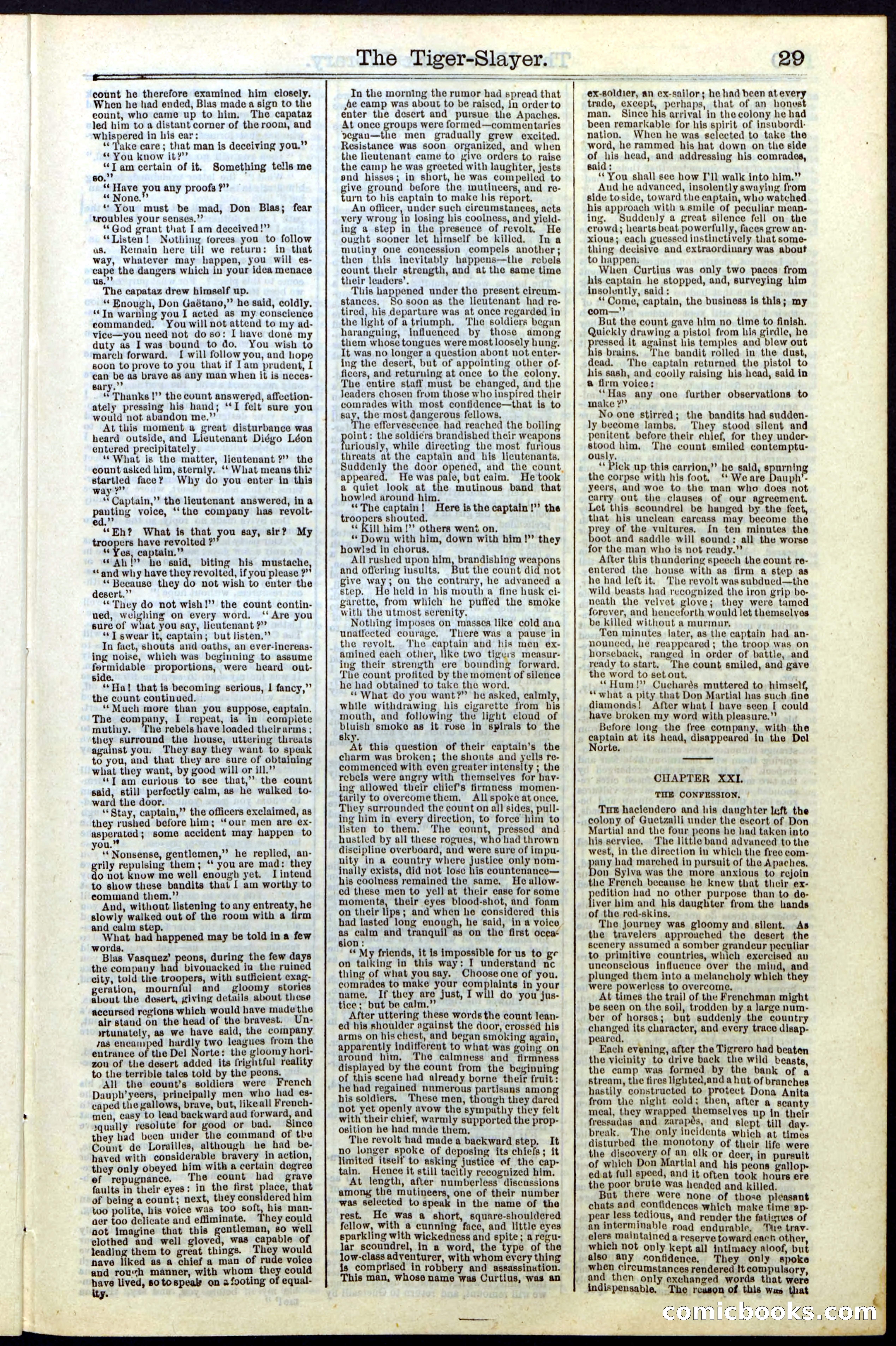
A restored page from Pulp Fiction, 1877. Page through the whole issue in the reader above.
📄 Transcribed text from this page (OCR, searchable)
Machine-transcribed from the original scan — historical spelling and the odd misread are preserved.
OP oe - a ne rrr rn RS a TS ES SE SE count he therefore examined him closely, When he had ended, Blas made a sign to the count, who came up to him. The capataz led him to a distant corner of the room, and whispered in his ear; “Take care; that man is deceiving you.” “ You know it?”’ “Tam certain of it. Something tells me ” ‘* Have you any proofs ?” “* None.”’ “ You must be mad, Don Blas; fear troubles your senses.”’ ‘God grant that I am deceived!” “Listen! Nothing torees you to follow us. Remain here till we return: in that way, whatever may happen, you will es- cape the dangers which in your idea menace us The capataz drew himself up. “ Enough, Don Gaétano,” he said, coldly. ‘In warning youl acted as my conscience commanded. You will not attend to my ad- vice—you need not do so: I have done my duty as I was bound to do. You wish to march forward. I will follow you, and hope soon to prove to you that if lam prudent, I can be as brave as any man when it is neces- ”» ry. “ Thanks !’’ the count answered, affection- ately pressing his hand; ‘I felt sure you would not abandon me.”’ At this moment a great disturbance was heard outside, and Lieutenant Diégo Léon entered precipitately. ‘*What is the matter, lieutenant ?” the count asked him, sternly. ** What means thir startled face? Why do you enter in this way ?”’ 3 Captain,’’ the lieutenant answered, ina panting voice, ‘‘the company has revolt- “Eh? What is that you say, sir? My troopers have revolted ?” “ Yes, captain.” “Anh? he said, biting his mustache, *‘and why have they revolted, if you please ?” ‘“‘Beeause they do not wish to enter the desert.”’ ‘They do not wish!’ the count contin- ued, weighing on every word. ‘‘ Are you sure of wuat you say, licutenant ?” “*T swear it, captain; but listen.” In fact, shouts and oaths, an ever-increas- ing noise, which was beginning to assume fermidable proportions, were heard out- e. ‘Hal that is becoming serious, | fancy,’ the count continued. ‘*Much more than you suppose, captain. The company, I repeat, is in complete mutiny. The rebels have loaded theirarms ; they surround the house, uttering threats against you. They say they want to speak to you, and that they are sure of obtaining what they want, by good will or ill.” ‘“‘] am curious to see that,’”’ the count said, still perfectly calm, as he walked to- ward the door. ‘Stay, captain,” the officers exclaimed, as they rushed before him; “four men are ex- asperated ; some accident may happen to ou.’ , ‘* Nonsense, gentlemen,”’ he replied, an- rily repulsing them; “‘ you are mad: they io not know me well enough yet. Iintend to show these bandits that [ am worthy to command them.”’ And, without listening to any entreaty slowly walked out of the room with a fi and calm — What bad happened may be told in a few words. Blas Vasquez’ peons, during the few days the company had bivouacked in the ruined city, told the troopers, with suificient exag- geration, mournful and gloomy stories about the desert, giving details about these accursed regions which would have made the air stand on the head of the bravest. Un- tunately, as we have said, the company vas encamped hardly two leagues from the entrance of the Del Norte: the gloomy hori- zon of the desert added its frightful reality to the terrible tales told by the peons. All the count’s soldiers were French Dauph’yeers, principally men who had e¢s- caped the gallows, brave, but, like all French- men, easy to lead backward aud forward and rquully resolute for good or bad. nce they had been under the command of the Count de Lorailles, although he had be- haved with considerable bravery in action, they only obeyed him with a certain degree ef repugnance. ‘The count had grave faults in their eyes: in the first place, that of being a count; next, they cons dered him two polite, his voice was too oo his man- aer too delicate and effiminate. They could not Imagine that this _mepient 80 well clothed and well gloved, was capable of leading them to great things. a would nave liked as a chief a man of rude voice he rm and rouvh manner, with whom ap could have lived, sotospeal on a footing o ity. equal- The Tiger-Slayer. In the morning the rumor bad spread that se camp was about to be raised, in order to enter the desert and pursue the Apaches. At once groups were formed—commentaries vegau—the men gradually grew excited. Resistance was soon organized, and when the lieutenant came to pive orders to raise the camp he was greeted with laughter, jests end hisses; in short, he was compelled to rive ground before the mutineers, and re- urn to his captain to make his report. An officer, under such circumstances, acts very wrong in losing his coolness, and yield- ing a step in the presence of revolt, He ought sooner let himself be killed. Ina mutiny one concession compels another; then this inevitably happens—the rebels count their strength, and at the same time their leaders’. This happened under the present cireum- stances. So sooo as the lieutenant had re- tired, his departure was at once regarded in the light of atriumph, ‘The soldiers begun haranguing, influenced by those among them whose tongues were most loosely hung. It was no longer a question abont not enter- ing the desert, but of appointing other of- ficers, and returning at once to the colony. The entire staff must be changed, and the leaders chosen from those who inspired their comrades with most confidence—that is to ws the most dangerous fellows, he effervescence had reached the boiling oint: the soldiers brandished their weapons uriously, while directing the most furious threats at the captain and his lieutenants. Suddenl appeared. He was pale, but caim. He took a quiet look at the mutinous band that howled around him. “The captain! Here is the captain !’’ the troopers shouted. ** Kill him !’’ others went on. “ Down with him, down with him !”’ they howled in chorus. All rushed upon him, brandishing weapons and offering insults, But the count did not give way; on the contrary, he advanced a step. He held in his mouth a fine husk ci- garette, from which he puffed the smoke with the utmost serenity, Nothing imposes on masses like cold ana unatfected courage. There was a pause in the revolt. The captain and his men ex- amined cach other, like two tigers measur- ing their strength ere bounding forward. The count profited by the moment of silence he had obtained to take the word, ** What do you want?” he asked, calmly, while withdrawing his cigarette from his mouth, and following the light cloud of bluish smoke as it ruse in spirals to the sky. xt this question of their captain’s the charm was broken; the shouts and ha re- commenced with even greater intensity ; the rebels were angry with themselves for hav- ing allowed their clicf’s firmness momen- tarily to overcomethem, Allspoke atonce, They surrounded the count on all sides, pull- ing him in every direction, to force him to listen to them. The connt, pressed and hustled by all these rogues, who had thrown discipline overboard, and were sure of impu- nity in a country where dustics only nom- inally exists, did not lose his ecountenance— his coolness remained the same. He allow- ed these men to yell at their ease for some moments, their eyes blood-shot, and foam on their lips ; and when he considered this had lasted long enough, he said, in a voice " calm and tranquil as on the first oceas sion : ‘“* My friends, it is impossible for us to ge on talking in this way: I understand nec thing of what yousay. Choose one of you. comrades to make your complaints in your name. If they are just, I will do you jus- tice; but be calm.” After uttering these words the count lean- ed his shoulder against the door, crossed his arms on his chest, and began smoking again, apparently indifferent to what was going on around him, The calmness and firmness displayed by the count from the beginning of this scene had already borne their fruit: he had regained numerous partisuns amon bis soldiers, These men, though they dare not yet openly avow the sympathy they felt with their chief, warmly supported the prop- osition he had made them, The revolt had made a backward step. It no lunger spoke of deposing its chiefs; it limited itself to asking justice of the cap- tain. Hence it still tacitly recognized him. At length, after numberless discussions among the mutineers, one of their number was selected to speak in the name of the rest. He was a short, square-shouldered fellow, with a cunning face, and little eyes sparkling with wickedness and spite; a regu- lar scoundrel, in a word, the type of the low-class adventurer, with whom every thing is comprised in robbery and assassinution. This man, whose name was Curtius, was an the door opened, and the count, a ex-soldier, an ex-sailor; he had been atevery trade, except, perhaps, that of an honvust man. Since his arrival in the colony he had been remarkable for his spirit of insubordi- nation. When he was salenion to take the word, he rammed his hat down on the side otanis head, and addressing his comrades, said ; ‘* You shall see how I'll walk into him.”’ Aud he advanced, insolently swaying from side toside, toward the captain, who watched his approach with a smile of peculiar mean- ing. Suddenly a great silence fell on the crowd; hearts beat powerfully, faces grew an- xious; each guessed instinctively that some- thing decisive and extraordinary was about to happen, When Curtius was only two paces from his captain he stopped, and, surveying him insolently, said: **Come, captain, the business is this; my com—’’ But the count gave him no time to finish. cenickly drawing a pistol from his girdle, he ressed it against his temples and blew out is brains. The bandit rolled in the dust, dead. The captain returned the pistol to his sash, and coolly raising his head, said in a firm voice; ‘*Has any one further observations to make ?”? No one stirred; the bandits had sudden- ly beeome lambs, They stood silent and penitent before their chief, for they under: stood him. The count smiled contemptu- ously, ‘Pick up this carrion,” he said, spurnin the corpse with his foot. ‘Weare Dauph’- yeers, and woe to the man who does not carry out the clauses of our agreement. Let this scoundrel be hanged by the feet, that his unclean carcass may become the rey of the vultures. In ten minutes the oot and saddle will sound: all the worse for the man who is not ready.” After this thundering speech the count re- entered the house with as firm a step as he had left it. The revolt was subdued—the wild beasts had recognized the iron grip be- neath the velvet glove; they were tamed forever, and henceforth would let themselves be killed without a murmur. Ten minutes later, as the captain had an- nounced, he reappeared; the troop was on horseback, ranged in order of battle, and ready to start. The count smiled, and gave the word to set out. ' “Hum!” Cucharés muttered to himself, **what a pity that Don Martial has such fine diamonds! After what I have seen [I could have broken my word with pleasure.” Before long the free company, with the cepiain at its head, disappeared in the Dol orte, rm a ee CHAPTER XXI. THE CONFESSION, — Tue haciendero and his daughter left the colony of Guetzalli under the escort of Don Martial and the four peana he had taken into his service. The little band advanced to the west, in the direction in which the free com- yuny had marched in pursuit of the Apaches. on Sylva was the more anxious to rejoin the French because he knew that their ex- ee had no other purpose than to de- iver him and his daughter from the hands of the red-skins, The journey was gloomy and silent. As the travelers approuched the desert the scenery assumed a somber grandeur peculiar to primitive countries, which exercised au unconscious influence over the mind, and plunged them into a melancholy which they were powerless to overcome, At times the trail of the Frenchman might be seen on the soil, trodden by a large num- ber of horses; but suddenly the country changed its character, and every trace disap- peared, Each evening, after the Tigrero had beaten the vicinity to drive back the wild beasts, the camp was formed by the bank of a stream, the fires lighted,and a hut of branches hastily constructed to protect Dona Anita from the night cold; then, after a scanty meal, they wrapped themselves up in their fressadas and zarapes, and slept till day- break, The only incidents which at times disturbed the monotony of their life were the discovery of an elk or deer, in pursuit of which Don Martial and his peons gallop- edat full speed, and it often took hours ere the poor brute was headed and killed. But there were none of those pleasant chats and confidences which make time ap- ar less tedious, and render the fatignws of an interminable road endurable, The trav- elers maintained a reserve toward each other, which not only kept all intimacy aloof, but also any confidence. They only spoke when circumstances rendered It compulsory, and then only exchanged words that were indispensable. The rcugon of this was that Eomichbooks Cc oo (e) ’