
Pulp Fiction, 1877 · page 28 of 40
Beadle's New York Dime Library, Vol. II, No. 15 — page 28: what you’re looking at
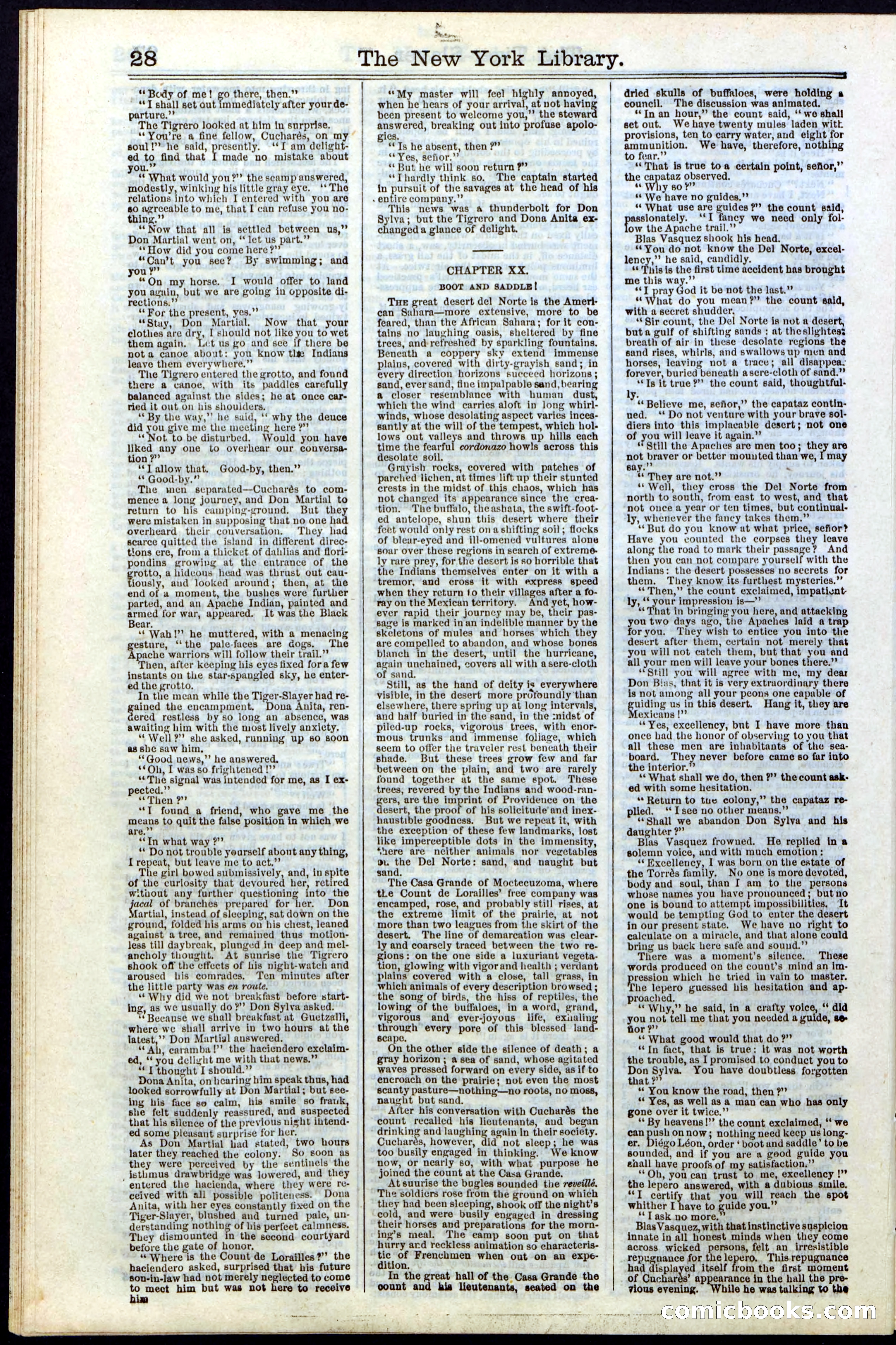
A restored page from Pulp Fiction, 1877. Page through the whole issue in the reader above.
📄 Transcribed text from this page (OCR, searchable)
Machine-transcribed from the original scan — historical spelling and the odd misread are preserved.
bs fon rete 38 The New York Library. Qao-on. ee ee ae — a - = —— — — a aS eo ee. Se ae Ee SSS Se eg +--+ -- = Ses FETs ———— — 7 —— -—- = = >>=r = = es ———— ~ = —— o-n= 2 i> iw: Ss > ee SS UZ —— a en —<——er= e —< - - = ——— — ~ —— == —_ ** Bady of me! go there, then.” **T shall set out immediately after yourde- parture.”’ The Tigrero looked at him tn surprise. ‘“You’re a fine fellow, Cucharés, on my soul!’’ he said, gee PhS “*T am delight- ed to find that [ made no mistake about ** What would you?’ the seamp answered, modestly, winking his little gray eye. ‘*The relations into which I entered with you are so agreeable to me, that I can refuse you no- thing.” “Now that all is settled between us,” Don Martial went on, “ let us part.” ‘How did you come here?” or cat you see? By swimming; and u “On my horse. I would offer to land you avuin, but we are going in opposite di- rections.” “For the present, yes.” “Stuy, Don Martial. Now that your clothes are dry, I should not like you to wet them again. Lect us go and see if there be nota canoe about: you know tle Indians leave them everywhere.” The Tigrero entered the grotto, and found there a canoe, with its paddles carefully bajanced against the sides; he at once car- ried it out on his shoulders. ‘“* By the way,’’ he said, ‘‘ why the deuce did te give me the meeting here ?”’ ** Not. to be disturbed. Would you have liked any one to overhear our conversa- tion ?” ‘‘] allow that. Good-by, then.’’ ** Good-by.” The wen separated—Cucharés to com- mence a long journey, and Don Martial to return to his camping-ground. But they were mistaken in supposing that no one had overheard their conversation. They had seurce quitted the island in different direc- tions ere, from a thicket of dahlias and flori- pondins growing at the entrance of the rotto, a hideous head was thrust out cau- iously, aud looked around; then, at the end of a moment, the bushes were further parted, and an Apache Indian, painted and armed for war, appeared. It was the Black ear. ‘‘ Wah!’ he muttered, with a menacing gesture, “the pale-faces are dogs. The Apache warriors will follow their trail.” hen, after keeping his eyes fixed fora few instants on the star-spangled sky, he enter- ed the grotto. In the mean while the Tiger-Slayer had re- gained the encampment, ‘Dona nita, ren- ered restless by so long an absence, was awaiting him with the most lively anxiety. ‘““ Well?” she asked, running up 80 soon as she saw him, **Good news,”’ he answered, ‘Oh, I was so frightened !”’ **The signal was intended for me, as I ex- pected.”’ ** Then.?’’ “T found a friend, who gave me the means to quit the false position in which we are.’ “*TIn what way ?” ‘** Do not trouble yourself abont any thing, I repeat, but leave me to act,” The girl bowed submissively, and, in spite of the curiosity that devoured her, retired witnout any further questionin into the Gon of branches prepared for her. Don artial, instead of slecping, sat down on the ground, folded his arms on his chest, leaned against a tree, and remained thus motion- less till daybreak, plunged in deep and mel- ancholy thought. At sunrise the Tigrero shook off the cffects of his night-watch and aroused his comrades, Ten minutes after the little party was en route, ‘““Why did we not breakfast before start- ing, as we usually do ?”’ Don Sylva asked. ‘Because we shall breakfast at Guetzalli, where we shall arrive in two hours at the latest,’? Don Martial answered. “Al, caramba!’’ the haciendero exclaim- ed, “‘ you delight me with that news.”’ “‘T thought I should.” Dona Anita, on hearing him speak thus, had looked sorrowfully at Don Martial; but see- ing his face so calm, his smile so frauk she felt suddenly reassured, and suspected that his silence of the previous night ihtend- ed some pleasant surprise for her. As Don Martial liad stated, two hours later they reached the colony. So soon as they were perceived by the sentinels the isthmus drawbridge was lowered, and they entered the hacienda, where they were re- ceived with all possible politeness. Dona Anita, with her eyes constantly fixed on the Tiger-Slayer, blushed and turned pale, un- derstanding nothing of his perfeet calmness. They dismounted in the second courtyard before the gate of honor, “Where is the Count de Lorailles?’’ the haciendero asked, surprised that his future son-in-law had not merely neglected to come “My master will feel highly annoyed, when he hears of your arrival, at not havin been present to welcome you,”’ the stewar See ts breaking out into profuse apolo- es. Be Ts he absent, then ?”” ‘“Yes, sefior.”’ ‘But he will soon return ?” “Thardly think so, The captain started in pursuit of the savages at the head of his . entire company.” This news was 4 thunderbolt for Don Sylva; but the Tigrero and Dona Anita ex- changed a glance of delight. --_ CHAPTER XX. BOOT AND SADDLE! Tue great desert del Norte is the Ameri- can Sahara—more extensive, more to be feared, than the African Sahara; for it con- tains no laughing oasis, sheltered by fine trees, and refreshed by sparkling fountains. Beneath a coppery sky extend immense plains, covered with dirty-grayish sand; in every direction horizons succeed horizons; sand, ever sand, fine impalpable sand, bearing a closer resemblance with human dust, which the wind carries aloft in long whirl- winds, whose desolating aspect varies inces- santly at the will of the tempest, which hol- lows out valley and throws up hills each time the fearful cordonazo howls across this desolate soil. Grayish rocks, covered with patches of parched lichen, at times lift up their stunted crests in the midst of this chaos, which has not changed its appearance since the crea- tion. The buffalo, the ashata, the swift-foot- ed antelope, shun this desert where their feet would only rest ona shifting soil; flocks of blear-eyed and ill-omened vultures alone soar over these regions in search of extreme- ly rare prey, for the desert is so horrible that the Indians themselves enter on it with a tremor, and cross it with express speed when they return fo their villages after a fo- ray on the Mexican territory. nd yet, how- ever rapid their journey may be, their pas- sage is marked in an indelible manner by the skeletons of mules and horses which they are compelled to abandon, and whose bones blanch in the desert, until the hurricane, arain unchained, covers all with asere-cloth of sand. Still, as the hand of deity is everywhere visible, in the desert more profoundly than elsewhere, there spring up at long intervals, and half buried in the sand, in the :nidst of piled-up rocks, vigorous trees, with enor- mous trunks and immense foliage, which seem to offer the traveler rest beneath their shade. But these trees grow few and far between on the plain, and two are rarely found together at the same spot. These trees, revered by the Indians and wood-ran- ers, are the imprint of Providence on the esert, the proof of his solicitude’and inex- haustible goodness. But we repeat it, with the exception of these few landmarks, lost like imperceptible dots in the immensity, “here are neither animals nor vegetables ou ait Del Norte: sand, and naught but sand. The Casa Grande of Moctecuzoma, where tLe Count de Lorailles’ free company was encamped, rose, and probably still rises, at the extreme limit of the prairie, at not more than two leagues from the skirt of the desert. The line of demarcation was clear- ly and coarsely traced between the two re- gions: on the one side a luxuriant vegeta- tion, glowing with vigor and health ; verdant plains covered with a close, tall grass, in which animals of every description browsed ; the song of birds, the hiss of reptiles, the lowing of the buffaloes, in a word, grand, vigorous and ever-joyous life, exialin through every pore of this blessed latide scape. On the other side the silence of death; a gray horizon ; a sea of sand, whose agitated waves pressed forward on every side, asif to encroach on the prairie; not even the most scanty pasture—nothing—no roots, no moss, naught but sand. After his conversation with Cucharés the count recalled his lieutenants, and began drinking and ce again in their society. Cucharés, however, did not sleep; he was too busily engaged in thinking. We know now, or nearly 80, with what purpose he joined the count at the Casa Grande. At suurise the bugles sounded the reveillé. The soldicrs rose from the ground on which they had been sleeping, shook off the night's -cold, and were busily engaged in dressing their horses and preparations for the morn- ing’s meal. The eamp soon put on that hurry ard reckless animation so echaracteris- ~ tic of Frenchmen when out on an expe- dition. In ray erie hall of the Casa Grande the count hia lieutenants, seated on the ——e dried skulls of buffaloes, were holding a council. The discussion was animated, “Tn an hour,” the count said, ‘* we shall set out. We have twenty mules laden witk provisions, ten to carry water, and eight for ammunition. We have, therefore, nothing to fear.”’ “That is true toa certain point, sefior,”’ the capataz observed. “Why 60?” ** We have no guides,”’ “ What use are guides ?” the count said, susan 2h ‘I fancy we need only fol- ow the Apache trail.” Blas Vasquez shook his head. ““You do not know the Del Norte, excel- lency,”’ he said, candidly, ‘¢ This is the first time accident has brought me this way.’ **T pray God it be not the last.” “What do you mean?” the count said, with a secret shudder, “Sir count, the Del Norte is not a desert, but a gulf of shifting sands : at theslightes; breath of air in these desolate regions the sand rises, whirls, and swallows up men and horses, leaving not a trace; all disappea, forever, buried beneath ascre-cloth of sand.” ‘*Ts it true?” the count said, thoughtful- l Mu Believe me, sefior,’’ the capataz contin- ued. ‘ Do not venture with your brave sol- diers into this implaeable desert; not one of you will leave it ayain.” * Still the Apaches are men too; they are not braver or better mounted than we, I may Bay. . if They are not.” ‘* Well, they cross the Del Norte from north to south, from east to west, and that not once a year or ten times, but continual- ly, whenever the fancy takes them,” ‘But do you know at what price, sefior? Have you counted the corpses they leave along the road to mark their passage? And then you can not compare yourself with the Indians: the desert possesses no secrets for them. They know its furthest mysteries.’ “Then,” the count exclaimed, impativat ly, ‘‘ your impression is—”’ “That in bringing you here, and attacking ou two days ago, the Apaches laid a trap oryou. They wish to entice you into the desert after them, certain not merely that you will not catch them, but that you and all your men will leave your bones there.” ‘Still you will agree with me, my dear Don Bias, that it is very extraordinary there is not among all your peons one capable of guiding us in this desert. Hang it, they are exicans !”’ “Yes, excelleney, but I have more than once had the honor of observing to you that all these men are inhabitants of the sea- board. They never before came so far into the interior.” ‘What shall we do, then ?”’ the count ask- ed with some hesitation. * Return to tue colony,’”’ the capataz re- plied. ‘‘Isee no other means.” ‘*Shall we abandon Don Sylva and his daughter ?” Blas Vasquez frowned. He replied in a solemn voice, und with much emotion: ‘« Excellency, I was born on the estate of the Torrés family. No one is more devoted, body and soul, than I am to the persons whose names you have pronounced; but no one is bound to attempt impossibilities, ‘It would be tempting God to enter the desert in our present state. We have no right to calculate on a miracle, and that alone could bring us back here safe and sound.” There was a moment's silence. These words produced on the count’s mind an Im- ression which he tried in vain to master. he lepero guessed his hesitation and ap- proached, ‘““Why,” he said, in a crafty voice, ‘ did you pot tell me that you needed a guide, se fior ?”’ : ‘* What good would that do?” ‘In fact, that is true: it was not worth the trouble, as I promised to conduct you to Don Sylva. You have doubtless forgotten that ? * You know the road, then ?”’ ** Yes, as well as a man can who has only gone over it twice.” ** By heavens!’’ the count exclaimed, ‘* we can Poe on now; nothing need keep us long- er igo Léon, order ‘ boot and saddle’ to be sounded, and if you are a good guide you enall have proofs of my satisfaction,” **Oh, you can trust to me, excellency !” the lepero answered, with a dubious smile. “I certify that you will reach the spot whither I have to guide you,”’ ‘Task no more, Blas Vasquez, with that instinctive suspicion innate in all honest minds when they come across wicked persons, felt an_ irresistible repugnance for the lepero. This repugnance had displayed itself from the first moment of Cuchares’ app in the hall the pre- vious evening. he mect him but was not here to receive hile he was talking to the =~COMIENOOKS: CO a =) i 2 TE eT ee = perm ‘——— oo Wy | By