
Pulp Fiction, 1877 · page 20 of 40
Beadle's New York Dime Library, Vol. II, No. 15 — page 20: what you’re looking at
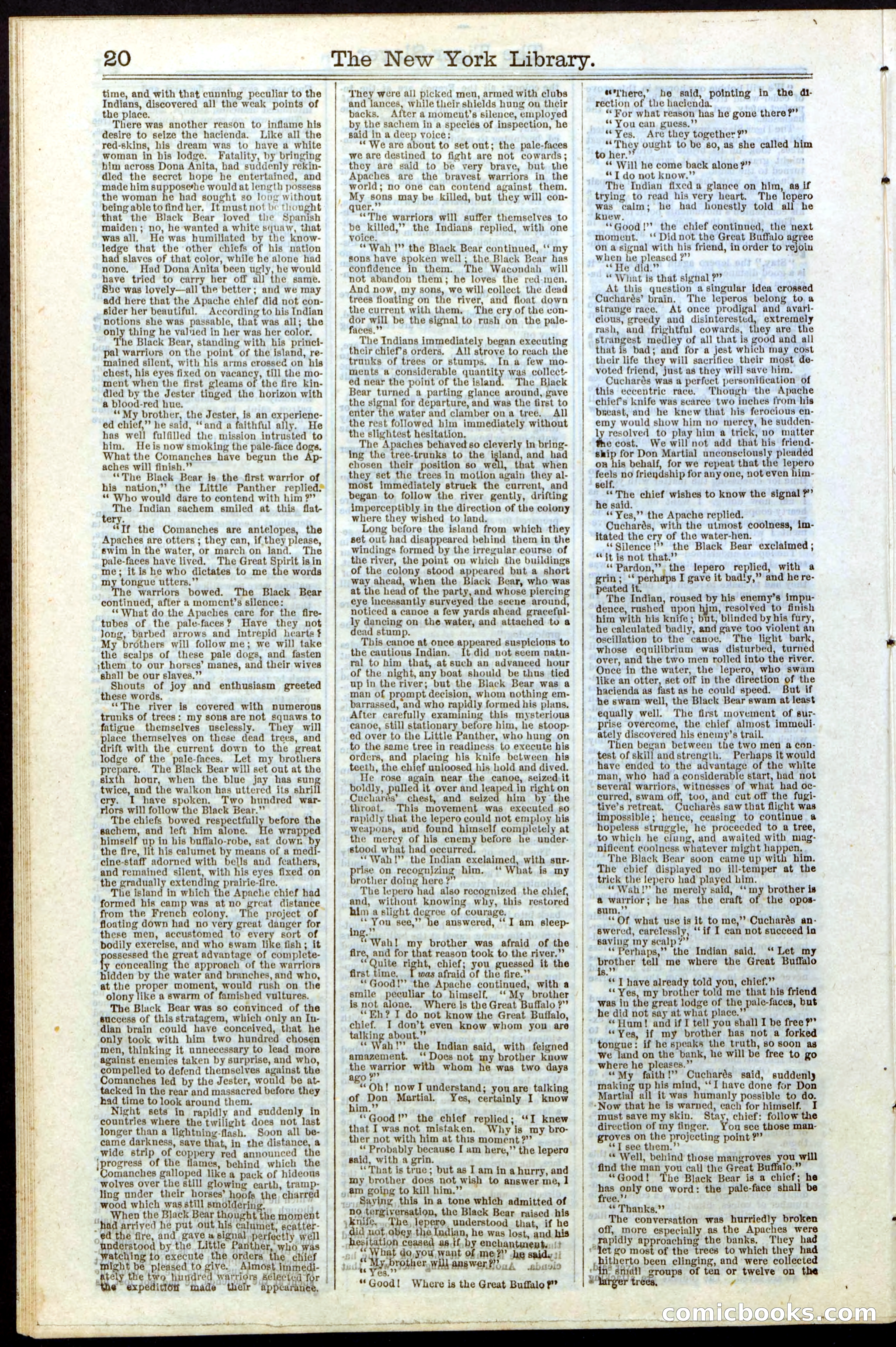
A restored page from Pulp Fiction, 1877. Page through the whole issue in the reader above.
📄 Transcribed text from this page (OCR, searchable)
Machine-transcribed from the original scan — historical spelling and the odd misread are preserved.
“; oma 2. OT tr BS SS ES eet oe Sw eee > Soe EG Re —— a LE a — ~— a se — ee eh ao Se — a | “Had arrived he put out his calumet, ecatter- 04 the fire, and gave u signal perfectly well “understood by the Little Panther, who was ‘might be pleased to give. te ‘the expedition “made the The New York Library. time, and with that cunning peculiar to the Indians, discovered all the weak points of the place. There was another reason to inflame his desire to seize the hacienda. Like all the red-skins, his dream was to have a white woman in bis lodge. Fatality, by bringing bim across Dona Anita, bad suddenly rekin- dled the secret hope he entertained, and made him supposehe would at length possess the woman he had sought so lovug without being able to find her. It must not be thought that the Black Bear loved the Spanish maiden; no, he wanted a white squaw, that was all. He was humiliated by the know- ledge that the other chiefs of his nation had slaves of that color, while he alone had none. Had Dona Anita been ugly, he would have tried to carry her off all the same. She was lovely—all the better; and we may add here that the Apache chief did not con- sider her beautiful. According to his Indian notions she was passable, that was all; the only thing he valued in her was her color. The Black Bear, standing with his princi- pal warriors on the point of the island, re- mained silent, with his arms crossed on his chest, his eyes fixed on vacancy, till the mo- ment when the first gleams of the fire kin- dled by the Jester tinged the horizon with a blood-red hue. ‘*My brother, the Jester, is an experienc- ed chief,’ he sald, “and a faithful ally. He has well fulfilled the mission intrusted to him. Heis now smoking the pale-face dogs. What the Comanches have begun the Ap- aches will finish.” ‘The Black Bear is. the first warrior of his nation,” the Little Panther replied? “Who would dare to contend with him ?” The Indian sachem smiled at this flat- ry. “Tf the Comanches are antelopes, the Apaches are otters ; they can, if they please, swim in the water, or march on land. The pale-faces have lived. The Great Spirit isin me; itis he who dictates to me the words a Nate ha utters.” he warriors bowed. The Black Bear continued, after a moment’s silence: ‘What do the Apaches care for the fire- tubes of the pale-faces? Have they not Jong, barbed arrows and intrepid hearts t My brothers will follow me; we will take the scalps of these pale dogs, and fasten :them to our horses’ manes, and their wives shall be our slaves.” Shouts of joy and enthusiasm greeted these words. “The river is covered with numerous trunks of trees: my sons are not squaws to fatigue themselves uselessly. They will place themselves on these dead trees, and drift with the current down to the great lodge of the pale-faces. Let my brothers prepare. The Black Bear will set out at the sixth hour, when the blue jay has sung twice, and the walkon has uttered its shrill ery. I have spoken. Two hundred war- riors will follow the Black Bear.” The chiefs bowed respectfully before the sachem, and left him alone. e wrapped himself up in his buffalo-robe, sat down b the fire, lit his calumet by means of a medi- cine-staff adorned with bells and feathers, and remained silent, with his eyes fixed on the gradually extending prairie-fire. The island in which the Apache chief had formed his cata was atno great distance from the French colony. The project of floating down had no very great danger for these men, accustomed to every sort of bodily exercise, and who swam like fish; it ossessed the great advantage of complete- y concealing the approach of the warriors hidden by the water and branches, and who, at the proper moment, would rush on the olony like a swarm of famished vultures. The Black Bear was so convinced of the success of this stratagem, which only an In- dian brain could have conceived, that he only took with him two hundred chosen men, thinking it unnecessary to lead more against enemies taken by surprise, and who, compelled to defend themselves against the Comanches led by the Jester, would be at- tacked In the rear and massacred before they had time to look around them. Night sets in rapidly and suddenly in countries where the twilight does not last longer than a lightning-flash. Soon all be- came darkness, save that, in the distance, a wide strip of coppery red announced the i ig of the flames, behind which the omanches galloped like a pack of hideous wolves over the still glowing earth, tramp- ling under their horses’ hoofs the, charred wood which wasstill smoldering. | When the Black Bear thought the moment watching to execute the orders the chief ppe ne wet t Mbentr ade = - ’ Almost. immedi- | | teu ry} es, ee ee ‘They were all picked men, armed with clubs and lances, while their shields hung on their backs. After a moment’s silence, employed by the sachem in a species of inspection, he said in a deep voice: “We are about to set ont; the pale-faces we are destined to fight are not cowards; they are said to be very brave, but the Apaches are the bravest warriors in the world; no one can contend against them. My sons may be killed, but they will con- quer.”’ “The warriors will suffer themselves to be killed,’ the Indians replied, with one voice. “Wah !” the Black Bear continued, ‘‘ my sons have spoken well; the Black Bear has confidence in them. The Wacondah will not abandon them; he loves the red-men. And now, my sons, we will collect the dead trees fioating on the river, and float down the current with them, The cry of the von- dor will be the signal to rush on the pale- faces.” The Indians immediately began executing their chief’s orders. All strove to reach the trunks of trees or stumps. In a few mo- ments a considerable quantity was collect- ed near the point of the island The Black Bear turned a parting glance around, gave the signal for departure, and was the first to enter the water and clamber ona tree. All the rest followed him immediately without the slightest hesitation. The Apaches behaved so cleverly in bring- Ing the tree-trunks to the igland, and had chosen their position so well, that when they set the trees in motion again they al- most immediately struck the current, and began to follow the river gently, drifting imperceptibly in the direction of the colony where they wished to land. Long before the island from which they set out had disappeared behind them in the windings formed by the irregular course of the river, the point on which the buildings of the colony stood appeared but a short way ahead, when the Black Bear, who was at the head of the party, and whose piercin eye incessantly surveyed the scene around, noticed a canoe a few yards ahead graceful- ly dancing on the water, and attached to a dead stump. This canoe at once appeared suspicions to the cautions Indian. It did not seem natn- ral to him that, at such an advanced hour of the night, any boat should be thus tied up in the river; but the Black Bear was a man of prompt decision, whom nothing em- barrassed, and who rapidly formed his plans. After carefully examining this mysterious canoe, still stationary before him, he stoop- ed over to the Little Panther, who hung on to the same tree in readiness to execute his orders, and placing his knife between his teeth, the chief unloosed his hold and dived. He rose again near the canoe, seized. it boldly, pulle it over and leaped in right on Cucharés’ chest, and seized him by the throat. This movement was executed so rapidly that the lepero could not employ his weapons, and found himself completely at the mercy of his enemy before he under- stood what had occurred. ‘Wah !”’ the Indian exelaimed, with sur- hay on recognizing him. ‘ What is my rother doing here ?” The lepero had also recognized the chief, and, without knowing why, this restored him a slight degree of courage. * You see,”’ a answered, ‘I am sleep- ‘Wah! my brother was afraid of the fire, and for that reason took to the river.” ** Quite right, chief; you guessed it the first time. TI was afraid of the fire.” ‘**Good!”’ the Apache continued, with a smile peculiar to himself. ‘‘My brother is not alone. Where jis the Great Buffalo ?”’ ““Eh? I do not know the Great Buffalo, chief. I don’t even know whom yon are talking about.” ““ Wah!’ the Indian said, with feigned amazement. ‘‘ Does not my brother know the warrior with whom he was two days ago } “Oh! now I understand; you are talking af Don Martial. Yes, certainly I know m. *“Good!” the chief replied; “I knew that I was not mistaken. hy is my bro- ther not with him at this moment ?”’ ‘“‘ Probably because I am here,’ the lepera said, with a grin. ‘That is true; but as I am in a hurry, and my brother does not wish to answer me, 1 , am going to kill him.” Saying this ina tone which admitted of no torgiversation, the Black Bear raised his | knife... The, lepero. understood that, if he | 1a wat at the Indian om epadee ey he was lost, and his hesitation ceased a8 if,by enchantinente::/! pil 2 oe, 99,708. ant of me?) he saidy si ue yas brother Wil answenrP? of abmvis “Good! Where is the Great Buffalo?” nn oe teins teeth a a alee nn pe GOO OE in ] “Yet go mos itherto been clinging, and were collected : 8 “* groups of ten or twelve on the «“"rhere,’ he said, pointing In the di- rection of the hacienda. “For what reason has he gone there?’ “You can guess,” “Yes, Are they together?” “They ought to be 80, as she called him to her.’ ** Will he come back alone?” *“T do not know.” The Indian fixed a glance on him, as if trying to read his very heart. The lepero was calm; he had honestly told all he Kuew. **Good!’’ the chief continued, the next moment. ‘* Didnot the Great Buffalo agree on a signal with his friend, in order to rejoin when he pleased ?” ‘*He did.” “What is that signal ?” At this question a singular idea crossed Cucharés’ brain. The leperos belong to. a strange race. At once prodigal and ayari- cious, greedy and ‘ape, | extremely rash, and frightful cowards, they are the strangest medley of all that is good and all that is bad; and for a jest which may cost their life they will sacrifice their most de- voted friend, just as they will save him. Cucharés was a perfect personification of this eccentric race. Though the Apache chief's knife was scarce two inches from his breast, and he knew that his ferocious en- emy would show him no mercy, he sudden- ly resolved to play him a trick, no matter e cost. We will not add that his friend- ship for Don Martial unconsciously pleaded on his behalf, for we repeat that the lepero feels no friendship for any one, not even him- self. “The chief wishes to know the signal?” he said. ‘*Yes,’’ the Apache replied. Cucharés, with the utmost coolness, im- itated the cry of the water-hen. “ Silence!’ the Black Bear exclaimed ; “it is not that.” ‘* Pardon,”’. the lepero replied, with a grin; ‘* perhaps I gave it badly,” and he re- peated it. The Indian, roused by his enemy’s impu- dence, rushed upon hjm, resolved to finish him with his knife ; but, blinded by his fury, he calculated badly, and gave too violent an oscillation to the canoe. The light bark whose equilibrium was disturbed turned over, and the two men rolled into the river. Once in the water, the lepero, who swam like an otter, set off in the direction of the hacienda as fast as he could speed. But if he swam well, the Black Bear swam at least equally well. The first movement of sur- prise overcome, the chief almost immedi- ately discovered his enemy’s trail. ‘hen began between the two men a con- test of skill andstrength. Perhaps it would have ended to the advantage of the white man, who had a considerable start, had not several warriors, witnesses of what had oc- curred, swam off, too, and cut off the fugi- tive’s retreat. Cucharés saw that flight was impossible; hence, ceasing to continue a hopeless struggle, he proceeded to a tree, to which he clung, and awaited with mag- nificent coolness whatever might happen, The Black Bear soon came up with him. The cbief displayed no ill-temper at the trick the lepero had played him. ““Wah!’’ he merely said, ‘my brother is a warrior; he has the craft of the opos- sum.”’ “Of what use is it to me,’’? Cucharés an- swered, carelessly, ‘‘if I can not succeed in saving my sealp?”’ ‘* Perhaps,” the Indian said, ‘“* Let my Ler St tell me where the Great Buffalo **T have tina told you, chief.” ‘Yes, my brother told me that his friend was in the great lodge of the pale-faces, but he did not say at what place,’ “Hum! and if I tell you shall I be free?” “Yes, if my brother has not a forked tongue: if he speaks the truth, 80 soon as we lund on the bank, he will be free to go where he pleases.”’ “My faith!’ Cucharés said, suddenly makin up his mind, ‘‘I have done for Don Martial all it was humanly possible to do. ‘Now that he is warned, each for himself. I must save my skin. Stay, chief: follow the direction of my finger. on sce those man- groves on the projecting point ” ‘“*T see them.”’ “ Well, behind those mangroves you will find the man you call the Great Buffalo.” “Good! The Black Bear is a chicf; he one only one word: the pale-face shall be ee”? ** Thanks.” The conversation was hurriedly broken off, more especially as the Apaches were rapidly approaching the banks, They had fof the trees to which they had / aGOMIE JOOKS, com”