
Pulp Fiction, 1877 · page 19 of 40
Beadle's New York Dime Library, Vol. II, No. 15 — page 19: what you’re looking at
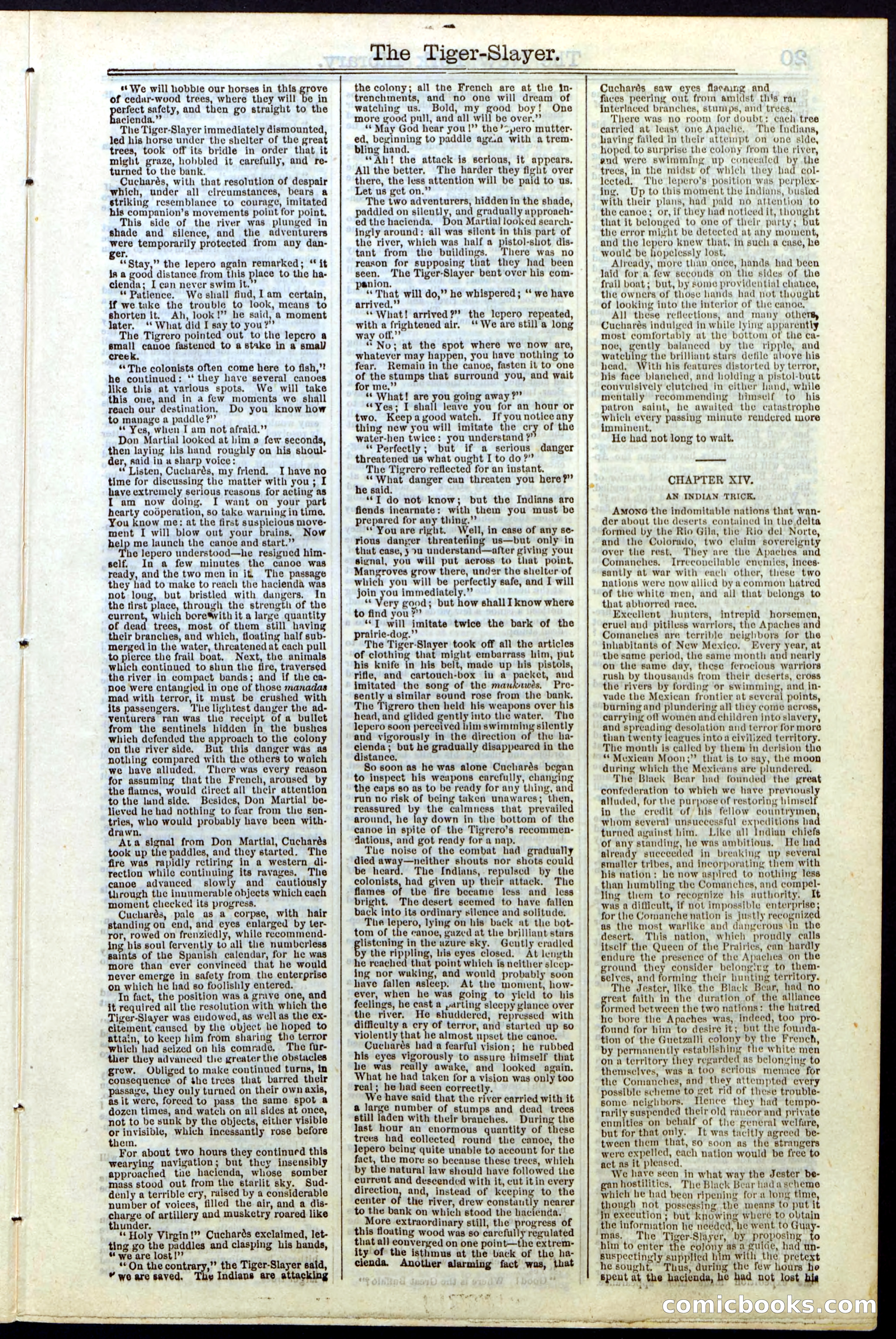
A restored page from Pulp Fiction, 1877. Page through the whole issue in the reader above.
📄 Transcribed text from this page (OCR, searchable)
Machine-transcribed from the original scan — historical spelling and the odd misread are preserved.
7 ———— s¢ We will hobble our horses in this grove of cedur-wvod trees, where they will be in erfect safety, and then go straight to the acienda.”” The Tiger-Slayer immediately dismounted, led his horse under the shelter of the great trees, took off its bridle in order that it might graze, hobbled it carefully, and re- turned to the bank. Cucharés, with that resolution of despair which, under all circumstances, bears a striking resemblance to courage, imitated his companion’s movements point for point. This side of the river was plunged in shade and silence, and the adventurers were temporarily protected from any dan- er. F “Stay,” the lepero again remarked; ‘“* it is a good distance from this place to the ha- cienda; I can never swim it,” “Patience. We shall find, lam certain, if we tuke the trouble to look, means to shorten it. Ah, look!’’ he said, a moment later, ‘* What did I say to you?” The Tigrero pointed out to the lepero a emall canoe fastencd to a stake in a smal creek. “The colonists often come here to fish,” he continued: ‘‘ they have several canoes like this at various spots. We will take this one, and in a few moments we shall reach our destination. Do you know how to manage a paddle?” ‘© Yes, when I am not afraid.” Don Martial looked at him 9 few seconds, then laying his hand roughly on his shoul- der, said in «a sharp voice: ‘* Listen, Cucharés, my friend. I have no time for discussing the matter with you; I have extremely serious reasons for acting as I am now doing. I want on your part hearty coOperation, so take warning in time, You know me; at the first suspicious move- ment I will blow out your brains. Now help me launch the canoe and start.” The lepero understood—he resigned him- self. In a few minutes the canoe was ready, and the two men in it The passage they had to make to reach the hacienda was not long, but bristled with dangers. In the tirst place, through the strength of the current, Which bore®with it a large quantity of dead trees, most of them still having their branches, and which, floating half sub- merged in the water, threatenedat cach pull to pierce the frail boat, Next, the animals which continued to shun the fire, traversed the river in compact bands; and if the ca- noe were entangled in one of those manadas mad with terror, it must be crushed with its passengers. ‘Tlic lightest danger the ad- venturers ran was the receipt of a bullet from the sentinels hidden in the bushes which defended the approach to the colony on the river side, But this danger was as nothing compared with the others to woich we bave alluded, There was eyery reason for assuming thatthe French, aroused by the flames, would direct all their attention to the lund side. Besides, Don Martial be- lieved he had nothing to fear from the sen- tries, who would probably have been with- drawn. Ata signal from Don Martial, Cucharés took up the pendles, and they started. The fire was rapidly retiring in a western di- rection while continuing its ravages. The canoe advanced slowly and cautious] through the innumerable objects which cac moment cliccked its progress. Cucharés, pale as a corpse, with hair standing on end, and eyes enlarged by ter- ror, rowed on frenziedly, while recommend- ing his soul fervently to ali the numberless saints of the Spanish calendar, for he was more than ever convinced that he would never emerge in safety from the enterprise on which he had so foolishly entered. In fact, the position was a grave one, and it required all the resolution with which the Tiger-Slayer was cudowed, as well as the ex- citement caused by the object he hoped to attain, to keep him from sharing the terror which had seized on his comrade, The fur- ther they advanced the greater the obstacles grew. Obliged to make continued turns, in | consequence of she trees that barred their save, they only turned on their own axis, as it were, forced to pass the same spot a dozen times, and watch on all sides at once, not to be sunk by the objects, either visible or invisible, which incessantly rose before them. For about two hours they continued this wearying navigation; but they insensibly approached tie hacienda, whose somber mass stood out from the starlit sky. Sud- denly a terrible ery, raised by a considerable number of voices, filled the air, and a dis- charge of artillery and musketry roared like under, “ Holy Virgin!” Cucharés exclaimed, let- ting go the paddles and clasping his hands, “ we are lost!”’ thd ‘On the contrary,” the Tiger-Slayer said, “woare saved, Thy Indians are attacking _ “= The Tiger-Slayer. the colony; all the French are at the in- trenchments, and no one will dream of watching us. Bold, my good boy! One more good pull, and all will be over.” ‘* May God hear you!”’ the’*pero mutter: ed, beginning to paddle aye.a with a trem- bling hand. “Ah! the attack is serious, it appears. All the better. The harder they fight over there, the less attention will be paid to us. Let us get on.” The two adventurers, hidden in the shade, paddled on silently, and gradually approach- ed the hacienda. Don Martial looked search- ingly around: all was silent in this part of the river, which was half a pistol-shot dis- tant from the buildings. There was no reason for supposing that they had been seen. ‘The Tiger-Slayer bent over his com- nion. ‘That will do,” he whispered; “‘ we have arrived,” ‘* What! arrived?’ the lepero repeated, with a frightened air. ‘We are still a long way off.” ‘““No; at the spot where we now are, whatever may rgd lg you have nothing to fear. Remain in the canoe, fasten it to one of the stumps that surround you, and wait for me,” ‘““ What! are you going away?” “Yes; I shall leave you for an hour or two. Keepayood watch. If you notice any thing new you will imitate the cry of the water-hen twice: you understand ?’ “Perfectly; but if a serious danger threatened us what ought I to do?” The Tigrcro reflected for an instant. “What danger cun threaten you here?” he said. ‘*T do not know; but the Indians are fiends incarnate: with them you must be prepared for any en ** You are right. Well, in case of any se- rious danger threateting us—but only in thut case, 5 u understand—alter giving your signal, you will put across to that point, Mangroves grow there, under the shelter of which you will be perfectly safe, and I will join you immediately.” ** Very good; but how shall I know where to find you?’ ‘‘T will imitate twice the bark of the prairie-dog.”’ The Tiger-Slayer took off all the articles of clothing that might embarrass him, put his knife in his belt, made up his pistols rifle, and cartouch-box in a packet, and imitated the song of the maukuwes. Pre- sently u similar sound rose from the bank. The Tigrero then held his weapons over his head, and glided De ee the water. Tho lepero soon perceived him swimming silently and vigorously in the direction of the ha- cienda; but he gradually disappeared in the distance. So soon as he was alone Cucharés began to inspect his weapons carefully, changing the caps so as to be ready for any thing, and run no risk of being taken unawares; then, reassured 7 the calmness that prevailed around, he lay down in the bottom of the canoe in spite of the Tigrero’s recommen- dations, and got ready for a nap. The noise of the combat had gradually died away—neither shouts nor shots could be heard. The [ndians, repulscd by the colonists, had given up their attack. The flames of tbe tire became less and less bright. The desert seemed to have fallen back into its ordinary silence and solitude. The lepero, lying on his back at the bot- tom of the canoe, guzed at the brilliant stars coaeam in the uzure sky. Gently cradled y the rippling, his eyes closed. At lenyth he reached that point which is neither slcep- ing nor waking, and would probably soon have fallen asleep. At the moment, how- ever, when he was going to yicld to his feelings, he cast a parting sleepy glance over the river. He shuddered, repressed with difficulty a = of terror, and started up 60 violently that he almost upset the canoe. Cucharés had a fearful vision; he rubbed his eyes vigorously to assure himself that he was really awake, and looked again. What he had taken for a vision was only too real; he had seen correctly. We have said that the river carried with it a large number of stumps and dead trees still laden with their branches. During the Jast hour an enormous quantity of these trees had collected round the canoe, the lJepero being quite unable to account for the fact, the more so because these trees, which by the natural law should have followed the eurrent and descended with it, cut itin every direction, and, instead of keeping to the center of the river, drew constantly nearer to the bank on which stood the hacienda. More extraordinary still, the progress of this floating wood was so carefully regulated that all converged on one point—the extrem- ity of the isthmus at the back of the ha- cienda. Another alarming fact was, that eto ,* ‘ ¢ refer va ‘mas. The Ti Cucharés saw eyes flacaing and faces peering out from amidst th's ras interlaced branches, stumps, and trees. There was no room for doubt: cach tree carried at least one Apache, The Indians, having failed in their attempt on one side, hoped to surprise the colony from the river, end were swimming up concealed by the trees, in the midst of which they had col- lected. The lepero’s position was perplex- ing. Up to this moment the Indians, busied with their plans, had paid no attention to the canoe; or, if they had noticed it, thought that it belonged to one of their party; but the error might be detected at any moment, and the lepero knew that, in such a case, he would be hopelessly lost, Already, more thin once, hands had been laid for a few seconds on the sides of the frail boat; but, by some providential chance, the owners of those hands had not thought of looking into the interior of the canoe, All these reflections, and many other Cucharés indulged in while lying apparently most comfortably at the bottom of the ca- nov, gently balanced by the ripple, and watching the brilliant sturs defile above his head, With his features distorted by terror, his face blanched, and holding a pistol-butt convulsively clutched in either hand, while mentally recommending himself to his patron saint, he awaited the catastrophe which every passing minute rendered more imminent, He had not long to wait. CHAPTER XIV. AN INDIAN TRICK, Amone the indomitable nations that wan- der about the deserts contained in the delta formed by the Rio Gila, the Rio del Norte, and the Colorado, two claim sovereignty over the rest. They are the Apaches and Comanches. Irreconcilable enemies, inces- santly at war with each other, these two nations were now allicd bya common hatred of the white men, and all that belongs to that abhorred race, Excellent hunters, intrepid horsemen cruel aud pitiless warriors, the Apaches an Comanches are terrible neighbors for the inhabitants of New Mexico. Every year, at the same period, the same month and nearly on the same day, these ferocious warriors rush by thousands from their deserts, cross the rivers by fording or swimming, and in- vude the Mexican frontier at several points, burning and plundering all they come across, carrying off women and children into slavery, and spreading desolation and terror for more than twenty leagues into a civilized territory. The month is called by them in derision the ~ * Mexican Moon;’’ that is to say, the moon during which the Mexicans are plundered. The Black Bear hid founded the great confederation to which we have previous! alluded, for the purpose of restoring himsel in the credit of his fellow countrymen whom several unsuccessful al al had turned against him. Like all Indian chiefs of any standing, he was ambitious. He had already succeeded in breaking wp several smuller tribes, and incorporating them with his nation: he now aspired to nothing less than humbling the Comanches, and compel- ling them to recognize his authority. It was a difficult, if not impossible enterprise; for the Comanche nation is justly recognize as the most warlike and dangerous ‘in the desert. This nation, which proudly calls itself the Queen of the Prairies, can hardly endure the presence of the Apaches on the ground x consider belongirg to them- selves, and forming their hunting territory. The Jester, like the Black Bear, had no eat faith in the duration of the alliance ormed between the two nations: the hatred he bore the Apaches was, indeed, too pro- found for him to desire it; but the founda- tion of the Guetzalli colony by the French, by permanently establishing the white men on a territory they regarded as belonging to themsclves, was a too serious menace for the Comanches, and they attempted every possible scheme to get rid of these trouble- some neighbors. Tlence they had tempo- rarily suspended their old rancor and private eniratttes on behalf of the general welfare, but for that only. It was tacitly agreed be- tween them that, so soon as the strangers were expelled, cach nation would be free to act as it pleased. | We have seen in what way the Jester be- nhostilitics, The Black Bear hada scheme which be had been ripening for a long time though not possessing the means to put it execution; but knowing where to obtain the information he needed, he went to Guay- . er-Slayer, by proposing. to him to enter the colony a8 a guide, had un- Be rectingly supplied him with the pretext he sought, Thus, CaaS the few hours he spent at the haciénda, he had not lost, i ° . —_ ii ee eee =— 4 + S reads eg | ’ ‘ ‘ OE ee EA ee tee ee J : ~ rd Ne gg ae gy ae an nn ge: a : - comicbooks.com Senet onteas Shapes etree cee emmeree 7 a -_ . f -_ 77 oo 1 uit 7