
Pulp Fiction, 1877 · page 16 of 28
Beadle's Dime Library, Vol. II, No. 14 — page 16: what you’re looking at
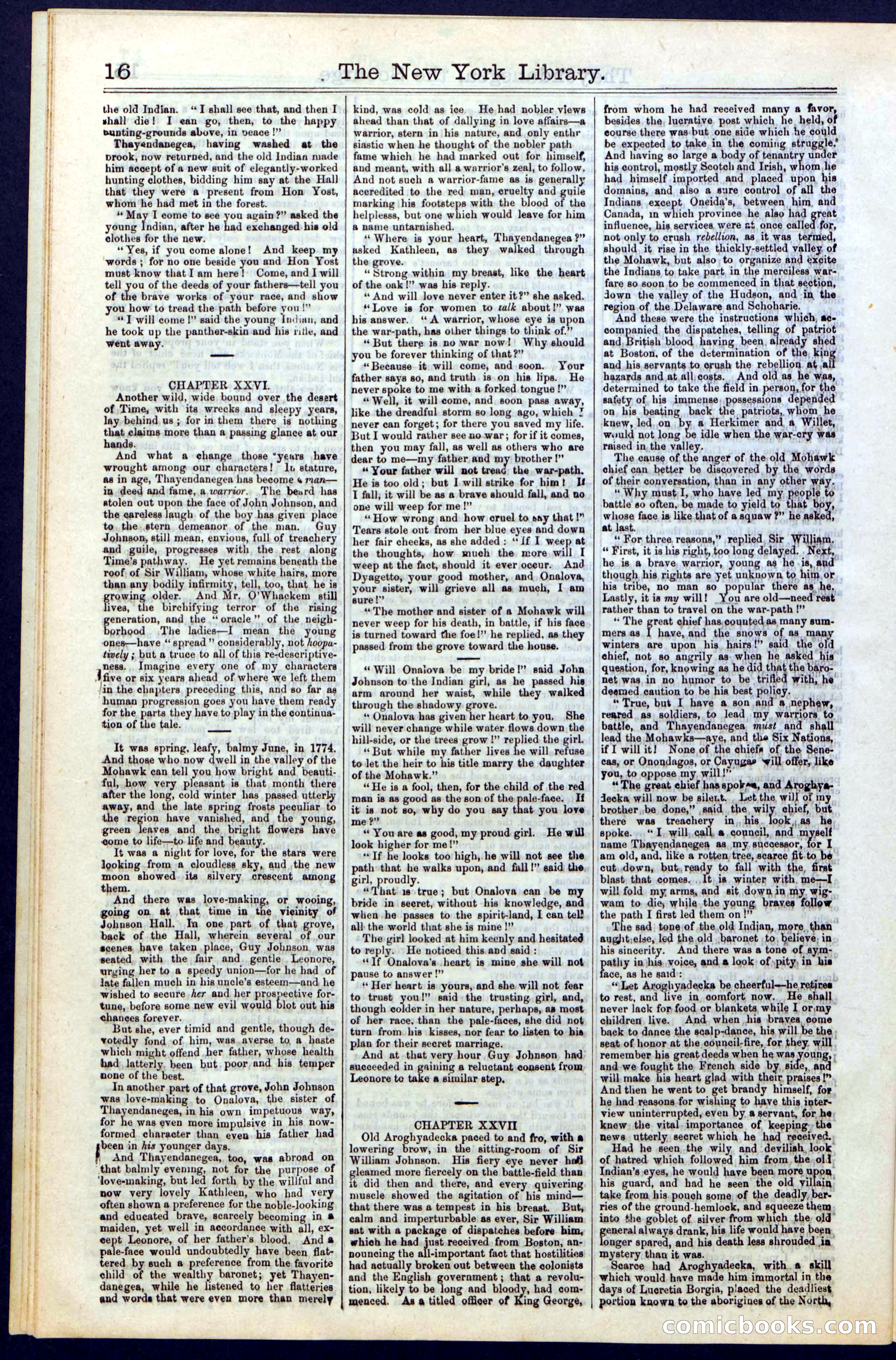
A restored page from Pulp Fiction, 1877. Page through the whole issue in the reader above.
📄 Transcribed text from this page (OCR, searchable)
Machine-transcribed from the original scan — historical spelling and the odd misread are preserved.
16 . The New York Library. the old Indian. “I shall see that, and then I shall die! I ean go, then, to the happy bunting-grounds above, in veace !” Thayendanegea, having washed at the prook, now returned, and the old Indian made him accept of a new suit of elegantly-worked hunting clothes, bidding him say at the Hall that they were a present from Hon Yost, whom he had met in the forest. “May I come to see you again?” asked the young Indian, after he had exchanged his old clothes for the new. “Yes, if you come alone! And keep my words ; for no one beside you and Hon Yost must know that Iam here! Come, and I will tell you of the deeds of your fathers—tell you of the brave works of your race, and show you how to tread the path before you!” “T will come !” said the young Indian, and he took up the panther-skin and his rifle, and went away. . CHAPTER XXVI. Another wild, wide bound over the desert of Time, with its wrecks and sleepy years, lay behind us ; for in them there is nothing that claims more than a passing glance at our hands. And what a change those ‘years have wrought among our characters! 1b stature, as in age, Thayendanegea has become « man— in deed and fame, a warrior. The beard has stolen out upon the face of John Johnson, and the careless laugh of the boy has given place to. the stern demeanor of the man, Guy Johnaon, still mean, envious, full of treachery and guile, progresses with the rest along Time’s pathway. He yet remains beneath the roof of Sir William, whose white hairs, more than any bodily infirmity, tell, too, that he is growing older. And Mr, O’Whackem still ives, the birchifying terror of the rising generation, and the “oracle”’ of the neigh- erbood The ladies—I mean the young ones—have “spread” considerably, not hoopa- tively ; but a truce to all of this re-descriptive- ,ness. Imagine every one of my characters five or six years ahead of where we left them lin the chapters preceding this, and so far as human progression goes you have them ready for the parts they have to play in the continua- tion of the tale. It was spring, leafy, balmy June, in 1774. And those who now dwell in the valley of the Mohawk can tell you how bright and beauti- ful, how very pleasant is that month there after the long, cold winter has passed utterly away, and the late spring frosts peculiar to the region have st Spa and the young, green leaves and the bright flowers have come to life—to life and beauty. It was a night for love, for the stars were looking from a cloudless sky, and the new moon showed. its silvery crescent among them. And there was love-making, or wooing, going on at that time in the vieinity of Johnson Hall. In one part of that grove, back of the Hall, wherein several of our scenes, have taken place, Guy Johnson. was seated, with the fair and. gentle Leonore, urging her to a speedy union—for he had of late fallen much in his uncle’s esteem—and. he wished to secure Aer and her prospective for- tune, before some new evil would blot out his chances forever. ut she, ever timid and gentle, though de- votedly fond of him, was.averse to a haste which might offend her father, whose health had latterly, been but poor,and his temper none of the best. In another part of that grove, John Johnson was love-making to Onalova, the sister of Thayendanegea, in his own impetuous way, for he was even more impulsive in his now- formed character than even his father had been in his younger days, And Thayendanegea, too, was abroad on that balmly evening, not for the purpose of ‘love-making, but led forth by the willful and now very lovely Kathleen, who bad very often shown a preference for the noble-looking and educated brave, scarcely becoming in ® maiden, yet well in accordance with all, ex- cept Leonore, of her father’s blood, And @ pale-face would undoubtedly have been flat- tered by such a preference from the favorite child of the wealthy baronet; yet Thayen- danegea, while he listened to her flatteries and words that were even more than merely kind, was cold as iee. He had nobler views ahead than that of dallying in love affairs—a warrior, stern in his nature, and only enthr siastic when he thought of the nobler path fame which he had marked out for himself, and meant, with all a warrior’s zeal, to follow. And not such a warrior-fame as is generally aceredited to the red man, cruelty and guile marking his footsteps with the blood of the helplesss, but one which would leave for him & name untarnished. ‘Where is your heart, Thayendanegea ?” asked Kathleen, as they walked through the grove. “Strong within my breast, like the heart of the oak!’ was his reply. “ And will love never enter it?” she asked. “Love is for women to talk about!” was his answer. “A warrior, whose eye is upon the war-path, has other things to think of.” “ But there is no war now! Why should you be forever thinking of that?” “ Because it will come, and soon. father says so, and truth is on his lips. never spoke to me with a forked tongue !” “Well, it will come, and soon pass away, like the dreadful storm so long ago, which ! never can forget; for there you saved my life. But I would rather see no war; for if it comes, then you may fall, as well as others who are dear to me—my father and my brother !” “ Your father will not treac the war-path, He is too old; but I will strike for him! If I fall; it will be as a brave should fall, and no one will weep for me!” “How wrong and how cruel to say that !” Tears stole out from her blue eyes and down her fair cheeks, as she added: “[f I ep at the thoughts, how much the more will I weep at the fact, should it ever oceur. And Dyagetto, your good mother, and Onalova, your sister, will grieve all as much, I am sure |” “The mother and sister of a Mohawk will never weep for his death, in battle, if his face is turned toward the foe!” he replied, as they passed from the grove toward the house. Your He “Will Onaiova be my bride!” said John Johnson to the Indian girl, as he passed his arm around her waist, while they walked through the shadowy grove. * Onalova has given her heart to you, She will never change while water flows down the hill-side, or the trees grow !” replied the girl. “But while my father lives he will refuse to let the heir to his title marry the daughter of the Mohawk.” “He is a fool, then, for the child of the red man is as good as the son of the pale-face. If it is not so, why do you say that you love me »” “ You are as good, my proud girl. He will look higher for me!” “If he looks too high, he will not see the path that he walks upon, and fall!” said the, girl, proudly. “That 18 true; but Onalova can be m bride in secret, without his knowledge, an when he passes to the spirit-land, I can tel? all the world that she is mine !” The girl looked at him keenly and hesitated to reply. He noticed this and said : ‘If Onalova’s heart is mine she will not pause to answer !” Her heart is yours, and she will not fear to trust you!” said the trusting girl, and, though colder in her nature, perhaps, as most of her race, than the pale-faces, she did not turn from his kisses, nor fear to listen to his plan for their secret marriage. And at that very hour Guy Johnson had succeeded in gaining a reluctant consent from Leonore te take a similar step, CHAPTER XXVII Old Aroghyadecka paced to and fro, with a lowering brow, in the sitting-room of Sir William Johnson. His fiery eye never hal gleamed more fiercely on the battle-field than it did then and there, and every quivering muscle showed the agitation of his mind— that there was a tempest in his breast. But, calm and imperturbable as ever, Sir William sat with a package of dispatches before him, which he had just received from Boston, an- nouncing the all-important fact that hostilities had actually broken out between the colonists and the English government; that a revolu- tion, likely to be long and bloody, had com- menced. As a titled officer of King George, seat. of honor at the council-fire, for they. from whom he had received many a favor, besides the, lucrative post which he held, of course there was but one side which he could be expected to take in the coming struggle.’ And having so large a body of tenantr under his control, mostly Scotch and Irish, whom, he had himself imported and placed upon his domains, and also a sure control of all the Indians except Oneida’s, between him, and Canada, in witioh province he also had great influence, his services, were st once called for, not only to crush rebellion, as it was termed, should it rise in the thickly-settled valley. of the Mohawk, but also to organize and excite the Indians to take part, in the merciless war- fare so soon to be commenced in that section, down the yalley of the Hudson, and in the region of the Delaware and Schoharie. And these were the instructions which, ae- companied the dispatches, telling of patriot and, British blood having been, already shed at Boston, of the determination of the, kin and his servants to crush the rebellion ata hazards and at allcosts. And old as he was, determined to take the field in. person, for the safety of his immense, possessions depended on his beating back the patriots, whom he knew, led.on by a Herkimer and a Willet, would not long be idle when the war-cry was raised in the valley. 7 The cause of the anger of the old Mohawk chief can better be discovered by the words of their conversation, than in any other way. “ Why must I, who have led my people to battle so often, be made to yield to that boy, whose face is like that of a squaw ?” he nikex at last. “ For three. reasons,” replied Sir Williqm. “ First, it is his right, too long delayed. Next, he is a brave, warrior, young as he .is, and though his rights are yet unknown to him, or his tribe, no man so popular there as he, Lastly, it is my will! You are old—need rest rather than to travel on the war-path !” “ The great chief has,countedas many sum- mers as f have, and the snows of as many winters are upon his hairs!” said the old chief, not so angrily as. when he asked his question, for, knowing as he did that the baro- net was in no humor to be trifled with, he deemed caution to be his best policy. “True, but I have a son and a nephew, reared as soldiers, to lead my. warriors to battle, and Thayendanegea must and shall lead the Mohawks—aye, and the Six Nations, if I will it! None of the chiefa of the Sene- cas, or Onondagos, or Cayugae will offer, like you, to oppose my, will!” : “The great chief hasspoksa, and Aroghya- Jecka will now be silent. . Let the will of my brother,,be done,” said the, wily chief, but there was treache in, his. look, as he spoke. “I, will, call, a council, and myself name Thayendanegea as my successor, for I am old, and, like a rotten, tree, searce fit to, cut, down, bata raetly to fall with the, first blast that comes. It is winter with, me—I will fold my, arms, and sit, down in my. wig- wam to die, while the young braves follow the path I first led them on!” The sad tonejof the old Indjan, more than aug)tvelse, led the old baronet to, believe; in his sincerity. And there was a tone of aym- paiby in his, voice, and a look of pity, in his ace, as he said: : * Let Aroghyadecke be cheerful——he retires to rest, and live in comfort now. He shall never lack for food or blankets, while I ormy children live. And when his braves. come back to dance the scalp-dance, his will be he remember his great deeds when he was young, ; and we fought the French side by, side, and will make his heart glad with their praises |” And then he went to get brandy himself, for he had reasons for wishing to have this inter- view uninterrupted, even by a servant, for he knew the vital. importance of keeping. the news utterly secret which he had received. Had he seen the wily and devilish, look of hatred which followed him from, theold Indian’s eyes, he would have been more upon. his guard, and had he seen the old villain take from his. pouch some, of the deadly, ber. ries of the ground-hemlock, and squeeze them into the goblet of silver from which the old ral always drank, his life would have been. onger spared, and his death less shrouded in mystery than it was. Scarce had Aroghyadecka, witha skill which would have made him immortal in the days of Lucretia Borgia, placed the deadliest portion known to the aborigines of the North, Eomicbooksne (0)