
Pulp Fiction, 1877 · page 15 of 28
Beadle's Dime Library, Vol. II, No. 14 — page 15: what you’re looking at
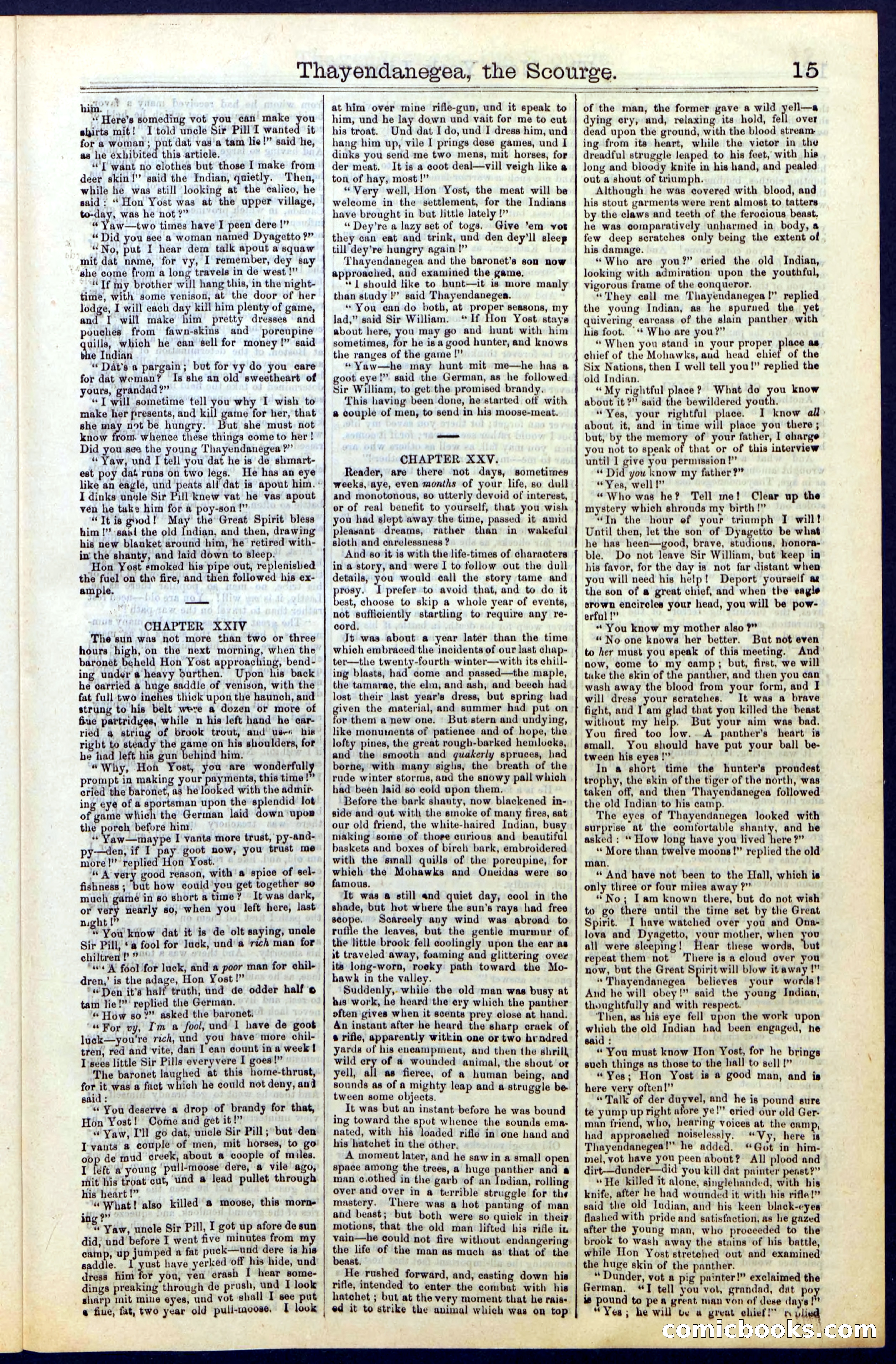
A restored page from Pulp Fiction, 1877. Page through the whole issue in the reader above.
📄 Transcribed text from this page (OCR, searchable)
Machine-transcribed from the original scan — historical spelling and the odd misread are preserved.
— ‘‘ Here's someding vot you can make fi skirts mit! I told uncle Sir Pill T wanted it for a woman; put dat vas'a tam lie!” said he, as he éxhibited this article. “'T want no clothes but those I make from deer skin!’ said the Indian, quietly. Then, while he was still looking at the calico, he said: “ Hon Yost was at the upper village, to-day, was he not ?” 4 Vie size times have I peen dere !” “Did you see a woman named Dyagetto ?” “No, put I hear dem talk apout a squaw mit dat name, for vy, I remember, dey say she come from a long travels in de west !” “Tf my brother will hang this, in the night- time, with some venison, at the door of her lodge, I will each day kill him plenty of game, and [ will make him pretty dresses and pouches from fawa-skins and poreupine uills, which he can sell for money!” said the Indian “ Dat's a pargain; but for vy do you care for dat woman? Is she an old sweetheart of yours, grandad?” “TI will sometime tell you why I wish to make her presents, and kill game for her, that she may not be hungry. But she must not know from. whence these things come to her! Did you see the young Thayendanegea?” “Yaw, und I tell you dat he is de shmart- est poy dat runs on two legs. He has an eye like an eagle, und peats all dat is apout him. I dinks ungle Sir Pill knew vat he vas apout vén he take him for @ poy-son !” “Tt is good! May the Great Spirit bless him !’* gad the old Indian, and then, drawing his new blanket around him, he retired with- in the shanty, and laid down to sleep. ‘Hon Yost smoked his pipe out, replenished the fuel on tho fire, and then followed his ex- ample. CHAPTER XXIV The sun was not more than two or three hours high, on the next morning, when the baronet beheld Hon Yost gppvthchink? bend- ing under @ heavy burthen. Upon his back he carried a huge saddle of venison, with the fat full two inches thick upon the haunch, and strung to his belt weve a dozen or more of fiue partridges, while n his left hand he car- ried q string of brook trout, and user bis right to steady the game on his shoulders, for he had left his gun behind him. “Why, Hon Yost, you are wonderfully prompt in making your payments, this time !” cried the baronet, a3 he looked with the admir- ing eye of a sportsman upon the s lendid lot of game which the German laid down upon the porch before hinr, ‘'Yaw—tmaype I vants more trust, py-and- py-—den, if I poy goot now, you trust me more!’ replied Hon Yost. “ A very good reason, with @ spice of sel- fishneas ; but how could yeu get together so much garné in so short a time? It was dark, or very nearly so, when you left here, last night |” c You know dat it is de olt saying, uncle Sir Pill, ‘@ fool for luck, und’ a rich man for chiltren ? ”° "4¢ A fool for luck, and a poor man for chil- dren,’ is the adage, Hon Yost!” ‘«'Den it’s half truth, und de odder half tam lie!” replied the German. “ How so?” asked the baronet. «For vy, I'm a fool, und 1 have de goot luck—you're rich, und you have more chil- tren, red and vite, dan I can count in a week | I'sees little Sir Pills everyvere I goes!” The baronet laughed at this home-thrust, for it was a fact which he could not deny, and said : «“ You deserve a drop of brandy for that, Hon Yost! Come and get it!” “ Yaw, Dll go dat, uncle Sir Pill; but den I-vauts a couple of men, mit horses, to go: oop de mud creek, about a coople of miles. I left a young ‘pull-moose dere, a vile ago, mit his troat cut, und @ lead pullet through his heart !” “What! also killed @ moose, this morn- + 9” th Yaw, uncle Sir Pill, I got up afore de sun did; und before I went five minutes from m camp, up jumped a fat puck—und dere is his saddle. I yust have yerked off his hide, und dress him for you, ven erash I hear some- dings preaking through de prush, und I look sharp mit mine eyes, und vot shall TI see put @ five, fat, two year old pull-moose, I look Thayendanegea, the Scourge. ES at him over mine rifle-gun, und it speak to him, und he lay down und vait for me to cut his troat. Und dat I do, und I dress him, und hang him up, vile I prings dese games, und I dinks you send me two mens, mit horses, for der meat. It is a coot deal—vill veigh like a ton of hay, most!” “Very well, Hon Yost, the meat will be welcome in the settlement, for the Indians have brought in but little lately !” “ Dey’re a lazy set of togs. Give ’em vot they can eat and trink, und den dey’ll sleep till dey’re hungry again !” Thayendanegea and the baronet’s son now approached, and examined the game. “| should like to bunt—it is more manly than study !”’ said Thayendanegea. * You can do both, at proper seasons, my lad,” said Sir William. “If Hon Yost stays about here, you may go and hunt with him sometimes, for he is a good hunter, and knows the ranges of the game |” “ Yaw—he may hunt mit me—he has a goot eye!” said the German, as he followed. Sir William, to get the promised brandy. This having been done, he started off with a couple of men, to send in his moose-meat. CHAPTER XXYV. Reader, are there not days, sometimes weeks, aye, even months of your life, so dull and monotonous, 8o utterly devoid of interest, or of real benefit to yourself, that you wish you had slept away the time, passed it amid pleavant dreams, rather than in wakeful sloth and carelessness ? And so it is with the life-times of characters in a story, and were I to follow out the dull details, you would call the story tame and prosy: I prefer to avoid that, and to do it est, choose to skip a whole year of events, not sufficiently startling to require any re- cord, Jt was about a year later than the time which embraced the incidents of our last chap- ter—the twenty-fourth winter—with its chill- ing blasts, had come and passed—the maple, the tamarae, the elm, and ash, and beech had lost their last year’s dress, but spring had given the material, and summer had put on ‘or them a new one. But stern and undying, like monuments of patience and of hope, the lofty pines, the great rough-barked hemlocks, and the smooth and quakerly spruces, had borne, with many sighs, the breath of the rude winter storms, and the snowy pall which had been Jaid so cold upon them. Before the bark shanty, now blackened in- side and out with the emoke of many fires, sat our old friend, the white-haired Indian, busy making some of thoree curious and beautiful baskets and boxes of birch bark, embroidered with the small quills of the porcupine, for which the Mohawks and Oneidas were so famous. It was a still and quiet day, cool in the shade, but hot where the sun's rays had free scope. Scarcely any wind was abroad to rufile the leaves, but the gentle murmur of the little brook fell coolingly upon the ear as it traveled away, foaming and glittering over its long-worn, rocky path toward the Mo- hawk in the valley. Suddenly, while the old man was busy at his work, he heard the ery which the panther often gives when it scents prey close at hand. An instant after he heard the sharp crack of 8 rifle, apparently witkin one or two hrndred yards of his encampment, and then the shrill wild ery of a wounded animal, the shout or yell, all as fieree, of a human being, and sounds as of a mighty leap and a struggle be tween some objects. _ It was but an instant before he was bound ing toward the spot whence the sounds ema- nated, with his loaded rifle in one hand and his hatchet in the other. A moment later, and he saw in a small open space among the trees, a huge panther am 4 man c.othed in the garb of an Frcstion; rolling over and over in a terrible struggle for the mastery. There was a hot panting of man and beast; but both were so quick in their motions, that the old man lifted his rifle in vain—he could not fire without endangering: the life of the man as much as that of the beast. He rushed forward, and, casting down his rifle, intended to enter the sotistio’ with his hatchet ; but at the very moment that he rais+ ed it to strike the auimal which was on top 15 of the man, the former gave a wild yell—a dying ery, and, relaxing its hold, fell over dead upon the ground, with the blood stream ing from its heart, while the victor in the dreadful struggle leaped to his feet, with his long and bloody knife in his hand, and pealed out a shout of triumph. Although he was covered with blood, and his stout garments were rent almost to tatters by the claws and teeth of the ferocious beast, he was comparatively unharmed in body, a few deep scratches only being the extent of his damage. “Who are you?” cried the old Indian, looking with admiration upon the youthful, vigorous frame of the conqueror. “They call me Thayendanegea!” replied the young Indian, as he spurned the yet quivering carcass of the slain panther with his foot. ‘‘* Who are you?” “When you stand in your proper place as chief of the Mohawks, and head chief of the Six Nations, then I well tell you!” replied the old Indian. “My rightful place? What do you know about it?” said the bewildered youth. “Yes, your rightful place. I know all) about it, and in time will place you there ; but, by the memory of your father, I charge you not to speak of that or of this interview until I give you permission!” “ Did you know my father?” “Yes, well!” “Who was he? Tell me! Clear up the mystery which shrouds my birth!” “In the hour ef your triumph I will! Until then, let the son of Dyagetto be what he has heen—good, brave, studious, honora- ble. Do not leave Sir William, but keep in his favor, for the day is not far distant when you will need his help! Deport yourself ax the son of a great chief, and when the eagle srown encircles your head, you will be pow- erful |” 3 “You know my mother also ?” “No one knows her better. But not even to her must you speak of this meeting. And now, come to my camp; but, first, we will take the skin of the panther, and then you can wash away the blood from your form, and I will dress your scratches. It was a brave fight, and I am glad that you killed the beast without my help. But your aim was bad. You fired too low..A panther’s heart is small, You should have put your ball be- tween his eyes |” In a short time the hunter's proudest trophy, the skin of the tiger of the north, was taken off, and then Thayendanegea followed the old Indian to his camp. The eyes of Thayendanegea looked with surprise at the comfortable shanty, and he asked : “ How long have you lived here?” “ More than twelve moons!” replied the old man, “And have not been to the Hall, which is only three or four miles away ?” “No; Iam known there, but do not wish to go there until the time set by the Great Spirit. I have watched over you and Ona- lova and Dyagetto, your mother, when you all were sleeping! Hear these words, but repeat them not There is a cloud over you’ now, but the Great Spirit will blow it away !" “'Thayendanegea believes your words! Aud he will obey!” said the young Indian, thoughtfully and with respect. ‘Then, as his eye fell upon the work upon wlieh the old Indian had been engaged, he said : “ You must know Ion Yost, for he brings such things as those to the hall to sel] !” “Yes; Hon Yost is a good man, and is here very often!” “Talk of der duyvel, and he is pound sure te yump up right afore ye!” cried our old Ger- man friend, who, hearing voices at the camp, had approached noiselessly, “Vy, here is Thayendanegea!” he added. “Got in him- mel, yot have you peen about? All plood and dirt-—dunder—did you kill dat painter penst?” “He killed it alone, singlehanded, with his knife, after he had wounded it with his rifle!” said the old Indian, and his keen black-eyes flashed with pride and satisfaction, as he gazed after the young man, who proceeded to the brook to wash away the stains of his battle, while Hon Yost stretehed out and examined the huge skin of the panther. “ Dunder, vot a pig puinter!” exclaimed the German. “T tell you vol, grandad, dat po i) pound to pea great man von of dese days!” “Yea; he will ve w great chief!" ry we ied “comieboo —_—s