
Pulp Fiction, 1877 · page 13 of 28
Beadle's Dime Library, Vol. II, No. 14 — page 13: what you’re looking at
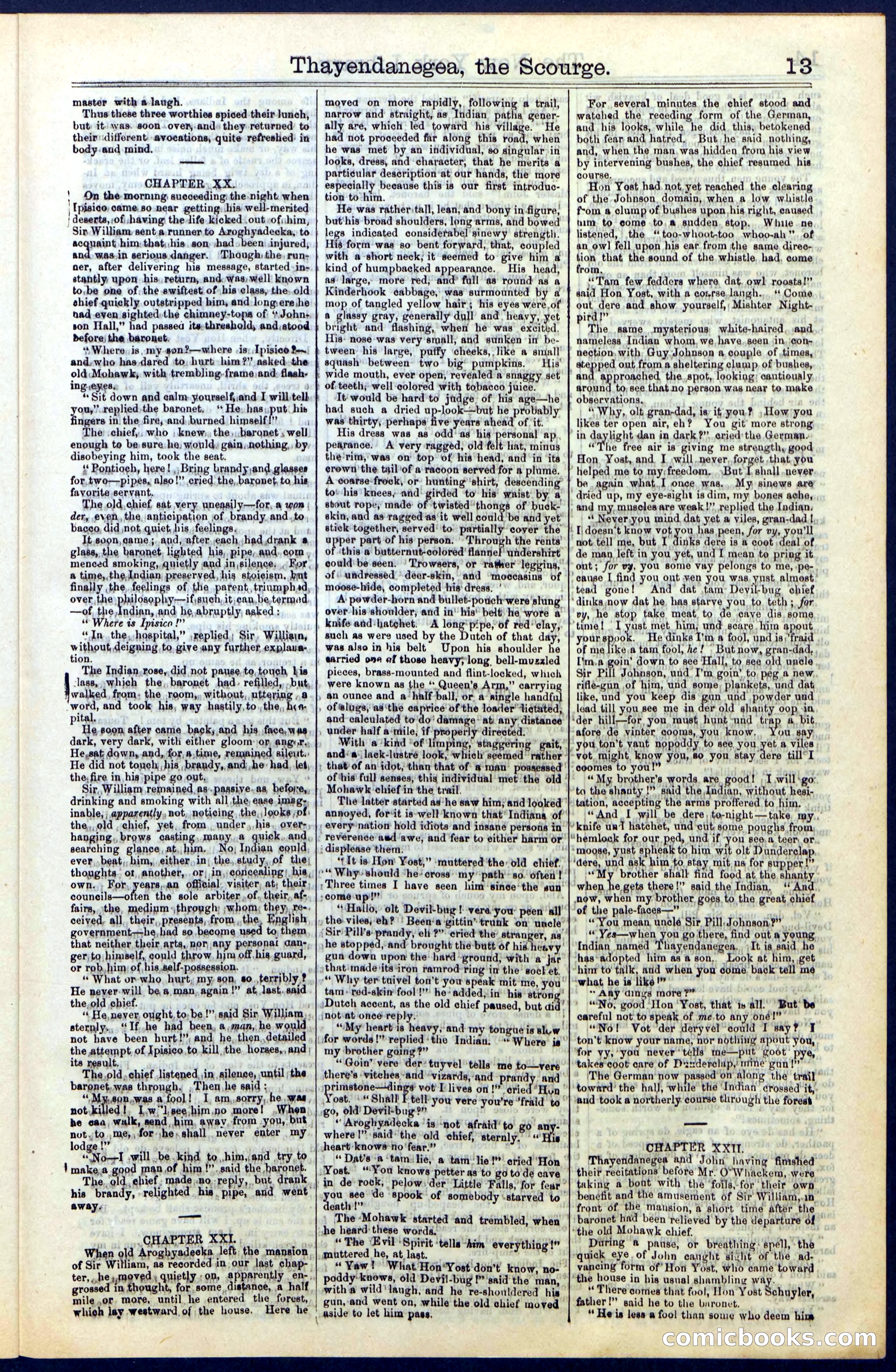
A restored page from Pulp Fiction, 1877. Page through the whole issue in the reader above.
📄 Transcribed text from this page (OCR, searchable)
Machine-transcribed from the original scan — historical spelling and the odd misread are preserved.
Thayendanegea, the Scourge. 13 master with a laugh. Thus these three worthies spiced their lunch, but it. was. soon .over,.and» they returned to their different: avocations, quite refreshed in body-and mind. CHAPTER, XX. ' On the morning succeeding the night when | [pisico, came, so near getting: his well-merited | deserts, of ,having: the dife kicked .out»ofihim, Sin William sent a.runner to Aroghyadecka, to acquaint him: that; his. son, had. been injured, and was.in serious. danger. ‘Though the, run- ner, after delivering his message, started .in- stantly, upon his, return, and was, well known to,be one of. the swiftest of his class, the. old shief quickly outstripped him, and long ere jhe nad even sighted: the i re a of “ John+ son Hall,” had passed itsthreshold, and\atood before the baronet. “Where. is, my-son?—where .is; Ipisico ~: and. who has dared to, hurt him?’ asked the | old:Mohawk, with trembling, frame,and; flash- ing eyes, you,” replied the baronet, ‘ He: has, pes his fingers in. the fire, and burned himself!” he’ chief,. who , knew, the,..baronet , well enough to be eure he, would, gain. nothing, by, disobeying him, took the seat. ‘ Pontioch, here! ,, Bring brandy,and. glasses for, two—pipes, also!” cried the, baronet, to his favorite servant, The old. chief, sat very uneasily—for, a won | der, even, the anticipation of brandy. and.to, bacco, did not, quiet, his, feelings. ' It soon, came ;. and, after each had drank », glass, the baronet, lighted his, pipe,.and. com , menced smoking, quietly and in silence, . Kr. a time, the, Indian preserved, hig stoi¢ism, but finally the, feelings of the patenk, fumphad, over the praiidsep Ly-—if\such, it,can,betermed, —of the Indian, and he abruptly, asked : “ Where is Ipisico !”” “In the, hospital,” ,replied; Sir, Williain, without, deigning to give any further explaua- tion. The Indian,rose, did not pause, to, touch his lass,, which the, baronet had. refilled, but, *walked from, the room,, without, uttering ,a ‘word, and took his, way hastily,to (Sr Bes ital. ” : He soon after came back, and his face, was dark, very dark, with either gloom or Angi P.. He,sat; down, and, for,s,time, remained sileut. He did not touch; his ,brandy,,and;,he: had, let, the; fire in his pipe go out, | Nae Sir, William remained as.passive.as, before, drinking and smoking with all the, ease imag. inable, | apparently, not, noticing, the, Jooks jot the,,old , chief, yet, from , under, his. overs, hanging. brows casting, many, ¢ nick. and, searching glance, at, him, No, Indian eonid, ever, beat, him,, either,in; the, study, of the; thoughts. ot, another, or, in, concealing), hia, own. , For, years,.an offieial. visiter, at, their, couneils—often the sole arbiter of. their, af- fairs, the, medium-throygh; ;whom; they, re-, ceived, all, their, presents, from, the, English government—-he, had so become used to them, that neither their arts, nor any personal sar gerito himself, could throw, hjm off hig guard, or rob, him of his,self-possession. BA “ What or-who hurt, my: son, so terribly ? He peyer will, be, 8, man, again!” at lest. said the,old chief. 38 so Lah be “ He never, ought, to, be!” said Sir William, , sternly., “If.he had been, a,maqn, he woul not have been hurt!”, and he, then, detailed the attempt, of Ipisico,to. kill the horaes,, and | its nesult. 0..%% , The,old, chief listened, in ailence, until the baronet, was through, , Then, he said ; 4“ not killed I.w.‘lsee,him.no more! .When he caa, walk, send, him, away, from .you, but, nut,to,me,, for he,shall. never enter my lodge !’’ “No-rl will .be kind to,.him, and try,to ' make,a good man.of him!” said the haronet. The. al chief, made .no reply, but, dranl his brandy, -relighted his pipe, and went” away. en old Aroghyadecka, Jeft: the mansion. of ea han PA in our last chap- ter, ,he moved, quietly «on, grossed in| which lay westward of the house, Here he 4 son,was a fool! . 1, am,.sorry, he. was, he heard these worda, apparently en-.. ought, fab dome datanos, a half, mile or. more, until he entered the forest, moved on more rapidly, following a trail, narrow and straight, as Indian paths gener- ally aré, which led toward his village. “He had not proceeded far along this road; when he was met by an individual, 60 singular. in looks, dress, and character, that he merits a particular description at our hands, the more especially beeause this is our first introduc- tion to him. He was rather: tall, lean, and bony in figure, but‘his broad shoulders, long arms, and bowed legs indicated considetabel sinewy strength. Hié form was so bent forward, that, coupled with a short neck; it seemed to give him a kind of humpbacked appearance. His head, ag large, more red; and’ fall as round as a Kinderhook cabbage, was surmounted by @ mop of tangled yellow hair; his eyes were, of a glassy gray, generally dull and. heavy, yet bright and flashing, when he was excited, His: nose was very sraall, and sunken in be- tween his large, puffy cheeks, Jike a small’ squash between two big’ pumpkins. His’ wide mouth, ever open, revealed a snaggy set ) } of teeth; well colored with tobacco juice. “Sit down and calm yourself,,and I willtell, } It would be hard to judge of his age—he had such a dried up-look—but he probably was thirty; perhaps hrevedes ahead of it. His dress was as odd‘ as hig personal ap, pearance. A very ragged, old rt hat, minus the’rim, was on top of his head, and in its crown the tail'of a racoon served for a plume. A coarse‘frock, or hunting ‘shirt, descending to: his knees, and: girded to’ his waist by a’ stout rope, made of tivisted’'thon 6 of buck- skin, and as ragged as'it well could be and yet" | stick together, served: to partially cover the upper part of his person. Through the rents’ of ‘this a butternut-coloréd' flannel undershirt’ could: be seen. 'Trowsers, or ‘rather legyins,’ of: ufdressed déer-skin, and ‘moccasins of » moose-hide, completed his dress. ' A: powder-horn and bullet-pouch-were'slung’ over his shoulder; and in' his‘ belt he wore a’ knife and‘hatchet. A long‘ pipe, of red‘ clay, such as were used by the Dateh of that day, was also in hia belt Upon his shoulder he | earried one ef those heavy; long, bell-mvzzled pieces, brass-mounted and flint-locked, which were known as the “ Queen’s Arm,” carryin , an ounce and a’ half ball, or a ningle hand , of lags, asthe caprice of the loader Tictuted, and calculated to'do' damage* at any distance , under half a‘mile, if ‘properly dirested. With a’kind Poh | staggering gait, | y anda: lack-luatré look, which’ seemed ” rather - , that of an idot, than that of # man possessed | of ‘his full senses, this individual met the old ‘| Mohawk chief in the trail. The latter started as‘he saw him; and looked’ annoyed, for'it is-well known that’ Indiana of” | every'nation hold idiots and insané persons in’ reverence aed awe, and fear to either harm or’ ' : displease them. ‘tt is Hon Yost,” ‘muttered the: old chief. ““ Why should “he: cross’ my’ path’ so. often! : Three times I have seen him ‘sinee-the sun’ ;come up'!’’ ‘Hallo, olt Devil-bug !-veré‘you péen’ all’ the viles, eh?! Been‘a gittin’ trunk ‘on unele’ | ’ ‘Sir Pills prauey eli?” cried the’ stranger, as -he stopped, and brought the butt of hia. eavy: gun down upon the hard ground, with a jar that:made its ‘iron ramrod- ring im the’ soeF et. “Why ter taivel ton't you speak mit ine, you tam» red-skin’ fool!" he- added, in his strong’ )Dutch accent, as the old chief paused, but did? ‘not-at once reply. “My heart is heavy, and my tongue is sluw. for words!” replied ‘the Indian. “Where is” my brother te a ‘Goin’ vere der’ tuyvel ‘tells me to—vere” there's vitches and “vizards, ‘and ‘prandy and» PP arse ‘vot T lives on !” ‘vied “Fun Yost. «Shall E tell yow vere you're “fraid to go, old’ Devil-bug >” ‘ Avoghyadecka ‘is -not ‘afraid’ to go an - where!” said’ the old chief, sternly, He ‘ heart knows no 'fear.” ‘i “ Dat’s a ‘tam: lie, a tam ‘lie! ered ‘Hon | ‘Yost. “You knows petter as'to go tode cave in de rovk, pelow. der Little Falls,’for fear” rqsiiee de ‘spook of somebody -starved to’ eath !"’ . | The Mohawk started and trembled, when | “The Evil ‘Spirit ‘tella“him everything!” muttered he, at last. _ “Yaw! What Hon"Yost don’t know, no- poddy knows, old Devil-bug P’ said the man, — witha wild'laugh, and he re-shouldered his _ gun, and went on, while the old chief moved _ r aside to let him pass. ‘ 1’ “No, good Hon ‘Yost, that is all.’ ‘But be For several minutes the chief stood and watched the receding form of the German, and his looks, while he did. this, betokened both fear and hatred, But he said. nothing, and, when the man. was hidden from his view by intervening bushes, the chief resumed his course, | Hon Yost had not, yet reached the clearing of the Johnson domain, when a low whistle f-om a clump of bushes upon_his right, caused tum to come to,a sudden stop. While ne listened, the “too-whoot-too whoo-ah”. of an owl fell upon his ear from the same diree- tion that the sound of the whistle, had, come from, ater) : “Tam few fedders where dat. owl roosts!’ said Hon Yost, with a cozrselangh... * Come out dere and show yourself,;Mishter Night- ird ad P The same mysterious white-haired, and nameless Indian whom, we, have,seen in, ¢on- nection, with, Guy Johnson a couple of times, atepped out from a sheltering clump, of bushes, dot proached the spot, looking: cautiously drabaa to; see. that no person was near to, make observations, “Why, olt gran-dad, is if you? ,How you likes ter open air, eh? You git more strong in daylight dan in dark?” cried the German. 4 wT he free air is giving me strength, good ‘Hon Yost, and I ;will never, forget that you helped me to my; freedom, But I, shall .neyer. be again what,I once was., My sinews are dried up, my eye-sight is dim, my bones ache, -and my, muscles are weak!’ replied the Indian. “ Never, you mind dat yet a viles, gran-dad |, ‘ T\ doesn’t know vot you has peen, for vy, Fon not tell me, but I dinks dere is a coot deal of de man left in you yet, und I mean to pring it out; for vy, you some vay pelongs to me, -pe-, cause [ find you ont ven you was ane tead gone! And dat tam Devyil-bug chief ‘dinks now dat he has starve you to teth ; for vy, he stop take meat to de cave dis some ‘time! I yast met him, und scare him apout yourspook, He dinks I’m a fool, und is,"fraid of me like.a tam fool, he! | But now, gran-dad, ['m.a goin’ down to see Hall, to see old uncle | Sir Pill Johnson, und I’m goin’ to, peg a new. riflé-gun of him, und some, plankets, und dat like, und you keep dis Ban ‘und powder und lead till you.see me in der old ghanty oop in ‘der hill—for you must hunt und SAR a, bit, afore de vinter cooms, you know, You say you ton’t yant nopoddy to see you yet a viles | dere till I -vot. might, know you, 60 you. stay -eoomes to you!” Siw ae fe “My brother's words are good! | I will\go: “ta the shanty !” said the Indian, without hesi- tation, pig ae Wi arms proffered to him. 4 An “knife urd hatchet, und cut some poughs from, “hemloek for our ped, und if you see,a teer, or. ‘mogse, yust spheak to him wit olt Dunderelap. ‘dere, und ask him to stay mit us for supper!” “My brother shall find food at the bani ‘when, he apts there!” said the Indian, “An snow, when my brother. goes. to the great chief ‘of the pale-faces—” “ Yea—when you go there, find out a young Indian named Thayendanegea, It is said he ‘has-adopted him as a son, Look at him, get | “hinr to’ talk, add when you come back tell me “what he is like!” * ARY dinys more careful not to speak of me.to any oné!” — “Nol Vot any? ton't know your name, nor nothing apout you, for yy, you never‘ tells me—put goot’ pye, “takes coot care of Dxderelup, mine gan!” ' (The German now passed on alon ‘oud took a northerly: course through the forest ' 4 oe t ‘CHAPTER XX11. Thayerdane rea and John having fitshed theit recitations before Mr. O"Whackem, were’ iking a boat with the ‘foils,-for their own enefit and the amusement of Sir William,.an_ front of the mansion, short time after the — ‘baronet had been relieved by the departure of “the old Mohawk chief. During a pause, or breuthing spell,” the | quick eye of John caught sight of the ad- vancing form of’ Hon Yost, who came toward | ‘the house in his usual shambling way “There comes that fool, Hon Yost father!” said he to the baronet. ~ “ Heis less a fool than some who deem hime | Gomicboo cS I will be dere, to-night—take my. “You mean, unclé Sir Pill. Johnson?” der deryvel could I say? ‘1 long the trail | toward’ the’ hall, while the ‘Indian’ crossed it,. chuyler, . : abe je beaten “=.