
Pulp Fiction, 1877 · page 12 of 28
Beadle's Dime Library, Vol. II, No. 14 — page 12: what you’re looking at
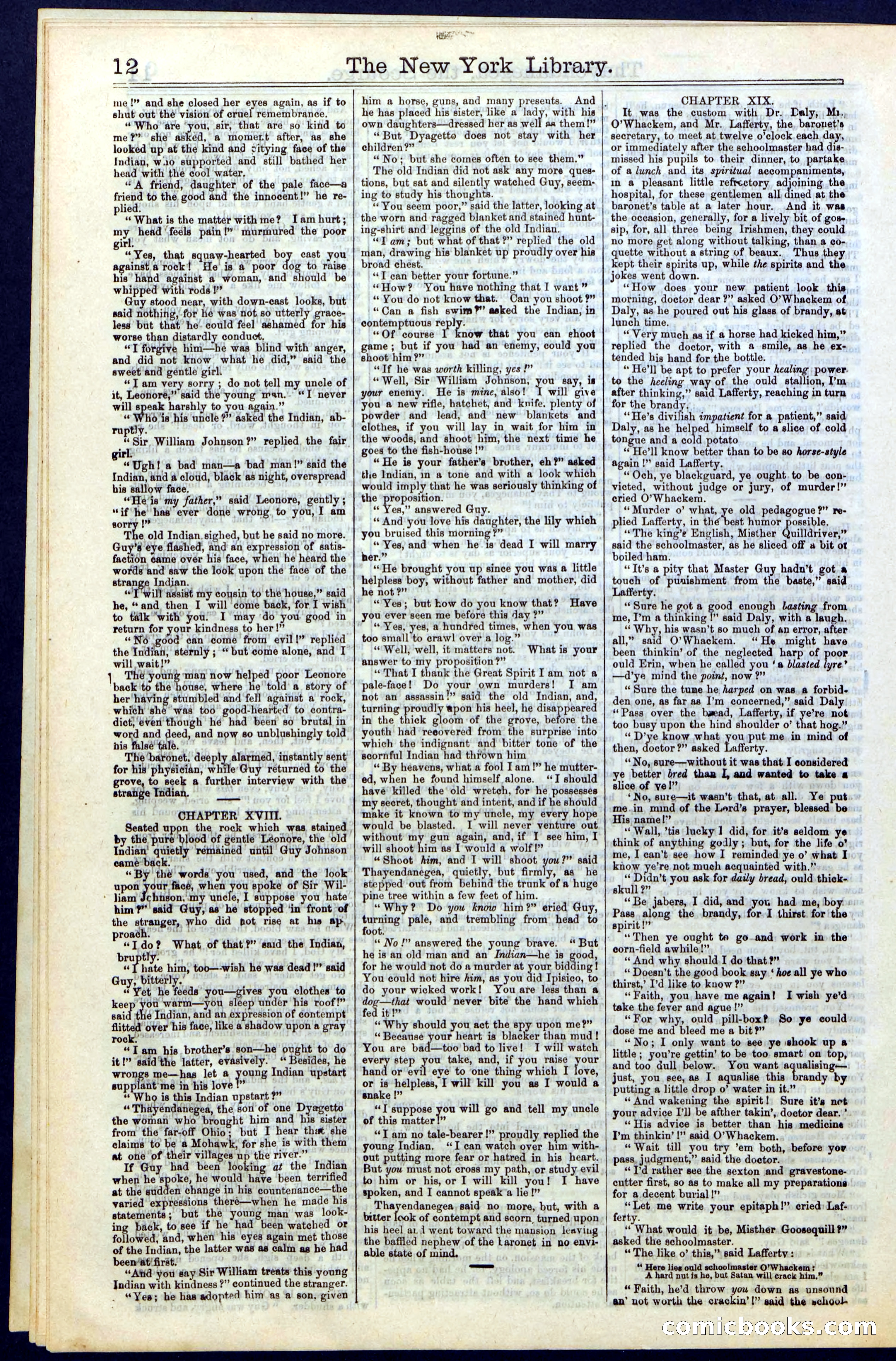
A restored page from Pulp Fiction, 1877. Page through the whole issue in the reader above.
📄 Transcribed text from this page (OCR, searchable)
Machine-transcribed from the original scan — historical spelling and the odd misread are preserved.
— = _— a < oD ~ SOS eee Oy ee ee ed . —~ = . EE NS SE “ — a 6 ated ~~ Se ee Se a ee a x a = = > osemiine <i Es Sag aeees = - ee — - wis ; : : ’ Tatet ona* _ ————s 2. a o—— —_— ~ es en ee eo : > ia 7 The New York Library. aR RS LR ETT TS A SS A SE ET AT a a TS RS SR me!” and she closed her eyes again, as if to shut out thé vision of cruel remembrance. “Who are “you, sir, that are so kind to me?” she asked, a momert after, as she looked up at the kind and vitying face of the Indian, w20 supported and still bathed her head with the cool water, “A friend, daughter of the pale face—a eo to the, good and the innocent!” he re- lied. , ar What is the matter with me? Iam hurt; my head ‘feels pain!” murmured the poor girl. “Yes, that squaw-hearted boy cast you against arock! He is a poor dog to raise his hand against a woman, and should be whipped with rods !”” Guy stood near, with down-cast looks, but said nothing, for hé was not so utterly grace- less but that he. could feel ashamed for his worse than distardly conduct, “T forgive him—he was blind with anger, and did not know what he did,” said the sweet and gentle girl. “J am very sorry ; do not tell my uncle of it, Leonoré,” said the young man.. “I never will speak harshly to you again.” ‘‘ Who is his uncle ?” asked the Indian, ab- ruptly. ’ “Sir William Johnson?” replied, the fair irl en Ugh! a bad man—a bad man!” said the Indian, and 4 cloud, black as night, overspread his sallow face. ‘““He’is' my father,” said Leonore, gently ; “if he has ever done wrong. to you, I am sorry !” The old Indian. sighed, but he said no more. Guy's eye flashed, and an expression of satis- faction came over his face, when he heard the words and saw the look upon the face of the strange Indian. . “Twill assist my consin to the house,” said he, “and then I will come back, for I wish to talk “with you. I may do you good in return for your kindness to her!” “N6 good can come from evil!” replied the Indian, sternly ; “ but come alone, and I will wait!” Thé young ‘man now helped poor Leonore back to the house, where he told a story of her having stumbled and fell against a rock, which she was too good-hearted to contra- dict, even though hé had been so brutal in word and deed, and now so unblushingly told nis false tale. The baronet, deeply alarmed, instantly sent for his physician, while'Guy returned to the grove, to seek a further interview with the strange Indian. . | CHAPTER XVIII. Seated upon the ro ” by the pure blood of gentle Léonore, the old Indian’ quietly remained until Guy Johnson camé back. = , “By thé words you used, and the look upon your face, when you spoke of Sir Wil- * Jiam chison, my uncle, I suppose you hate him?” said Guy, as he stopped ‘in front of the stranger, who did pot rise at his ap, roach. | eft | “Ido? What of that?” said the Indian, bruptly. * t hate him, too—-wish he was dead !”” said Guy, bitterly.’ “Yet he feeds you—gives you clothes to keep you warm—youn sleep under his roof!” said the Indian, and an expression of contempt flitted' over his face, like a shadow upon a gray rock. | ~ ¥ his brother’s son—he ought to do it!” daid the latter, evasively. ‘ Besides, he wrongs me—has let 4 young Indian upstart supplant me in his love !” “Who is this Indian upstart ?” “ Thiyéndahegea, the son of one Dyagetto the woman who brought him and his sister from the far-off Ohio; but I hear that she claims to be a Mohawk, for she is with them at one of their villages np the river.” If Guy had been looking at the Indian when he spoke, he would have been terrified at the sudden change in his countenance—the varied expressions there—when he made his statements; but the young man was look- ing pale to see if he had been watched or followed, and, when his eyes again met those of the Indian, the latter was as calm ag he had been“#t/ first.’ : “And you say Sir William treats this young | Indian with kindness ?” continued the stranger. “Yes; he has adopted him as a son, given which was. stained , him a horse, guns, and many presents. And he has placed his sister, like a lady, with his own daughters—dressed her as well as them!” “But Dyagetto does not stay with her children?” “No; but she comes often to see them.” The old Indian did not ask any more ques- tions, but sat and silently watehed Guy, seem- ing to study his thoughts. “You seem poor,” said the latter, looking at the worn and ragged blanket and stained hunt- ing-shirt and leggins of the old Indian. “T am; but what of that ?” replied the old man, drawing his blanket up proudly over his broad chest. “T can better your fortune.” “How? You have nothing that I wart” “ You do not know that. Can you shoot ?” “Can a fish swim?’ asked the Indian, in contemptuous re Iv: “Of course now that you can ehoot game; but if you had an enemy, could you shoot him?” “Tf he was worth killing, yes !” “Well, Sir William Johnson, you say, is your enemy. He is mine, also! will give you a new rifle, hatchet, and knife. plenty of powder and lead, and new blankets and clothes, if you will lay in wait for him in the woods, and shoot him, the next time he goes to the fish-house !” “He is your father’s bruther, eh?” asked the Indian, in a tone and with a look which would imply that he was seriously thinking of the proposition. “ Yes,” answered Guy. “And you love his daughter, the lily which you bruised this morning ?” “ Yes, and when he is dead I will marry her.” “He brought you up since you was a little helpless boy, without father and mother, did he not ?” “Yes; but how do you know that? Have you ever seen me before this day ?” “ Yes, yes, a hundred times, when you was too small to craw! over a log.” ‘“Well, well, it matters not. answer to my proposition?” “That I thank the Great Spirit I am not a pale-face! Do your own murders! I am not an assassin!” said the old Indian, and, turning proudly apon his heel, he rr ener in the thick gloom of the grove, before the youth had reeovered from the surprise into which the indignant and bitter tone of the scornful Indian had thrown him “ By heavens, what a fool Iam!” he mutter- ed, when he found himself alone. “I should havé killed the old wretch, for he possesses my secret, thought and intent, and if he should make it known to my uncle, my every hope would be blasted. I will never venture out without my gun again, and, if I see him, I will shoot him as I would a wolf!” “Shoot him, and I will shoot you?” said Thayendanegea, quietly, but firmly, aa he stepped out from behind the trunk of a huge pine tree within a few feet of him. “Why? Do you know him?” eried Guy, turning pale, and trembling from head to foot. | “No!” answered the young brave. “ But he is an old man and an Indian—he is good, for he would not do a murder at your bidding! You could not hire him, as you did Ipisico, to do your wicked work! You are less than a “ —that would never bite the hand which ed it!” “Why should you act the spy upon me?” “Because your heart is blacker than mud! You are bad—too bad to live! I will watch every step hie take, and, if you raise your hand or evil eye to one thing which I love, or is helpless, I will kill you as I would a snake |” “T suppose you will go and tell my uncle of this matter!” “T am no tale-bearer!” proudly replied the young Indian, “I can watch over him with- out putting more fear or hatred in his heart. But you must not cross my path, or study evil to him or his, or I will kill you! I have spoken, and I cannot speak‘a lie !” poe endunckcs said no more, but, with a bitter look of contempt and scorn, turned upon his heel ar i went toward the mansion leaving the baffled nephew of the Laronet in no envi- able state of mind, What is your CHAPTER XIX. It was the custom with Dr. Daly, My... O’Whackem, and Mr. Lafferty, the, baronet’s secretary, to meet at twelve o’clock each day, or immediately after the schoolmaster had dis- missed his pupils to their dinner, to partake of a lunch and its spiritual accompaniments, in a pleasant little refrectory adjoining the hospital, for these gentlemen all dined at the baronet’s table at a later hour. And it was the oceasion, generally, for a lively bit of goa- sip, for, all three being Irishmen, they could no more get along without talking, than a co- quette without a string of beaux. Thus they kept their spirits up, while the spirits and the jokes went down. ‘How does your new patient look this morning, doctor dear ?” asked O’Whackem of Daly, as he poured out his glass of brandy, at lunch time. “Very much as if a horse had kicked him,” replied the doctor, with a smile, as he ex- tended his hand for the bottle. “ He'll be apt to prefer your healing power. to the heeling way of the ould stallion, I’m after thinking,” said Lafferty, reaching in turn for the brandy. ‘“He’s divilish impatient for a patient,” said Daly, as he helped himself to a slice of cold tongue and a cold potato ‘He'll know better than to be so horse-style again !” said Lafferty. “Och, ye blackguard, ye ought. to be con- victed, without judge or jury, of murder!” | cried O’Whackem. “Murder o’ what, ye old pedagogue ?” re- plied Lafferty, in thé best humor possible, “The king’e English, Misther Quillariver,” said the schoolmaster, as he sliced off a bit ot boiled ham. “Tt’s a pity that Master Guy hadn’t got a touch of pusishment from the baste,” said Lafferty. “Sure he got a good enough Lasting from me, I’m a thinking !” said Daly, with a laugh. “ Why, his wasn’t so much of an error, after all,” said O’Whackem. “He might have been thinkin’ of the neglected harp of poor ould Erin, when he called you ‘a blasted lyre’ —d’ye mind the point, now ?” “Sure the tume he harped on was a forbid- den one, as far as I’m concerned,” said Daly “Pass over the baead, Lafferty, if ye’re not too busy upon the hind shoulder o’ that hog.” “ D’ye know what you put me in mind of then, doctor?” asked Lafferty. ‘No, sure—without it was that: I considered ye better bred than I, and wanted to take « slice of ye!” ‘No, sure—it wasn’t that, at all. Ye put. me.in mind of the Lard’s prayer, blessed be His name!” “Wall, ’tis lucky 1 did, for it’s seldom ye think of anything godly; but, for the life o’ me, I can’t see how I reminded ye o’ what I know ye’re not much acquainted with.” “* Didn’t you ask for daily bread, ould thick- skull 2” “ Be jabers, I did, and you had me, boy : Pass along the brandy, for I thirst. for the spirit!” “Then ye ought te go-and work in the corn-field awhile!” “ And why should I do that?” “ Doesn't the good book say ‘hoe all ye who thirst,’ I’d like to know ?” “Faith, you have me again! I wish ye'’d take the fever and ague !” “For why, ould pill-box? So ye could dose me and bleed me a bit ?” “No; I only want to see ye shook up a little ; you’re gettin’ to be too smart on top, and too dull below. You want aqualising— just, you see, as I aqualise this brandy by putting a little drop o’ water in it.” “ And wakening the spirit! Sure it’s net your advice I'l) be afther takin’, doctor dear.’ “His advice is better than his medicine I’m thinkin’! said O’Whackem. “Wait till you try ’em both, before yov pass, judgment,” said the doetor. “Td rather see the sexton and gravestone- cutter first, 80 as to make all my preparations for a decent burial!” ‘ “Let me write your epitaph!” eried: Laf- erty. ‘What would it be, Misther Goosequill ?” asked the schoolmaster. “ The like o’ this,” said Lafferty : . eee lies ould schoolmaster O’Whacker : A put is he, but Satan will crack him,” “Faith, he’d throw you down as unsound an’ uot worth the crac in’!”’ said the school Eomicbooksco