
Pulp Fiction, 1881 · page 7 of 24
Beadle's Dime Library, No. 139 — page 7: what you’re looking at
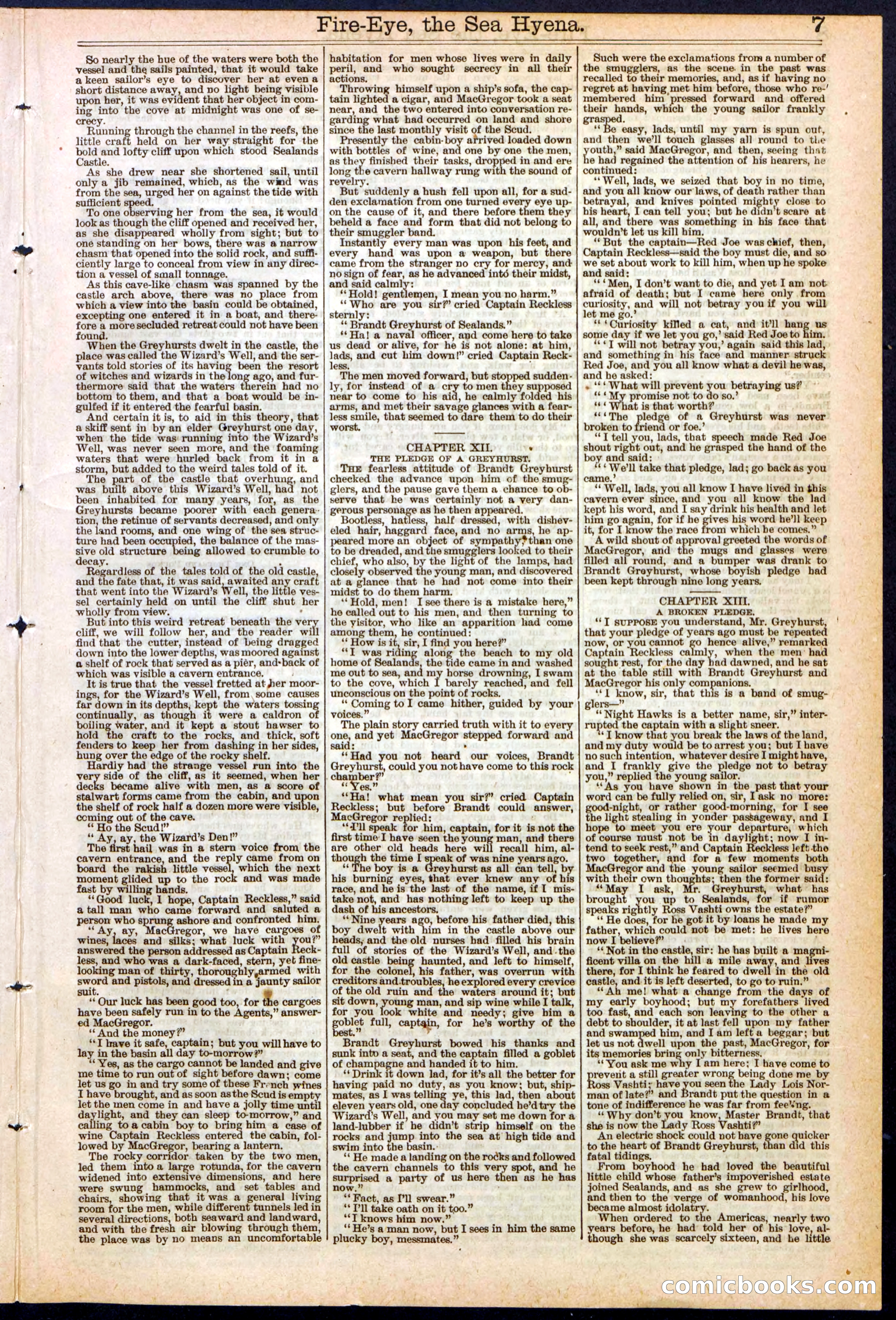
A restored page from Pulp Fiction, 1881. Page through the whole issue in the reader above.
📄 Transcribed text from this page (OCR, searchable)
Machine-transcribed from the original scan — historical spelling and the odd misread are preserved.
Fire-Kye, the Sea Hyena. So nearly the hue of the waters were both the vessel and the sails painted, that it would take a keen sailor’s eye to discover her at evena short distance away, and no light being visible upon her, it was evident that her object in com- ing into the cove at midnight was one of se- crecy. Running through the channel in the reefs, the little craft held on her way straight for the bold and lofty cliff upon which stood Sealands Castile. As she drew near she shortened sail, until only a jib remained, which, as the wind was from the sea, urged her on against the tide with sufficient speed, To one observing her from the sea, it would look as though the cliff opened and received her, as she disappeared wholly from sight; but to one standing on her bows, there was a narrow chasm that opened into the solid rock, and suffi- ciently large to conceal from view in any direc- tion a vessel of small tonnage. As this cave-like chasm was spanned by the castle arch above, there was no place from which a view into the basin could be obtained, excepting one entered it in a boat, and there- fore a more secluded retreat could not have been found. When the Greyhursts dwelt in the castle, the place was called the Wizard’s Well, and the ser- vants told stories of its having been the resort of witches and wizards in the long ago, and fur- thermore said that the waters therein had no bottom to them, and that a boat would be in- gulfed if it entered the fearful basin. And certain it is, to aid in this theory, that a skiff sent in by an elder Greyhurst one day, when the tide was running into the Wizard’s Well, was never seen more, and the foaming waters that were hurled back from it in a storm, but added to the weird tales told of it. The part of the castle that overhung, and was built above this Wizard’s Well, had not been inhabited for many years, for, as the Greyhursts became rer with each genera: tion, the retinue of servants decreased, and only the land rooms, and one wing of the sea struc- ture had been occupied, the balance of the mas- sive old structure being allowed to crumble to ecay. . Regardless of the tales told of the old castle, and the fate that, it was said, awaited any craft that went into the Wizard’s Well, the little ves- sel certainly held on until the cliff shut her wholly from view. ’ But into this weird retreat beneath the ve cliff, we will follow her, and the reader will find that the cutter, instead of being dragged down into the lower depths, was moored against a shelf of rock that served as a piér, and-back of which was visible a cavern entrance. ; It is true that the vessel fretted at her moor- ings, for the Wizard’s Well, from, some causes far down in its depths, kept the waters tossing continually, as though it were a caldron of boiling water, and it kept a stout hawser to hold the craft to the rocks, and thick, soft fenders to keep her from dashing in her sides, hung over the edge of the rocky shelf. Hardiy had the strange vessel run into the very side of the cliff, as it seemed, when her decks became alive with men, as a score of stalwart forms came from the cabin, and upon the shelf of rock half a dozen more were visible, coming out of the cave. * Ho the Scud!” ‘“* Ay, ay, the Wizard’s Den!” The first hail was in a stern voice from the cavern entrance, and the reply came from on board the rakish little vessel, which the next moment glided up to the rock and was made fast by willing hands. ‘Good luck, 1 hope, Captain Reckless,” said a tall man who came forward and saluted a person who sprung ashore and confronted him. ‘““Ay, ay, MacGregor, we haye cargoes of wines, laces and silks; what luck with el answered the person addressed as Captain Reck- less, and who was a dark-faced, stern, yet fine- looking man of thirty, thoroughly ed with Tt and pistols, and dressed in a jaunty sailor suit. ‘‘ Our luck has been good too, for the cargoes have been safely run in to the Agents,” answer- ed MacGregor. ‘‘ And the money?” “*T have it safe, captain; but you will have to lay in the basin all day to-morrow?” “Yes, as the cargo cannot be landed and give me time to run out of sight before dawn; come let us go in and try some of these French wines I have brought, and as soon asthe Scud is emp let the men come in and have a jolly time mee daylight, and they can sleep to-morrow,” and ing toacabin boy to bring him a case of wine Captain Reckless entered the cabin, fol- lowed by MacGregor, bearing a lantern. The rocky corridor taken by the two men, led them intoa e rotunda, for the cavern widened into extensive dimensions, and here were swung hammocks, and set tables and chai showing that it was a general living room for the men, while different tunnels led in several directions, both seaward and landward, and with the fresh air blowing through them, the place was by no means an uncomfortable cha ber habitation for men whose lives were in daily peril, and who sought secrecy in all their actions. Throwing himself upon a ship’s sofa, the cap- tain lighted a cigar, and MacGregor took a seat near, and the two entered into conversation re- garding what had occurred on land and shore since the last monthly visit of the Scud. Presently the cabin-boy afrived loaded down with bottles of wine, and one by one the men, as they finished their tasks, drop in and ere long the cavern hallway rung with the sound of revelry. But suddenly a hush fell upon all, for a sud- den exclamation from one turned every eye up- on the cause of it, and there before them they beheld a face and form that did not belong to their smuggler band. Instantly every man was upon his feet, and every hand was upon a weapon, but there came from the stranger no cry for mercy, and no sign of fear, as he advanced inté their midst, and said oe re “Hold! gentlemen, I mean you no harm.” ‘“Who are you sir?’ cried Captain Reckless sternly: “‘ Brandt Greyhurst of Sealands.” ** Ha! a naval officer, and come here to take us dead or alive, for he is not alone: at him, lads, and cut him down!” cried Captain Reck- less. The men moved forward, but wn sudden - ly, for instead of a cry to men they supposed near to come to his aid, he calmly folded his arms, and met their savage glances with a fear- less smile, that seemed to dare them to do their worst. CHAPTER XII. . THE PLEDGE OF A GREYHURST. THE fearless attitude of Brandt Greyhurst checked the advance upon him of the smug- glers, and the pause gave them a chance to ob- serve that he was certainly not a very dan- gerous personage as he then appeared. Bootless, hatless, half dressed, with dishev- eled hair, haggard face, and no arms, he ap- peared more an object of sympathy;than one to be dreaded, and the smugglers looked to their chief, who also, by the light of the lamps, had closely observed the young man, and discovered at a glance that he had not come into their midst to do them harm. ‘‘Hold, men! I see there is a mistake here,” he called out to his men, and then turning to the yisitor, who like an apparition had come among them, he continued: ‘* How is it, sir, I find you here?” “T was ridin along the beach to my old home of Sealands, the tide came in and washed me out to sea, and my horse drowning, I swam to the cove, which 1 barely reached, and fell unconscious on the point of rocks. ** Coming toI came hither, guided by your voices.” The plain story carried truth with it to every Sore and yet MacGregor stepped forward and said: , “* Had pe not heard our voices, Brandt ite " could you not have come to this rock ” ‘Ha! what mean you sir?” cried Captain Reckless; but before Brandt could answer, MacGregor replied: : “Pll speak for him, captain, for it is not the first time I have seen the young man, and there are Other old heads here will recall him, al- though the time I of was nine years ago. ‘*The boy is a Greyhurst as all can tell, b his burning eyes, that ever knew any of h race, and he is the last of the name, if I mis- take not, and has nothing left to keep up the dash of his ancestors. “Nine Ages ago, before his father died, this boy dwelt with him in the castle above our heads, and the old nurses had filled his brain full of stories of the Wizard’s Well, and.the old castle being haunted, and left to himself, for the colonel, his father, was overrun with creditors and.troubles, he explored every crevice of the old ruin and the waters around it; but sit down, young man, and sip wine while I talk, for you look white and needy; give him a blet full, captain, for he’s worthy of the t,”? Brandt Greyhurst bowed his thanks and sunk into a seat, and the captain filled a goblet of cham e and handed it to him. ** Drink it down lad, for it’s all the better for having paid no duty, as you know; but, ship- mates, as I was telling ye, this lad, then about eleven years old, one day concluded he’d try the Wizard’s Well, and you may set me down for a land-lubber if he didn’t strip himself on the rocks and jump into the sea at high tide and swim into the basin..- ‘‘ He made a landing on the rocks and followed the cavern channels to this very spot, and he surprised a party of us here then as he has now.” , ** Fact, as I'll swear.” ** Pll take oath on it too.” ‘*T knows him now.” ; ‘“‘ He’s aman now, but I sees in him the same plucky boy, messmates.” af f ae ¢ ‘ 4 a= » , = ~ = ee eae Such were the exclamations from a number of the smugglers, as the scene. in the past was recalled to their memories, and, as if having no regret at having met him before, those who re-' membered him pressed forward and offered their hands, which the young sailor frankly 2 easy, lads, until my yarn is spun ouf, and then we'll touch glasses all round to the ‘phe ” said MacGregor, and then, seeing that e had regained the attention of his hearers, he continued: ‘* Well, lads, we seized that boy in no time, and you all know our laws, of death rather than betrayal, and knives pointed mighty close to his heart, I can tell you; but he didn't scare at all, and there was something in his face that wouldn’t let us kill him. ‘*But the captain—Red Joe was chief, then, Captain Reckless—said the boy must die, and so we set about work to kill him, when up he spoke and said: *** Men, I don’t want to die, and yet I am not afraid of death; but I came here only from curiosity, and will not betray youif you will let me go.’ *** Curiosity kiNed a cat, and itll hang us some day if we let you go,’ said Red Joe to ‘**] will not betray you,’ again said this lad, and something in his face and manner struck Red Joe, and you all know what a devil he was, and he asked: » ‘** What will prevent you betraying us? si promise not to do so.’ ra at is that worth? ‘““*The pledge of a Greyhurst was never broken to friend or foe.’ | “T tell you, lads, that speech made Red Joe shout right out, and he grasped the hand of the boy and said: “<< We'll take that pledge, lad; go back as you came.’ ‘¢ Well, lads, you all know I have lived in this cavern ever since, and you all know the lad kept his word, and I say drink his health and let him go again, for if he _— his word he’ll keep it, for I know the race from which he comes.” A wild shout of approval greeted the words of MacGregor, and the mugs and glasses were filled all round, and a bumper was drank to Brandt Greyhurst, whose boyish pledge had been kept through nine long years. CHAPTER XIII, A BROKEN PLEDGE. ‘‘T suPPOSE you understand, Mr. Greyhurst A se ted that your pledge of years ago must be re now, or you cannot go hence alive,” remarked Captain Reckless ca , when the men’ had sought rest, for the day bad dawned, and he sat at the table still with Brandt Greyhurst and MacGregor his only companions. . I know, sir, that this is a band of smug- ers—” “Night Hawks is a better name, sir,” inter- rupted the captain with a slight sneer. ‘I know that you break the laws of the land, and my duty would be to arrest you; but I have no such intention, whatever desire I might have, and I frankly give the pledge not to betray you,” replied the young sailor. ‘As you have shown in the past that your word can be fully relied on, sir, Iask no more: good-night, or rather good-morning, for I see the light stealing in yonder passageway, and I hope to meet you ere Tous pe sh gad. which of course roust not be in daylight; now I in- tend to seek rest,” and Captain less left the two together, and for a few moments both gt and the young sailor seemed b with their own thoughts; then the former said: A or 4 I ask, Greyhurst, what has brought you up to Sealands, for if rumor speaks rightly Ross Vashti owns the estate?” ‘** He does, for he got it by loans he made my father, which could not be met: he lives here now I believe?” , ‘* Not in the castle, sir: he has built a magni- ficent villa on the hill a mile away, and lives there, for I think he feared to dwell in the old castle, and. it is left deserted, to go to ruin.” “ me! what a change from the days of my early boyhood; but my forefathers lived too fast, and each son leaving to the other a debt to shoulder, it at last fell upon my father and swam him, and Iam left a beggar; but let us not dwell upon the past, MacGregor, for its memories peas. fag bitterness. ; ‘You ask me w y Iam here; I have come to revent a still greater wrong being done me by Rees Vashti; have you seen the Lady Lois Nor- man of late?” and Brandt put the question in a tone of indifference he was far from fee¥ng. “Why don’t you know, Master Brandt, that she is now the Lady Ross Vashti?” An electric shock could not have fone uicker to the heart of Brandt Greyhurst, than did this fatal tidings. From boyhood he had loved the beautiful little child whose father’s impoverished estate joined Sealands, and as she grew to girlhood, and then to the verge of womanhood, his love became almost cago When ordered to the Americas, nearly two ope before, he had told her of his love, al- ough she was scarcely sixteen, and he little vob . a - i 1 aaiiceloyeye) S) C ae ae ( 7. * < a f «ll Lo a = *