
Pulp Fiction, 1881 · page 6 of 24
Beadle's Dime Library, No. 139 — page 6: what you’re looking at
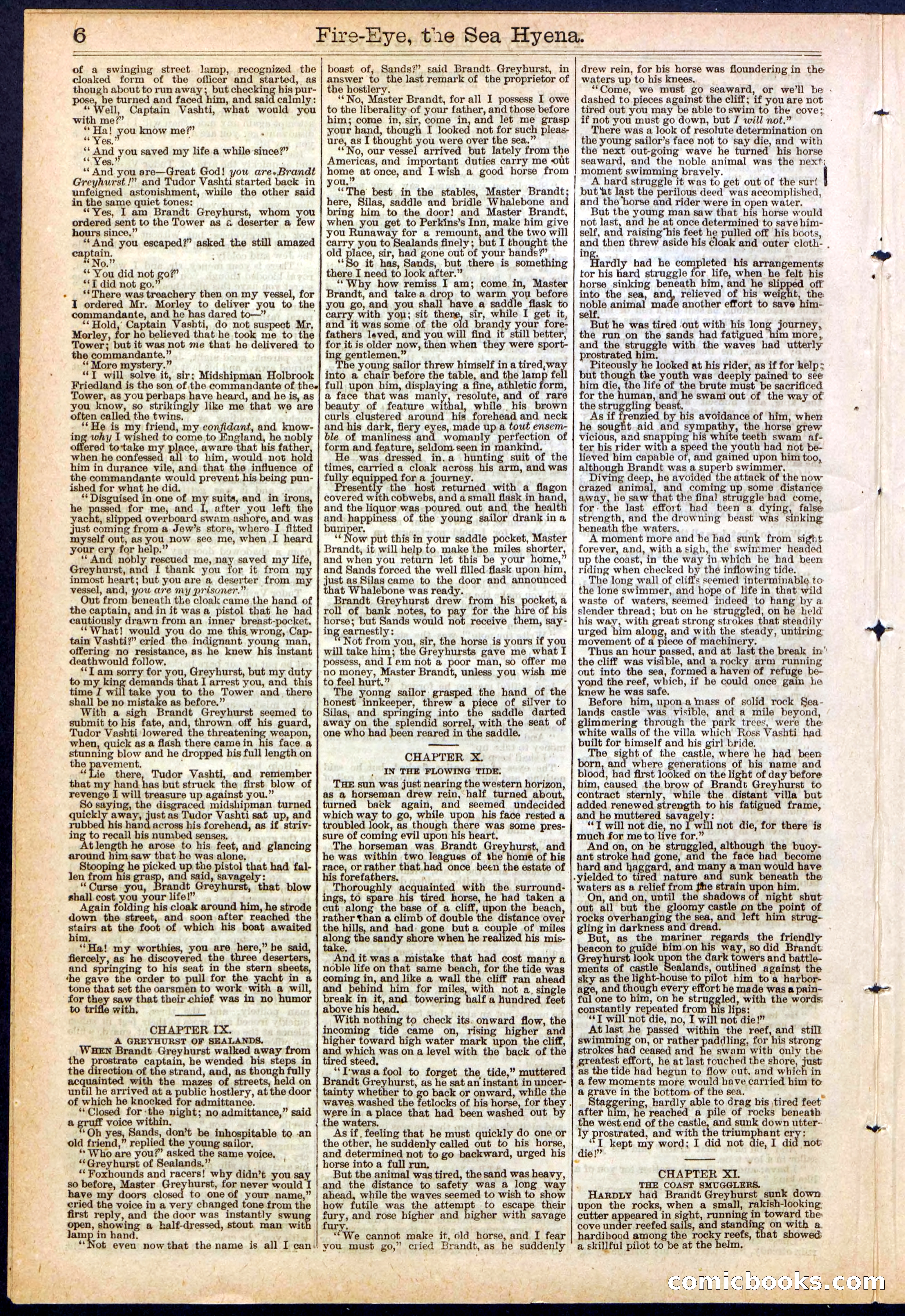
A restored page from Pulp Fiction, 1881. Page through the whole issue in the reader above.
📄 Transcribed text from this page (OCR, searchable)
Machine-transcribed from the original scan — historical spelling and the odd misread are preserved.
———_ of a swinging street lamp, recognized the cloaked form of the officer and started, as though about to run away; but checking his pur- pose, be turned and faced him, and said calmly: re Well, Captain Vashti, what would you with me?” * Ha! you know me?’ ae Yes.’ E ** And you saved my life a while since?’ “és Yes.’ ““ And you are—Great God! you areeBrandt Greyhurst !” and Tudor Vashti started back in unfeigned astonishment, while the other said in the same quiet tones: ‘Yes, I am Brandt Greyhurst, whom you ordered sent to the Tower as & deserter a few hours since,” **And you escaped?” asked the still amazed captain. *No.”’ ** You did not go” **T did not go.’ **There was treachery then on my vessel, for I ordered Mr. Morley to deliver you to the commandante, and he has dared to—” “Hold, Captain Vashti, do not suspect Mr, Morley, for ho believed that he took me to the Tower; but it was not me that he delivered to the commandante.”’ ‘* More mystery.” “‘T will solve it, sir; Midshipman Holbrook Friedland is the son of the commandante of thee Tower, as you perbaps have heard, and he is, as you know, so strikingly like me that we are often called the twins. ‘He is my friend, my confidant, and know- ing why I wished to come to England, he nobly offered to‘take my place, aware that his father when he confessed to him, would not hold him in durance vile, and that the influence of the commandante would prevent his being pun- ished for what he did. , ** Disguised in one of my suits, and in irons, he passed for me, and I, after you left the yacht, slipped overboard swam ashore, and was just coming from a Jew’s store, where I fitted myself out, as you now see me, when,I heard your ory for help.” ‘‘ And nobly rescued me, nay saved my life, Greyhurst, and I thank you for it from my inmost heart; but you are a deserter from my vessel, and, you are my prisoner.” Out from beneath the cloak came the hand of the captain, and in it was a pistol that he had cautiously drawn from an inner breast-pocket, ‘What! would you do me this wrong, Cap- tain Vashti?” cried the indignant young man, offering no resistance, as he knew his instant deathwould follow, **T am sorry for you, Greyhurst, but my dut to my king demands that I arrest you, and this time I will take you to the Tower and there shall be no mi @ as before.” With a sigh Brandt Greyhurst seemed to submit to his fate, and, thrown off his guard, Tudor Vashti lowered the threatening weapon, when, quick as a flash there camein his face. a stunning blow and he dropped his full length on the pavement. : “Lie there, Tudor Vashti, and remember that my hand has but struck the first blow of revenge I will treasure up against you.” S0 saying, the disgraced midshipman turned quickly away, just as Tudor Vashti sat up, and rubbed his hand across his forehead, as if striv- eee BY recall his numbed senses. tlength he arose to his feet, and glancing around him saw that he was alone, Stooping he picked up the pistol that had fal- len from grasp, and said, savagely: “Curse you, Brandt Greyhurst, that blow shall cost you your life!” Again folding his cloak around him, he strode - down the street, and soon after reached the aif at the foot of which his boat awaited Ha! my worthies, you are here,” he said, fiercely, as he discovered the three deserters, and Sadr Sag to his seat in the stern sheets, ‘he gave the order to pull for the yacht in a tone that set the oarsmen to work with a will, for they saw that their chief was in no humor to triffe with. CHAPTER IX. A GREYHURST OF SEALANDS, WHEN Brandt Greyhurst walked away from the prostrate captain, he wended bis steps in the direction of the strand, and, as shongh fully ig i with the mazes of streets, held on until he arrived at a public hostlery, at the door of which he knocked for admittance. ‘Closed for -the night; no admittance,” said a voice within. ‘Oh yes, Sands, don’t be inhospitable to -an old friend,” replied the young sailor. * Who are you?” asked the same voice, “‘Greyhurst of Sealands,”’ . ‘Foxhounds and racers! why didn’t you sa so before, Master Greyhurst, for never would have my doors cl to one of your name,” cried the voice in a very changed tone from the first reply, and the door was instantly swun , showing a half-dressed, stout. man wit Jamp in hand. “Not even now that the name is all I can: et oe te re ee Fire-Bye, tie Sea Hyena. i i ct ee boast of, Sands?’ said Brandt. Greyhurst, in answer to the last remark of the proprietor of the hostlery. ‘*No, Master Brandt, for all I possess I owe to the liberality of your father, and those before him; come in, sir, come in, and let me grasp your hand, though I looked not for such pleas- ure, as I thought you were over the sea.” “No, our vessel arrived but lately from the Americas, and important duties carry me out home at once, and I wish a good horse from ou. “The best in the stables, Master Brandt; here, Silas, saddle and bridle Whalebone and bring him to the door! and Master Brandt, when you get to Perkins’s Inn, make him give you Runaway for a remount, and the two will carry you to Sealands finely; but I thought the old place, sir, had gone out of your bands?” ‘*So it has, Sands, but there is something there I need to look after.” ‘Why how remiss I am; come in, Master Brandt, and take a drop to warm you before you go, and you shall have a saddle flask to carry with yon; sit thene, sir, while I get it, and it was some of the old brandy your fore- fathers leved, and you will find it still better, for it is older now, then when they were sport- ing. gentlemen.” he young sailor threw himself ina phar has into a chair before the table, and the lamp fe full upon him, displaying a fine, athletic form, a face that was manly, resolute, and of rare beauty of . feature witbal, while his brown curls clustered around his forehead and neck and his dark, fiery eyes, made up a tout ensem- ble of manliness and womanly perfection of form and feature, seldom seen in mankind, He was dressed in.a hunting suit of the times, carried a cloak across his arm, and was fully eanipned for a journey. Presently the host returned with a flagon covered with cobwebs, and a small flask in hand, and the liquor was poured out and the health and happiness of the young sailor drank ina Dap oes ‘Now put this in your saddle pocket, Master Brandt, it will help to make the miles shorter, and when you return let this be your home,” and Sands forced the well filled flask upon him, just as Silas came to the door and announced that Whalebone was ready. Brandt Greyhurst drew from his ket, a roll of bank notes, to pay for the hire of his horse; but Sands would not receive them, say- ing earnestly: ‘Not from you, sir, the horse is yours if you will take him; the Greyhursts gave me what I possess, and I em not a poor man, so offer me no money, Master Brandt, unless you wish me to feel hurt.” The yonng sailor grasped the hand of the honest innkeeper, threw a piece of silver to Silas, and springing into the saddle darted away on the splendid sorrel, with the seat of one who had been reared in the saddle. CHAPTER X. IN THE FLOWING TIDE. THE sun was just nearing the western horizon, as a horseman drew rein, half turned about, turned back again, and seemed undecided which way to go, while upon his face rested a troubled look, as though there was some pres- sure of coming evil upon his heart. The horseman was Brandt Greyhurst, and he was within two leagues of the home of his race, or rather that. had once been the estate of his forefathers. Thoroughly acquainted with the surround- ings, to spare his tired horse, he had taken a cut along the base of a cliff, upon the beach, rather than a climb of double the distance over the hills, and had: gone but a couple of miles along the sandy shore when he real his mis- And it was a mistake that had cost many a noble life on that same beach, for the tide was coming in, and like a wall the cliff ran ahead and behind him for miles, with not a, single break in it, and towering half a hundred feet above his head. With nothing to check its. onward flow, the incoming tide came on, rising higher and higher toward high water mark upon the cliff, and which was on a level with the back of the tired steed. ‘‘I’was a fool to forget the tide,” muttered Brandt Greyhurst, as he sat an instant in uncer- tainty whether to go back or onward, while the waves washed the fetlocks of his horse, were in a place that had been washed out by the waters. As if, feeling that he must quickly do one or the other, he suddenly called out to his horse, and determined not to go backward, urged his horse into a full run, But the animal was tired, the sand was heavy, and the distance to safety was a long way ahead, while the waves seemed to wish to show how futile was the a to escape their fury, and rose higher and higher with savage “We cannot make it, old horse, and I fear you must go,” cried Brandt, as he suddenly -yielded to tired nature an for they . —_- drew rein, for his horse was floundering in the waters up to his knees. “Come, we must go seaward, or we'll be . dashed to pieces against the cliff; if you are not tired out you may be able toswim to the cove; if not you must go down, but J will not.” There was a look of resolute determination on the young sailor’s face not to say die, and with the next out-going wave he turned his horse seaward, and the noble animal was the next; moment swimming bravely. A hard struggle it was to get out of the sur{ but ‘at last the perilous deed was accomplished, and the horse and rider were in open water. But the young man saw that bis horse would not last, and he at once determined to save him- self, and raising”his feet he pulled off his boots, and then threw aside his Cloak and outer cloth- . ing. Fiardly had he completed his arrangements tor his hard struggle for life, when he felt his horse sinking beneath him, and he in off into the sea, and, relieved of his weight, the noble animal made another effort to save him- self. But he was tired out with his long Journey. the run on the sands had fatigued him more, and the struggle with the waves had utterly prostrated him. Piteously he looked at his rider, as if for help; but though the youth was deeply pained to see him die, the life of the brute must be sacrificed for the human, and he swani out of the way of the struggling beast, As if frenzied by his avoidance of him, wher he sought aid and sympathy, the horse grew vicious, and snapping his white teeth swam af- ter his rider with a speed the youth had not be- lieved him capable of, and gained upon him too, although Brandt was a superb swimmer. Diving deep, he avoided the attack of the now crazed animal, and coming up some distance away, he saw that the final struggle had come, for: the last effort had been a dying, false strength, and the drowning beast was sinking: beneath the waters. A moment more and he bad sunk from sight forever, and, with a sigh, the swimmer headed up the coast, in the way in which he had beer riding when checked by the inflowing tide. The long wall of cliffs seemed interminable ta the lone swimmer, and hope of life in that wild waste of waters, seemed indeed to hang by a slender thread; but on he struggled, on he held his way, with great strong strokes that steadily urged him along, and with the steady, untiring. movement of a piece of machinery. Thus an hour passed, and at last the break in’ the cliff was visible, and arocky arm running out into the sea, formed a haven of refuge be- ond the reef, which, if he could once g he Loe he was safe. Before him, upon.a ‘mass of solid rock Sea- lands castle was visible, and a mile beyond, glimmering through the park trees, were the white walls of the villa which Ross Vashti had built for himself and his girl bride. The sight of the castle, where he had been born, and where generations of his name and blood, had first looked on the light of day before him, caused the brow of Brandt Greyhurst to contract sternly, while the distant villa but added renewed strength to his fatigued frame, and he muttered savagely: “*T will not die, no Twill not die, for there is much for me to live for.” And on, on he struggled, although the buoy- ant stroke had gone, and the face had become hard and haggard, and many a man would have sunk beneath the waters as a relief from fhe strain upon him. On, and on, until the shadows of night shut out all but the gloomy castle on the point of rocks overhanging the sea, and left him strug- gling in darkness and dread. But, as the mariner regards the fiealy beacon to guide him.on his way, so did Brandt: Greyhurst look i the dark towers and battle- ments of castle Sealands, outlined against the sky as the light-house to pilot him to a harbor- age, and though every effort he made was a pain- ful one to him, on he oad hath with the words: constantly repeated from his lips: ‘“¢T will not die, no, I will not die!” At last he passed within the reef, and still swimming on, or rather paddling, for his strong strokes had ceased and he swam with only the greatest effort, he at last touched the shore, just as the tide had begun to flow out, and which in a few moments more would have carried him to a grave in the bottom of the sea. “ Staggering, hardly able to drag bis tired feet after him, he reached a pile of rocks beneath the west end of the castle, AE down utter- ly prostrated, and with the triumphant cry: me kept my word; I did not die, I di ie! CHAPTER XI. , THE COAST SMUGGLERS. Harpty had Brandt Greyburst sunk down: upon the rocks, when a small, rakish-looking: cutter appeared in sight, running in toward the cove under reefed sails, and standing on with a hardibood among the reefs, that showed a skillful pilot to be at the elm. not. “ Eomichooks , : ‘ * / . ’ 7 - LP feet: 7 = #7 - a va = << Snt al ‘