
Pulp Fiction, 1881 · page 4 of 24
Beadle's Dime Library, No. 139 — page 4: what you’re looking at
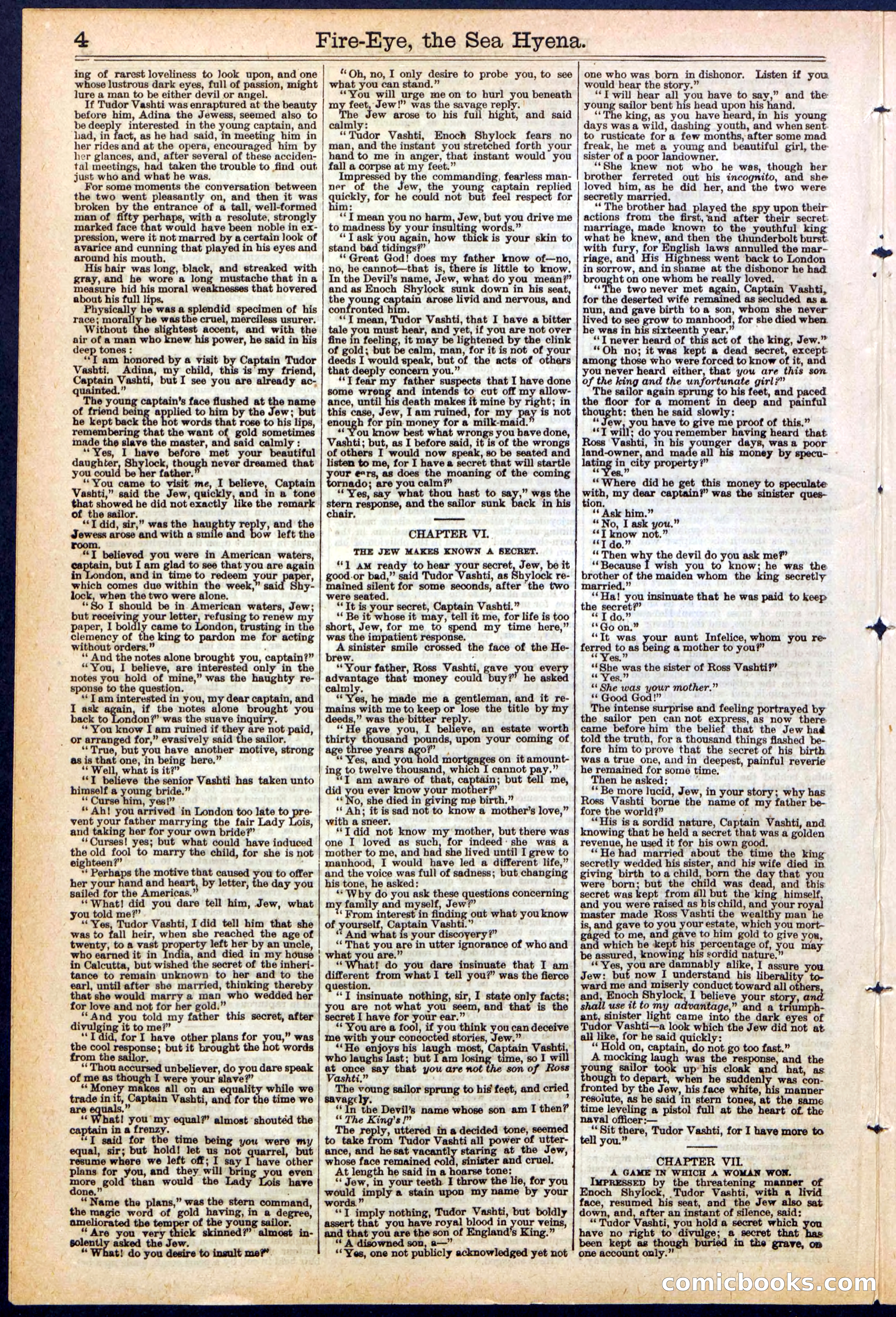
A restored page from Pulp Fiction, 1881. Page through the whole issue in the reader above.
📄 Transcribed text from this page (OCR, searchable)
Machine-transcribed from the original scan — historical spelling and the odd misread are preserved.
4 ing of rarest loveliness to Jook upon, and one whose lustrous dark eyes, full of passion, might lure a man to be either devil or angel. If Tudor Vashti was enraptured at the beauty before him, Adina the Jewess, seemed also to be ek interested in the young captain, and had, in fact, as he had said, in meeting him in her rides and at the opera, encouraged him by her glances, and, after several of these acciden- tal meetings, had taken the trouble to find out just who and what he was. For some moments the conversation between the two went pleasantly on, and then it was broken by the entrance of a tall, well-formed man of fifty perhaps, with a resolute, strongly marked face that would have been noble in ex- pression, were it not marred by a certain look of avarice and cunning that played in his eyes and around his mouth, His hair was long, black, and streaked with gray, and he wore a long mustache that ina measure hid his moral weaknesses that hovered about his full lips, oe pen he was a splendid specimen of his race; mo he was the cruel, merciless usurer. Without the slightest accent, and with the air of aman who knew his power, he said in his deep tones : ‘*T am honored by a visit b Captain Tudor Vashti. Adina, my child, this is' my friend, Captain Vashti, but I see you are already ac- ‘ The nd betag appli face flushed at the name of friend applied to him by the Jew; but he kept back the hot words that rose to his lips, remembering that the want + gold sometimes made the slave the master, and said calmly : “Yes, I have before met your beautiful daughter Soe face though never dreamed that you could be her father. “You came to visit me, I believe, Captain Vashti,” said the Jew, quickly, and in a tone that showed he did not exactly like the remark of the sailor. ‘“*T did, sir,” was the menny reply, and the Jewess arose and with a smile and bow left the room. “T believed you were in American waters, a vor but I am glad to see that you are again in ndon, and in time to redeem your r, which comes due within the week,” said f hy- lock, when the two were alone. “So I should be in American waters, Jew; but receiving your letter, refusing to renew my clemency of the on me for D without orders.” . ** And the notes alone brought you, captain?” “You, I believe, are interested only in the notes you hold of mine,” was the haughty re- sponse to the question. “‘T am interested in you, my dear captain, and I ask again, if the notes alone brought you back 00 London?” was the suave inquiry. “You know I am ruined if they are not paid, _ Or arranged for,” evasively said the sailor. “True, but you have another motive, strong as is that one, in being here.” “* Well, what is it?” “I believe the senior Vashti has taken unto himself a young or : eb ** Ah! you arrived in London too late to A i vent your father marrying the fair Lady Lois, and taking her for your own bride?” ‘*Ourses! yes; but what could have induced the old fool to marry the child, for she is not eighteen?” , ** Perhaps the motive that caused you to offer her your hand and heart, by letter, the day you sailed for the Americas.’ ‘* What! did you dare tell him, Jew, what you told me?” “Yes, Tudor Vashti, I did tell him that she was to fall heir, when she reached the age of twenty, to a vast ~ y left her by an uncle, who earned it in India, and died in my house in Calcutta, but wished the secret of the inheri- tance to remain unknown to her and to the earl, until after she married, thinking thereby that she would marry a man who wedded her for love and not for her gold.” ‘‘And you told my father this secret, after Oe it to me?” “a a for I have other plans for you,” was the cool se; but it brought the hot words from the sallor. ‘* Thou accursed unbeliever, do you dare speak of me as rene 0 were your slave?’ ** Money m all on an equality while we trade ini Captain Vashti, and for the time we “What! you my equal?’ almost shouted the captain in a frenzy. ‘I said for the time you were my ual, sir; but hold! let us not aeexet, but where we left off; I say I have other plans for you, and they will bring you even sa ta ‘than would the Lady Lois have ne. “Name the plans,” was the stern command, ‘ -— Fire-Kye, the Sea Hyena. See een ee en eee eee ee en ee ee eee ee he it ee ee “Oh, no, I only desire to probe you, to see what you can stand.” “You will urge meon to hurl you beneath my feet, Jew!” was the savage reply. | = ew arose to his full hight, and said calmly: “Tudor Vashti, Enoch Shylock fears no man, and the instant you stretched forth your hand to me in anger, that instant would you fall a corpse at my feet.” Impressed by the commanding, fearless man- ner of the Jew, the young captain replied quickly, for he could not but feel respect for m: ‘*T mean you no harm, Jew, but you drive me to madness by your insulting words.” “‘T ask you again, how thick is your skin to stand bad tidings?’ ‘Great God! does my father know of—no, | no, he cannot—that is, there is little to know. In the Devil’s name, Jew, what do you mean?” and as Enoch Shylock sunk down in his seat, the young captain arose livid and nervous, and confronted him. **T mean, Tudor Vashti, that I have a bitter tale re must hear, and yet, if you are not over fine in feeling, it may be lightened by the clink of gold; but be calm, man, for it is not of your deeds I would speak, but of the acts of others that deeply concern you.” ‘*T fear my father that I have done some wreng and intends to cut off my allow- ance, until his death makes it mine by right; in this case, Jew, I am ruined, for my pay is not enough for pin money for a milk-maid. “You know best what wrongs you have done, Vashti; but, as I before said, it is of the wrongs of others I would now speak, so be seated and listen to me, for I have a secret that will startle deen ers, as does the moaning of the coming ado; are you calm?” “Yes, say what thou hast to say,” was the tbo response, and the sailor sunk k in his Cc . CHAPTER VI. THE JEW MAKES KNOWN A BECRET. ‘‘] am ready to hear your secret, Jew, be it good.or bad,” said Tudor Vashti, as Shylock re- mained silent for some seconds, after the two were seated. “Tt is your secret, Captain Vashti.” ‘** Be it whose it may, tell it me, for life is too short, Jew, for me to spend my time here,” was the impatient response. ‘ A sinister smile crossed the face of the He- rew. ‘Your father, Ross Vashti, gave you every act that money could buy?’ he asked nly. ** Yes, he made me a gentleman, and it re- mains with me ta keep or lose the title by my deeds,” was the bitter reply. “He gave you, I believe, an estate worth thirty thousand pounds, upon your coming of t years ago?” . “Yes, and you hold mortga ing to twelve thousand, which I cannot pay.” ‘I am aware of that, captain; but tell me, did you ever know your mother?’ ‘« No, she died in giving me birth.” ‘* Ah; it is sad not to know a mother’s love,” with a sneer. ‘‘T did not know my mother, but there was one I loved as such, for indeed: she was a mother to me, and had she lived until I grew to manhood, I would have led a different life,” and the voice was full of sadness; but changing his tone, he asked: ‘* Why do you ask these questions concerning my family and myself, Jew?” ‘From interest in finding out what you know of yourself Captain Vashti.” “ And what your discoyery ?” “That you are in utter ignorance of who and what you are.” “ t! do you dare insinuate that I am different from what I tell you?’ was the fierce question. “T insinuate nothing, sir, I state only facts; you are not what you seem, and that is the secret I have for your ear.” ‘* You are a fool, if you think you can deceive me with your concocted stories, Jew.” : on itamount- ‘“‘He enjoys his laugh most, Captain Vashti, who laughs ; but lam oo e, 80 1 wi ge you are not son of Ross ashti. : The voung sailor sprung to his feet, and cried Sava cly. : ? “In the Devil’s name whose son am I then? ““ The King’s!” The reply, uttered in a decided tone, seemed to take from Tudor Vashti all power of utter- ance, and hesat vacantly staring at the Jew, whose face remained cold, sinister and cruel. At length he said in a hoarse tone: ‘‘ Jew, in your teeth I throw the lie, for you i imply a stain upon my name by your wo one who was born in dishonor. Listen if you would hear the story.” ““T will hear all you have to say,” and the young sailor bent his head upon his hand, ‘The king, as you have heard, in his young days was a wild, dashing youth, and when sent to rusticate for a few months, after some mad freak, he met a young and beautiful girl, the sister of a poor landowner. “She knew not who he was, though her brother ferreted out his incognito, and she loved him, as he did her, and the two were secretly married. ‘‘ The brother had played the spy upon their actions from the first, and after their secret marriage, made known to the youthful king what he knew, and then the thunderbolt burst: with fury, for English laws annulled the mar- riage, and His Highness went back to London in sorrow, and in shame at the dishonor he had brought on one whom he really loved. “The two never met again, Captain Vashti, for the deserted wife remained as secluded as a nun, and gave birth toa son, whom she never lived to see grow to manhood, for she died when. he was in his sixteenth year,’ “‘T never heard of this act of the king, Jew.” “Ob no; it was kept a dead secret, except. among those who were forced to know of it, and you never heard either, that you are this son of the king and the unfortunate girl?” The sailor again sprung to his feet, and paced the floor for a moment in deep and painful thought: then he said slowly: “Jew, you have to give me proof of this.” or: will; do you remember having heard that Ross Vashti, in his younger days, was a poor land-owner, and e all his money by specu- 9% ee beg city property ? “Where did he get this money to speculate Hep my dear captain?’ was the sinister ques- on “Ask him.” “No, I ask you.” “‘T know not.” 4c I do. ” “Then why the devil do you ask me?” ‘*Because | wish you to know; he was the brother of the maiden whom the king secretly married.” ‘‘Ha! you insinuate that he was paid to keep the secret?” **T do.” **Go on.” “Tt was your aunt Infelice, whom you re- et to as ing a mother to you es. ‘“‘She was the sister of Ross Vashti?’ “a Yes ” “ She was your mother.” ** Good God!” The intense surprise and feeling portrayed by the sailor pen can not express, as now there came before him the belief that the Jew had told the truth, for a thousand things flashed be- fore him to prove that the secret of his birth was a true one, and in deepest, painful reverie he remained for some time. more lucid, Jew, in your s ; why has Ross Vashti borne the Seine of my father be- fore the world?” i . “His is a sordid nature, Captain Vashti, and. knowing that he held a secret that was a golden revenue, he used it for his own goo ‘He had married about the time the king secretly wedded his sister, and his wife died in giving birth toa child, born the day that you were born; but the child was dead, and this secret was kept from all but the king himself and you were raised as his child, and your royal master made Ross Vashti the wealthy man he is, and gave to you your estate, which you mort~ to me, and gave to him gold to give you, and which be kept his percentage of, you may be assured, knowing his sordid nature,” ‘Yes, rp are damnably alike, I assure you Jew: but now I understand his liberality” to- ward me and miserly conduct toward all pe Cron and, Enoch Shylock, I believe your age £ and shall use it to my advantage,” and a triumph- ant, sinister light came into the dark eyes of Tudor Vashti—a look which the Jew did not at all like, for he said quickly: | “ Hold on, captain, do not go too fast.” A mocking aoe was the response, and the A= sailor took up his cloak gnd hat, as hough to depart, when he sudd was con- fronted by the Jew, his face white, his manner resolute, as he said in stern tones, at the same time leveling a pistol full at the heart of. the naval officer:— “Sit there, Tudor Vashti, for I have more to ou. y joilileanat CHAPTER VIL A GAME IN WHICH A WOMAN WON. IMPRESSED by the threatening manner of Enoch Shylock, Tudor Vashti, with a livid face, resumed his seat, and the Jew also sat the magic word of gold having, in a degree, ‘‘T imply nothing, Tudor Vashti, but boldly | down, and, after an instant of silence, said: ; ameliorated the te e. of the young sailor. assert Ghe son lave royal blood in your veins, ue Trader Veakel you hold a secret which you “Are you very thick skinned?’ almost in- | and that you are the son of England’s King.” have no right to divulge; a secret that 7 solently asked the Jew. ‘* A disowned a—” been kept as though in the grave, op om - ! do you desire to insult me?” “Yes, one not publicly acknowledged yet not one account only.” | “t : : Te ‘ | Bri, eee noe | | ~- comircbooks.com