
Pulp Fiction, 1881 · page 3 of 24
Beadle's Dime Library, No. 139 — page 3: what you’re looking at
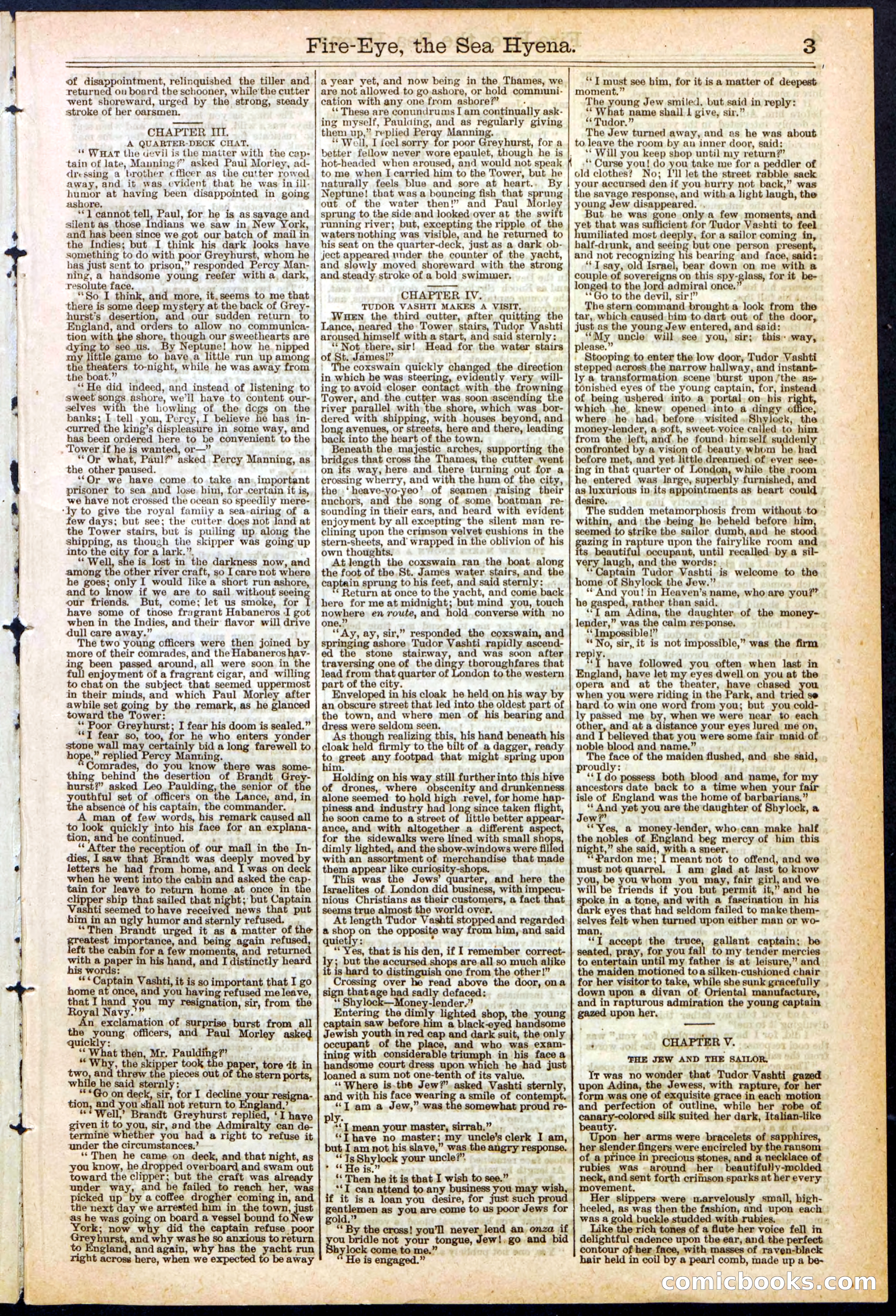
A restored page from Pulp Fiction, 1881. Page through the whole issue in the reader above.
📄 Transcribed text from this page (OCR, searchable)
Machine-transcribed from the original scan — historical spelling and the odd misread are preserved.
§ “4 > hes . 2 ee eae Ses ee ll A Mt Fire-Eye, the Sea Hyena. £ ' + of disappointment, relinquished the tiller andj a year yet, and now being in the Thames, we returned ou board the schooner, while’the cutter went shoreward, urged by the strong, steady stroke of her oarsmen. CHAPTER ITT. A QUARTER-DECK CHAT. ‘“ WHAT the cevil is the matter with the cap- tain of late, Manning?’ asked Paul Morley, ad- dressing a brother cflicer as the cutter rowed away, and it was evident that he was in ill- humor at having been disappointed in going ashore, ‘*) cannot tell, Paul, for he is as savage and silent as those Indians we saw in, New York, and has been since we got our batch of mail in the Indies; but I think his dark looks have something to do with poor Greyhurst, whom he has just sent to prison,” responded Percy Man- ning, a handsome young reefer with a, dark, resolute face. ‘So I think, and more, it,seems to me that there is some deep mystery at the back of Grey- hurst’s desertion, and our sudden return to England, and orders to allow no communica- tion with the shore, though our sweethearts are dying to see us. By Neptune! how he. nipped my little game to bave.a little run up among the theaters to-night, while he was away from the boat.” —_, ‘‘He did indeed, and instead of listening to sweet pens ashore, we'll have to content our- selves with the howling of the dogs on the banks; I tell you, Percy, I believe he has in- curred the king’s displeasure in some way, and has been ordered here to be convenient to the ‘Tower if he is wanted, or—” ““Or what, Paul?’ asked Percy Manning, as the other paused. . ‘‘Or we have come to take an important prisoner to sea and lose him, for.certain it is, we have not crossed the ocean so speedily mere- ‘ly to give the royal family a sea-airing of a tew days; but see; the cutter does not land at the Tower stairs, but is pulling up along the shipping, as though the skipper was going up into the city for a lark.” “* Well, she is lost in the darkness now, and among the other river craft, so I care not where he goes; only I would like a short run ashore, and to know if we are to sail without seein our friends. But, come; let us smoke, for have some of those fragrant Habaneros I got when in the Indies, and their flavor will drive dull care away.” The two young officers were then joined by more of their comrades, and the Habaneros hav- ng been passed around, all were soon in the enjoyment of a fragrent cigar, and willing to chat on the subject that seemed uppermost in their minds, and which Paul Morley after awhile set going by the remark, as he glanced toward the Tower: _ ** Poor Greyhurst; I fear his doom is sealed.” “*T fear so, too, for he who enters yonder stone wall may certainly bid a long farewell to hope,” replied Percy Manning. Comrades, do you know there was some- thing behind the desertion of Brandt Grey- burst?’ asked Leo Paulding, the senior of the outhful set of officers on the Lance, and, in e absence of his captain, the commander. A man of few words, his remark caused all to look quickly into his face for an explana- tion, and he continued. ; _“‘ After the reception of our mail in the In- dies, Isaw that Brandt was deeply agree by letters he had from home, and I was on dec when he went into the cabin and asked the cap- tain for leave to return home at once in the clipper ship that sailed that nigbt; but Captain Vashti seemed to have received news that put bim in an ugly humor and sternly re “Then Brandt urged it as a matter of the test importance, and being again refused, eft the cabin for a few moments, and returned with a paper in his hand, and I distinctly heard his words: " “* Captain Vashti, it is so important that I go home at once, and you having refused me leave, that I hand you my resignation, sir, from the Royal Navy. An exclamation of rise burst from all the young, officers, and Paul Morley asked quickly: “What then, Mr. Paulding? ; “Why, the skipper took the paper, tore it in two, and threw the pieces out of the stern ports, w he said sternly: 7S ig paca _**Go on deck, sir, for I decline tion, d you shall not return to Ri ** Well,’ Brandt Greyhurst replied, ‘I have given it to you, sir, and the Admiralty can de- termine whether you had a right to refuse it under the circumstances.’ ‘* Then he came on deck, and that night, as you know, he dropped overboard and swam out toward the clipper; but the craft was already under way, and be failed to reach her, was picked up by a coffee atogaee eS in, and n the next day we | town, F ac as he was going on board a vessel bound fo New York; now why did the captain refuse poor ee st, and why was he so anxious to return to England, and again, why has the yacht run right across here, when we expected to be away are not allowed to go ashore, or hold communi- cation with any one from asbore?” ** These are conundrums I am continually ask- ing myself, Paulding, and as regularly giving them up,” replied Perey Manning. ** Weil, I feel sorry for poor Greyhurst, for a better fellow never wore epaulet, though he is |. hot-headed when aroused, and would not speak to me when I carried him to the Tower, but he naturally feels blue and sore at heart.. By Neptune! that was a bouncing fish that sprung out of the water then!” and Paul Morle sprung to the side and looked over at the swift running river; but, excepting the ripple of the waters nothing was visible, and he returned to his seat on the quarter-deck, just as a dark ob- ject appeared under the counter of the yacht, and slowly moved shoreward with the strong and steady. stroke of a bold swimmer. CHAPTER IV. TUDOR VASHTI MAKES A VISIT, Wuen the third cutter, after quitting the Lance, neared the: Tower stairs, Tudor Vashti aroused himself with a start, and said sternly: ‘* Not there, sir! Head for the water stairs of St. James!” e coxswain quickly changed the direction in which he was steering, evidently very. will- ing to avoid closer contact with the frowning Tower, and the cutter was soon ascending the river parallel with the shore, which was_bor- dered with shipping, with houses beyond, and long avenues, or streets, here and there, leading back into the heart of the town. Beneath the majestic arches, supporting the bridges that cross the Thames, the cutter went on its way, here and there turning out for a crossing wherry, and with the hum of the city, the ‘ heave- O80: of seamen: raising their anchors, and the song of some boatman re- sounding in their ears, and heard with evident enjoyment by all excepting the silent man re- clining upon the crimson velvet cushions in the stern-sheets, and wrapped in the oblivion of his own thoughts. At length the coxswain ran the boat along the foot of the St. James wots stairs, and the captain sprung to his feet, and said sternly: ‘Return at once to the yacht, and come back here for me at midnight; but mind you, touch nowhere en route, and hold converse with no one,’ ‘Ay, ay, sir,” responded the coxswain, and springing ashore Tudor Vashti rapidly ascend- ed the stone stairway, and was soon after traversing one of the dingy thoroughfares that lead from that quarter of London to the western part of the city. Enveloped in his cloak he held on his way by an obscure street that led into the oldest part of the town, and where men of his bearing and dress were seldom seen. As though realizing this, his hand beneath his cloak held firmly to the bilt of a dagger, ready Ms greet any footpad that might spring upon m. Holding on his way still furtherinto this hive of drones, where obscenity and drunkenness alone seemed to hold high revel, for home hap- pine and industry had long. since taken flight, e soon came to a street of little better appear- ance, and with altogether a different aspect, for the sidewalks were lined with small sore dimly lighted, and the show-windows were ed rs an amorepent os a a that made them appear like curios ops. This aad the Jews’ quarter, and here the Israelites of London did business, with impecu- nious Christians as their customers, a fact that seems true almost the world over. At length Tudor Vashti stopped and regarded a — on the opposite way from him, and said quietly: “Yes, that is his den, if I remember correct- YY but the accursed shops are all so much alike it is hard to distinguish one from the other!” _Crossing over he read above the door, ona si pasage bed pally defaced: ‘ Shylock— aneye ender,” _ Entering the lighted shop, the young cap saw before a black-eyed handsome Jewish youth in red cap and dark suit, the only occupant of the place, and who was exam- ining with considerable arinmeph in his face o8 ane MA court dress upon which he had j loaned a sum not one-tenth of its value. ‘‘ Where is.the Jew?’ asked Vashti sternly, and with his face wearing a smile of contempt. “JT am a Jew,” was the somewhat proud re- ly. P **T mean your master, sirrah,” . “Thave no master; my uncle’s clerk I am, but I am not his slave,” was the response. ‘““TIsShylock your uncle?” 7 p “He is.” . " ‘* Then he it is that I wish to see.” **T can attend to any business you may wish | if it is Te roe deaite, for fa ud. gentlemen as you are come to us poor Jews for just such pro gold. 5 the cross! youll neyer lend an onza if you bridle not aur tongue, Jew!, go and bid ry lock come tome.” | a He is engaged.” / ‘* T must see bim, for it is a matter of deepest moment,” The young Jew smiled, but said in reply: ** What name shall | give, sir.” “Tudor.” The Jew turned away, and as he was about to leave the room by an inner door, said: ‘* Will you keep shop until my return?’ ‘** Curse you! do ape take me for a peddler of old clothes?) No; I'll let the street rabble sack your accursed den if you burry not back,” was the savage response, and with. a light laugh, the young Jew disappeared. .. But he was gone only a few moments, and et that was sufficient for Tudor Vashti to feel 1umiliated most deeply, for a sailor coming in, half-drunk, and seeing but one person present, and not recognizing his bearing and face, said: ‘* T say, old Israel, bear down on me with a couple of sovereigns ov this spy-glass, for it be- longed to the lord admiral once.’ vm ‘*Go to the devil, sir!” : ns The stern command brought a look from tar, which caused him to dart out of the door, just as the young Jew entered, and said: es, uncle will see you, sir; this: way, . please. . Stooping to enter the low door, Tudor Vashti stepped across the narrow hallway, and instant- ly a transformation scene burst upon ‘the as- tonished eyes of the young captain, for, instead of being ushered into a portal on. bis bt, which ,he, knew opened into a dingy office, where he. had, before visited . Shylock, the money-lender, a soft, sweet-voice called to him from the left, and, he found. himself sudden! confronted by a vision of beauty whom he. ba before met, and yet little dreamed of ever see-— ing in that quarter of London, while the room he entered was large, superbly furnished, and as luxurious iv its appointments as beart could esire. The sudden metamorphosis from without -to — within, and the being he beheld before him seemed to strike the sailor dumb, and he s gazing in rapture upon the fairylike room and ts. beautiful occupant, until recalled: by a sil- very laugh, and the words: **Captain Tudor Vashti home of Shylock the Jew.” “ And F io in Heaven’s name, who are you?” he gasped, rather than said. ‘‘T am Adina, the daughter of the money- lender,” was the calm response. ** Im ible!” ** No, sir, it is not impossible,” was the firm reply. : hE have followed you often when last in England, have let my eyes dwell on you at the opera and at the theater, have chased you when you were riding in the Park, and tried se hard to win one word from you; but you cold- ly passed me by, when we were near to each other, and at a distance your eyes lured mé on and I believed that you were some fair maid of . noble blood and name,” m The face of the maiden flushed, and she said, proudly: ‘‘T do possess both blood and name, for my ” is welcome to the ancestors date back to a time when your isle of England was the home of bar ; “ ppd yet you are the daughter of Shylock, a ew ‘Yes, a money-lender, who;can make half . the nobles of England beg mercy of him this night,” she said, with a sneer. ‘Pardon me; I meant not to offend, and we must not quarrel, I am glad at last to know you, be you whom you may, fair girl, and we will be friends if you but permit it,” and he ke in a tone, and with a fascination in his k eyes that had seldom failed to make them- selves felt when turned upon either man or wo- man, : “T accept the truce, gallant captain; be seated, pray, for you fall to my tender mercies to entertain until my father is at leisure,” and the maiden motioned toa silken-cushioned chair ? for her visitor to take, while she sunk gracefully , down upon a divan of Oriental man and in rapturous admiration the young captain gazed upon her. re oe ’ _.. CHAPTER V. . THE JEW AND THE SAILOR. It was no wonder that Tudor Vashti gazed» upon Adina, the Jewess, with rapture, for her form was one of exquisite grace in each motion and perfection of ee Rai her r of canary-colored silk suited dark, Italian-like . j i @ (air _her arms were bracelets of sapphires, ty. Upon her slender fingers were enc by the ransom | of a prince in precious stones, and a of | rubies was around her beau y-molded neck, and sent forth crimson sparks at her every Y ges lip lously qmail, high- ppers were marvelously sm s -aetioeeenenea tees ns was 4 goid Du i mig as ike the ri nes of a flute her voice fell in aaligntrn cadence upon the ear, and the perfect. contour with masses of raven-black hair held in coil by a pearl comb, made up a be- cOmicbooks u (ECO) r " x, ish. ae se - ar | eek OE. + Me s = a ~ . > 7) AEX y, es = er