
Pulp Fiction, 1881 · page 8 of 24
Beadle's New York Dime Library, No. 138 — page 8: what you’re looking at
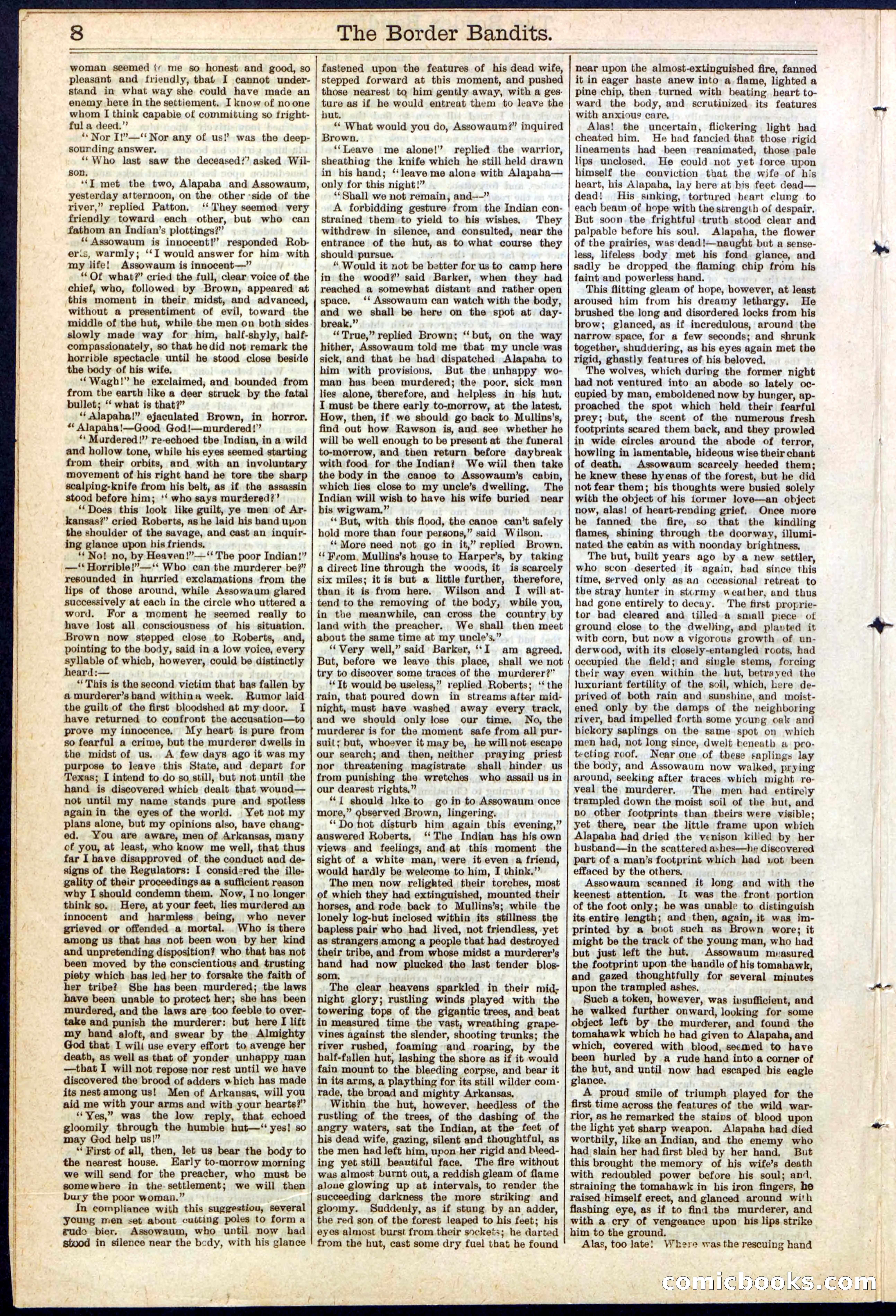
A restored page from Pulp Fiction, 1881. Page through the whole issue in the reader above.
📄 Transcribed text from this page (OCR, searchable)
Machine-transcribed from the original scan — historical spelling and the odd misread are preserved.
a SS a 8 woman seemed {r me so honest and good, so pleasant and friendly, that I cannot under- stand in what way she could have made an enemy here in the settiement. I know of noone whom I think capabie of committing so fright- ful a deed.” ** Nor I!’—‘‘ Nor any of us!’ was the deep- sounding answer. ‘Who last saw the deceased?’ asked Wil- son, ‘‘T met the two, Alapaba and Assowaum, yesterday afternoon, on the other side of the river,” replied Patton. ‘‘ They seemed very friendly toward each other, but who can fathom an Indian’s plottings?’ ‘“Assowaum is innocent!’ responded Rob- ers, warmly; ‘‘I would answer for him with my life! Assowaum is innocent—” “Of what?” cried the full, clear voice of the chief, who, followed by Brown, appeared at this moment in their midst, and advanced, without a presentiment of evil, toward the middle of the hut, while the men on both sides slowly made way for him, half-shyly, half- compassionately, so that hedid not remark the horrible spectacle until he stood close beside the body of his wife. ‘“Wagh!” he exclaimed, and bounded from from the earth like a deer struck by the fatal bullet; ‘‘ what is that?” ‘“‘ Alapaha!” ejaculated Brown, in horror. ** Alapaha!—Good God!—murdered!” ‘* Murdered!” re-echoed tbe Indian, in a wild and hollow tone, while his eyes seemed starting from their orbits, and with an involuntary movement of his right band he tore the sharp scalping-knife from his belt, as if the assassin stood before him; ‘‘ who says murdered?’ “Does this look like guilt, ye men of Ar- kansas?’ cried Roberts, as he laid bis band upon the shoulder of the savage, and cast an inquir- ing glance upon his friends. ‘* No! no, by Heaven!”—‘‘ The poor Indian!” —‘* Horrible!”—‘‘ Who can the murderer be?” resounded in hurried exclamations from the lips of those around, while Assowaum glared successively at each in the circle who uttered a word. For a moment he seemed really to have lost all consciousness of his situation. Brown now stepped close to Roberts, and, pointing to the body, said in a low voice, every syllable of which, however, could be distinctly heard:— “This is the second victim that has fallen by a murderer’s band withina week. Rumor laid the guilt of the first bloodshed at my door, I have returned to confront the accusation—to prove my innocence, My heart is pure from so fearful a crime, but the murderer dwells in the midst of us. A few days ago it was my purpose to leave this State, and depart for Texas; I intend to do so still, but not until the hand is discovered whicb dealt that wound— not until my name stands pure and spotless again in the eyes of the world. Yet not my plans alone, but my opinions also, have chang- ed. You are aware, men of Arkansas, many of you, at least, who kaow me well, that thus far I have disapproved of the conduct and de- signs of the Regulators: I considered the ille- gality of their proceedings as a sufficient reason why I should condemn them. Now, I no longer think so. Here, at your feet, lies murdered an innocent and harmless being, who never grieved or offended a mortal. Who is there among us that has not been won by her kind and unpretending disposition? who that bas not been moved by the conscientious and trusting piety which has led her to forsake the faith of her tribe? She has been murdered; the laws have been unable to protect her; she has been murdered, and the laws are too feeble to over- take and punish the murderer: but here I lift my hand aloft, and swear by the Almighty God that I will use every effort to avenge her death, as well as that of yonder unhappy man —tbat I will not repose nor rest until we have discovered the brood of adders which has made its nestamong us! Men of Arkansas, will you aid me with your arms and with your hearts?’ ‘*Yes,” was the low reply, that echoed gloomily through the humbie hut—‘“ yes! so may God help us!” “First of all, then, let us bear the body to the nearest house. Early to-morrow morning we will send for the preacher, who must be somewhere in the-settlement; we will then bury the poor woman.” In compliance with this suggestion, several young men set about cutting poles to forma gudo bier. Assowaum, who until now had stood in silence near the bedy, with his glance The Border Bandits. fastened upon the features of his dead wife, stepped forward at this moment, and pushed those nearest to him gently away, with a ges- ture as if he would entreat them to leave the but. ** What would you do, Assowaum?” inquired Brown. ‘‘Leave me alone!” replied the warrior, sheathing the knife which he still held drawn in his hand; ‘‘ leave me alone with Alapaha— only for this night!” “Shall we not remain, and—-” A forbidding gesture from the Indian con- strained them to yield to his wishes. They withdrew in silence, and consulted, near the entrance of the hut, as to what course they should pursue. . “ Would it not be better for us to camp here in the wood?’ said Barker, when they had reached a somewhat distant and rather open space. ‘* Assowaum can watch with the body, and we shall be here on the spot at day- break,” “True,” replied Brown; ‘‘ but, on the way hither, Assowaum told me that my uncle was sick, and that he had dispatched Alapaha to him with provisions, But the unhappy wo- man has been murdered; the poor, sick man lies alone, therefore, and helpless in his hut, I must be there early to-morrow, at the latest. How, then, if we sbould go back to Mullins’s, find out how Rawson is, and see whether he will be well enough to be present at the funeral to-morrow, and then return before daybreak with food for the Indian! We wiil then take the body in the canoe to Assowaum’s cabin, which lies close to my uncle’s dwelling, The Indian will wish to have his wife buried near bis wigwam,”’ ** But, with this flood, the canoe can’t safely hold more than four persons,” said Wilson, ‘* More need not go in it,” replied Brown. ‘¢ vom, Mullins’s house to Harper’s, by taking a direct line through the woods, it is scarcely six miles; itis but a little further, therefore, than it is from here. Wilson and I will at- tend to the removing of the body, while you, in the meanwhile, can cross the country by land with the preacher. We shall then meet about the same time at my uncle’s,” ‘Very well,” said Barker, ‘I am agreed, But, before we leave this place, shall we not try to discover some traces of the murderer?” ‘Tt would be useless,” replied Roberts; ‘‘ the rain, that poured down in streams after mid- night, must bave washed away every track, and we should only lose our time. No, the murderer is for the moment safe from all pur- suit; but, whoever it may be, he willnot escape our search; and then, neither praying priest nor threatening magistrate shall hinder us from punishing the wretches who assail us in our dearest rights,” {| should hketo goin to Assowaum once more,” observed Brown, lingering. **Do hot disturb him again this evening,” answered Roberts. ‘The Indian has his own views and feelings, and at this moment the sight of a white man, were it even a friend, would hardly be welcome to him, I think.” The men now relighted their torches, most of which they had extinguished, mounted their horses, and rode back to Mullins’s; while the lonely log-but inclosed within its stillness the bapless pair who had lived, not friendless, yet as strangers among a people that had destroyed their tribe, and from whose midst a murderer’s hand had now plucked the last tender blos- som, The clear heavens sparkled in their mid, night glory; rustling winds played with the towering tops of the gigantic trees, and beat in measured time the vast, wreathing grape- vines against the slender, shooting trunks; the river rushed, foaming and roaring, by the half-fallen hut, lashing the shore as if it would fain mount to the bleeding corpse, and bear it in its arms, a plaything for its still wilder com- rade, the broad and mighty Arkansas. Within the hut, however, heedless of the rustling of the trees, of the dashing of the angry waters, sat the Indian, at the feet of his dead wife, gazing, silent and thoughtful, as tbe men had left him, upon her rigid and bleed- ing yet still beautiful face. The fire without was almost burnt out, a reddish gleam of flame aloue glowing up at intervals, to render the succeeding darkness the more striking and gloomy. Suddenly, as if stung by an adder, the red son of the forest leaped to his feet; his eyes almost burst from their sockets; he darted from the hut, cast some dry fuel that he found near upon the almost-extinguished fire, fanned it in eager haste anew into a. flame, lighted a pine chip, then turned with beating heart to- ward the body, and scrutinized its features with anxious care, Alas! the uncertain, flickering light had cheated him. He had fancied that those rigid lineaments had been reanimated, those pale lips unclosed. He could not yet force upon himself the conviction that the wife of his heart, his Alapaha, lay here at bis feet dead— dead! His sinking, tortured heart clung to each beam of hope with the strength of despair. But soon the frightful truth stood clear and palpable before his soul. Alapaha, the flower of the prairies, was dead!—naught but a sense- less, lifeless body met his fond glance, and sadly he dropped the flaming chip from his faint and powerless hand, This flitting gleam of hope, however, at least aroused him from his dreamy lethargy. He brushed the long and disordered locks from his brow; glanced, as if incredulous, around the narrow space, for a few seconds; and shrunk together, shuddering, as his eyes again met the rigid, ghastly features of his beloved, The wolves, which during the former night had not ventured into an abode so lately oc- eupied by man, emboldened now by hunger, ap- proached the spot which held their fearful prey; but, the scent of the numerous fresh footprints scared them back, and they prowled in wide circles around the abode of terror, howling in lamentable, hideous wise their chant of death, Assowaum scarcely heeded them; he knew these hyenas of the forest, but he did not fear them; his thoughts were busied solely with the object of his former love—an object now, alas! of heart-rending grief. Once more he fanned the fire, so that the kindling flames, shining through the doorway, illumi- nated the cabin as with noonday brightness, The but, built years ago by a new settler, who scon deserted it again, bad since this time, served only as an occasiona) retreat to the stray hunter in stormy weather, and thus had gone entirely to decay. The first proprie- tor bad cleared and tilled a small piece of ground close to the dwelling, and planted it with corn, but now a vigorous growth of un- derwood, with its closely-entangled roots, had occupied the field; and single stems, forcing their way even within the but, betrayed the luxuriant fertility of the soil, which, here de- prived of both rain and sunshine, and moist- ened only by the damps of the neighboring river, bad impelled forth some young oak and hickory saplings on the same spot on which men had, not long since, dwelt beneath a pro- tecting roof. Near one of these saplings lay the body, and Assowaum now walked, prying around, seeking after traces which might re- veal the murderer, The men had entirely trampled down the moist soil of the hut, and no otber footprints than theirs were visible; yet there, near the little frame upon which Alapaha had dried the venison killed by her husband—in the scattered ashes—he discovered part of a man’s footprint which had vot been effaced by the others, Assowaum scanned it long and with the keenest. attention, It was the front portion of the foot only; he was unable to distinguish its entire length; and then, again, it was im- printed by a boot such as Brown wore; it might be the track of the young man, who had but just left the hut. Assowaum mwasured the footprint upon the handle of his tomahawk, and gazed thoughtfully for several minutes upon the trampled ashes, Such a token, however, was insufficient, and he walked further onward, looking for some object left by the murderer, and found the tomahawk which he had given to Alapaha, and which, covered with blood, seemed to have been hurled by a rude hand into a corner of the hut, and until now had escaped bie eagle glance. A proud smile of triumph played for the first time across the features of the wild war- rior, as he remarked the stains of blood upon the light yet sharp weapon. Alapaha had died worthily, like an Indian, and the enemy who had slain her had first bled by her hand, But this brought the memory of his wife’s death with redoubled power before his soul; an‘, straining the tomahawk in his iron fingers, raised himself erect, and glanced around with flashing eye, as if to find the murderer, and with a cry of vengeance upon his lips strike him to the ground. Alas, too late! Where was the rescuing hand co Goimilcbooks::