
Pulp Fiction, 1881 · page 7 of 24
Beadle's New York Dime Library, No. 138 — page 7: what you’re looking at
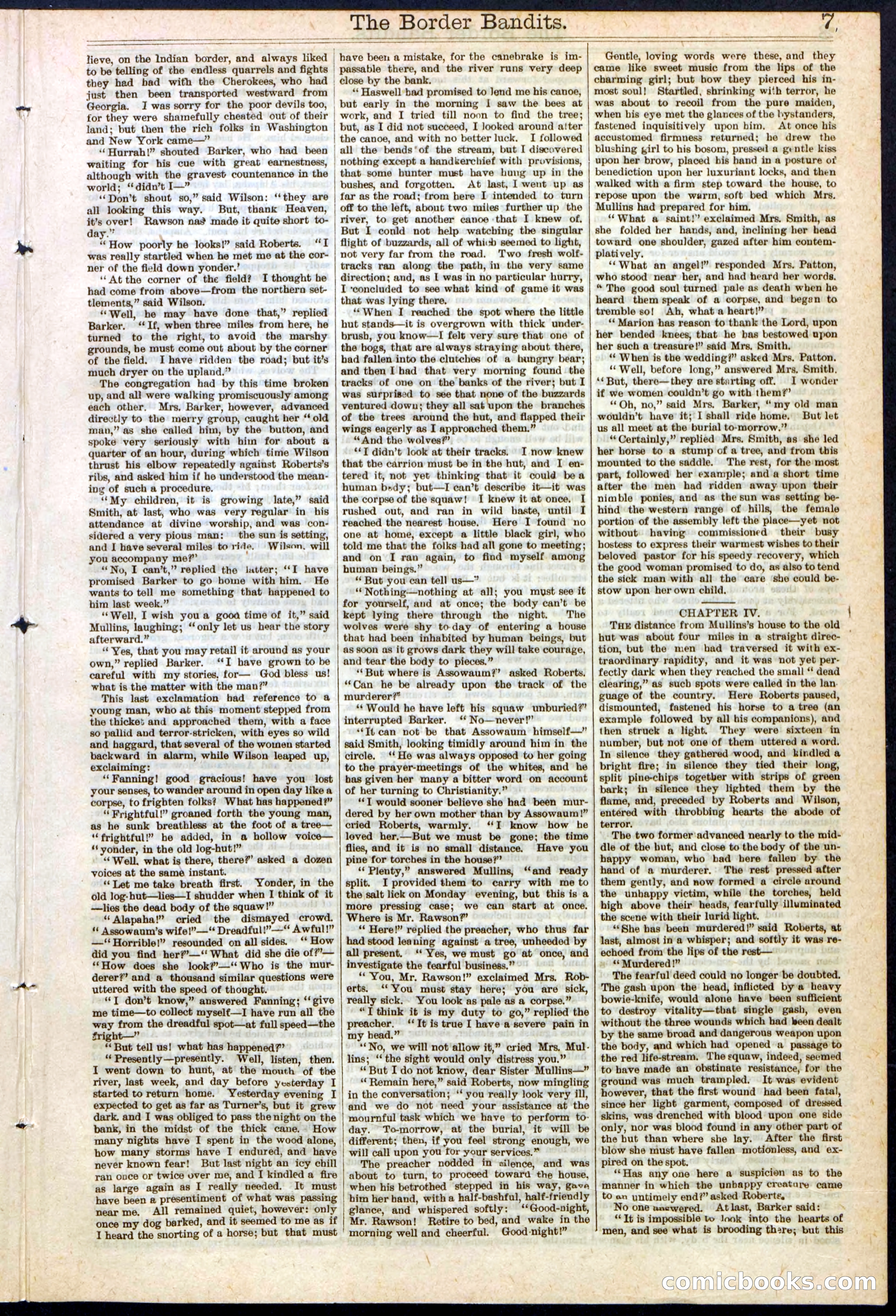
A restored page from Pulp Fiction, 1881. Page through the whole issue in the reader above.
📄 Transcribed text from this page (OCR, searchable)
Machine-transcribed from the original scan — historical spelling and the odd misread are preserved.
LL AL A ALL AALALAALALA es ee eee —— oe The Border Bandits. ete re ee ———— lieve, on the Indian border, and always liked | have been a mistake, for the canebrake is im- to be telling of the endless quarrels and fights | passable there, and the river runs very deep they had bad with the Cherokees, who had | close by the bank. just then been transported westward from Georgia. | “‘ Haswell bad promised to Jend me his canoe, I was sorry for the poor devils too, _ but early in the morning | saw the bees at for they were shamefully cheated out of their | work, and I tried till noon to find the tree; land; but then the rich folks in Washington | but, as I did not succeed, I looked around atter and New York came—” the canoe, and with no better luck. I followed “Hurrah!” shouted Barker, who had been | all the bends‘of the stream, but I discovered waiting for his cue with great earnestness, nothing except a handkerchief with provisions, although with the gravest countenance in the | that some bunter must have hung up in the world; “didn’t I—” bushes, and forgotten. At last, 1 went up as “Don’t shout so,” said Wilson: ‘they are | tar as the road; from here I intended to turn | off to the left, about two miles further up the it’s over! Rawson na’ made it quite short to- | river, to get another canoe ‘that I knew of. all looking this way. But, thank Heaven, day.” “How poorly he looks!” said Roberts. ‘TI was really startled when he met me at the cor- ner of the field down yonder.’ ‘‘Atthe corner of the field? I thought he had come from above—from the northern set- tlements,” said Wilson. ‘Well, he may have done that,” replied Barker. ‘If, when three miles from here, he turned to the right, to avoid the marshy grounds, be must come out about by the corner of the field. Ihave ridden the road; but it’s much dryer on the upland.” The congregation had by this time broken up, and all were walking promiscuously among each other. Mrs, Barker, however, advanced directly to the merry group, caught her “old man,” as she called him, by the button, and spoke very seriously with him for about a quarter of an hour, during which time Wilson thrust his elbow repeatedly against Roberts’s ribs, and asked him if he understood the mean- ing of such a procedure. ‘““My children, it is growing late,” said Smith, at last, who was very regular in his attendance at divine worship, and was con- sidered a very pious man: the sun is setting, and I have several miles to ride. Wilson. will you accompany me?” “No, I can’t,” replied the latter; ‘‘I have promised Barker to go bome with him. He wants to tell me something that happened to him last week.” ‘‘Well, I wish you a gooa time of it,” said Mullins, laughing; “only let us hear the story afterward.” “Yes, that you may retail if around as your own,” replied Barker. ‘“‘I have grown to be careful with my stories, for— God bless us! what is the matter with the man?” This last exclamation bad reference to a young man, who at this moment stepped from the thicket and approached them, with a face so pallid and terror-stricken, with eyes so wild and haggard, that several of the women started backward in alarm, while Wilson leaped up, exclaiming: ‘‘Fanning! good gracious! have you lost your senses, to wander around in open day like a corpse, to frighten folks? What has happened?” “ Frightful!” groaned forth the young man, as he sunk breathless at the foot of a tree— “frightful!” be added, in a hollow voice— ‘‘ yonder, in the old log-hut!” ‘“ Well. what is there, there?’ asked a dozen voices at the same instant. ‘Let me take breath first. Yonder, in the old log-hut—lies—I shudder when I think of it —lies the dead body of the squaw!” “‘ Alapaha!” cried the dismayed crowd. “ Assowaum’s wife!” —“ Dreadful!”—“ Awful!” —‘‘ Horrible!” resounded on all sides. ‘ How did you find her?’—‘‘ What did she die of?’— ‘“How does she look?’—‘*Who is the mur- derer?’ and a thousand similar questions were uttered with the speed of thought. “JT don’t know,” answered Fanning; ‘give me time—to collect myself—I have run all the way from the dreadful spot—at full speed—the fright—” ‘But tell us! what has happened?’ “ Presently—presently. Well, listen, then. I went down to hunt, at the mouth of the river, last week, and day before yesterday I started to return home. Yesterday evening I expected to get as far as Turner’s, but it grew dark. and I was obliged to pass the night on the bank, in the midst of the thick cane. How many nights have I spent in the wood alone, how many storms have I endured, and have never known fear! But last night an icy chill ran once or twice over me, and I kindled a fire as large again as I really needed. It must have been a presentiment of what was passing near me. All remained quiet, however: only once my dog barked, and it seemed to me as if | Mr. Rawson! I heard the snorting of a horse; but that must ' morning well and cheerful. But I conld not help watching the singular flight of buzzards, all of which seemed to light, not very far from the road. Two fresh wolf- tracks ran along the path, in the very same direction; and, as | was in no particular hurry, I ‘concluded to see what kind of game it was that was lying there, ‘*When I reached the spot where the little hut stands—it is overgrown with thick under- brush, you know—lI felt very sure that one of the bogs, that are always straying about there, had fallen into the clutches of a hungry bear; and then I had that very morning found the tracks of one on the banks of the river; but I was surprised to see that none of the buzzards ventured down; they all sat upon the branches of the trees around the hut, and flapped their wings eagerly as I approached them.” “And the wolves?’ **T didn’t look at their tracks. I now knew that the carrion must be in the hut, and I en- tered it, not yet thinking that it could bea human bedy; but—I can’t describe it—it was the corpse of the squaw! I knew it at once, I rushed out, and ran in wild baste, until I reached the nearest house. Here I found no one at home, except a little black girl, who told me that the folks had all gone to meeting; and on I ran again, to find myself among human beings.” * But you can tell us—” ‘* Nothing—nothing at all; you must see it for yourself, and at once; the body can’t be kept lying there through the night. The wolves were shy today of entering a house that had been inhabited by human beings, but as soon as it grows dark they will take courage, and tear the body to pieces.” ‘‘But where is Assowaum?’ asked Roberts. ‘“‘Can he be already upon the track of the murderer?” ‘* Would he have left his squaw unburied?’ interrupted Barker. ‘* No—never!” ‘*Tt can not be that Assowaum himself—” said Smith, looking timidly around him in the circle. ‘He was always opposed to her going to the prayer-meetings of the whites, and he bas given her mapy a bitter word on account of her turning to Christianity.” **T would sooner believe she had been mur- dered by her own mother than by Assowaum|!” cried Roberts, warmly. ‘'I know how he loved her.—But we must be gone; the time flies, and it is no small distance. Have you pine for torches in the house?” ‘* Plenty,” answered Mullins, “‘and ready split. I provided them to carry with me to the salt lick on Monday evening, but this is a more pressing case; we can start at once. Where is Mr. Rawson?’ ‘‘ Here!” replied the preacher, who thus far had stood leaning against a tree, unheeded by all present. ‘‘ Yes, we must go at once, and investigate the fearful business.” **'You, Mr. Rawson!” exclaimed Mrs. Rob- erts. ‘‘You must stay here; you are sick, really sick, You look as pale as a corpse.” “T think it is my duty to go,” replied the preacher. ‘It is true I have a severe pain in my head.” ‘No, we will not allow it,” cried Mrs, Mul- lins; “‘ the sight would only distress you.” “But I do not know, dear Sister Mullins—” “Remain here,” said Roberts, now mingling in the conversation; ‘‘ you really look very ill, and we do not need your assistance at the mournful task which we have to perform to- day. To-morrow, at the burial, it will be different; then, if you feel strong enough, we will call upon you for your services.” The preacher nodded in silence, and was about to turn, to proceed toward the house, when his betrothed stepped in his way, gava him her band, with a half-bashful, half-friendly glance, and whispered softly: ‘‘Good-night, Retire to bed, and wake in the Good-night!” \ / a nm er ee Gentle, loving words were these, and they came like sweet music from the lips of the charming girl; but bow they pierced his in- most soul! Startled, shrinking with terror, he was about to recoil from the pure maiden, when bis eye met the glances of the bystanders, fastened inquisitively upon him. At once his accustomed firmness returned; he drew the blushing girl to his bosom, pressed a gentle kiss upon her brow, placed bis hand in a posture of benediction upon her luxuriant locks, and then walked with a firm step toward the house, to repose upon the warm, soft bed which Mrs. Mullins had prepared for him. ‘What a saint!” exclaimed Mrs. Smith, as she folded her hands, and, inclining her head toward one shoulder, gazed after him contem- platively. ‘‘What an angel!” responded Mrs. Patton, who stood near her, and had heard her words, “ The good soul turned pale as death when he heard them speak of a corpse, and began to tremble so! Ah, what a heart!” ‘* Marion has reason to thank the Lord, upon her bended knees, that he bas bestowed upon her such a treasure!” said Mrs, Smith, ‘* When is the wedding?” asked Mrs, Patton. ‘Well, before long,” answered Mrs, Smith. ‘¢ But, there—they are starting off. I wonder if we women couldn’t go with them?’ ‘Oh, no,” said Mrs. Barker, “my old man wouldn’t have it; I shall ride home. But let us all meet at the burial to-morrow.” “ Certainly,” replied Mrs, Smith, as she led | her horse to a stump of a tree, and from this mounted to the saddle. The rest, for the most part, followed her example; and a short time after the men had ridden away upon their nimble ponies, and as the sun was setting be- hind the western range of hills, the female portion of the assembly left the place—yet not without having commissioned their busy hostess to express their warmest wishes to their beloved pastor for his speedy recovery, which the good woman promised to do, as also to tend the sick man with all the care she could be- stow upon her own child. CHAPTER IV. \ THE distance from Mullins’s house to the old _ hut was about four miles in a straight direc- tion, but the men had traversed it with ex- traordinary rapidity, and it was not yet per- fectly dark when they reached the small “ dead clearing,” as sucb spots were called in the lan. guage of the country. Here Roberts paused, dismounted, fastened his horse to a tree (an example followed by all bis companions), and then struck a light. They were sixteen in number, but not one of them uttered a word. In silence they gathered wood, and kindled a bright fire; in silence they tied their long, split pine-chips togetber with strips of green bark; in silence they lighted them by the flame, and, preceded by Roberts and Wilson, entered with throbbing hearts the abode of terror. The two former advanced nearly to the mid- dle of the but, and close to the body of the un- happy woman, who bad bere fallen by the hand of a murderer. The rest pressed after them gently, and now formed a circle around © the unhappy victim, while the torches, held high above their heads, fearfully illuminated the scene with their lurid light. “She bas been murdered!” said Roberts, at last, almost in a whisper; and softly it was re echoed from the lips of the rest— ! . “Murdered!” iy The fearful deed could no longer be doubted. The gash upon the head, inflicted bya heavy bowie-knife, would alone have been sufficient to destroy vitality—tbat single gash, even without the three wounds which had been dealt by the same broad and dangerous weapon upon the body, and which had opened a passage to the red life-stream. The equaw, indeed, seemed to have made an obstinate resistance, for the ground was much trampled. It was evident however, that the first wound had been fatal, since her light garment, composed of dressed skins, was drenched with blood upon one side only, nor was blood found in any other part of the hut than where she lay. After the first blow she must have fallen motionless, and ex- pired on the spot. , “Has any one here a suspicion as to the manner in which the unbappy creature came to an untimely end?” asked Roberts, No one unewered. Atlast, Barker said: ‘It is impossible to look into the hearts of men, and see what is brooding there; but this <SuGO Gomicdoo