
Pulp Fiction, 1881 · page 11 of 32
Beadle's New York Dime Library, No. 137 — page 11: what you’re looking at
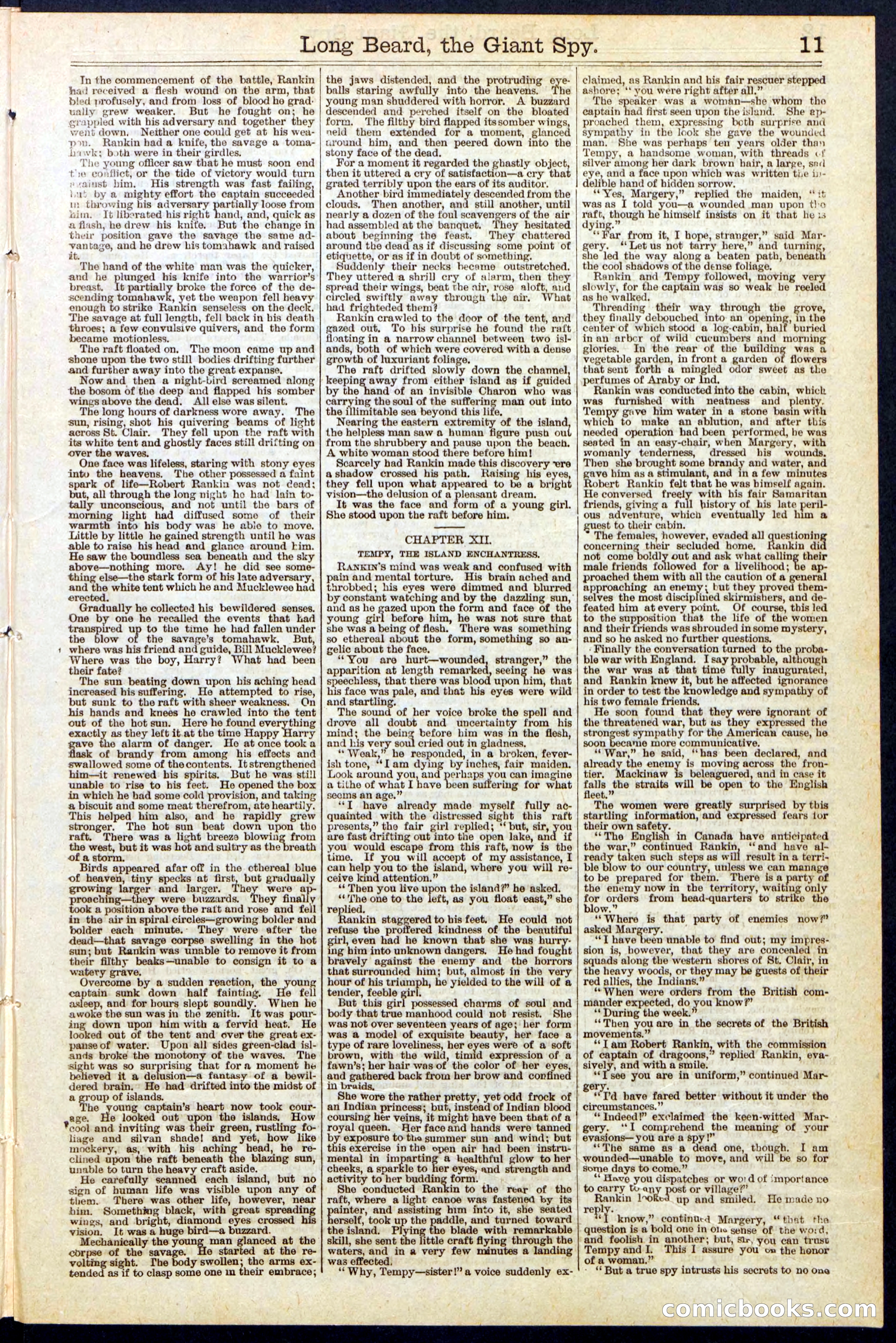
A restored page from Pulp Fiction, 1881. Page through the whole issue in the reader above.
📄 Transcribed text from this page (OCR, searchable)
Machine-transcribed from the original scan — historical spelling and the odd misread are preserved.
ty £4, _ m= In the commencement of the battle, Rankin had received a flesh wound on the arm, that bled profusely, and from loss of blood he grad. ually grew weaker. But he fought on; he erappled with bis adversary and together they went down. Neither one could get at his wea- pon. Rankin had a knife, the savage a toma- hawk: both were in their girdles. The young oflicer saw that he must soon end toe eonfliet, or the tide of victory would turn »roinsh bim. His strength was fast failing iu by a mighty effort the captain succeeded in throwing bis adversary partially loose from aim. It liberated his right band, and, quick as a fiash, he drew his knite, But the change in their position gave the savage the same ad- vantage, and he drew his tomahawk and raised zt. The hand of the white man was the quicker, and he plunged his knife into the warrior’s breast. tt partially broke the force of the de- scending tomahawk, yet the weapon fell heavy enough to strike Rankin senseless on the deck, The savage at full length, fell back in his death throes; a few convulsive quivers, and the form became motionless. The raft floated on, The moon came up and shone upon the two still bodies drifting further and further away into the great expanse. Now and then a night-bird screamed along the bosom of the deep and flapped his somber wings above the dead. All else was silent. The long hours of darkness wore away. The sun, rising, shot his quivering beams of light across St. Clair. They fell upon the raft with its white tent and ghostly faces still drifting on over the waves. One face was lifeless, staring with stony eyes intu the heavens. The other possessed a faint spark of life—Robert Rankin was not cead;: but, all through the long night ho had lain to- tally unconscious, and not until the bars of morning light had diffused some of their warmth into his body was he able to move, Little by little he gained strength until he was able to raise his head and glance around kim. He saw the boundless sea beneath and the sky above—nothing more. Ay! he did see some- thing else—the stark form of his late adversary, and the white tent which he and Mucklewee had erected. Gradually he collected his bewildered senses. One by one he recalled the events that had transpired up to the time he had fallen under the blow of the savage’s tomahawk. But, where was his friend and guide, Bill Mucklewee? Where was the boy, Harry? What had been their fate? The sun beating down upon his aching head increased his suffering. He attempted to rise, but sunk to the raft with sheer weakness. On his hands and knees he crawled into the tent out of the hotsun. Here he found everything exactly as they left it.at the time Happy Harry ve the alarm of danger. He at once took a k of brandy from among his effects and swallowed some of thecontents. It strengthened him—it renewed his spirits. But he was still unable to rise to bis feet. He opened the box in which he had some cold provision, and taking a biscuit and some meat therefrom, ate heartily. This helped him also, and he rapidly grew stronger. The hot sun beat down upon tho raft. There was a light breezo blowing from the west, but it was hot and sultry as the breath of a storm. Birds appeared afar off in the cthereal blue of heaven, tiny specks at first, but gradually growing larger and larger. They were a proaching—they were buzzards. They finally took a position above the ratt and rose and fell in the air in spiral circles—growing bolder and bolder each minute.- They were after the dead—that savage corpse swelling in the hot sun; but Rankin was unable to remove it from their filthy beaks—unable to consign it to a watery grave. Overcome by a sudden reaction, the young captain sunk down half fainting. He fell asleep, and for bours slept soundly. When he awoke the sun was in the zenith. It was pour- ing down upon him with a fervid heat. He looked out of the tent and over the great ex- panse of water. Upon all sides green-clad isl- ands broke the monotony of the waves. The ht was so surprising that fora moment he believed it a delusion—a fantasy of a bewil- dered brain. He had drifted into the midst of a group of islands. he young captain’s heart now took cour- age. He looked out upon the islands, How *oool and inviting was their green, rustling fo- liage and silvan shade! and yet, how like mockery, as, with his aching head, he re- clined upon the raft beneath the blazing sun, unable to turn the heavy craft aside. He carefully seanned each island, but no sign of human life was visible upon any of tiem. There tals seg) ri however, near him. Somethin , with great spreadin wings, and bright, diamond eyes crossed his vision. It was a huge bird—a b k Mechanically the y' man ced at the corpse of the ie se e star at the re- New ¢ sight. Ihe body swollen; the arms ex- tended as if to clasp some one im their embrace; the jaws distended, and the protruding ore. balls staring awfully into the heavens. The young man shuddered with horror. A buzzard descended and perched itself on the bloated form. The filthy bird flapped itssomber wings neld them extended for a moment, glance «round him, and then peered down into the stony face of the dead. For a moment it regarded the ghastly object then it uttered a cry of satisfaction—a cry that grated terribly upon the ears of its auditor. Another bird immediately descended from the clouds. Then another, and still another, until nearly a dozen of the toul scavengers of the air had assembled at the banquet. They hesitated about beginning the feast. They chattered around the dead as if discussing some point of etiquette, or as if in doubt of something. Suddenly their necks became outstretched. They uttered a shril] cry of alarm, then they spread their wings, beat the air, rose aloft, aud circled swiftly away through the air. What had frighteded them? Rankin crawled to the door of the tent, and gazed out. To his surprise he found the raft floating in a narrow channel between two isl- ands, both of which were covered with a dense growth of luxuriant foliage, The raft drifted slowly down the channel keeping away from either island as if guided by the hand of an invisible Charon who was carrying the soul of the suffering man out into the illimitable sea beyond this life, Nearing the eastern extremity of the meee the helpless man saw a human figure push ou from the shrubbery and pause upon the beach. A white woman stood there before him! Scarcely had Rankin made this discovery ere a shadow crossed his path. Raising his eyes, they fell upon what appeared to be a bright vision—the delusion of a pleasant dream. It was the face and form of a young girl. She stood upon the raft before him. CHAPTER XII. TEMPY, THE ISLAND ENCHANTRESS. RANKIN'S mind was weak and confused with pain and mental torture, His brain ached and throbbed; his eyes were dimmed and blurred by constant watching and by the dazzling sun, and as he saree upon the form and face of the young girl before him, he was not sure that she was a being of flesh. There was something so ethereal about the form, something so an- gelic about the face. “You are hurt—wounded, stranger,” the apparition at length remarked a he was speechless, that there was blood upon him, that pe was pale, and that his eyes were wild and s g. The sound of her voice broke the spell and drove all doubt and uncertainty from his mind; the being before him was in the flesh, and his very soul cried out in gladness, * Weak,” he responded, in a broken, fever- ish tone, “‘Iam dying by inches, fair maiden. Look around you, and perbape ou can imagine a tithe of what I have been suffering for what secms an age.” ‘“‘T have already made myself fully ac- quainted with the distressed sight this raft presents,” the fair girl replied; ‘‘ but, sir, you are fast drifting out into the open lake, and if you would escape from this raft, now is the time. If you will accept of my assistance, I can help yar to the island, where you will re- ceive kind attention.” ‘* Then you live upon the island?” he asked. ‘he one to the left, as you float east,” she replied. nkin weaned tp his feet. He could not refuse the proffered kindness of the beautiful girl, even had he known that she was hurry- ing him into unknown dangers. He had fought bravely against the enemy and the horrors that surrounded him; but, almost in the very hour of his vie a he yielded to the will of a tender, feeble girl. But this girl possessed charms of soul and body that true manhood could not resist. She was not over seventeen years of age; her form was a model of exquisite beauty, her face a type of rare loveliness, her eyes were of a soft brown, with the wild, timid expression of a fawn’s; her hair was of the color of her eyes, and gathered back from her brow and confined In braids, She wore the rather pretty, yet odd frock of an Indian princess; but, instead of Indian blood coursing her veins, it might have been that of a royal queen. Her faceand hands were tanned b to the summer sun and wind; but this exercise inthe open air had been instru- mental in im voy 2 & healthful glow to her cheeks, a sparkle to her eyes, and strength and activity to her me sem, Be . She conducted Rankin to the rear of the raft, where a light canoe was fastened by its Hamed and assisting him into it, she seated erself, took up the dle, and turned toward the island. lying blade with remarkable skill, she sent the little craft pao Ba the waters, and in a very few minutes a landing was effected, “Why, Tempy—sister!” a voice suddenly ex Long Beard, the Giant Spy. i ll claimed, as Rankin and his fair rescuer stepped ashore: ‘* you were right after all,” The speaker was a woman—she whom the captain had first seen upon the island. She ep- proached them, expressing both surprise and sympathy in the look she gave the wounded man, She was perhaps ten years older than Tempy, a handsome woman, with threads «f silver among her dark brown hair, a large, sad eye, and a face upon which was written the i:- delible hand of hidden sorrow. ‘Yes, Margery,” replied the maiden, “iti was as I told you—a wounded man upon t)o raft, though he himself insists on it that he is dying.” “Far from it, I hope, stranger,” said Mar- ery. ‘‘Letus not tarry bere,” and turning, she led the way alonga beaten path, beneath the cool shadows of the dense foliage, Rankin and Tempy followed, moving very slowly, for the captain was so weak be reeled as he walked, Threading their way through the grove, they finally debouched into an opening, in the center of which stood a log-cabin, half buried inan arber of wild cucumbers and morning glories. In the rear of the building was a vegetable garden, in front a garden of flowers that sent forth a mingled odor sweet as the perfumes of Araby or Ind. Rankin was conducted into the cabin, which was furnished with neatness and plenty, Tempy gave him water in a stone basin with which to make an ablution, and after this needed operation had been performed, be was seated in an easy-chair, when Margery, with womanly tenderness, dressed his wounds. Then she brought some brandy and water, and ave him as a stimulant, and ina few minutes obert Rankin felt that he was himeelf again. He conversed freely with bis fair Samaritan friends, giving a full history of his late peril- ous adventure, which eventually led him a est to their cabin. The females, however, evaded all questionin concerning their secluded home, nkin di not come boldly out and ask what calling their male friends followed for a livelihood; be ap- proached them with all the caution of a L Fran approaching an enemy; but they proved them- selves the most disciplined skirmishers, and de- feated him atevery point. Of course, this led to the supposition that the life of the women and their friends was shrouded in some mystery, and so he asked no further questions. ‘Finally the conversation turned to the proba- ble war with England. I say probable, although the war was at that time fully inaugurated, and Rankin knew it, but he affected ignorance in order to test the knowledge and sympathy of his two female friends, He soon found that they were ignorant of the threatened war, but us they expressed the strongest sympathy for the American cause, he soon became more communicative. ‘*War,” he said, ‘has been declared, and already the enemy is moving across the fron- tier. Mackinaw beleaguered, and in case it fe the straits will be open to the English eet. The women were greatly surprised by this startling information, and expressed fears lor their own eG “The Eng in Canada have anticipated the war,” continued Rankin, “‘and have al- eeaey taken such steps as will result in a terri- ble blow to our country, unless we can manage to be prepared for them. There isa party of the enemy now in the territory, waiting only eH orders from head-quarters to strike the ow." ‘*Where is that party of enemies now?” asked Margery. : ‘*T have been unable to find out; my impres- sion is, however, that they are concealed in squads along the western shores of St. Clair, in the heavy woods, or they may be guests of their red allies, the Indians.” “When were orders from the British com- mander expected, do you know?” ‘*During the week. ‘‘Then you are in the secrets of the British movements.” “Tam Robert Rankin, with the commission of captain of dragoons,” replied Rankin, eva- sively and with a smile. ' “T see you are in uniform,” continued Mar- ery. er I'd bave fared better without it under the circumstances.” “Indeed!” exclaimed the keen-witted Mar- gery. ‘I comprehend the meaning of your evasions— you are a spy!” | ‘“The same as a dead one, though. I am wounded—unable to move, and will be so for some days to come.” *‘ Have you dispatches or wo: d of importance to carry toan or village?” Rankin roked op and smiled. He made no reply. ny know,” continted Margery, “that the question is a bold one in One sense of the word, and foolish in another; but, Str, you can trust Tempy and L I assure you om the henor of a woman.” ; | - But a true spy intrusts his secrets to no one JOO ime S "CO ee