
Pulp Fiction, 1881 · page 10 of 32
Beadle's New York Dime Library, No. 137 — page 10: what you’re looking at
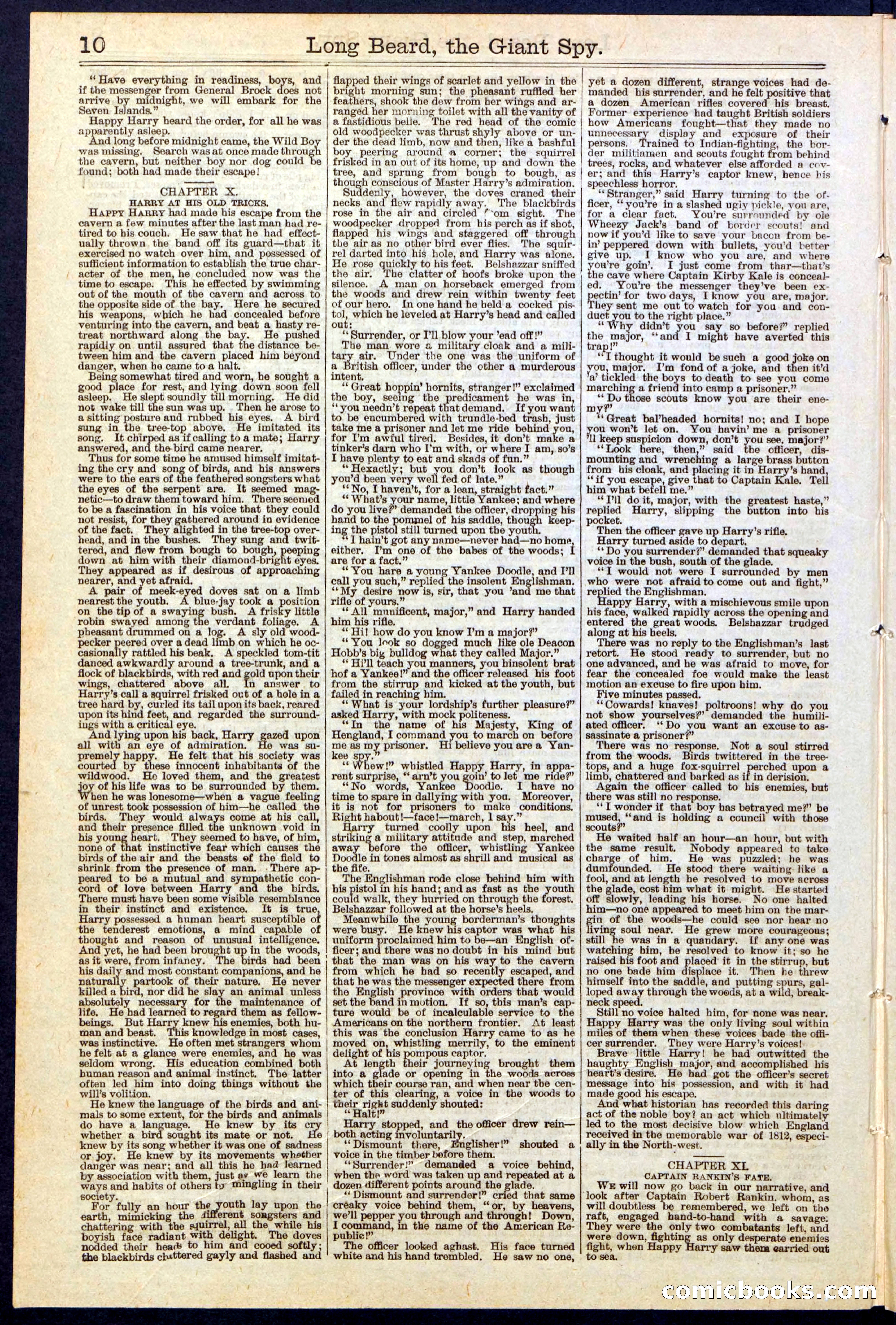
A restored page from Pulp Fiction, 1881. Page through the whole issue in the reader above.
📄 Transcribed text from this page (OCR, searchable)
Machine-transcribed from the original scan — historical spelling and the odd misread are preserved.
4 Ws ‘the 10 “Have everything in readiness, boys, and if the messenger from General Brock does not arrive by midnight, we will embark for the Seven IsJands.” Happy Harry heard the order, for all he was apparently asleep. And long before midnight came, the Wild Bo was missing. Search was at once made throug the cavern, but neither boy nor dog could be found; both had made their escape! CHAPTER X. HARRY AT HIS OLD TRICKS, Happy Harry had made his escape from the cavern a few minutes after the last man had re- tired to his couch. He saw that he had effect- ually thrown the band off its guard—that it exercised no watch over him, and possessed of sufficient information to establish the true char- acter of the men, he concluded now was the time to escape. This he effected by swimming out of the mouth of the cavern and across to the opposite side of the bay, Here he secured his weapons, which he had concealed before venturing into the cavern, and beat a hasty re- treat northward along the bay. He pushed rapidly on until assured that the distance be- tween him and the cavern placed him beyond danger, when he came to a halt. Being somewhat tired and worn, he sought a good place for rest, and lying down soon fell asleep. He slept soundly till morning. He did not wake till the sun was ut Then he arose to a sitting pasture and rubbed his eyes. A bird sung in the tree-top above. He imitated its song. It chi as ifcalling to a mate; Harry answered, and the bird came nearer. Thus for some time he amused himself imitat- ing the cry and song of birds, and his answers were to the ears of the feathered songsters what the eyes of the serpent are. It seemed mag- netic—to draw them toward him. There seemed to be a fascination in his voice that they could not resist, for they gathered around in evidence of the fact. They alighted in the tree-top over- head, and in the bushes. They sung and twit- tered, and flew from bough to bough, peeping down at him with their diamond-bright eyes, They appeared as if desirous of approaching nearer, and yet afraid. ir of meek-eyed doves sat on a limb nearest the youth. blue-jay took a position on the tip of a swaying bush. A frisky little robin swayed among the verdant foliage. A pheasant drummed on a log. A sly old wood- pecker peered over a dead limb on which he oc- casionally rattled his beak. A speckled tom-tit danced awkwardly around a tree-trunk, and a flock of blackbirds, with red and gold upon their wings, chattered above all, In answer to Harry’s call a squirrel frisked out of a hole ina tree hard by, curled its tail upon its back, reared upon its hind feet, and regarded the surround- ings with a critical eye. nd lying upon his back, Harry d upon all with an eye of admiration. He was su- premel happy. He felt that his society was co by these innocent inhabitants of the wildwood. He loved them, and the greatest {oy of his life was to be surrounded by them. ben he was lonesome—when a vague feeling of unrest took possession of him—he called the birds. They would slvaye come at his call, and their presence filled the unknown void in his young eart, They seemed to have, of him, none of that instinctive fear which causes the birds of the air and the beasts of the field to shrink from the presence of man. . There ap- peared to be a mutual and sympathetic con- cord of love between Harry and the birds. There must have been some visible resemblance in their instinct and existence. It is true Harry possessed a human heart susceptible of nderest emotions, a mind capable of thought and reason of unusual intelligence. And yet, he had been OrneE : in the woods, as it were, from infancy. e birds had been his daily and most constant companions, and he nat i partook of their nature. He never killed a bird, nor did he slay an animal unless absolutely nec for the maintenance of life, He had learned to regard them as fellow- beings. But Harry knew his enemies, both hu- man and beast. This knowledge in most cases, was instinctive. He often met strangers whom he felt at a glance were enemies, and he was seldom wrong. His education combined both buman reason and animal instinct. The latter often led him into doing things without the will’s volition. He knew the language of the birds and ani- mals to some extent, for the birds and animals do have a TROBE: He knew by its ce whether a bird sought its mate or not. e knew by its song whether it was one of sadness or joy. He knew by its movements whether danger was near; and all this he had learned by association with them, as we learn the ways and habits of others by Mingling in their atel ty. e For fully. an hour the youth lay upon the ; cking the different songsters and chatter! with sce squirrel, all the while his nodded ace radiant With delight. The doves Jy 5 the blackbirds chsttered gayly and flashed and L their heat to him and cooed softl ! - i TT flapped their wings of scarlet and yellow in the bright morning sun; the pheasant ruffled her feathers, shook the dew from ber wings and ar- ranged her morning toilet with all the vanity of a fastidious belle. The red head of the comic old woodpecker was thrust shyly above or un- der the dead limb, now and then, like a bashful boy peering around # corner; the squirrel frisked in an out of its home, up and down the tree, and sprung from bough to bough, as though conscious of Master Harry’s admiration. Suddenly, however, the doves craned their necks and flew rapidly away. The blackbirds rose in the air and circled ’*om sight. The woodpecker dropped from his perch as if shot, flapped his wings and staggered off through the air as no other bird ever flies. The squir- rel darted into his hole, and Harry was alone. He rose quickly to his feet. Belshazzar sniffed the air. The clatter of hoofs broke upon the silence. A man on horseback emerged from the woods and drew rein within twenty feet of our hero, In one hand he held a cocked pis- tol, which he leveled at Harry’s head and called out: ** Surrender, or I'll blow your ’ead off!” The man wore a military cloak and a mili- ag air. Under the one was the uniform of a British officer, under the other a murderous intent, ‘Great hoppin’ hornits, stranger!” exclaimed the boy, seeing the predicament he was in, ‘you needn’t repeat thatdemand. If you want to be encumbered with trundle-bed trash, just take me a prisoner and let me ride behind you, for I’m awful tired. Besides, it don’t make a tinker’s darn who I'm with, or where I am, so’s I have plenty to eat and skads of fun.” “ Hexactly; but you don’t look as though you’d been very well fed of late.” ‘*No, [ haven’t, for a lean, straight fact.” * What's your name, little Yankee; and where do you live?” demanded the officer, dropping his hand to the pommel of his saddle, though keep- ing the pistol still turned upon the yout ‘1 hain’t got any name—never had—no home either. I’m one of the babes of the woods; I are for a fact.” ‘You hare a young Yankee Doodle, and I'll call you such,” replied the insolent Englishman. ‘*My desire now is, sir, that you ’and me that rifle of yours.” ‘* All mnnificent, major,” and Harry handed him his rifle. ** Hi! how do you know I’m a major?” You look so dogged much like ole Deacon Hobb’s big bulldog what they called Major.” ** Hi’ll teach you manners, you binsolent brat hof a Yankee!” and the officer released his foot from the stirrup and kicked at the youth, but failed in reaching him. ‘* What is your lordship’s further pleasure?” asked Harry, with mock politeness. ‘In the name of his Majesty, King of Hengland, [ command you to march on before me as my prisoner. Hi believe you area Yan- kee Spy: : x ew!” whistled Happy Harry, in appa- rent surprise, *‘ arn’t you goin’ to let me ride?” “No words, Yankee Doodle. I have no time to spare in dallying with you. Moreover, it is not for prisoners to make conditions. Right habout!—face!—march, 1 say.” rry turned coolly upon his heel, and striking a military attitude and step, marched ory fore the officer, whistling Yankee ze a in tones almost as shrill and musical as the fife. The Englishman rode close behind him with his yore in his hand; and as fast as the youth could walk, they hurried on through the forest, Belshazzar followed at the horse’s heels, Meanwhile the young borderman’s thoughts were b He knew his captor was what his uniform proclaimed him to be—an English of- ficer; and there was no doubt in his mind but that the man was on his way to the cavern from which he had so recently escaped, and that he was the messenger e there from the English province with orders that would set the band in muvtion. If so, this man’s cap- ture would be of incalculable service to the Americans on the northern frontier. At least this was the conclusion Harry came to as he moved on, whistling merrily, to the eminent delight of his pompous captor, ; At engtt heir ag brought them into a glade or opening in the woods. across which their course ran, and when near the cen- ter of this clearing, a voice in the woods to their ae suddenly shouted: ‘Ha Harry stopped, and the officer drew rein— both acting involuntarily . ‘“Dismount there, glisher!” shouted a voice in the timber before them. “Surrender!” demanded a voice behind, when the word was taken up and repeated at a dozen different points around the glade. “ Dismount set ee a agg eno same créaky voice i em, “or, by vens, we'll pepper you through and through! Down, I ch oe a = the name of the American Re- publie The officer looked aghast. His face turned white and his hand trembled. He saw no one, { ong Beard, the Giant Spy. a eee LL Tw yet a dozen different, strange voices had de- manded his surrender, and he felt positive that a dozen American rifles covered his breast. Former experience had taught British soldiers how Americans fought—that they made no unnecessary display and exposure of their persons. Trained to Indian-fighting, the bor- der militiamen and scouts fought from behind trees, rocks, and whatever else afforded a cov- er; and this Harry’s captor knew, hence bis speechless horror. Stranger,” said Harry turning to the of- ficer, ‘‘you’re in a slashed ugiy pickle, you are, for a clear fact. You’re surrounded by ole Wheezy Jack’s band of border scouts! and now if you’d like to save your bacon from be- in’ peppered down with bullets, you'd better give up. I know who you are, and where you're goin’. I just come from thar—that’s the cave where Captain Kirby Kale is conceal- ed. You're the messenger they’ve been ex- oectin’ for two days, I know you are, major. hey sent me out to watch for you and con- athe to the right place.” “Why didn’t ype say so before?’ replied the major, “‘an trap!” “IT thought it would be such a good joke on you, major. I’m fond of a joke, and then it’d a’ tickled the boys to death to see you come marching a friend into camp a prisoner.” oa a8 ose scouts know you are their ene- m **Great bal’headed hornits! no; and I hope you won’t let on. You havin’ me a prisoner ll keep suspicion down, don’t aa see, major?’ ‘*Look here, then,” said the officer, dis- mounting and wrenching a large brass button from his cloak, and placing it in Harry’s hand “if you see give that to Captain Kale. Tel him what befell me.” **T'll do it, major, with the greatest haste,” ee ve Harry, slipping the button into his pocket. Then the officer gave up Harry’s rifle. Harry turned aside to depart. **Do you surrender?” demanded that squeaky voice in the bush, south of the glade. **I would not were I surrounded by men who were not afraid to come out and fight,” pe the Englishman. appy Harry, with a mischievous smile upon his face, walked rapidly across the opening and entered the great woods. Belshazzar trudged along at his beels. There was no reply to the Englishman’s last retort. He stood ready to surrender, but no one advanced, and he was afraid to move, for fear the concealed foe would make the least motion an excuse to fire upon him. Five minutes passed. *“Cowards! knaves! poltroons! why do you not show yourselves?’ demanded the humili- ated officer. ‘‘Do you want an excuse to as- sassinate a otisonert! There was no response. Not a soul stirred from the woods. Birds twittered in the tree- tops, and a huge fox-squirrel perched upon a limb, chattered and barked as if in derision. Again the officer called to his enemies, but there was still no response. ‘*T wonder if that boy has betrayed me?’ be mused, ‘and is holding a council with those scouts?” He waited half an hour—an hour, but with the same result. Nobody appeared to take charge of him. He was puzzled; he was dumfounded. He stood there waiting like a fool, and at length he resolved to move across the glade, cost bim what it might. He started off slowly, leading his horse. No one halted him—no one appeared to meet him on the mar- n of the woods—he could see nor hear no iving soul near. He grew more courageous; still he was in a quandary. If any one was watching bim, he resolved to know it; so he raised his foot and placed it in the stirrup, but no one bade him displace it. Then he threw himself into the saddle, and putting spurs, gal- loped away through the woods, at a wild, break- neck s P Still no voice halted him, for none was near. Happy Harry was the only living soul within miles of them when these voices bade the offi- cer surrender. They were Harry’s voices! Brave little Harry! he had outwitted the haughty English major, and accomplished his heart’s desire. He had got the officer’s secret message into his possession, and with it had made good his escape. And what historian has recorded this daring act of the noble boy? an act which ultimately led to the most decisive blow which England received in the memorable war of 1812, especi- ally in the North-west. CHAPTER XI. _. CAPTAIN RANKIN’S FATE. WE will now go back in our narrative, and look after Captain Robert Rankin, whom, as will doubtless remembered, we left on the raft, engaged hand-to-hand with a savage: They were the only two combatants left, and were down, fighting as only desperate enemies = Happy saw them earried out I might have averted this micboo G ‘Ss (E(0) (eo) S|