
Pulp Fiction, 1881 · page 25 of 32
Beadle's New York Dime Library, No. 136 — page 25: what you’re looking at
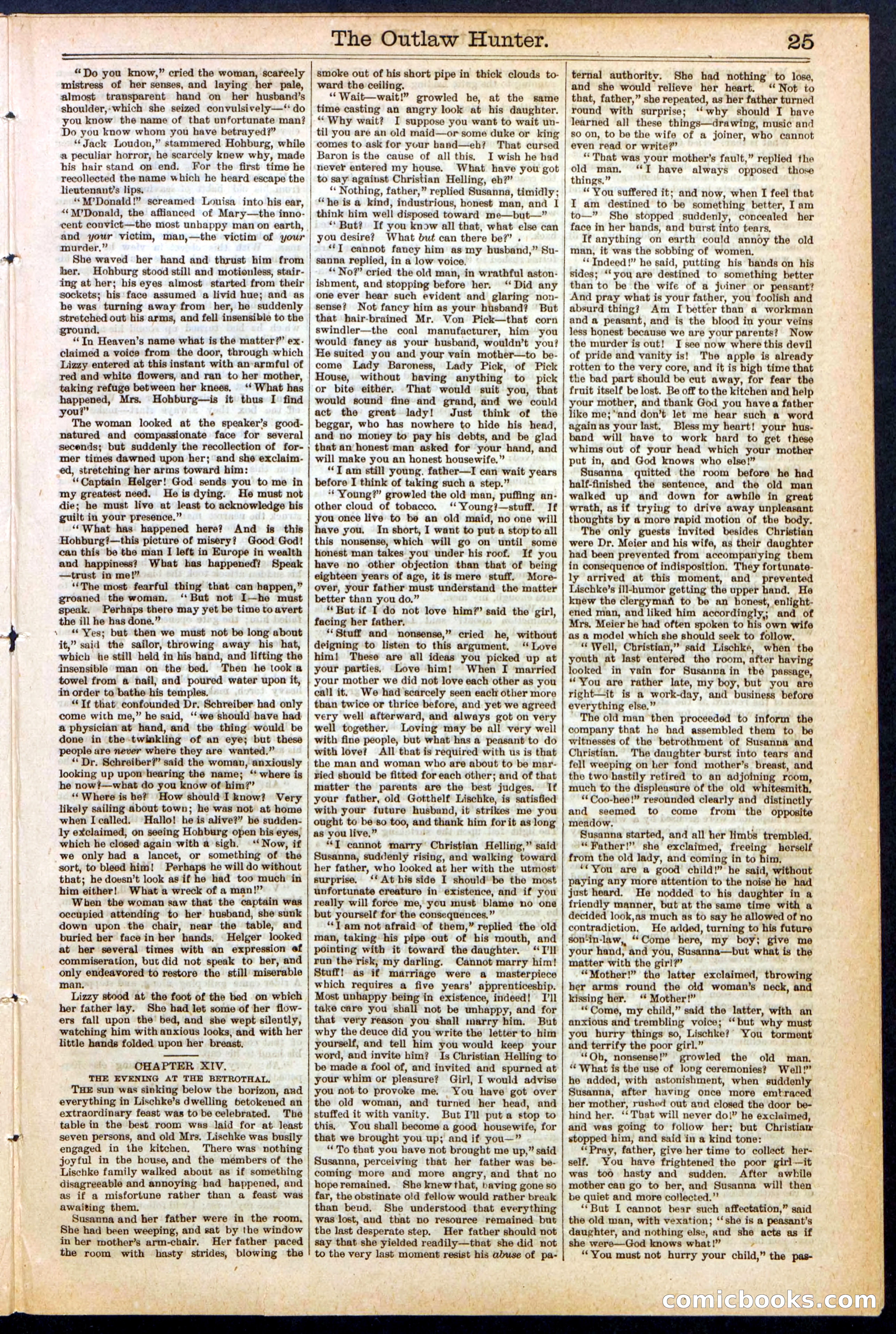
A restored page from Pulp Fiction, 1881. Page through the whole issue in the reader above.
📄 Transcribed text from this page (OCR, searchable)
Machine-transcribed from the original scan — historical spelling and the odd misread are preserved.
_ ts 3 A LE Ee a EL OL The Outlaw Hunter, “Do you know,” cried the woman, scarcely mistress of her senses, and laying her pale, almost transparent hand on her husband’s shoulder,-which she seized convulsively—* do you know the name of that unfortunate man? Do you know whom you have betrayed?” ‘‘ Jack Loudon,” stammered Hohburg, while a peculiar horror, he scarcely knew why, made his hair stand on end. For the first time he recollected the name which he heard escape the lieutenant’s lips. ‘“M’Donald!” screamed Louisa into his ear, “(M’Donald, the affianced of Mary—the inno- cent convict—the most unbappy man on earth, and your victim, man,—the victim of your murder,” She waved her hand and thrust him from | her. Hohburg stood still and motionless, stair- ing at her; his eyes almost started from their sockets; his face assumed a livid hue; and as be was turning away from her, he suddenly stretched out his arms, and fell insensible to the ground. ‘‘In Heaven’s name what is the matter?” ex. claimed a voice from the door, through which Lizzy entered at this instant with an armful of red and white flowers, and ran to her mother, taking refuge between her knees. ‘ What has happened, Mrs. Hohburg—is it thus I find you?” ‘ The woman looked at the speaker’s good- natured and compassionate face for several secends; but suddenly the recollection of for- mer times dawned upon her; and she exclaim- ed, stretching her arms toward him: ‘Captain Helger! God sends you to me in my greatest need. Heis dying. He must not die; he must live at least to acknowledge his guilt in your presence.” ‘* What has happened here? And is this Hohburg?—this picture of misery? Good God! can this be the man I left in Europe in wealth and happiness? What has happened? Speak —trust in me!” ‘‘The most fearful thing that can happen,” groaned the woman. ‘But not I—he must speak. Perhaps there may yet be time to avert the ill he has done.” “Yes; but then we must not be long about it,” said the sailor, throwing away his hat, which he still held in his hand, and lifting the insensible man on the bed. Then he took a towel from a nail, and poured water upon it, in order to bathe his temples. “Tf that’: confounded Dr. Schreiber had only come with me,” he said, ‘“‘ we should have had a physician at hand, and tbe thing would be done in the twinkling of an eye; but these people are never where they are wanted.” ‘‘Dr. Schreiber?’ said the woman, anxiously looking up upon’hearing the name; “ where is he now?—what do you know of him?’ ‘* Where is he? How should I know? Very likely sailing about town; he was not at home when I called. Hallo! he is alive?” he sudden- ly exclaimed, on seeing Hohburg open bis eyes, which he closed again with a sigh. ‘‘ Now, if we only had a lancet, or something of the sort, to bleed him! Perbaps he will do without that; he doesn’t look as if he had too much in him either! What a wreck of a man!” When the woman saw that the captain was occupied attending to her husband, she sunk down upon the chair, near the table, and buried her face in her hands. Helger looked at her several times with an expression ef commiseration, but did not speak to her, and only endeavored to restore the still miserable man. : Lizzy stood at the foot of the bed on which her father lay. She had let some of her flow- ers fall upon the’ bed, and she wept silently, watching him with anxious looks, and with her little hands folded upon her breast. _ CHAPTER XIV. THE EVENING AT THE BETROTHAL. THE sun was sinking below the horizon, aud everything in Lischke’s dwelling betokened an extraordinary feast was to be celebrated. The table in the best room was laid for at least seven persons, and old Mrs. Lischke was busily engaged in the kitchen, There was nothing joyful in the house, and the members of the Lischke family walked about as if something disagreeable and annoying had happened, and as if a misfortune rather than a feast was awaiting them. Susanna and her father were in the room, She had been weeping, and sat by the window in her mother’s arm-chair. Her father paced the room with hasty strides, blowing the / ‘ a ra ‘ ; _ a ose he aS. a a smoke out of his short pipe in thick clouds to- ward the ceiling. ‘““ Wait—wait!” growled he, at the same time casting an angry look at his daughter. “Why wait? I suppose you want to wait un- til you are an old maid—or some duke or king comes to ask for your band—eh? That cursed Baron is the cause of all this. I wish he had never entered my house. What have you got to say against Christian Helling, eh?” ** Nothing, father,” replied Susanna, timidly; “he is a kind, industrious, honest man, and I think him well disposed toward me—but—” ‘But? If you know all that, what else can you desire? What but can there be?” . ‘‘I cannot fancy him as my husband,” Su- sanna replied, in a low voice. ** No?” cried the old man, in wrathful aston- ishment, and stopping before her. “Did any one ever hear such evident and glaring non- sense? Not fancy him as your hisband? But that hair-brained Mr. Von Pick—that corn swindler—the coal manufacturer, him you would faney as your husband, wouldn’t you? He suited you and your vain mother—to be- come Lady Baroness, Lady Pick, of Pick House, without having anything to pick or bite either. That would suit you, that would sound fine and grand, and we could act the great lady! Just think of the beggar, who has nowhere to hide his head, and no money to pay his debts, and be glad that an honest man asked for your hand, and will make you an honest housewife.” “Tam still young. father—I can wait years before I think of tuking such a step.” ‘* Young?” growled the old man, puffing an- other cloud of tobacco, ‘‘ Young/—stuff. If you once live to be an old maid, no one will have you, In short, I want to put a stop to all this nonsense, which will go on until some honest man takes you under his roof. If you have no other objection than that of being eighteen years of age, itis mere stuff. More- over, your father must understand the matter better than you do.” * But if I do not love him?” said the girl, facing her father. ‘Stuff and nonsense,” cried he, without deigning to listen to this argument. “ Love him! These are all ideas you picked up at your parties, Love him! When I married your mother we did not love each other as you call it. We had scarcely seen each other more than twice or thrice before, and yet we agreed very well afterward, and always got on very well together. Loving may be all very well with fine people, but what has a peasant to do with love? All that is required with us is that the man and woman who are about to be mar- vied should be fitted foreach other; and of that matter the parents are the best judges. If your father, old Gotthelf Lischke, is satisfied with your future husband, it strikes me you ought to beso too, and thank him for it as long as you live,” ; “IT cannot marry Christian Helling,” said Susanna, suddenly rising, and walking toward her father, who looked at her with the utmost surprise. ‘* At his side I should be the most unfortunate creature in existence, and if you really will force me, you must blame no one but yourself for the consequences,” “Tam not afraid of them,” replied the old man, taking his pipe out of his mouth, and pointing with it toward the daughter. “I'll run the risk, my darling. Cannot marry him! Stuff! as if marriage were a masterpiece which requires a five years’ apprenticeship. Most unhappy being in existence, indeed! T’ll take care you shall not be unhappy, and for that very reason you shall marry him. But why the deuce did you write the letter to him yourself, and tell him you would keep your word, and invite him? Is Christian Helling to be made a fool of, and invited and spurned at your whim or pleasure? Girl, I would advise you not to provoke me. You have got over the old woman, and turned her head, and stuffed it with vanity. But I'll puta stop to this. You shall become a good housewife, for that we brought you up; and if you—” “To that you have not brought me up,” said Susanna, perceiving that her father was be- coming more and more angry, and that no hope remained. She knewthat, paving gone so far, the obstinate o!d fellow would rather break than bend. She understood that everything was lost, aud tbat no resource remained but the last desperate step. Her father should not say that she yielded readily—that she did not to the very last moment resist his abuse of pa- Toi, (E(0) ft € ternal authority. She had nothing to lose, and she would relieve her heart. ‘“ Not to that, father,” she repeated, as her father turned round with surprise; “why should I have learned all these things—drawing, music and so on, to be the wife of a joiner, who cannot even read or write?’ “That was your mother’s fault,” replied the old man. “TI have always opposed those things.” “You suffered it; and now, when I feel that I am destined to be something better, I am to—” She stopped suddenly, concealed her face in her hands, and burst into tears, If anything on earth could annoy the old man, it was the sobbing of women. ** Indeed!” he said, putting his hands on his sides; “‘you are destined to something better than to be the wife of a juiner or peasant? And pray what is your father, you foolish and absurd thing? Am I better than a workman and a peasant, and is the blood in your veins less honest because we are your parents? Now the murder is out! I see now where this devil of pride and vanity is! The apple is already rotten to the very core, and it is high time that the bad part should be cut away, for fear the fruit itself be lost. Be off to the kitchen and help your mother, and thank God you havea father like me;“and don’t let me hear such a word againas your last. Bless my heart! your hus- band will have to work hard to get these whims out of your head which your mother put in, and God knows who else!” Susanna quitted the room before he had half-finished the sentence, and the old man walked up and down for awhile in great wrath, as if trying to drive away unpleasant thoughts by a more rapid motion of the body. The only guests invited besides Christian were Dr. Meier and his wife, as their daughter had been preyented from accompanying them in consequence of indisposition. They fortunate- ly arrived at this moment, and prevented Lischke’s ill-humor getting the upper hand. He knew the clergyman to be an honest, enlight- ened man, and liked him accordingly; and of Mrs. Meier he had often spoken to his own wife as a model which she should seek to follow. — “Well, Christian,” said Lischke, when the youth at last entered the room, after having looked in vain for Susannain the passage, “You are rather late, my boy, but you are right—it is a work-day, and business before everything else,” The old man ‘then proceeded to inform the company that he had assembled them to be witnesses of the betrothment of Susanna and Christian. The daughter burst into tears and fell weeping on her fond mother’s breast, and the two hastily retired to an adjoining room, much to the displeasure of the old whitesmith, “*Coo-hee!” resounded clearly and distinctly and seemed to come from the opposite meadow, Susanna started, and all her limbs trembled. “Father!” she exclaimed, freeing herself from the old lady, and coming in to him, **You are a good child!” he said, without paying any more attention to the noise he had just heard. He nodded to his daughter in a friendly manner, but at the same time with a decided look,as much as to say he allowed of no contradiction, He added, turning to his future son‘in-law, “Come here, my boy; give me your hand, and you, Susanna—but what is the matter with the girl?’ “Mother!” the latter exclaimed, throwin her arms round the old woman’s neck, kissing her. ‘ Mother!” **Come, my child,” said the latter, with an anxious and trembling voice; “but why must you hurry things so, Lischke?’ You torment and terrify the poor girl.” “‘Ob, nonsense!” growled the old man. “What is the use of long ceremonies? Well!’ he added, with astonishment, when suddenly Susanna, after having once more embraced her mother, rushed out and closed the door be- hind her. ‘‘ That will never do|” he exclaimed, and was going to follow her; but Christiaw stopped him, and said in a kind tone: “Pray, father, give her time to collect her- self. You have frightened the poor girl —it was too hasty and sudden. After awhile mother can go to ber, and Susanna will then be quiet and more collected.”’ oe **But I cannot bear such affectation,” said the old man, with vexation; ‘‘she is a peasant’s daughter, and nothing else, and she acts as she were—God knows what!” ; “You must not hurry your child,” the pas- JOO mile ‘S 25 t (Ee) »