
Pulp Fiction, 1881 · page 24 of 32
Beadle's New York Dime Library, No. 136 — page 24: what you’re looking at
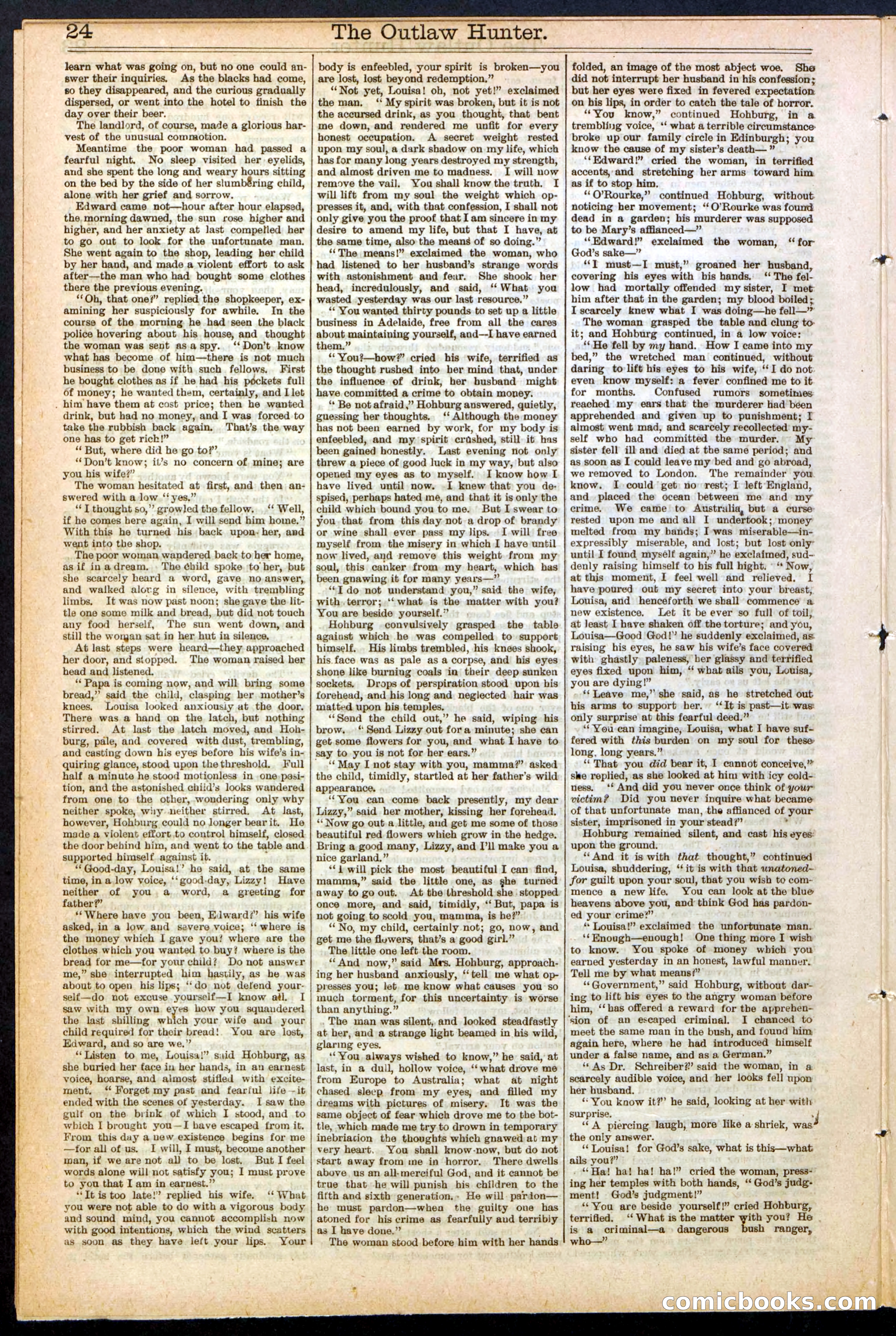
A restored page from Pulp Fiction, 1881. Page through the whole issue in the reader above.
📄 Transcribed text from this page (OCR, searchable)
Machine-transcribed from the original scan — historical spelling and the odd misread are preserved.
2 2 es . eS ye ae - ¥ —. ‘7 ' a learn what was going on, but no one could an- swer their inquiries, As the blacks had come, s0 they disappeared, and the curious gradually dispersed, or went into the hotel to finish the day over their beer. The landlord, of course, made a glorious har- vest of the unusual commotion. Meantime the poor woman had passed a fearful night. No sleep visited her eyelids, and she spent the long and weary hours sifting on the bed by the side of her slumb€ring child, alone with her grief and sorrow. Edward came not—hour after hour elapsed, the, morning dawned, the sun rose higher and higher, and her anxiety at last compelled her to go out to look for the unfortunate man. She went again to the shop, leading her child by her hand, and made a violent effort to ask after—-the man who had bought some clothes there the previous evening. ‘*Oh, that one?’ replied the shopkeeper, ex- amining her suspiciously for awhile. In the course of the morning he had seen the black police hovering about his house, and thought the woman was sent asaspy. ‘‘ Don’t know what has become of him—there is not much business to be done with such fellows. First he bought clothes as if he had his péckets full of money; he wanted them, certainly, and [let . him have them at cost price; then he wanted drink, but had no money, and I was forced to take the rubbish back again. That’s the way one has to get rick!” ‘But, where did he go to?’ ** Don’t know; it’s no concern of mine; are you his wife?” The woman hesitated at first, and then an- swered with a low ‘ yes,” ‘* I thought so,” growled the fellow, ‘‘ Well, if he comes here again, I will send him home.” With this he turned his back upon. her, and went into the shop. _ The poor woman wandered back to her home, as if inadream. . The ¢hild spoke. to her, but she scarcely heard a word, gave no answer, and walked alorg in silence, with trembling limbs, It was now past noon; she gave the lit- tle one some milk and bread, but did not touch any food herself, The sun went down, and still the worgan sat in her hut in silence, At last steps were heard—they approached her door, and stopped. The woman raised her head and listened. ** Papa is coming now, and will bring some bread,” said the child, clasping her mother’s knees. Louisa looked anxiousiy at the door. There was a hand on the latch, but nothing stirred. At last the latch moved, and Hoh- burg, pale, and covered with dust, trembling, and casting down his eyes before his wife’s in- quiring glance, stood upon thethreshold. Full half a minute he stood motionless in one-posi- tion, and the astonished child’s looks wandered from one to the other, wondering only why neither spoke, why neither stirred. At last, however, Hohburg could no longer bearit. He made a violent effort,to control himself, closed the door behind him, and went to the table and supported himself against it. ‘‘Good-day, Louisa!” he said, at the same time, in a low voice, ‘‘good-day, Lizzy! Have neither of you a word, a greeting for father?’ ** Where have you been, Edward?” his wife asked, in a low and severe voice; ‘‘ where is the money which I gave you? where are the clothes which you wanted to buy! where is the bread for me—for your child? Do not answer me,” she interrupted him hastily, as he was about to open his lips; ‘“‘do not defend your- self—do not excuse yourself—I know a#l. I saw with my own A how you squaudered the last shilling which your wife and. your child required for their bread!. You are lost, Edward, and so are we.” “Listen to me, Louisa!” suid Hohburg, as she buried her face in her hands, in an earnest voice, hoarse, and almost stifled with excite- ment. ‘ Forget my past and feariul life —-it ended with the scenes of yesterday. I saw the guif on the brink of which I stood, and to which I brought you—I bave escaped from it. From this day a new existence begins for me —for all of us. I will, I must, become another man, if we are not all to be lost, But I feel _ words alone will not satisfy you; I must prove to you that I am in earnest.” “Tt is too late!” replied his wife. ‘‘ What you were not able to do with a vigorous body ~ The Outlaw Lunter. body is enfeebled, your spirit is broken—you are lost, lost beyond redemption,” “Not yet, Louisa! oh, not yet!” exclaimed the man, ‘ My spirit was broken, but it is not the accursed drink, as you thought, that bent me down, and rendered me unfit for every bonest occupation. A secret weight rested upon my soul, a dark shadow on my life, which has for many long years destroyed my strength, and almost driven me to madness. I will now remove the vail. You shall know the truth, I will lift from my soul the weight which op- presses it, and, with that confession, I shall not only give you the proof that I am sincere in my desire to amend my life, but that I have, at the same time, also the means of so doing.” ‘‘The means!” exclaimed the woman, who had listened to ber husband’s strange words with astonishment and feur. She shook her head, incredulously, and said, ‘‘ What you wasted yesterday was our last resource.” ‘* You wanted thirty pounds to set up a little business in Adelaide, free from all the cares about maintaining yourself, and—-I have earned them.” ‘* Youf—how?’ cried his wife, terrified as the thought rushed into ber mind that, under the influence of drink, her busband might have committed a crime to obtain money. “ Be not afraid,’ Hohburg answered, quietly, guessing her thoughts. ‘* Although the money has not been earned by work, for my body is enfeebled, and my spirit crashed, still it has been gained honestly. Last evening not only threw a piece of good luck in my way, but also opened my eyes as to myself. I know how I have lived until now. .1 knew that you de- spised, perhaps hated me, and that it is only the child which bound you to me. But I swear to you that from this day not a drop of brandy or wine shall ever pass my lips. I will free myself from the misery in which I have until now lived, and remove this weight from my soul, this canker from my heart, which has been gnawing it for many years—” ‘‘T do not understand you,” said the wife, with. terror; ‘‘ what is the matter with you? You are beside yourself.” Hohburg convulsively grasped the table against which be was compelled to support himself. His limbs trembled, his knees shook, his. face was as pale as a corpse, and his eyes shone like burning coals in their deep sunken sockets. Drops of perspiration stood upon bis forehead, and his long and neglected hair was matted upon his temples, ‘‘Send the child out,’ he said, wiping his brow. ‘ Send Lizzy out fora minute; she can get. some flowers for you, and what I have to say to you is not for her ears.” ‘May I not stay with you, mamma?’ asked the child, timidly, startled at her father’s wild appearance, ‘You can come back presently, my dear Lizzy,” said her mother, kissing her forehead. ‘‘ Now go out a little, and get me some of those beautiful red flowers whieh grow in the hedge. Bring a good many, Lizzy, and I'll make you a nice garland.” **} will pick the most beautiful I can find, mamma,” said the little one, as ghe turned away to go out. At the threshold she stopped once more, and said, timidly, ‘‘ But, papa is not going to scold you, mamma, is he?’ ‘No, my child, certainly not; go, now, and get me the fluwers, that’s a good girl.” The little one left the room. *‘ And now,” said Mes. Hohburg, approach- ing her husband anxiously, ‘‘ tell me what op- presses you; let. me know what causes you so much torment, for this uncertainty is worse than anything.” The man was silent, and looked steadfastly at ber, and a strange light beamed in his wild, glaring eyes. ‘You always wished to know,” he said, at last, in a dull, hollow voice, ‘‘ what drove me from Europe to Australia; what at night chased sleep from my eyes, and filled my dreams with pictures of misery. It was the same object of fear which drove me to the bot- tle, which made me try to drown in temporary inebriation the thoughts which gnawed at my very heart. You shall know-now, but do not start away from me in horror. There dwells above. us an all-mereciful God, and it cannot be true that he will punish bis children to the fitth and sixth generation, He will. pardon— he must pardon—whea the guilty one has ‘sion of an escaped criminal. folded, an image of the most abject woe. She did not interrupt her husband in his confession; but her eyes were fixed in fevered expectation on his lips, in order to catch the tale of horror. “You know,” continued Hohburg, in a trembling voice, ‘‘ what a terrible circumstance broke up our family circle in Edinburgh; you know the cause of my sister’s death— ‘*Edward!” cried the woman, in terrified accents, and stretching her arms toward him as if to stop him. *O’Rourke,” continued Hohburg, without noticing ber movement; ‘“‘O’Rourke was found dead in a garden; his murderer was supposed to be Mary’s afflanced—” ‘““Edward!” exclaimed the woman, God’s sake—” “I must—I must,” groaned her husband, covering his eyes with his hands, “ The fel- low had mortally offended my sister, I met him after that in the garden; my blood boiled ; I scarcely knew what I was doing—he fell—” The woman grasped the table and clung to it; and Hohburg continued, in a low voice: ** He fell by my hand. How I came into my bed,” the wretched man continued, without daring to lift his eyes to his wife, ‘‘I do not even know myself: a fever confined me to it for months. Confused rumors sometimes reached my ears that the murderer had béen apprehended and given up to punishment; I almost went mad, and scarcely recollected’ my- self who had committed the murder. My sister fell ill and died at the same period; and as soon as I could leave my bed and go abroad, we removed to London. The remainder you know. I could get no rest; I left England, and placed the ocean between me and my crime. We came to Australia, but a curse rested upon me and all I undertook; money melted from my bands; I was miserable—in- expressibly miserable, and lost; but lost only until I found myself again,” he exclaimed, sud- denly raising himself to bis full hight. © “ Now, at this moment, I feel well and relieved. [ have poured out my secret into your breast; Louisa, and henceforth we shall commence a new existence. Let it be ever so full of toil; at least I have shaken off the torture; and you, Louisa—Good God!” he suddenly exclaimed, as raising his eyes, he saw his wife’s face covered with ghastly paleness, ber glassy and terrified eyes fixed upon him, “ what ails you, Louisa, you are dying!” ‘‘ Leave me,’ she said, as he stretched out his arms to support her. ‘It is past—it was: only surprise at this fearful deed.” = ‘* You ean imagine, Louisa, what I have suf- fered with this burden on my soul for these long, long years.” ‘That you did bear it, I cannot conceive,” ske replied, as she looked at him with icy cold- ness. ‘* And did you never once think of your victim? Did you never inquire what became of that unfortunate man, the affianced of your sister, imprisoned in your stead?’ . Hohburg remained silent, and cast his eyes: upon the ground. “And it is with that thought,” continued Louisa, shuddering, ‘it is with that uwnatoned- for guilt upon your soul, that you wish to com- mence a new life. You can look at the blue heavens above you, and’ think God has pardon- ed your crime?” * Louisa!” exclaimed the unfortunate man. ‘¢ Knough—enough! One thing more I wish to know. You spoke of money which you earned yesterday in an honest, lawful manner. Tell me by what means?” ‘‘Government,” said Hohburg, without dar- ing to lift his eyes to the angry woman before him, ‘‘bas offered a reward for the apprehen- I chanced to meet the same man in the bush, and found him again here, where he had introduced himself under a false name, and as a German.” ** As Dr. Schreiber?’ said the woman, in a searcely audible voice, and her looks fell upon her husband. ‘You know it?’ he said, looking at her with surprise. ‘J “A piercing laugh, more like a shriek, was the only answer. ‘‘ Louisa! for God’s sake, what is this—what ails you?” . “ Ha! ha! ha! ha!” cried the woman, press- ing her temples with both hands, ‘ God’s judg- ment! God’s judgment!” ‘‘You are beside yourself!” cried Hohburg, ** for | and sound mind, you cannot accomplish now | atoned for his crime as fearfully aud terribly | terrified. ‘‘ What is the matter with you? He | with good intentions, which the wind scatters } as I have done.’ : is a criminal—a dangerous ranger, as soon as they have left your lips.. Your The woman stood before him with her hands ' who—” a bi ars ye. ta — < ' moa” . a -.\ ‘ '