
Pulp Fiction, 1881 · page 20 of 32
Beadle's New York Dime Library No. 125 — page 20: what you’re looking at
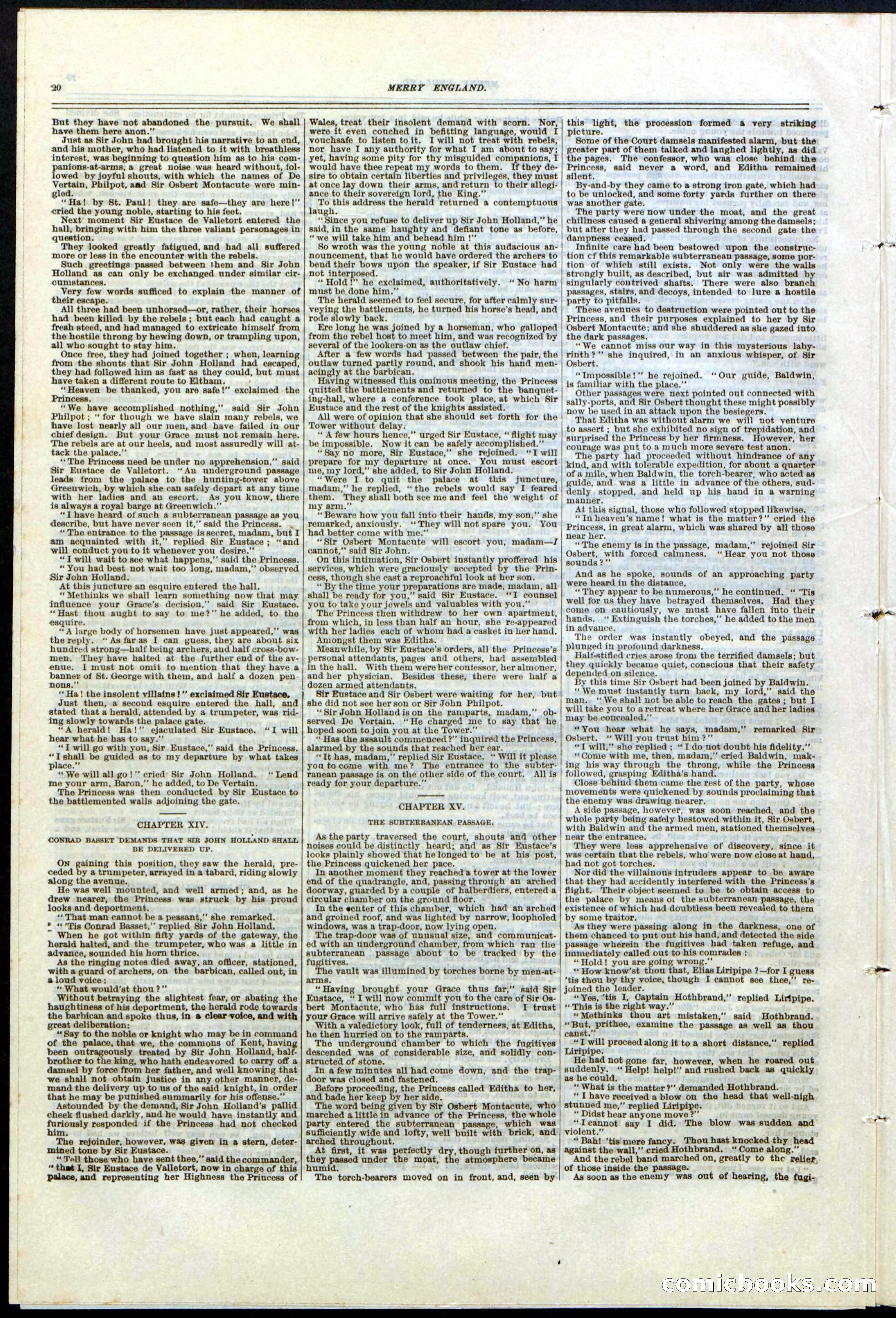
A restored page from Pulp Fiction, 1881. Page through the whole issue in the reader above.
📄 Transcribed text from this page (OCR, searchable)
Machine-transcribed from the original scan — historical spelling and the odd misread are preserved.
MERRY ENGLAND. But they have not abandoned the pursuit. We shall have them here anon.” Just as Sir John had brought his narrative to an end, and his mother, who had listened to it with breathless interest, was beginning to question him as to his com- pe tm a great noise was heard without, fol- owed by joyful shouts, with which the names of De — Philpot, and Sir Osbert Montacute were min- gled. “Ha! by St. Paul! they are safe—they are here!" cried the young noble, starting to his feet. Next moment Sir Eustace de Valletort entered the hall, bringing with him the three valiant personages in question. They looked greatly fatigued, and had all suffered more or less in the encounter with the rebels. Such greetings passed between them and Sir John Holland as can only be exchanged under similar cir- cumstances. Very few words sufficed to explain the manner of their escape. ; All three had been unhorsed—or, rather, their horses had been killed by the rebels ; but each had caught a fresh steed, and had managed to extricate himself from the hostile throng by hewing down, or trampling upon, all who sought to stay him. Once free, they had joined together ; when, learnin from the shouts that Sir John Holland had escaped, they had followed him as fast as they could, but must have taken a different route to Eltham. “Heaven be thanked, you are safe!’’ exclaimed the Princess. “We have accomplished nothing,” said Sir John Philpot ; “ for though we have slain many rebels, we have lost nearly all our men, and have failed in our chief design. But your Grace must not remain here. The rebels are at our heels, and most assuredly will at- tack the palace.”’ ‘The Princess need be under no apprehension,”’ said Sir Eustace de Valletort. “An underground passage leads from the ace to the hunting-tower above Greenwich, by which she can safely depart at any time with her ladies and an escort. As you know, there is always a royal barge at Greenwich.” “T have heard of such a subterranean passage as you describe, but have never seen it,’’ said the Princess. , “ The entrance to the passage is secret, madam, but I am acquainted with it,’’ replied Sir Eustace; “and will conduct you to it whenever you desire.”’ “I will wait to see what og Pa said the Princess. “You had best not wait too long, madam,"’ observed Sir John Holland. At this juncture an esquire entered the hall. ‘‘ Methinks we shall learn something now that may influence your Grace's decision,’ said Sir Eustace. “Hast thou aught to say to me?”’ he added, to the esquire. “A large body of horsemen have just appeared,’ was the reply. “As faras I can guess, they are about six hundred strong—half being archers, and half cross-bow- men. They have halted at the further end of the av- enue. I must not omit to mention that they have a banner of St. George with them, and half a dozen pen- nons.”’ “Ha! the insolent villains!” excijaimed Sir Eustace, Just then, a second eaquine entered the hall, and stated that a herald, attended by a trumpeter, was rid- ing slowly towards the palace gate. “A herald! Ha!” ejaculated Sir Eustace. “I will hear what he bas to say."’ “I will go with wey Sir Eustace,"’ said the Princess. sas shall be guided as to my departure by what takes place.” ** We will all go!’’ cried Sir John Holland. “Lend me your arm, on,"’ he added, to De Vertain. The Princess was then conducted by Sir Eustace to the battlemented walls adjoining the gate. CHAPTER XIV. CONRAD BASSET DEMANDS THAT SIR JOHN HOLLAND SHALL BE DELIVERED UP. On guining this position, they saw the herald, pre- ceded by a trumpeter, arrayed in a tabard, riding slowly along the avenue. He was well mounted, and well armed; and, as he drew nearer, the Princess was struck by his proud looks and deportment. ‘That man cannot be a peasant,”’ she remarked. * “ "Tis Conrad Basset,’’ replied Sir John Holland, When he got within fifty yards of the gateway, the herald halted, and the trumpeter, who was a little in advance, sounded his horn thrice. " As the ringing notes died away, an officer, stationed, with a guard of archers, on the barbican, called out, in a loud voice: * What would’st thou?” the slightest fear, or abating the Figg ee om of his deportment, the herald rode towards the barbican and spoke thus, in a clear-voice, and with great deliberation: “Say to the noble or knight who may be in command of the palace, that we, the commons of Kent, havin been outrageously treated by Sir John Holland, half- brother to the king, who hath endeavored to carry off a damsel by force from her father, and well knowing that we shall not obtain justice in any other manner, de- mand the delivery up to us of the said knight, in order that he may be punished summarily for his offense.” Astounded by the demand, Sir John Holland's pallid cheek flushed darkly, and he would have instantly and Harv respon if the Princess had not checked m. The rejoinder, however, was given in a stern, deter- mined tone by Sir Kustace. ied “Tell those who have sent thee,”’ said the commander, “that I, Sir Eustace de Valletort, now in charge of this palace, and representing her Highness the Princess of Wales, treat their insolent demand with scorn. Nor, were it even conched in befitting language, would I vouchsafe to listen toit. I will not treat with rebels, nor have I any authority for what I am about to say; yet, having some pity for thy misguided companions, I would have thee repeat my words to them. If they de- sire to obtain certain liberties and privilege. they must at once lay down their arms, and return to their allegi- ance to their sovereign lord, the nan, : a address the herald returned a contemptuous augh. “Bince you refuse to deliver up Sir John Holland,” he said, in the same haughty and defiant tone as before, “we will take him and behead him !” So wroth was the young noble at this audacious an- nouncement, that he would have ordered the archers to bend their bows upon the speaker, if Sir Eustace had not interposed. “ Hold!” he exclaimed, authoritatively. “No harm must be done him.” The herald seemed to feel secure, for after calm] veying the battlements, he turned his horse’s h rode slowly back. Ere long he was sgiped by a horseman, who galloped from the rebel host to meet him, and was recognized by several of the lookers-on as the outlaw chief. After a few words had passed between the pair, the outlaw turned partly round, and shook his hand men- pe at the barbican. Having witnessed this ominous meeting, the Princess quitted the battlements and returned to the banquet- ing-hall, where a conference took place, at which Sir Eustace and the rest of the knights assisted. All were of opinion that she should set forth for the Tower without delay. * A few hours hence,” urged Sir Eustace, “flight may be impossible. Now it can be safely accomplished.” “Say no more, Sir Eustace,” she rejoined. “TI will prepare for my departure at once. You must escort me, my lord,” she added, to Sir John Holland. “Were I to quit the palace at this juncture, madam,” he replied, “the rebels would say I feared them. They shall both see me and feel the weight of my arm.” “Beware how you fall into their hands, my son,”’ she remarked, anxiously. ‘They will not spare you. You had better come with me.” “Sir Osbert Montacute will escort you, madam—J cannot,” said Sir John. On this intimation, Sir Osbert instantly proffered his services, which were graciously accepted by the Prin- cess, though she cast a reproachful look at her son. “ By the time your preparations are made, madam, all shall be ready for you,” said Sir Eustace. “I counsel you to take your jewels and valuables with you.” The Princess then withdrew to her own apartment, from which, in less than half an hour, she re-appeared with her ladies each of whom had a casket in her hand. Amongst them was Editha. Meanwhile, by Sir Eustace’s orders, all the Princess’s personal attendants, pages and others, had assembled in the hall. With them were her confessor, her almoner, and her physician. Besides these, there were half a dozen armed attendants. Sir Eustace and Sir Osbert were waiting for her, but she did not see her son or Sir John Philpot. “Sir John Hollandison the ramparts, madam,’’ ob- served De Vertain. “He charged me to say that he hoped soon to join you at the Tower.” “ Has the assault commenced ?” inquired the Princess, alarmed by the sounds that reached her ear. “It has, madam,” replied Sir Eustace, * Will it please you tocome with me? The entrance to the subter- ranean passage is on the other side of the court. All is ready for your departure.” CHAPTER XV. THE SUBTERRANEAN PASSAGE. As the perty traversed the court, shouts and other noises could be distinctly heard; and as Sir Enstace’s looks plainly showed that he longed to be at his post, the Princess quickened her pace. In another moment they reached a tower at the lower end of the quadrangle, and, passing through an arched doorway, guarded by a couple of halberdiers, entered a circular chamber on the ground floor. In the eenter of this chamber, which had an arched and groined roof, and was lighted by narrow, loopholed windows, was a trap-door, now lying open, The trap-door was of unnsual size, and communicat- ed with an underground chamber, from which ran the cuaere een passage about to be tracked by the fugitives. 6 vault was illumined by torches borne by men-at- arms. “Having brought your Grace thus far,” said Sir Eustace, “ I will now commit you to the care of Sir Os- bert Montacute, who has full instructions. TI trust your Grace will arrive safely at the Tower.” With a valedictory look, full of tendernegs, at Editha, he then hurried on to the ramparts. The underground chamber to which the fugitives descended was of considerable size, and solidly con- structed of stone. In a few minntes all had come down, and the trap- door was closed and fastened. Before proceeding, the Princess called Editha to her, and bade her keep by her side, The word bog 1A by Sir Osbert Montacute, who marched alittle in advance of the Princess, the whole party entered the subterranean passage, which was sufficiently wide and lofty, well built with brick, and arched throughout. , though further on, as At first, it was iets ' me under the moat, the atmosphere became umid. The torch-bearers moved on in front, and, seen by sur- , and = light, the procession formed a very striking picture. é; Some of the Court damsels manifested alarm, but the greater part of them talked and laughed lightly, as did . the pages. The confessor, who wag close behind the Princess, said never a word, and Editha remained silent. By-and-by they came to a strong iron gate, which had to be unlocked, and some forty yards further on there was another gate. The party were now under the moat, and the great chillness caused a general shivering among the damsels; but after they had passed through the second gate the dampness ceased. Infinite care had been bestowed wpon the construc- tion cf this remarkable subterranean passage, some por- tion of which still exists. Not only were the walls strongly built, as described, but air was admitted by singularly contrived shafts. There were also branch passages, stairs, and decoys, intended to lure a hostile party to pitfalls. These avenues to destruction were pointed out to the Princess, and their purposes explained to her by Sir Osbert Montacute; and she shuddered as she gazed into the dark passages. “We cannot miss our way in this mysterious laby- rinth?"’ she inquired, in an anxious whisper, of Sir Osbert. “Impossible!’’ he rejoined. is familiar with the place.”’ Other passages were next pointed out connected with sally-ports, and Sir Osbert thought these might possibly now be used in an attack upon the besiegers. That Editha was without alarm we will not venture to assert ; but she exhibited no sign of trepidation, and surprised the Princess by her firmness. However, her courage was put to a much more severe test anon. The party had proceeded without hindrance of any kind, and with tolerable expedition, for about a quarter of a mile, when Baldwin, the torch-bearer, who acted as guide, and was a little in advance of the others, sud- denly stopped, and held up his hand in a warning manner. At this signal, those who followed stopped likewise. “Tn heaven's name! what is the matter?” cried the Princess, in great alarm, which was shared by all those near her. “The enemy is in the passage, madam,” rejoined Sir Osbert, with forced calmness. ‘Hear you not those sounds ?”’ And as he spoke, sounds of an approaching party were heard in the distance, “They appear to be numerous,” he continued. “ "Tis well for us they have betrayed themselves. Had they come on cautiously, we must have fallen into their hands, ‘ Extinguish the torches,’’ he added to the men in advance, The order was instantly obeyed, and the passage plunged in profound darkness, Halt-stifled cries arose from the terrified damsels; but they quickly became quiet, conscious that their safety depended on silence. By this time Sir Osbert had been joined by Baldwin. “We must instantly turn back, my lord,” said the man. ‘ We shall not be able to reach the gates; but I will take you to aretreat where her Grace and her ladies may be concealed.”’ “You hear what he says, madam,” remarked Sir Osbert. ‘ Will you trust him ?”’ “1 will,” she replied ; “I do not doubt his fidelity.” “Come with me, then, madam,”’ cried Baldwin, mak- ing his way through the throng, while the Princess followed, grasping Editha’s hand, Close behind them came the rest of the party, whose movements were quickened by sounds proclaiming that the enemy was drawing nearer. A side passage, however, was soon reached, and the whole party being safely bestowed within it, Sir Osbert, with Baldwin and the armed men, stationed themselves near the entrance. . They were less apprehensive of discovery, since it was certain that the rebels, who were now close at hand, had not got torches. Nor did the villainous intruders appear to .be aware that they had accidently interfered with the Princess's flight. Their object seemed to be to obtain access to the palace by means of the subterranean , the existence of which had doubtless been revealed to them by some traitor. As they were passing oe: in the darkness, one of them chanced to put out his hand, and detected the side passage wherein the fugitives had taken refuge, and immediately called out to his comrades :; “Hold! you are pe re * How know’st thou t, Liripipe ?—for I guess ’tis thou by thy voice, though I cannot see thee,” re- joined the header. “Yos, ‘tis I, Captain Hothbrand,” replied Liripipe. “ This is the right way.” “Methinks thou art mistaken,” said Hothbrand. ae —y prithee, examine the passage as well as thou canst.” — I _ proceed along it toa short distance,” replied pipe. He had not gone far, however, when he roared out suddenly. “ Help! help!” and rushed back as quickly as he could, ** What is the matter ?’’ demanded Hothbrand. “ T have received a blow on the head that well-nigh stunued me,” replied Liri . “ Didst hear anyone move?” ib ye aah — say I did. The blow was sudden and violent.” Tre “ “ Bah! ’tis mere ere Thou hast knocked thy head against the wall,’’ cried Hothbrand. And the rebel band marched on, greatly to the relier, of those inside the passage. ” As soon as the enemy was out of hearing, the fugi- “Our guide, Baldwin, “ Come along.” . -_ JOOKS (E(0) € (E(0)