
Pulp Fiction, 1881 · page 19 of 32
Beadle's New York Dime Library No. 125 — page 19: what you’re looking at
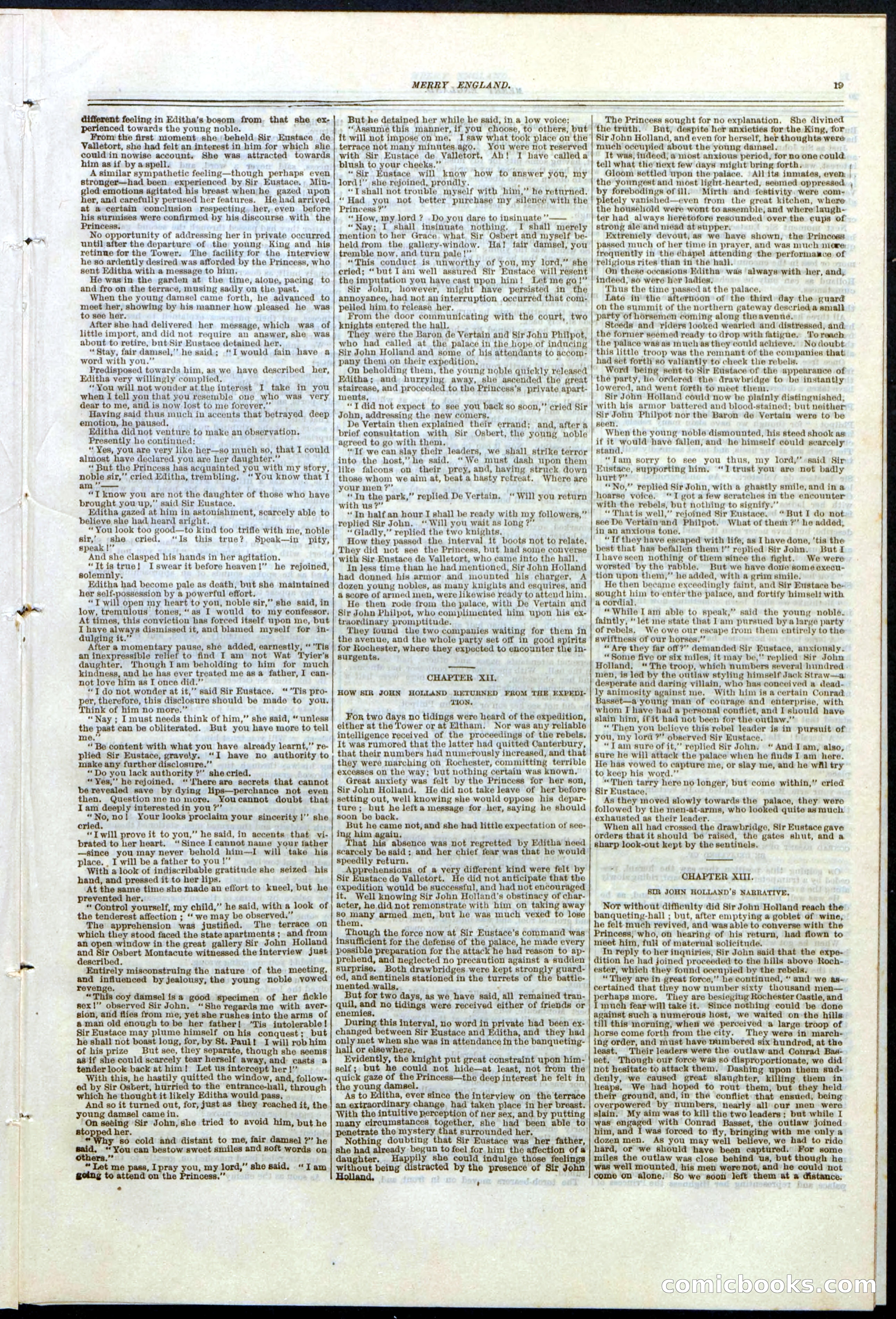
A restored page from Pulp Fiction, 1881. Page through the whole issue in the reader above.
📄 Transcribed text from this page (OCR, searchable)
Machine-transcribed from the original scan — historical spelling and the odd misread are preserved.
different fecling in Editha’s bosom from. that she ex- perienced towards the young noble. From the first moment she beheld Sir Eustace de Valletort, she had felt an interest in him for which she could in nowise account, She was attracted towards him as if by a spell. ‘° A similar sympathetic feeling—though perhaps even stronger—had been experienced by Sir Eustace. Min- gled emotions agitated his breast when he gazed upon her, and carefully perused her features. He had arrived at a certain conclusion respecting. her, even before his surmises were confirmed by his discourse with the Princess. No opportunity of addressing her in private occurred until after the departure of the young. King and his retinue for the Tower. The facility for the interview he so ardently desired was afforded by the Princess, who sent Editha with a message to him. He wasin the garden at the time, alone, pacing to and fro on the terrace, musing sadly on the past. When the young damsel came forth, he advanced to meet her, showing by his manner how pleased he was to see her. After she had delivered her message, which was of little import, and did not require an answer, she was about to retire, but Sir Eustace detained her, “Stay, fair damsel,’’ he said; “I would fain have a word with you.” Predisposed towards him, as we have described her, Editha very willingly complied. “You will not wonder at the interest I take in you when I tell yon that you resemble one who was very dear to me, and is now lost to me forever,” Having said thus much in accents that betrayed deep emotion, he paused, Editha did not venture to make an obseryation. Presently he continued: “ Yes, you are very like her—so much so, that I could almost have declared you are her daughter.” “ But the Princess has acquainted you with my story, noble sir,”’ cried Editha, trembling. ‘ You know that I am 5 SR ° “T know you are not the daughter of those who have brought you up,” said Sir Kustace. Editha gazed at him in astonishment, scarcely able to believe she had heard aright. “You look too good—to kind too trifle with me, noble sir,’ she cried, “Is this true? Speak—in pity, speak !”’ And she clasped his hands in her agitation. “TItistrue! Iswear it before heaven!” he rejoined, solemnly. Editha had become pale as death, but she maintained her self-possession by a powerful effort. “T will open my heart to yon, noble sir,” she said, in low, tremulous tones, “as I would to my confessor, At times, this conviction has forced itself upon me, but I have always dismissed it, and blamed myself for in- dulging it.” After a momentary pause, she added, earnestly, “ Tis an inexpressible relief to find I am not Wat Tyier's daughter. Though Iam beholding to him for much kindness, and he has ever treated me as a father, I can- not love him as I once did.” “T do not wonder at it,”’ said Sir Eustace. “’Tis pro- per, therefore, this disclosure should be made to you, Think of him no more.” “Nay ; I must needs think of him,” she said, “ unless the past can be obliterated. But you have more to tell me,”’ “ Be content with what you have already learnt,’ re- plied Sir Eustace, gravely. “I have no authority to make any further disclosure.” “Do you lack authority ?” she cried. “Yes,"’ he rejoined, “'lhere are secrets that cannot be revealed save by dying lips—perchance not even then. Question me no more. Youcannot doubt that Iam deeply interested in you ?”’ “a fe no! Your looks proclaim your sincerity !’’ she cried. “Twill prove it to you,” he said, in accents that vi- brated to her heart. “Since I cannot name your tather —since you may never behold him—I will take his place. _ I will be a father to you!” With a look of indiscribable gratitude she seized. his hand, and pressed it to her lips. At the same time she made an effort to kneel, but he prevented her. “ Control yourself, my child,” he said, with a look of the tenderest affection ; ‘‘ we may be observed. The apprehension was justified. The terrace on which they stood faced the state apartments ; and from an 0 window in the great gallery Sir John Holland and iene Montacute witnessed the interview just Entirely misconstruing the nature of the meeting, and influenced by jealousy, the young noble vowed revenge. a coy damsel is a good en of her fickle sex!” observed Sir John. “She regards me with aver- sion, and flies from me, yet she rushes into the arms of a man old enough to be her father! ’Tis intolerable! Sir Eustace may plume himself on his conquest; but he shall not boast long, for, by St. Paul! I will rob him of his prize But see, they separate, though she seems as'‘if she could scarcely tear herself away, and casts a tender look back at him! Let us intercept her!” With this, he hastily quitted the window, and, follow- ed by Sir Osbert, hurried to the entrance-hall, through which he thought it likely Editha would pass, And so it turned out, for, just as they reached it, the young damsel came in. ‘On sesing Sir John, she tried to avoid him, but he her. wR cs cold and distant to me, fair damsel ?”’ he Others.” Let me pass, Ipray you, my lord,” she said, “I am to attend onthe Sone” * E - = Oooo “You can bestow sweet smiles and soft words on | sh LL Ay tt ei ttt ntti MERRY . ENGLAND, But-he detained her while he said, in a low voice: ‘Assume this manner,if you choose, to others, but {t will not impose on me, I saw what took place on the terrace not many minutes.ago. You were not reserved with Sir Eustace de Valletort. Ah! I have calleda blush to your cheeks.” “Sir Eustace will know how to answer you, my lord !’’ she rejoined, prondly. . ‘LT shall not trouble myself with him,” he returned. ‘Had you not better purchase my silence with the Princess ?’’ * How, my lord ? .Do you dare to insinuate “Nay; I shall insinuate nothing. I shall merely mention to her Grace. what. Sir Osbert and myself be- held from the gallery-window. Ha! fair damsel, you tremble now, and turn pale!” “This conduct is unworthy of you, my lord,” she cried; “but lam well assured Sir Eustace will resent the imputation you haye cast upen him! Let me go!” Sir John, however, might have persisted in the annoyanee, had not an interruption occurred that com- pelled him to release her. From the door communicating with the court, two knights entered the hall. They were the Baron de Vertain and Sir John Philpot, who had called at the palace in the hope of inducing Sir John Holland and some of his attendants to accom- pany them on their expedition. ‘ On beholding them, the young noble qnickly released Editha; and hurrying away, she ascended the great staircase, and proceeded to the Princess’s private apart- nents, “T did not expect to see you back so soon,” cried Sir John, addressing the new comers. De Vertain then explained their errand; and, after a brief consultation with Sir Osbert, the young noble agreed to go with them, “If we can slay their leaders, we shall strike terror into the host,’’ he said. “We must dash upon them like falcons on their prey, and, having struck down those whom we aim at, beat a hasty retreat. Where are your men ?”’ ‘In the park,” replied De Vertain. ‘ Will you return with us?” “In halfan hour I shall be ready with m replied Sir John. ‘ Will you wait as long ? *Gladly,” replied the two knights. How they passed the interval it boots not to relate. They did not see the Princess, but had some converse with Sir Eustace de Valletort, who came into the hall. In less time than he had mentioned, Sir John Holland had donned his armor and mounted his charger, A dozen young nobles, as muny knights and esquires, and a score of armed men, were likewise ready to attend him. He then rode from the palace, with De Vertain and Sir John Philpot, who complimented him upon his ex- traordinary promptitude. They tound the two companies waiting for them in the avenue, and the whole party set off in good spirits for Rochester, where they expected to encounter the in- surgents. ” — y followers,” ----— CHAPTER XII HOW SIR JOHN HOLLAND RETURNED FROM THE EXPEDI- TION. For two days no tidings were heard of the expedition, either at the Tower or at Eltham. Nor was any reliable intelligence received of the proceedings of the rebels, It was rumored that the latter had quitted Canterbury, that their numbers had numerously increased, and that they were marching on Rochester, committing terrible excesses on the way; but nothing certain was known, Great anxiety was felt by the Princess for her son, Sir John Holland, He did not take leave of her before setting out, well knowing she would oppose his depar- ture; but he left a message for her, saying he should soon be back. But he came not, and she had little expectation of see- ing. him again. hat his absence was not regretted by Editha need scarcely be said; and her chief fear was that he would speedily return. . Apprehensions of a yery different kind were felt by Sir Eustace de Valletort. He did not anticipate that the expedition would be successful, and had not encouraged it. Well knowing Sir John Holland's obstinacy of char- acter, he did not remonstrate with him on taking away res many armed men, but he was much vexed to lose em. Though the force now at Sir Eustace'’s command was insufficient for the defense of the palace, he made every possible tion for the attack he had reason to ap- prehend, and neglected no precaution against a sudden surprise. Both drawbridges were kept spongy gure ed, and sentinels stationed in the turrets of the battle- mented walls, : But for two days, as we have said, all remained tran- qui § and no tidings were received either of friends or enemies, Dating this interval, no word in private had been ex- changed between Sir Eustace and Editha, and they had only met when she was in attendance in the banqueting- hall or elsewhere. Evidently, the knight put great constraint upon him- self; but he could not hide—at least, not from the uick gaze of the Princess—the deep interest he felt in t young damsel. . As to Editha, ever since the interview on the terrace an artzacsdinery change had taken place in her breast. With the intuitive perception of ner sex, and by putting many circumstances ether, she had been able to the mystery that surrounded her, . Nothing doubting that Sir Eustace was her father, y begun to feel for him the affection of a e had daughter. Happily she could indulge those baer without being Histracted by the presence of Sir ohn 19 The Princess sought for no explanation. She divined the truth. But, despite her anxieties for the King, for Sir John Holland, and even for herself, her thoughts were much occupied about the young damsel. | It was, iudeed, a most anxious period, for no one could tell what the next few days might bring forth. Gloom settled wpon the palace. All ita inmates, even the youngest and most ligirt-hearted, seemed oppressed py forebodings of ill. Mirth and festivity were com- pletely vanished—even from the great kitchen, where the household were wont to assemble, and where laugh- ter had always heretofore resounded over the cups of strong ale and méad at supper. Extremely devout, as we have shown, the Princess passed much of her time in prayer, and was much nieve frequently in the chapel attending the performance of religious rites than in the ha)l. On these occasions Editha was always swith her, and, indeed, so were her ladies, Thus the time passed at the palace. Late in’ the afternoon of the third day the guard on the summit of the northern gateway descrieda amall party of horsemen coming along theavenne. Steeds and riders looked wearied and distressed, and the former seemed ready to drop with fatigue. To reach the palace was as much as they could achieve. No doubt this little troop was the remnant of the companies that had set fortli so valiantly to check the rebels. Word being sent to Sir Eustace of the appearance of the party, he ordered the drawbridge to be instantly lowered, and went forth to meet then. Sir John Holland could now be plainly distingnished, with his armor battered and blood-stained; but neither Sir John Philpot nor the Baron de Vertain were to be seen, When the young noble dismounted, his steed shook as if it would have fallen, and he himself could searcely stand. “Tam sorry to see you thus, my lord,’ «said Sir enna supporting him. “I trust you are not badly aurt 7?” No,” replied Sir John, with a ghastly smile, and ina hoarse voice. “I got a few scratches in the encounter with the rebels, but nothing to signify.’’ “ Thatis well,” rejoined Sir Eustace. “But I do not see De Vertain ‘and Philpot. What of them ?’’ he added, in an anxions tone. “Tf they have escaped with life, as I have done, ‘tis the best that has befallen them!” replied Sir John. But I [have seen nothing of them since the fight. We were worsted by the rabble. But we have done some execu- tion upon them,”’ he added, with a grim simile. He then became exceedingly faint, and Sir Bustace be- sought him to enter the palace, and fortify himselt with a cordial. “While Lam able to speak,” said the young noblé. faintly, “let me state that Iam pursued bya large party of rebels, We owe our escape from them entirely to the swiftness of our horses.” “Are they far off?" demanded Sir Eustace, anxionsly. “Some five or six miles, it may be," replied Sir John Holland, “The troop, which numbers several hundred men, is led by the outlaw styling himself Jack Straw—a desperate and daring villain, who has conceived a dead- ly animosity against me, With him is a certain Conrad et—a young nan of courage and enterprise, with whom T have had a personal conflict, and I should have slain him, if ft had not been for the outlaw.” “Then you believe this rebel leader is in pursuit of you, my lord ?” observed Sir Eustace. “Tam sure of it,” replied Sir John. “ And Iam, also, sure he will attack the palace when he finds Iam here. He has vowed to capture me, or slay me, and he wf try to keep his word.” “Then tarry here no longer, but come within,” cried Sir Eustace, As they moved slowly towards the palace, they were followed by the men-at-arms, who looked quite as much exhausted as their leader. When all had crossed the drawbridge, Sir Eustace gave orders that it should be raised, the gates shut, and a sharp look-out kept by the sentinels. CHAPTER XIII. SIR JOHN HOLLAND'S NARRATIVE, Nor without difficulty did Sir John Holland reach the banqueting-hall ; but, after emptying a goblet of wine, he felt much revived, and was able to converse with the Princess; who, on hearing of his return, had flown to meet him, full of maternal golicitude. In ig 403 to her inquiries, Sir John said that the expe- dition he had joined proceeded to the hills above Roch- ester, which they found oceupied by the rebels, “ They are in great force," he continued, “ and we as- certained that they now number sixty thousand men— pelea more. They are besieging Rochester Castle, and much fear will take it. Since nothing could be done against such a numerous host, we waited on the hills till this morning, when we perceived a large troop of horse come forth from the city. They were in march- ing order, and must have mimbered six hundred, at the least. Their leaders were the outlaw and Conrad Baa- set. Though our force was so disproportionate, we did not hesitate to attack them. Dashing wpon them sud- denly, we caused great slaughter, ng them in poe We had hoped to rout them, but they held th ground, and, in the conflict that ensued, being overpowered by numbers, nearly all our men were slain. My aim was to kill the two leaders; but while I was on with Conrad Basset, the outlaw joined him, and I was forced to fly, bringing with me only a eae men. As you may well eve, we had to ride hard, or we should have been captured. For some miles the outlaw was close behind us, but though he was well mounted, his men werenot, and he could not come on alone. So we soon left them at a distance. — os JOOKS (EO) (C (E(0)