
Pulp Fiction, 1881 · page 8 of 32
Beadle's New York Dime Library No. 115 — page 8: what you’re looking at
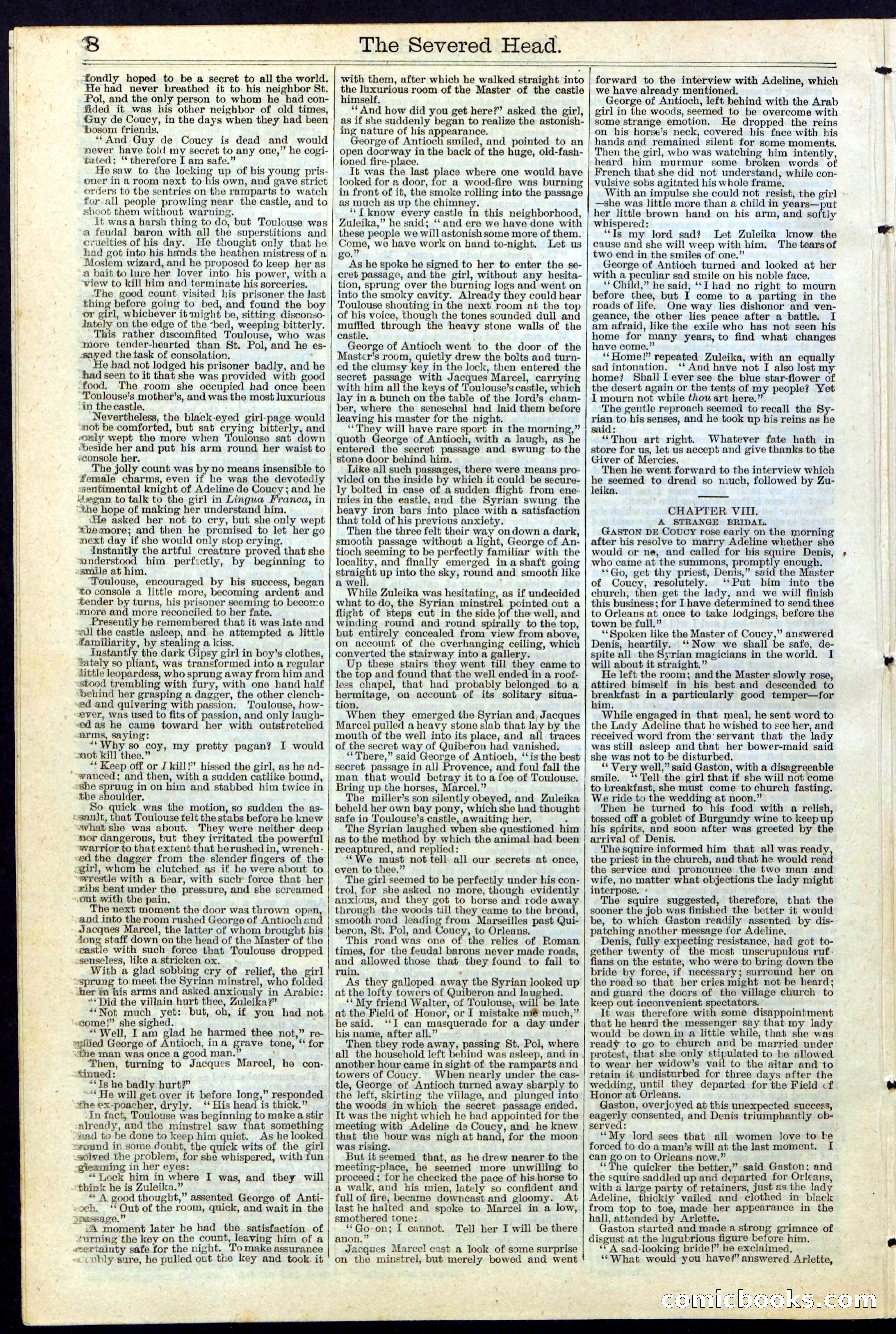
A restored page from Pulp Fiction, 1881. Page through the whole issue in the reader above.
📄 Transcribed text from this page (OCR, searchable)
Machine-transcribed from the original scan — historical spelling and the odd misread are preserved.
a Se A IE mgibed George of «wertainty safe for the night. fondly hoped to be a secret to all the world. He had never breathed it to his neighbor St. Pol, and the only person to whom he had con- fided it was his other neighbor of old times, Gny de Coucy, in the days when they had been bosom friends. ‘‘And Guy de Coucy is dead and would never have told my secret to any one,” he cogi- tated; “ therefore I am safe.” He saw to the locking up of his young pris- oner in a room next to his own, and gave strict orders to the sentries on the ramparts to watch for all people prowling near the castle, and to shoot them without warning. it wasa harsh thing to do, but Toulouse was a feudal baron with all the superstitions and cruelties of his day. He thought only that he had got into his hands the heathen mistress of a Moslem wizard, and he proposed to keep her as a bait to lure her lover into his power, with a view to kill him and terminate his sorceries. ‘The good count visited his prisoner the last thing before going to bed, and found the boy or girl, whichever it might be, sitting disconso- Jately on the edge of the -bed, weeping bitterly. This rather discomfited Toulouse, who was more tender-hearted than St. Pol, and he es- ayed the task of consolation. e had not lodged his prisoner badly, and he fad seen to it that she was provided with good food. The room she occupied had once been -Toulouse’s mother’s, and was the most luxurious -in the castle. Nevertheless, the black-eyed girl-page would not be comforted, but sat crying bitterly, and only wept the more when Toulouse sat down ‘beside her and put his arm round her waist to “console her. The jolly count was by no means insensible to female charms, even if he was the devotedly sentimental knight of Adeline de Coucy; and he “vegan to talk to the girl in Lingua Franca, in “the hope of making her understand him, ‘He asked her not to cry, but she only wept ‘Xhemore; and then he promised to let her go next day if she would only stop crying, instantly the artful creature proved that she “understood him perfectly, by beginning to smile at him. ‘Toulouse, encouraged by his success, began to console a little more, becoming ardent and tender by turns, his prisoner seeming to become ‘more and more reconciled to her fate. Presently he remembered that it was late and sal the eastle asleep, and he attempted a little familiarity, by stealing a kiss. Jastantly the dark Gipsy girl in boy’s clothes, jately so pliant, was transformed into a regular ‘ittle leopardess, who sprung away from him and «stood trembling with fury, with one hand half ‘behind her grasping a dagger, the other clench- ved and quivering with passion. Toulouse, how- . “yer, was used to fits of passion, and only laugh- das he came toward her with outstretched “arms, saying: “Why so coy, my pretty pagan? I would not kill thee.” “* Keep off or J kill!” hissed the girl, as he ad- ‘-waneed; and then, with a sudden catlike bound, in on him and stabbed him twice in she yes shoulder. the So ae was the motion, so sudden the as- <sault, t at Toulouse telt the stabs before he knew ‘what she was about. They were neither deep mor dangerous, but they irritated the powerful warrior to that extent that herushedin, wrench- ed the dagger from the slender fingers of the “girl, whom he clutched as if he were about to “wrestle with a bear, with suclr force that her -wibs bent under the pressure, and she screamed out with the pain, The next moment the door was thrown open, and into the room rushed George of Antioch and Jacques Marcel, the latter of whom brought his long staff down on the head of the Master of the castle with such force that Toulouse dropped senseless, like a stricken ox. With a glad sobbing cry of relief, the girl e “sprung to meet the Syrian minstrel, who fol her @& his arms and asked anxiously in Arabic: “* Did the villain hurt thee, Zuleika?” “Not much yet: but, oh, if you had not ‘<eome!” she sighed. ““ Well, I am glad he harmed thee not,” re- Siticeh. ina grave tone, ‘‘ for “he man was once a good man.” Then, turning to Jacques Marcel, ho con- - tinued: **Ts he badly hurt?” ~* He will get over it before long,” responded “he ex-poacher, dryly. ‘‘ His head is thick.” In fact, Toulouse was beginning to make a stir already, and the minstrel saw that somethin “pad to be done to keep him quiet. As he looke “awund in. some doubt, the quick wits of the girl un .silved the problem, for she whispered, with @ieaming in her eyes: ““Y,ock him in where I was, and they will ‘think he is Zuleila.” * A good thought,” assented George of Anti- och. ‘‘ Out of the room, quick, and wait in the prassage.” “A moment later he had the satisfaction of ‘urning the key on the count, leaving him of a _ Tomake assurance «cwbly sure, he pulled out the key and took. it — a? with them, after which he walked straight into the luxurious room of the Master of the castle himself. ‘And how did you get here?’ asked the girl, as if she suddenly began to realize the astonish- ing nature of his appearance. George of Antioch smiled, and pointed to an open doorway in the back of the huge, old-fash- ioned fire-place. It was the last place where one would have looked for a door, for a wood-fire was burning in front of it, the smoke rolling into the passage as much as up the chimney. ‘‘[ know every castle in this neighborhood, Zuleika,” he said; ‘‘ and ere we have done with these people we will astonish some more of them. Come, we have work on band to-night. Let us 0. As he spoke he signed to her to enter the se- cret passage, and the girl, without any hesita- tion, sprung over the burning logs and went on into the smoky cavity. Already they could hear Toulouse shouting in the next room at the top of his voice, though the tones sounded dull and ge through the heavy stone walls of the castle. George of Antioch went to the door of the Master’s room, quietly drew the bolts and turn- ed the clumsy key in the lock, then entered the secret passage with Jacques Marcel, carrying with him all the keys of Toulouse’s castle, which lay in a bunch on the table of the Jord’s cham- ber, where the seneschal had laid them before leaving his master for the night. ‘*They will have rare sport in the eg quoth George of Antioch, with a laugh, as he entered the secret passage and swung to the stone door behind him. Like all such passages, there were means pro- vided on the inside by which it could be secure- ly bolted in case of a sudden flight from ene- mies in the eastle, and the Syrian swung the heavy iron bars into place with a satisfaction that told of his previous anxiety. Then the three felt their way ondown a dark, smooth passage without a light, George of An- tioch seeming to be perfectly familiar with the locality, and finally emerged inashaft going gamigis up into the sky, round and smooth like a well. While Zuleika was hesitating, as if undecided what to do, the Syrian minstrel pointed out a flight of steps cut in the side fof the well, and winding round and round spirally to the top, but entirely concealed from view from above, on account of the overhanging ceiling, which converted the stairway into a gallery. Up these stairs they went till they came to the to and found that the well ended in a roof- less chapel, that had probably belonged to a hermitage, on account of its solitary situa- tion. When they emerged the Syrian and, Jacques Marcel pulled a heavy stone slab that lay by the mouth of the well into its place, and all traces of the secret way of Quiberon had vanished. ‘*There,” said George of Antioch, ‘is the best secret passage in all Provence, and foul fall the man that would betray it to a foe of Toulouse. Bring up the horses, Marcel.” The miller’s son silently obeyed, and Zuleika beheld her own bay pony, which she had thought safe in ‘Toulouse’s castle, awaiting her. ' The Syrian laughed when she questioned him as to the method by which the animal had been recaptured, and replied: ‘“‘We must not tell all our secrets at once, even to thee,” The girl seemed to be perfectly under his con- trol, for she asked no more, though evidently anxious, and they got to horse and rode awa through the woods till they came to the broad, smooth road leading from Marseilles past Qui- beron, St. Pol, and Coucy, to Orleans. This road was one of the relics of Roman times, for the feudal barons never made roads, and allowed those that they found to fall to ruin. As they galloped away the Syrian looked up at the lofty towers of Quiberon and laughed. ‘* My friend Walter, of Toulouse, will be late at the Field of Honor, or I mistake m@ much,” he said. ‘‘I can masquerade for a day under his name, afterall.” Then they rode away, passing St. Pol, where all the household left behind was asleep, and in another hour came in sight of the ramparts and towers of Coucy. When nearly under the cas- tle, George of Antioch turned away sharply to the left, skirting the village, and plunged into the woods in which the secret passage ended. It was the night which he had appointed for the meeting with Adeline ds Coucy, and he knew that the hour was nigh at hand, for the moon was rising. But it seemed that, as he drew nearer to the meeting-place, he seemed more unwilling to proceed; for he checked the pace of his horse to a walk, and his mien, lately so confident and full of fire, became downcast and gloomy. At last he halted and spoke to Marcel in a low, smothered tone: ‘*Go-on; I cannot. Tell her I will be there anon.” . Jacques Marcel east a look of some surprise on the minstrel, but merely bowed and went The Severed Head. 3 Se forward to the interview with Adeline, which we have already mentioned. George of Antioch, left behind with the Arab girl in the woods, seemed to be overcome with some strange emotion. He dropped the reins on his horse’s neck, covered his face with his hands and remained silent for some moments. Then the girl, who was watching him intently heard him murmur some broken words of French that she did not understand, while con- vulsive sobs agitated his whole frame. With an impulse she could not resist, the girl —she was little more than a child in years—put her little brown hand on his arm, and softly whispered: ‘Is my lord sad? Let Zuleika know the cause and she will weep with him. The tears of two end in the smiles of one.” George of Antioch turned and looked at her with a peculiar sad smile on his noble face. ‘* Child,” he said, ‘‘I had no right to mourn before thee, but 1 come to a parting in the roads of life. One way lies dishonor and ven- geance, the other lies peace after a battle. I am afraid, like the exile who has not seen his home for many years, to find what changes have come.” ‘‘Home!” repeated Zuleika, with an equally sad intonation. ‘‘ And have not I also lost my home? Shall I ever see the blue star-flower of the desert again or the tents of my people? Yet 1 mourn not while thou art here.” The gentle reproach seemed to recall the Sy- ae to his senses, and he took up his reins as he said : “Thou art right. Whatever fate hath in store for us, let us accept and give thanks to the Giver of Mercies. Then he went forward to the interview which fe eoeannet to dread so much, followed by Zu- eika. CHAPTER VIII. A STRANGE BRIDAL. GASTON DE Coucy rose early on the morning after his resolve to marry Adeline whether she would or ne, and called for his squire Denis, who came at the summons, promptly enough. ‘*Go, get thy priest, Denis,” said the Master of Coucy, resolutely. ‘‘Put him into the church, then get the lady, and we will finish this business; for I have determined to send thee to Orleans at once to take lodgings, before the town be full.” ‘** Spoken like the Master of Coucy,” answered Denis, heartily. ‘* Now we shall be safe, de- spite all the Syrian magicians in the world. I will about it straight.” He left the room; andthe Master slowly rose, attired bimself in his best and descended to arg in a particularly good temper—for im. While engaged in that meal, he sent word to the Lady Adeline that he wished to see her, and received word from the'servant that the lady was still asleep and that her bower-maid said she was not to be disturbed. 2 Very well,” said Gaston, with a disagreeable smile. ‘* Tell the girl that if she will not come to breakfast, she must come to church fasting. We ride to the wedding at noon.” Then he turned to his food with a relish, tossed off a goblet of Burgundy wine to keep up his spirits, and soon after was greeted by the arrival of Denis. The squire informed him that all was ready the priest in the church, and that he would rea the service and pronounce the two man and wife, no matter what objections the lady might interpose. * The squire suggested, therefore, that the sooner the job was finished the better it would be, to which Gaston readily assented by dis- patching another message for Adeline, Denis, fully expecting resistance, had got to- gether twenty of the most unscrupulous ruf- fians on the estate, who were to bring down the bride by force, if necessary; surround her on the road so that her cries might not be heard; and guard the doors of the village church to keep out inconvenient spectators. | It was therefore with some disappointment that he heard the messenger say that my lady would be down in a little while, that she was ready to go to church and be married under protest, that she only bad. epg to be allowed to wear her widow’s vail to the altar and to retain it undisturbed for three days after the wedding, until they departed for the Field cf Honor at Orleans. Gaston, overjoyed at this unexpected success, eagerly consented, and Denis triumphantly ob- served: ‘‘My lord sees that all women love to he forced to do a man’s will at the last moment. I can go on to Orleans now.” ““The quicker the better,” said Gaston; and the squire saddled up and departed for Orleans, with a large party of retainers, just as the lady Adeline, thickly vailed and clothed in black from top to toe, made her appearance in the hall, attended by Arlette. Gaston started and made a strong grimace of disgust at the lugubrious figure before him. ‘° A sad-looking bride!” he exclaimed, ‘*What would you have?” answered Arlette, \ (ECO A MINCE] OXeKo) <S (E(O) } gg