
Pulp Fiction, 1881 · page 7 of 32
Beadle's New York Dime Library No. 115 — page 7: what you’re looking at
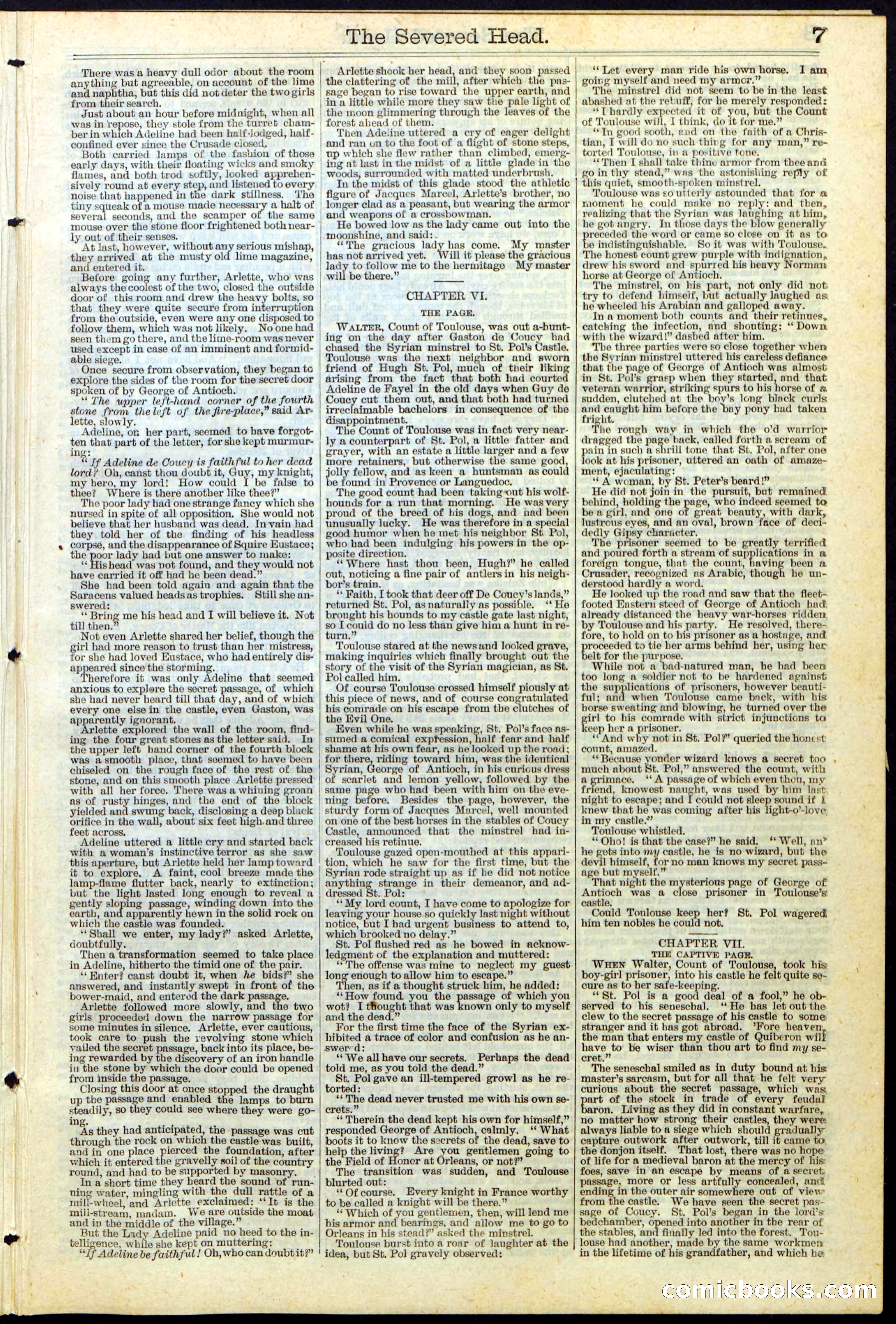
A restored page from Pulp Fiction, 1881. Page through the whole issue in the reader above.
📄 Transcribed text from this page (OCR, searchable)
Machine-transcribed from the original scan — historical spelling and the odd misread are preserved.
° There was a heavy dull odor about the room | anything but agreeable, on account of the lime | and naphtha, but this did not deter the two girls from their search. Just about an hour before midnight, when all was in repose, they stole from the turret cham- ber in which Adeline had been half-lodged, half- confined ever since the Crusade closed, Both carried lamps of the fashion of those early days, with their floating wicks and smoky flames, and both trod softly, looked apprehen- sively round at every step, and listened to every noise that happened in the dark stillness. ‘The tiny squeak of a mouse made necessary a halt of several seconds, and the scamper of the same mouse over the stone floor frightened both near- | ly out of their senses. At last, however, without any serious mishap, they arrived at the musty old lime magazine, and entered if. Before going any further, Arlette, who was always the coolest of the two, closed the outside door of this room and drew the heavy bolts, so that they were quite secure from interruption from the outside, even were any one disposed to follow them, which was not likely. Noone had seen them go there, and the lime-room was never used except in case of an imminent and formid- | able siege. Once secure from observation, they began to explore the sides of the room for the secret door spoken of by George of Antioch. “The upper left-hand corner of the fourth stone from the left of the fire-place,” said Ar- lette, slowly. Adeline, on her part, seemed to have forgot- ten that part of the letter, for she kept murmur- ing: “7p Adeline de Coucy is faithful to her dead lord? Oh, canst thou doubt it, Guy, my knight, my hero, my lord! How could I be false to thee? Where is there another like thee?” The poor lady had one strange fancy which she nursed in spite of all opposition. She would not believe that her husband was dead. In-vain had they told her of the finding of his headless corpse, and the disappearance of Squire Eustace; the poor lady had but one answer to make: ** Hishead was vot found, and they would not have carried it off had he been dead.” | She had been told again and again that the | Saracens valued headsas trophies. Still she an- | swered: ve Bring me his head and I will believe it. Not | till then. | Not even Arlette shared her belief, though the | girl had more reason to trust than her mistress, for she had loved Eustace, who had entirely dis- appeared since the storming. = herefore it was only Adeline that seemed | anxious to explore the secret passage, of which | she had never heard till that day, and of which | every one else in the castle, even Gaston, was sopereny ignorant. rlette explored the wall of the room, find- ing the four great stones as the letter said. In the upper left hand corner of the fourth block | was asmooth place, that seemed to have been | chiseled on the rough face of the rest of the stone, and on this smooth place Arlette pressed with all her force. There was a whining groan as of rusty hinges, and the end of the block yielded and swung back, disclosing a deep black orifice in the wall, about six feet high.and three feet across. Adeline uttered a little cry and started back with a woman’s instinctive terror as she saw this aperture, but Arlette held her lamp toward it to explore. A faint, cool breeze made the lamp-flame flutter back, nearly to extinction; but the light lasted long enough to reveal a gently sloping passage, ase pee! into the earth, and apparently hewn in the solid rock on which the castle was founded. ‘*Shall we enter, my lady?’ asked Arlette, doubtfully. Then a transformation seemed to take place in Adeline, hitherto the timid one of the pair. ‘‘ Bnter? canst doubt it, when he bids?’ she answered, and instantly swept in front of the bower-maid, and entered the dark pane Arlette followed more slowly, and the two girls proceeded down the narrow passage for some minutes in silence. Arlette, ever cautious, took care to push the revolving stone which vailed the secret passage, back into its place, be- ing rewarded by the discovery of an iron handle in the stone by which the door could be opened from inside the passage. Closing this door at once stopped the draught up the passage and enabled the lamps to burn steadily, so they could see where they were go- ing. -- they had anticipated, the passage was cut through the rock on which the castle was built, and in one place pierced the foundation, after which it entered the gravelly soil of the country round, and had to be supported by masonry, —_ In a short time they heard the sound of run- ning water, mingling with the dull rattle of a mill-wheel, and Arlette exclaimed: ‘‘It is the mili-stream, madam. We are outside the moat and ip the middle of the village. ” But the Lady Adeline paid no heed to the in- telligence, while she kept on muttering: “If Adeline be faithful ! Oh, who can doubt it?” ' _ has not arrived yet. | lad | will be there.” The Severed iiead. Arlette shook her head, and they soon passed the clattering of the mill, after which the pas- sage began to rise toward the upper earth, and ooo — OO in a little while more they saw the pale light of the moon glimmering through the leaves of the forest abead of them. Then Adeline uttered a cry of eager delight and ran on to the foot of a flight of stone steps, up which she flew rather than climbed, emerg- ing at last in the midst of a little glade in the woods, surrounded with matted underbrush. In the midst of this glade stood the athletic figure of Jacques Marcel, Arlette’s brother, no longer clad as a peasant, but wearing the armor and weapons of a crossbowman. He bowed low as the lady came out into the _ moonshine, and said: “The gracious lady has come. My master Vill it please the gracious to follow me to the hermitage My master CHAPTER VI. THE PAGE. WALTER, Count of Toulouse, was out a-hunt- ing on the day after Gaston de Coucy had chased the Syrian minstrel to St. Pol’s Castle. Toulouse was the next neighbor and sworn friend of Hugh St. Pol, much of their liking arising from the fact that both had courted Adeline de Fayel in the old days when Guy de Couey cut them out, and that both had turned irreclaimable bachelors in consequence of the disappointment. The Count of Toulouse was in fact very near- ly a counterpart of St. Pol, a little fatter and grayer, with an estate a little larger and a few more retainers, but otherwise the same good, jolly fellow, and as keen a huntsman as could e found in Provence or Languedoc. The good count had been takingout his wolf- hounds for a run that morning. He was very proud of the breed of his dogs, and had been unusually mite He was therefore in a special good humor when he met his neighbor St. Pol, who had been indulging his powers in the op- posite direction. “Where hast thou been, Hugh?” he called out, noticing a fine pair of antlersin his neigh- bor’s train. ** Faith, [ took that deer off De Coucy’s lands,” returned St. Pol, as naturally as possible. ‘ He brought his hounds to my castle gate last night, 9 I could do no less than give him a hunt in re- urn. Toulouse stared at the news and looked grave, making inquiries which finally brought out the story of the visit of the Syrian magician, as St. Pol called him. Of course Toulouse crossed himself piously at this piece of news, and of course congratulated his comrade on his escape from tbe clutches of the Evil One. Even while he was speaking, St. Pol’s face as- sumed a comical paatesticn tals fear and half shame at his own fear, as he looked up the road; for there, riding toward him, was the identical Syrian, George of Antioch, in his curious dress of scarlet and lemon yellow, followed by the same page who had been with him on the eve- ning ore. Besides the page, however, the sturdy form of Jacques Marcel, well mounted _on one of the best horses in the stables of Coucy Castle, announced that the minstrel had in- creased his retinue. Toulouse gazed open-mouthed at this appari- tion, which he saw for the first time, but the Syrian rode straight up as if he did not notice oe strange in their demeanor, and ad- dressed St. Pol: ‘** My lord count, I have come to apologize for leaving your house so quickly last night without notice, but [ had urgent business to attend to, which brooked no delay.” St. Pol flushed red as he bowed in acknow- ledgment of the explanation and muttered: * The offense was mine to neglect my guest long enough to allow him to escape.” en, as if a thought struck him, he added: age of which you “How found. you the Saieee on own only to myse wot? I thought that was and the dead.” For the first time the face of the Syrian ex- hi ee a trace of color and confusion as he an- swerd: ‘* ‘We all have our secrets. Perhaps the dead told me, as you told the dead.” St. Pol gave an ill-tempered growl as he re- rted: Mt The dead never trusted me with his own se- ‘Therein the dead kept his own for himself,” responded George of Antioch, calmly. ‘* What boots it to know the secrets of the dead, save to help the living? Are you gentlemen going to the Field of Honor at Orleans, or not?” The transition was sudden, and Toulouse blurted out: “Ofcourse. Every knight in France worthy to be called a knight will be there.” “Which of you gentlemen, then, will lend me his armor and bearings, and allow me to go to Orleans in his stead?” asked the minstrel. Toulouse burst into a roar of laughter at the idea, but St. Pol gravely observed: % ‘* Let every man ride his own horse. I am going myself and need my armo7.” The minstrel did not seem to be in the least abashed at the rebuff, for he merely responded: ‘*T hardly expected it of you, but the Count of Toulouse will, 1 think, do it for me.” “In good sooth, end on the faith of a Chris- tian, I will do no such thing for any man,” re- torted Toulouse, in a positive tone. ‘Then I shall take thine armor from thee and go in thy stead,” was the astonishing reply of this quiet, smooth-spoken minstrel. Toulouse was so utterly astounded that for a moment he could make no reply: and then, realizing that the Syrian was laughing at him, he got angry. In those days the blow generally oe the word or came so close on it as to 1¢ indistinguishable. So it was with Toulouse. The honest count grew purple with indignation, drew his sword and spurred his heavy Norman horse at George of Antioch. The minstrel, on his part, not only did not try to defend himseif, but actually laughed as he wheeled his Arabian and galloped away. In a moment both counts and their retinues, eatching the infection, and shouting: “* Down with the wizard!” dashed after bim. The three parties were so close together when the Syrian minstrel uttered his careless defiance that the page of George of Antioch was almost in St. Pol’s grasp when they started, and that veteran warrior, striking spurs to his horse of # sudden, clutched at the boy’s long black curls rere by him before the bay pony had taken right. The rough way in which the o'd warrior dragged the page back, called forth a scream of pain in such a shrill tone that St. Pol, after one ook at his prisoner, uttered an oath of amaze- ment, ejaculating: ‘* A woman, by St. Peter’s beard!” He did not join in the pursuit, bot remained behind, holding the page, who indeed seemed to be a girl, and one of great beauty, with dark, lustrous eyes, and an oval, brown face of deci- dedly Gipsy character. The prisoner seemed to be greatly terrified and poured forth a stream of ri fy hi in a foreign tongue, that the count, having been a Crusader, recognized as Arabic, though he un- derstood hardly a word. He looked up the road and saw that the fleet- footed Eastern steed of George of Antioch bad. already distanced the heavy war-horses ridden. by Toulouse and his party. He resolved, there- fore, to hold on to his prisoner as a hostage, and a a te to tie her arms behind her, using her lt for the purpose. While not a bad-natured man, he had been too long a soldier not to be hardened against the supplications of prisoners, however beauti- ful; and when Toulouse came back, with bis horse sweating and blowing, he turned over the irl to his comrade with strict injunctions to eep her a prisoner. ‘*And why not in St. Pol?’ queried the honest count, amazed. ** Because yonder wizard knows a secret too much about St. Pol,” answered the count, with agrimace, ‘A passage of which even thou, my friend, knowest naught, was used by him last. night to escape; and [ could not sleep sound if knew that he was coming after his light-o’-love in my castle.” Toulouse whistled. ‘Oho! is that the case?’ he said. ‘ Well, an” he gets into my castle, he is no wizard, but the devil himself, for no man knows my secret pass- age but myself.” That night the mysterious page of George of hag was a close prisoner in 'Toulouse’s castle. Could Toulouse keep her? St. Pol wagered him ten nobles he could not, CHAPTER VII. THE CAPTIVE PAGE. Wuen Walter, Count of Toulouse, took his boy-girl prisoner, into his castle he felt quite se- cure as to her safe-keeping. , “St. Pol is a deal of a fool,” he ob- served to his seneschal. ‘He has let out the clew to the secret passage of his castle to some stranger and it has got abroad. ’Fore heaver, the man that enters my castle of Quiberon wil} have to be wiser than thou art to find my se- cret. The seneschal smiled as in duty bound at his master’s sarcasm, but for all that he felt very curious about the secret ge, which was of the stock in trade of every feudal on. Living as they did in constant warfare, no matter how strong their castles, they were always liable to a siege which should radually capture outwork after outwork, till it came to, the donjon itself. That lost, there was no h of life for a medieval baron at the mercy of his: foes, save in an escape by means of a secret; , more or less artfully concealed, anck ending in the outer air somewhere out of view from the castle. We have seen the secret pas- sage of Coucy. St. Pol’s began in the lord’s chamber, opened into another in the rear of the stables, and finally led into the forest. Tou- louse had another, made by the same workmer in the lifetime of his grandfather, and which he \ <S com Ehboo (E(@)