
Pulp Fiction, 1881 · page 5 of 32
Beadle's New York Dime Library No. 115 — page 5: what you’re looking at
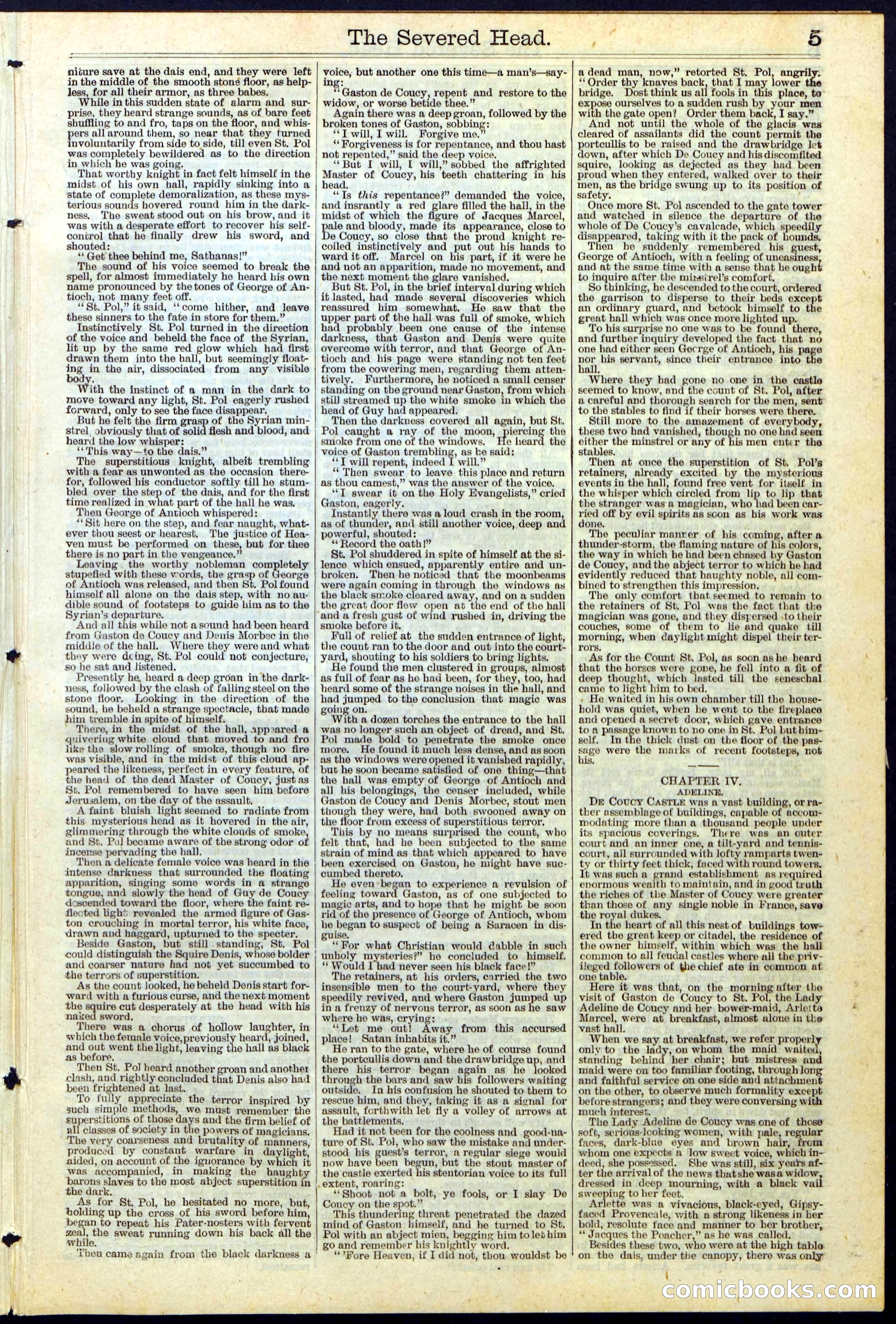
A restored page from Pulp Fiction, 1881. Page through the whole issue in the reader above.
📄 Transcribed text from this page (OCR, searchable)
Machine-transcribed from the original scan — historical spelling and the odd misread are preserved.
o ——EEE niture save at the dais end, and they were left in the middle of the smooth stone floor, as help- less, for all their armor, as three babes, While in this sudden state of alarm and sur- prise, they heard strange sounds, as of bare feet shuffling to and fro, taps on the floor, and whis- ers all around them, so near that they turned involuntarily from side to side, till even St. Pol was completely bewildered as to the direction in which he was going. That worthy knight in fact felt himself in the midst of his own hall, rapidly sinking into a state of complete demoralization, as these mys- terious sounds hovered round him in the dark- ness. The sweat stood out on his brow, and it was with a desperate effort to recover his self- control that he finally drew his sword, and shouted: ‘‘ Get thee behind me, Sathanas!” The sound of his voice seemed to break the spell, for almost immediately he heard his own name pronounced by the tones of George of An- tioch, not many feet off. ‘St. Pol,” it said, ‘‘come hither, and leave these sinners to the fate in store for them.” Instinetively St. Pol turned in the direction of the voice and beheld the face of the Syrian, lit up by the same red glow which had first drawn them into the hall, but seemingly float- ing in the air, dissociated from any visible ith the instinct of a man in the dark to move teward any light, St. Pol eagerly rushed forward, only to see the face disappear. But he felt the firm grasp of the Syrian min- strel, obviously that of solid flesh and blood, and heard the low whisper: ‘*Tbhis way—to the dais.” The superstitious knight, albeit trembling with a fear as unwonted as the occasion there- for, followed his conductor softly till he stum- bled over the step of the dais, and for the first time realized in what part of the hall he was. Then George of Antioch whispered: “Sit here on the step, and fear naught, what- ever thou seest or hearest, The justice of Hea- ven must be performed on these, but for thee there is no part in the vengeance.’ Leaving. the worthy nobleman completely stupefied with these vords, the grasp of George of Antioch was released, and then St. Pol found himself all alone on the dais step, with no au- dible sound of footsteps to guide him as to the Syrian’s departure. And all this while not a sound had been heard from Gaston de Coucy and Denis Morbee in the middie of the hall. Where they were and what they were dcing, St. Pol could not conjecture, so he sat and listened. : Presently he, heard a deep groan in the dark- ness, followed by the clash of falling steel on the stone floor. Looking in the direction of the sound, he beheld a strange spectacle, that made him tremble in spite of himself. There, in the midst of the hall, appeared a quivering white cloud that moved to and fro like the slowrolling of smoke, though no fire was Visible, and in the midst of this cloud ap- peared the likeness, perfect in every feature, of the head of the dead Master of Coucy, just as St. Pol remembered to have seen him before Jerusalem, on the day of the assault, A faint bluish light seemed to radiate from this mysterious head as it hovered in the air, glimmering through the white clouds of smoke, and St. Pol became aware of the strong odor of incense pervading the hall. Then a delicate female voice was heard in the intense darkness that surrounded the floating apparition, singing some words in a strange tongue, and slowly the head of Guy de Coucy doscended toward the floor, where the faint re- flected light revealed the armed figure of Gas- ton crouching in mortal terror, his white face, drawn and haggard, upturned to the specter. Beside Gaston, but still standing, St. Pol could distinguish the Squire Denis, whose bolder and coarser nature had not yet succumbed to the terrors of superstition. As the count looked, he beheld Denis start for- ward with a furious curse, and the next moment the he gem cut desperately at the head with his naked sword, There was a chorus of hollow laughter, in which the female voice,previously heard, joined, and out went the light, leaving the hall as black as before, Then St. Po] heard another groan and another clash, and rightly concluded that Denis also had been frightened at last. To fully appreciate the terror inspired by such simple methods, we must remember the superstitions of those days and the firm belief of all classes of society in the powers of magicians. The very coarseness and brutality of manners, produced by constant warfare in daylight, aided, on account of the ignorance by which it was accompanied, in making the haught barons slaves to the most abject superstition in the dark. As for St. Pol, he hesitated no more, but, holding up the cross of his sword before him began to repeat his Pater-nosters with ferven ve the sweat running down his back all the awhile. ‘Then came again from the black darkness a — ‘ OO C—O I ™ The Severed | Head. voice, but another one this time—a man’s—say- ing: Gaston de Coucy, repent and restore to the widow, or worse betide thee.” Again there was a deep groan, followed by the broken tones of Gaston, sobbing: ‘*T will, I will. Forgive me. ‘Forgiveness is for nepen tance, and thou hast not repented,” said the deep voice. ‘* But I will, | will,” sobbed the affrighted — of Coucy, his teeth chattering in his ead. ‘Is this repentance?” demanded the voice, and insrantly a red glare filled the hall, in the midst of which the figure of Jacques Marcel, pale and bloody, made its appearance, close to Je Coucy, so close that the proud knight re- coiled instinctively and put out his hands to ward it off. Marcel on his part, if it were he and not an apparition, made no movement, and the next moment the glare vanished. But St. Pol, in the brief interval during which it lasted, had made several discoveries which reassured him somewhat, He saw that the a part of the hall was full of smoke, which had probably been one cause of the intense darkness, that Gaston and Denis were quite overcome with terror, and that George of An- tioch and his page were standing not ten feet from the cowering men, regarding them atten- tively. Furthermore, he noticed a small censer standing on the ground near Gaston, from which stil) streamed up the white smoke in which the head of Guy had appeared. Then the darkness covered all again, but St. Pol caught a ray of the moon, perce the smoke from one of the windows. He heard the voice of Gaston trembling, as he said: ‘*T will repent, indeed I will.” ‘* Then swear to leave this place and return as thou camest,” was the answer of the voice. “T swear it on the Holy Evangelists,” cried Gaston, eagerly. Instantly there was a loud crash in the room as of thunder, and still another voice, deep an powerful, shouted: ** Record the oath!” St. Pol shuddered in spite of himself at the si- lence which ensued, apparently entire ard un- broken. Then he noticed that the moonheams were again coming in through the windows as the black smoke cleared away, and on a sudden the great door flew open at the end of the hall and a fresh gust of wind rushed in, driving the smoke before it. Full of relief at the sudden entrance of light, the count ran to the door and out into the court- yard, shouting to his soldiers to bring lights. He found the men clustered in groups, almost as full of fear as he had been, for they, too, had heard some of the strange noises in the hall, and had jumped to the conclusion that magic was going on. With a dozen torches the entrance to the hall was no longer such an object of dread, and St. Pol made bold to penetrate the smoke once more. He found it much less dense, and as soon as the windows were opened it vanished rapidly, but he soon became satisfied of one thing—that the hall was empty of George of Antioch and all his belongings, the censer included, while Gaston de Coucy and Denis Morbec, stout men though they were, had both swooned away on the floor from excess of superstitious terror, This by no means surprised the count, who felt that, had he been subjected to the same strain of mind as that which appeared to have been exercised on Gaston, he might have suc- cumbed thereto. He even began to experience a revulsion of feeling toward Gaston, as of one subjected to magic arts, and to hope that he might be soon rid of the presence of George of Antioch, whom he began to suspect of being a Saracen in dis- guise. “For what Christian would dabble in such unholy mysteries?” he concluded to himself. ‘** Would I had never seen his black face!” The retainers, at his orders, carried the two insensible men to the court-yard, where they speedily revived, and where Gaston jumped up in a frenzy of nervous terror, as soon as he saw where he was, crying: | “Let me out! Away from this accursed place! Satan inhabits it.” He ran to the gate, where he of course found the porteullis down and the drawbridge up, and there his terror began again as i faaked through the bars and saw his followers waiting outside. In his confusion he shouted to them to rescue him, and they, taking it as a signal for assault, forthwith let fly a volley of arrows at the battlements. Had it not been for the coolness and good-na- ture of St. Pol, who saw the mistake and under- stood his guest’s terror, a regular siege would now have been begun, but the stout master of the castle exerted his stentorian voice to its full extent, roaring: ‘‘Shoot not a bolt, ye fools, or I slay De Coucy on the spot.” This thundering threat penetrated the dazed mind of Gaston himself, and he turned to St. Pol with an abject mien, begging him to let him go and remember his knightly word. “?Fore Heaven, if I did not, thon wouldst be ; 5 ’ m_ en ee a - e-em a dead man, now,” retorted St. Pol, angrily. ‘‘Order thy knaves back, that I may lower the bridge. Dost think us all fools in this place, to ae ourselves to a sudden rush by your men with the gate open? Order them back, I say.” And not until the whole of the glacis was cleared of assailants did the count permit the orteullis to be raised and the drawbridge lect own, after which De Coucy and his discomfited squire, looking as dejected as they had been proud when they entered, walked over to their peo as the bridge swung up to its position of satety. Once more St. Pol ascended to the gate tower and watched in silence the departure of the whole of De Coucy’s cavalcade, which speedily disappeared, taking with it the pack of hounds, Then he suddenly remembered his guest, George of Antioch, with a feeling of uneasiness and at the same time with a sense that he ought to inquire alter the mitscrel’s comfort, So thinking, he descended to the court, ordered the garrison to disperse to their beds except an ordinary guard, and betook himself to the great hall which was once more lighted up. To his surprise no one was to be found there, and further inquiry developed the fact that no one had either seen Gecrge of Antioch, his ) ae his servant, since their entrance into the Where they had gone no one in the castle seemed to know, and the count of St. Pol, after a careful and thorough search for the men, sent to the stables to find if their horses were there. Still more to the amazement of everybody, these two had vanished, though no one had seen either the minstrel or any of his men enter the stables. Then at once the superstition of St. Pol’s retainers, already excited by the mysterious events in the hall, found free vent for itself in the whisper which cireled from lip to lip that the stranger was a magician, who had been car- _ off by evil spirits as scon as his work was one, The pecwiar manrer of his coming, after a thunder-storm, the flaming nature of his colors, the way in which he had been chased by Gaston de Couey, and the abject terror to which he had evidently reduced that haughty noble, all com- bined to strengthen this impression, The only comfort that seemed to remain to the retainers of St. Pol was the fact that the magician was gone, and they dispersed .to their couches, some of them to lie and quake till morning, when caylight might dispel their ter- rors, As for the Count St. Pol, as soon as he heard that the horses were gone, he fell into a fit of deep thought, which lasted till the seneschal came to light him to bed, . He waited in his own chamber till the house- hold was quiet, when he went to the fireplace and opened a secret door, which gave entrance to a passage known to no one in St. Pol but bim- self, In the thick dust on the floor of the pas- sea? were the marks of recent footsteps, not CHAPTER IV, ADELINE. Dr Covucy CaAsTLE was a vast building, or ra- ther assemblage of buildings, capable of accom- modating more than a thousand people under its spacious coverings. There was an outer court and an inner one, a tilt-yard and tennis- court, all surrounded with lofty ramparts twen- ty or aie feet thick, faced with round towers. It was such a grand establishment as required enormous wealth to maintain, and in good trath the riches of the Master of Coucy were greater than those of any single noble in France, save the royal dukes, In the heart of all this nest of buildings tow- ered the great keep or citadel, the residence of the owner himself, within which was the hall common to all feudal castles where all the priv- ileged followers of the chief ate in common at one table. Here it was that, on the mORDInS after the visit of Gaston de Coucy to St. Pol, the Lady Adeline de Coucy and her bower-maid, Arlette Marcel, were at breakfast, almost alone in the vast hall. When we say at breakfast, we refer proper] only to the lady, on whom the maid wait standing behind her chair; but mistress and maid were on too familiar footing, through lon and faithful service on one side and attachmen on the other, to observe much formality except before strangers; and they were conversing w much interest. The Lady Adeline de Coucy was one of those soft, serious-looking women, with pale, re faces, dark-blue eyes and brown hair, m whom one expects a low sweet voice, which in- deed, she possessed. She was still, six years af- ter the arrival of the news thatshe wasa widow dressed in deep mourning, with a black vai mi pl to her feet, Arlette was a vivacious, black-eyed, Gipsy- faced Provencale, with a strong likeness in her bold, resolute face and manner to her brother, ** Jacques the Poacher,” as he was called, Besides these two, who were at the high table. on the dais, under the canopy, there was only Gbhooks Gc (0) C ==? com