
Pulp Fiction, 1881 · page 4 of 32
Beadle's New York Dime Library No. 115 — page 4: what you’re looking at
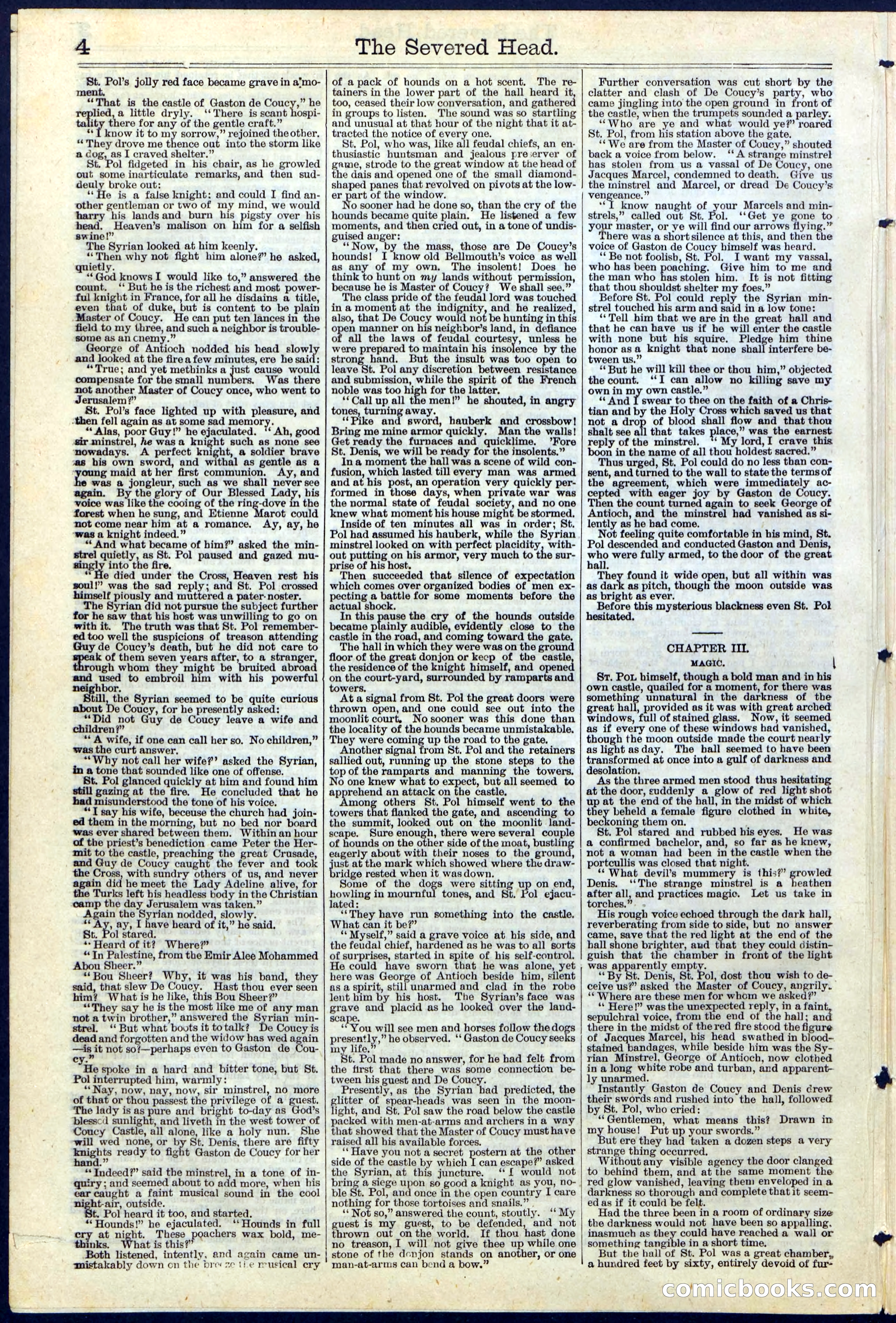
A restored page from Pulp Fiction, 1881. Page through the whole issue in the reader above.
📄 Transcribed text from this page (OCR, searchable)
Machine-transcribed from the original scan — historical spelling and the odd misread are preserved.
| | -then fell again as at some sad memor 4 St. Pol’s jolly red face became grave in a’mo- ment, “That is the castle of Gaston de Coucy,” he lied, a little dryly. ‘‘There is scant hospi- tality there for any of the gentle craft.” ** 1 know it to my sorrow,” rejoined the other. “They drove me thence out into the storm like a dog, as I craved shelter.” St. Pol fidgeted in his chair, as he growled out some inarticulate remarks, and then sud- deuly broke out: ‘‘He is a false knight: and could I find an- other gentleman or two of my mind, we would harry his lands and _ burn his pigsty over his head. Heaven’s malison on him for a selfish swine!” The Syrian looked at him keenly. ‘“‘Then why not fight him alone?’ he asked, quietly. ““God knows I would like to,” answered the count. ‘ But he is the richest and most power- ful knight in France, for all he disdains a title, even that of duke, but is content to be plain “Master of Coucy. ‘He can put ten lances in the field to my three, and such a neighbor is trouble- some as an cnemy.” George of Antioch nodded his head slowl and looked at the firea few minutes, ere he said: “True; and yet methinks a just cause would compensate for the small numbers. Was there not another Master of Coucy once, who went to Jerusalem?” St. Pol’s face lighted up with pleasure, and “Alas, poor Guy!” he ejaculated. vi Ah, good sir minstrel, he wasa knight such as none see mowadays. A perfect knight, a soldier brave as bis own sword, and withal as gentle as a young maid at her first communion. Ay, and was a jongleur, such as we shall never see By the glory of Our Blessed Lady, his voice was like the cooing of the ring-dove in the forest when he sung, and Etienne Marot could not come near him at a romance. Ay, ay, he was a knight indeed.” “And what became of him?’ asked the min- strel quietly, as St. Pol paused and gazed mu- singly into the fire. “He died under the Cross, Heaven rest his soul!” was the sad reply; and St. Pol crossed himself piously and muttered a pater- noster. The Syrian did not pursue the subject further for he saw that his host was unwilling to go on with it. The truth was that St. Pol remember- ed too well the suspicions of treason attending Guy de Coucy’s death, but he did not care to k of them seven years after, to a stranger ugh whom they might be bruited abroa and used to embroil him with his powerful neighbor. till, the Syrian seemed to be quite curious about De Coucy, for he presently asked: “Did on Guy de Coucy leave a wife and n ““ A wife, if one can call her so. No children,” was the curt answer, *“Why not call her wife?’ asked the Syrian, in a tone that sounded like one of offense. St. Pol glanced quickly at him and found him still gazing at the fire. He concluded that he had misunderstood the tone of his voice. “I say his wife, beceuse the church had join- ed them in the morning, but no bed nor board was ever shared between them. Within an hour of the priest’s benediction came Peter the Her- mit to the castle, preaching the great Crusade, _ and Guy de Coucy caught the fever and took the Cross, with sundry others of us, and never rg did he meet the Lady Adeline alive, for Turks left his headless body in the Christian camp the day Jerusalem was taken.” Again the Shabby: nodded, slowly. ** Ay, ay, I have heard of it,” he said, St. Pol stared. *» Heard of it? Where?” “Tn Palestine, from the Emir Alee Mohammed Abou Sheer.” “Bou Sheer? Why, it was his band, they said, that slew De Coucy. Hast thou ever seen him? What is he like, this Bou Sheer?’ “They say he is the most like me of any man not a twin brother,” answered the Syrian min- strel. ‘ But what bouts it to talk? Coucy is dead and forgotten and the widow has wed agein —is it not so/—perhaps even to Gaston de Cou- cy. He spoke in a hard and bitter tone, but St. Pol interrupted him, warmly: “Nay, now, nay, now, sir minstrel, no more of that or thou passest the privilege of a guest. The lady is as pure and bright to-day as God’s blesscd sunlight, and liveth in the west tower of Coucy Castle, all alone, like a holy nun. She will wed none, or by St. Denis, there are fifty knights ready to fight Gaston de Coucy for her “Indeed?” said the minstrel, in a tone of in- quiry ; and seemed about to add more, when his ear caught a faint musical sound in the cool ight-air, outside. t. Pol heard it too, and started. “Hounds!” he ejaculated. ‘Hounds in full cry at night. These poachers wax bold, me- thinks. hat is this?’ Both listened, intently, and again came un- mistakably down on the bre ze tie reusieal ery The Severed Head. of a pack of hounds on a hot scent. The re- tainers in the lower part of the hall heard it too, ceased their low conversation, and gathere in qroure to listen. The sound was so startling and unusual at that hour of the night that it at- tracted the notice of every one. St. Pol, who was, like all feudal chiefs, an en- thusiastic huntsman and jealous pre:erver of game, strode to the great window at the head of the dais and opened one of the small diamond- shaped panes that revolved on pivots at the low- er part of the window. o sooner had he done so, than the cry of the hounds became quite plain. He listened a few moments, and then cried out, in a tone of undis- guised anger: ‘‘ Now, by the mass, those are De Coucy’s hounds! I know old Bellmouth’s voice as well as any of my own. The insolent! Does he think to hunt on my lands without permission, because he is Master of Coucy? We shall see.” The class pride of the feudal lord was touched in a moment at the was and he realized, also, that De Coucy would not be hunting in this open manner on his neighbor’s land, in defiance of all the laws of feudal courtesy, unless he were prepared to maintain his insolence by the strong hand. But the insult was too open to leave St. Pol any discretion between resistance and submission, while the spirit of the French noble was too high for the latter. ‘*Call up all the men!” he shouted, in angry tones, turning away. ‘Pike and sword, hauberk and crossbow! Bring me mine armor quickly. Man the walls! Get ready the furnaces and quicklime. ’Fore St. Denis, we will be ready for the insolents,” In a moment the hall was a scene of wild con- fusion, which lasted till every man was armed and at his post, an operation very quickly per- formed in those days, when private war was the normal state of feudal society, and no one knew what moment his house might be stormed, Inside of ten minutes all was in order; St. Pol had assumed his hauberk, while the Syrian minstrel looked on with perfect placidity, with- out putting on his armor, very much to the sur- prise of his host. Then succeeded that silence of expectation which comes over organized bodies of men ex- pecting a battle for some moments before the actual shock. In this pause the cry of the hounds outside became plainly audible, evidently close to the castle in the road, and coming toward the gate. The hall in which they were was on the ground floor of the great donjon or keep of the castle the residence of the knight himself, and opened on the court-yard, surrounded by ramparts and towers. At a signal from St. Pol the great doors were thrown open, and one could see out into the moonlit court, Nosooner was this done than the locality of the hounds became unmistakable. They were coming up the road to the gate, Another signal from St. Pol and the retainers sallied out, running up the stone steps to the top of the ramparts and manning the towers. No one knew what to expect, but all seemed to apprehend an attack on the castle. mong others St. Pol himself went to the towers that flanked the gate, and ascending to the summit, looked out on the moonlit land- scape. Sure enough, there were several couple of hounds on the other side of the moat, bustlin eagerly about with their noses to the ground, just at the mark which showed where the draw- ridge rested when it was down. Some of the dogs were sitting up on end, barns in mournful tones, and St. Pol ejacu- ated: ‘‘They have run something into the castle. What can it be?’ ‘* Myself,” said a grave voice at his side, and the feudal chief, hardened as he was to all sorts of surprises, started in spite of his self-control. He could have sworn that he was alone, yet here was George of Antioch beside him, silent as a spirit, still unarmed and clad in the robe lent him by his host. The Syrian’s face was grave and placid as he looked over the land- scape. ‘*'You will see men and horses follow the dogs presently, he observed. ‘‘ Gaston de Coucy seeks my life, Bt. Pol made no answer, for he had felt from the first that there was some connection be- tween his guest and De Coucy. Presently, as the Syrian had predicted, the glitter of spear-heads was seen in the moon- light, and St, Pol saw the road below the castle packed with men-at-arms and archers ina way that showed that the Master of Coucy must have raised all his available forces. ‘‘Have you not a secret postern at the other side of the castle by chien can escape?” asked the Syrian, at this juncture. ‘“ {£ would not bring a siege upon so good a knight as you, no- | ble St. Pol, and once in the open country I care nothing for those tortoises and snails.” . ‘* Not so,” answered the count, stoutly. ‘‘ My uest is my guest, to be defended, and not thrown out onthe world. If thou hast done no treason, I will not give thee up while one stone of the denjon stands on another, or one man-at-arms can bend a bow.” . ? \ Further conversation was cut short by the clatter and clash of De Coucy’s party, who came jingling into the open ground in front of the castle, when the trumpets sounded a parley. “Who are ye and what would ye?” roared St. Pol, from his station above the gate. ‘* We are from the Master of Coucy,” shouted back a voice from below. ‘‘ A strange minstrel has stolen from us a vassal of De Coucy, one Jacques Marcel, condemned to death. Give us the minstrel and Marcel, or dread De Coucy’s vengeance.” ‘I know naught of your Marcels and min- strels,” called out St. Pol. ‘‘Get ye gone to ad master, or ve will find our arrows flying.” here was a shortsilence at this, and then the voice of Gaston de Coucy himse)f was heard. ‘* Be not foolish, St. Pol. I want my vassal who has been poncnss Give him to me and the man who has stolen him. It is not fitting that thou shouldst shelter my foes.” Before St. Pol could reply the Syrian min- strel touched his arm and said in a low tone: “Tell him that we are in the great hall and that he can have us if he will enter the castle with none but his squire. Pledge him thine honor asa knight that none shall interfere be- tween us,” ‘But he will kill thee or thou him,” objected the count. ‘I can allow no killing save my own in my own castle.” ‘‘ And I swear to thee on the faith of a Chris- tian and by the Holy Cross which saved us that not a drop of blood shall flow and that thou shalt see all that takes place,” was the earnest. reply of the minstrel. ‘“‘ My lord,I crave this boon in the name of all thou holdest sacred.” Thus urged, St. Pol could do no less than con- sent, and turned to the wall to state the terms of the agreement, which were immediately ac- cepted with eager joy by n de Coucy. Then the count turned again to seek George of Antioch, and the minstrel had vanished as si- lently as he had come. Not feeling quite comfortable in his mind, St. Pol descended and conducted Gaston and Denis hie were fully armed, to the door of the great all. They found it wide open, but all within was as dark as pitch, though the moon outside was as bright as ever. Before this mysterious blackness even St. Pol hesitated, CHAPTER IIL. MAGIC, | Sr. Pou himself, though a bold man and in his own castle, quailed for a moment, for there was pra, unnatural in the darkness of the great hall, provided as it was with great arched windows, full of stained glass. Now, it seemed as if every one of these windows had vanished, though the moon outside made the court nearly as light asday. The ball seemed to have been transformed at once into a gulf of darkness and desolation. As the three armed men stood thus hesitating at the door, suddenly a glow of red light shot up at the end of the hall, in the midst of which they beheld a female figure clothed in white, beckoning them on. St. Pol stared and rubbed his eyes. He was a confirmed bachelor, and, so far as he knew, not a woman had been in the castle when the portcullis was closed that night. ‘What devil’s mummery is this?’ growled Denis. ‘‘The strange minstrel is a heathen after all, and practices magic. Let us take in torches.” . His rough voice echoed through the dark hall, reverberating from side to side, but no answer came, save that the red light at the end of the hall shone brighter, aud that they could distin- guish that the chamber in front of the light was apparently empty. pty , “By St. Denis, St. Pol, dost thou wish to de- ceive us?” asked the Master of Coucy, angrily. ‘“Where are these men for whom we asked?” ‘‘ Here!” was the unexpected reply, in a fain sepulchral voice, from the end of the hall; an there in the midst of the red fire stood the figure of Jacques Marcel, his head swathed in blood- stained bandages, while beside him was the Sy- rian Minstrel, George of Antioch, now clothed in a long white robe and turban, and apparent- ly unarmed. Instantly Gaston de Coucy and Denis drew their swords and rushed into the hall, followed by St. Pol, who cried: ‘““Gentlemen, what means this? Drawn in my house! Put up your swords.” ut ere they had taken a dozen steps a very strange thing occurred. Without any visible agency the door clanged to behind them, and at the same moment the red glow vanished, leaving them enveloped in a darkness so thorough and complete that it seem- ed as if it could be felt. Had the three been in a room of ordinary size the darkness would not have been so appalling, inasmuch as they could have reached a wall or something tangible in a short time. But the hall of St. Pol was a great chamber, a hundred feet by sixty, entirely devoid of fur- Geom (0) Ebooks (c