
Pulp Fiction, 1881 · page 11 of 32
Beadle's New York Dime Library No. 115 — page 11: what you’re looking at
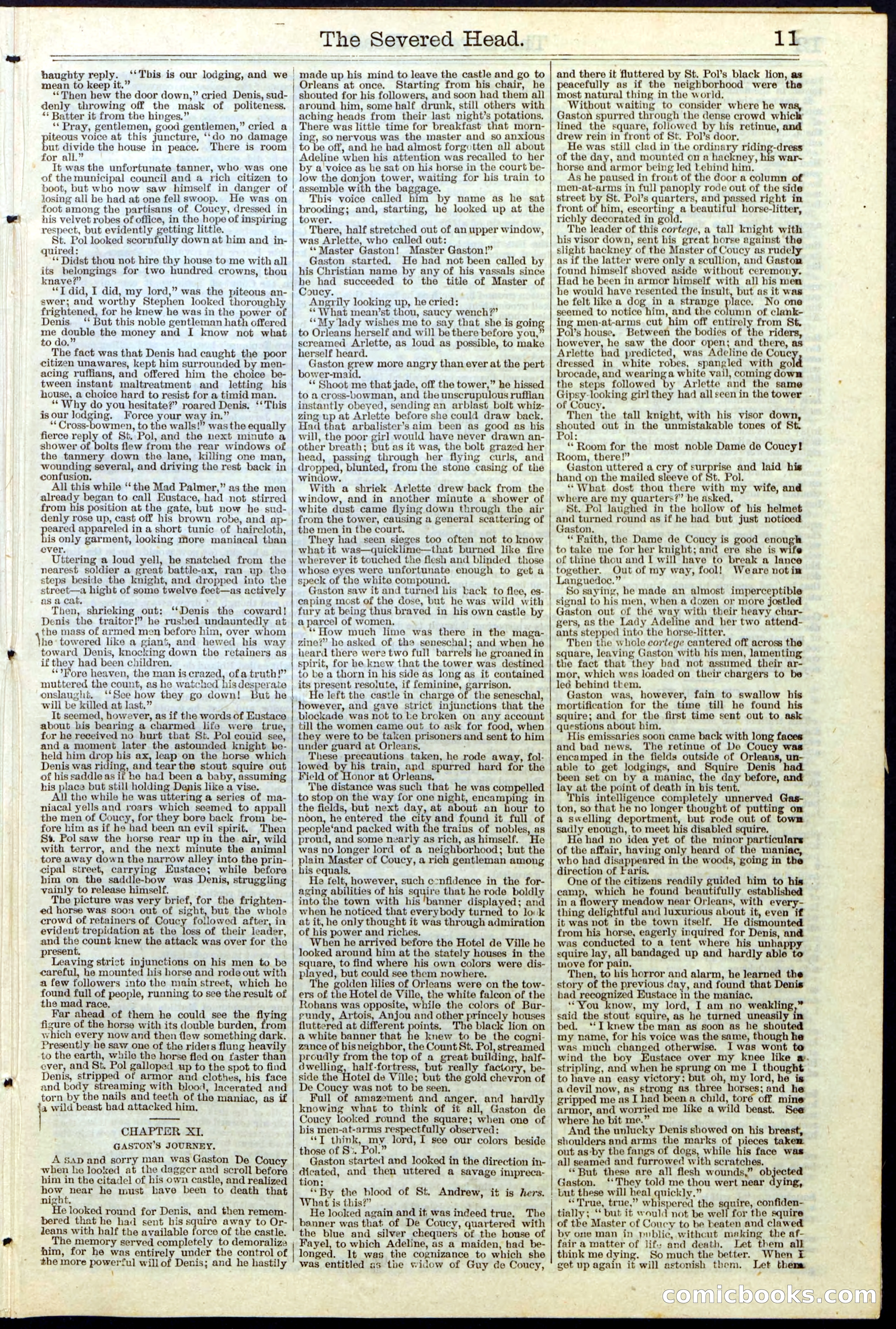
A restored page from Pulp Fiction, 1881. Page through the whole issue in the reader above.
📄 Transcribed text from this page (OCR, searchable)
Machine-transcribed from the original scan — historical spelling and the odd misread are preserved.
haughty reply. mean to keep it.” ‘“Then bhew the door down,” cried Denis, sud- denly throwing off the mask of politeness. ** Batter it from the hinges.” ‘* Pray, gentlemen, good gentlemen,” cried a yiteous voice at this juncture, ‘‘do no damage but divide the house in peace. There is room for all.” It was the unfortunate tanner, who was one of the municipal council and a rich citizen to boot, but who now saw himself in danger of losing all he had at one fell swoop. He was on foot among the partisans of Coucy, dressed in his velvet robes of office, in the hope of inspiring respect, but evidently getting little. St. Pol looked scornfully down at him and in- uired: arr Didst thou not hire thy house to me with all its belongings for two hundred crowns, thou knave?” ‘““T did, I did, my lord,” was the piteous an- swer; and worthy Stephen looked thoroughly frightened, for he knew he was in the power of Denis. ‘ But this noble gentleman hath offered me double the money and I know not what to do,” The fact was that Denis had caught the poor citizen unawares, kept him surrounded by men- acing ruffians, and offered him the choice be- tween instant maltreatment and letting his house, a choice hard to resist for a timid man. “Why do you hesitate?’ roared Denis. ‘‘ This isour lodging. Force your way in.” ‘* Cross-bowmen, to the walls!” was the equally fierce reply of St. Pol, and the next minute a shower of bolts flew from the rear windows of the tannery down the lane, killing one man, wounding several, and driving the rest back in confusion. All this while “‘ the Mad Palmer,” as the men already began to call Eustace, had not stirred from his position at the gate, but now he sud- denly rose up, cast off his brown robe, and ap- paler appareled in a short tunic of haircloth, is only garment, looking More maniacal than ever. Uttering a loud yell, he snatched from the nearest soldier a great battle-ax, ran up the steps beside the knight, and dropped into the street—a hight of some twelve feet—as actively as a cat. Then, shrieking out: ‘‘Denis the coward! Denis the traitor!” he rushed undauntedly at the mass of armed men before him, over whom he’ towered like a gian‘, and hewed his way toward Denis, knocking down the retainers as if they had been children. “Fore heaven, the man is crazed muttered the count, as he watched his desperate onslaught. ‘‘See how they go down! but he will be killed at last.” It seemed, however, as if the words of Eustace about his bearing a charmed life were true, for he received no hurt that St. Pol ecouid see, and a moment later the astounded knight be- held him drop his ax, leap on the horse which Denis was riding, and tear the stout squire out of his saddle as if he bad been a baby, assuming his place but still holding Denis like a vise. All the while he was uttering a series of ma- niacal yells and roars which seemed to appall the men of Coucy, for they bore back from be- fore him as if he had been an evil spirit. Then $+. Pol saw the horse rear up in the air, wild with terror, and the next minute the animal tore away down the narrow alley into the prin- cipal street, carrying Eustace; while before him on the saddle-bow was Denis, struggling vainly to release himself. The picture was very brief, for the frighten- ed horse was soon out of sight, but the whole crowd of retainers of Coucy followed after, in evident trepidation at the loss of their leader, and the count knew the attack was over for the present. Leaving strict injunctions on his men to be careful, he mounted his horse and rode out with a few followers into the main street, which he found full of people, running to see the result of the mad race, Far ahead of them he could see the flying figure of the horse with its double burden, from which every now and then flew something dark, Presently he saw one of the riders flung heavily to the earth, while the horse fled on faster than ever, and St. Pol galloped up to the spot to find Denis, stripped of armor and clothes, his face and body streaming with blood, lacerated and torn by the nails and teeth of the maniac, as if } wild beast bad attacked him, a ofa truth!” CHAPTER XI, GASTON’S JOURNEY. A Sap and sorry man was Gaston De Couc when he looked at the dagger and scroll before him in the citadel of his own castle, and realized how near he must bave been to death that nicht. He looked round for Denis, and then remem- bered that he had sent his squire away to Or- jeans with half the available force of the castle. _The memory served completely to demoralize him, for he was entirely under the control of the more powerful will of Denis; and he hastily \ ‘*Tbis is our lodging, and we | made up his mind to leave the castle and go to a Ne ee — EES ee OE a The. Baretod, Tene, Orleans at once. Starting from his chair, he shouted for his followers, and soon had them all _around him, some half drunk, still others with aching heads from their last night’s potations. There was little time for breakfast that morn- | ing, so nervous was the master and so anxious to be off, and he bad almost forgotten all about Adeline when his attention was recalled to her by a voice as he sat on his horse in the court be- low the donjon tower, waiting for his train to assemble with the baggage. This voice called him by name as he sat brooding; and, starting, he looked up at the tower. There, half stretched out of an upper window, was Arlette, who called out: ‘* Master Gaston! Master Gaston!” Gaston started. He had not been called by his Christian name by any of his vassals since he had succeeded to the title of Master of Coucy. Angrily looking up, he cried: “What mean’st thou, saucy wench?’ ‘*My lady wishes me to say that she is goin to Orleans herself and will be there before you, screamed Arlette, as loud as possible, to make herself heard. Gaston grew more angry than ever at the pert bower-maid. ** Shoot me that jade, off the tower,” he hissed to a cross-bowman, and the unscrupulous ruffian instantly obeyed, sending an arblast bolt whiz- zing up at Arlette before she could draw back. Had that arbalister’s aim been as good as his will, the poor girl would have never drawn an- other breath; but as it was, the bolt grazed her head, passing through her flying curls, and dropped, blunted, from the stone casing of the window. With a shriek Arlette drew back from the window, and in another minute a shower of white dust came flying down through the air from the tower, causing a general scattering of the men in the court. They had seen sieges too often not to know what it was—quicklime—that burned like fire wherever it touched the flesh and blinded those whose eyes were unfortunate enough to get a speck of the white compound. Gaston saw it and turned his back to flee, es- caping most of the dose, but he was wild with fury at being thus braved in his own castle by a parcel of women, ‘* How much lime was there in the maga- zine?” he asked of the seneschal; and mien he heard there were two full barrels he groaned in spirit, for he knew that the tower was destined to be a thorn in his side as long as it contained its present resolute, if feminine, garrison, He left the castle in charge of the seneschal, however, and gave strict injunctions that the blockade was not to be broken on any account till the women came out to ask for food, when they were to be taken prisoners and sent to him under guard at Orleans. These precautions taken, he rode away, fol- lowed by his train, and spurred hard for the Field of Honor at Orleans. The distance was such that he was compelled to stop on the way for one night, encamping in the fields, but next day, at about an hour to noon, he entered the city and found it full of people‘and packed with the trains of nobles, as proud, and some nvarly as rich, as himself. He was no longer lord of a neighborhood; but the plain Master of Coucy, a rich gentleman among his equals. He felt, however, such confidence in the for- aging abilities of his squire that he rode boldly into the town with his ‘banner displayed; and when he noticed that everybody trast to lovk at it, he only thought it was through admiration of his power and riches. When he arrived before the Hotel de Ville he looked around him at the stately houses in the square, to find where his own colors were dis- played, but could see them nowhere. he golden lilies of Orleans were on the tow- ers of the Hotel de Ville, the white falcon of the Rohans was opposite, while the colors of Bur- pundy, Artois, Anjou and other princely houses fluttered at different points. The black lion on a white banner that he knew to be the cogni- zance of bis neighbor, the Count St. Pol, streamed proudly from the top of a great building, balf- dwelling, half-fortress, but really factory, be- side the Hotel de Ville; but the gold chevron of De Coucy was not to be seen, Full of amazement and anger, and hardly knowing what to think of it all, Gaston de Coucy looked round the square; when one of bis men-at-arms respectfully observed: ‘‘T think, mv lord, I see our colors beside those of 85. Pol.” Gaston started and looked in the direction in- dicated, and then uttered a savage impreca- tion: **By the blood of St. Andrew, it is hers. What is this?” He looked again and it was indeed true. The banner was that of De Coucy, quartered with the blue and silver chequers of the house of Fayel, to which Adeline, as a maiden, bad be- longed. lt was the cognizance to which she was entitled as the widow of Guy de Coucy, ee 11 and there it fluttered by St. Pol’s black lion, as peacefully as if the neighborhood were the most natural thing in the world. Without waiting to consider where he was, Gaston spurred through the dense crowd which lined the square, followed by his retinue, and drew rein in front of St. Pol’s door, He was still clad in the ordinary riding-dress of the day, and mounted on a hackney, his war~ horse and armor being led Lebind him. As he paused in frout of the door a column of men-at-arms in full panoply rode out of the side street by St. Pol’s quarters, and passed right in front of him, escorting a beautiful horse-litter, richly decorated in gold. The leader of this cortege, a tall knight with his visor down, sent his great horse against the slight hackney of the Master of Coucy as rudely as if the latter were only a scullion, and Gaston found himself shoved aside without ceremony. Had he been in armor himself with all his men he would have resented the insult, but as it was he felt like a dog in a strange ace. No one seemed to notice him, and the column of clank- ing men-at-arms cut him off entirely from St. Pol’s house. Between the bodies of the riders, however, he saw the door open; and there, as Arlette bad predicted, was Adeline de Couc dressed in white robes, spangled with go brocade, and amet) Sa white vail, coming down the steps followed by Arlette and the same mm em eee Gipsy-looking girl they had allseen in the tower . of Coucy. Then the tall knight, with his visor down, ea out in the unmistakable tones of St. ol: ** Room for the most noble Dame de Coucy! Room, there!” Gaston uttered a cry of surprise and laid his hand on the mailed sleeve of St. Pol. “What dost thou there with my wife, and where are my quarters?” he asked. St. Pol laughed in the hollow of his helmet and turned round as if he had but just noticed Gaston. “Faith, the Dame de Coucy is good antes to take me for her knight; and ere she is wife of thine thou and | will have to break a lance together. Out of my way, fool! Weare notin Languedoc.” So saying, he made an almost imperceptible signal to his men, when a dozen or more jostled Gaston out of thé way with their heavy char- gers, as the Lady Adeline and her two attend- ants stepped into the horse-litter. Then the whole cortege cantered off across the square, leaving Gaston witb his men, lamenting the fact that they bad not assumed their ar- mor, which was loaded on their chargers to be led behind them. Gaston was, however, fain to swallow his mortification for the time till he found his squire; and for the first time sent out to ask questions about him. His emissaries soon came back with long faces and bad news, The retinue of De Coucy was encamped in the fields outside of Orleans, un- able to get lodgings, and Squire Denis had been set on by a maniac, the day before, and lav at the point of death in bis tent. is intelligence completely unnerved Gas- ton, so that he no longer thought of putting om a swelling deportment, but rode out of towm sadly enough, to meet his disabled squire. He had no idea yet of the minor particulars of the affair, having only heard of the maniac, who had disappeared in the woods, going in the direction of Faris. ! One of the citizens readily guided him to his . camp, which he found beautifully established in a flowery meadow near Orleans, with every- thing delightful and luxurious about it, even if it was not in the town itself. He dismounted from his horse, eagerly inquired for Denis, and was conducted to a tent where his unhappy squire lay, all bandaged up and hardly able to move for pain. Then, to his horror and alarm, he learned the story of the previous day, and found that Denis bad ae zed cig a ie maniac, 7 ‘You know, my lord, I am no weakling said the stout s = as he turned uneasily in bed. ‘‘I knew the man as soon as he shouted my name, for his voice was the same, though he was much changed otherwise. I was wont te wind the boy Eustace over my knee like a#. stripling, and when he sprung on me I thought to have an easy victory; but oh, my lord, he ig a devil now, as strong as three horses; and he gripped me as I had been a child, toré off mine armor, and worried me like a wild beast. See where he bit me.” : : And the unlucky Denis showed on his breast, shoulders and arms the marks of pieces takem out as-by the fangs of dogs, while his face was all seamed and furrowed with scratches. “But these are all flesh wounds,” objected Gaston. ‘‘ They told me thou wert near dying, | but these will heal quickly.” “True, trne,” whispered the squire, confiden- tially; ** but it would not be wall for the squire of the Master of Coucy to be beaten and clawed by one man in public, withcut making the af- fair a matter of lif. and death. Let them all think me dying. So much the better. When FE get up again it will astonish them. Let them - AMCELO OVC) (E(0) <S (E(@)