
Pulp Fiction, 1881 · page 10 of 32
Beadle's New York Dime Library No. 115 — page 10: what you’re looking at
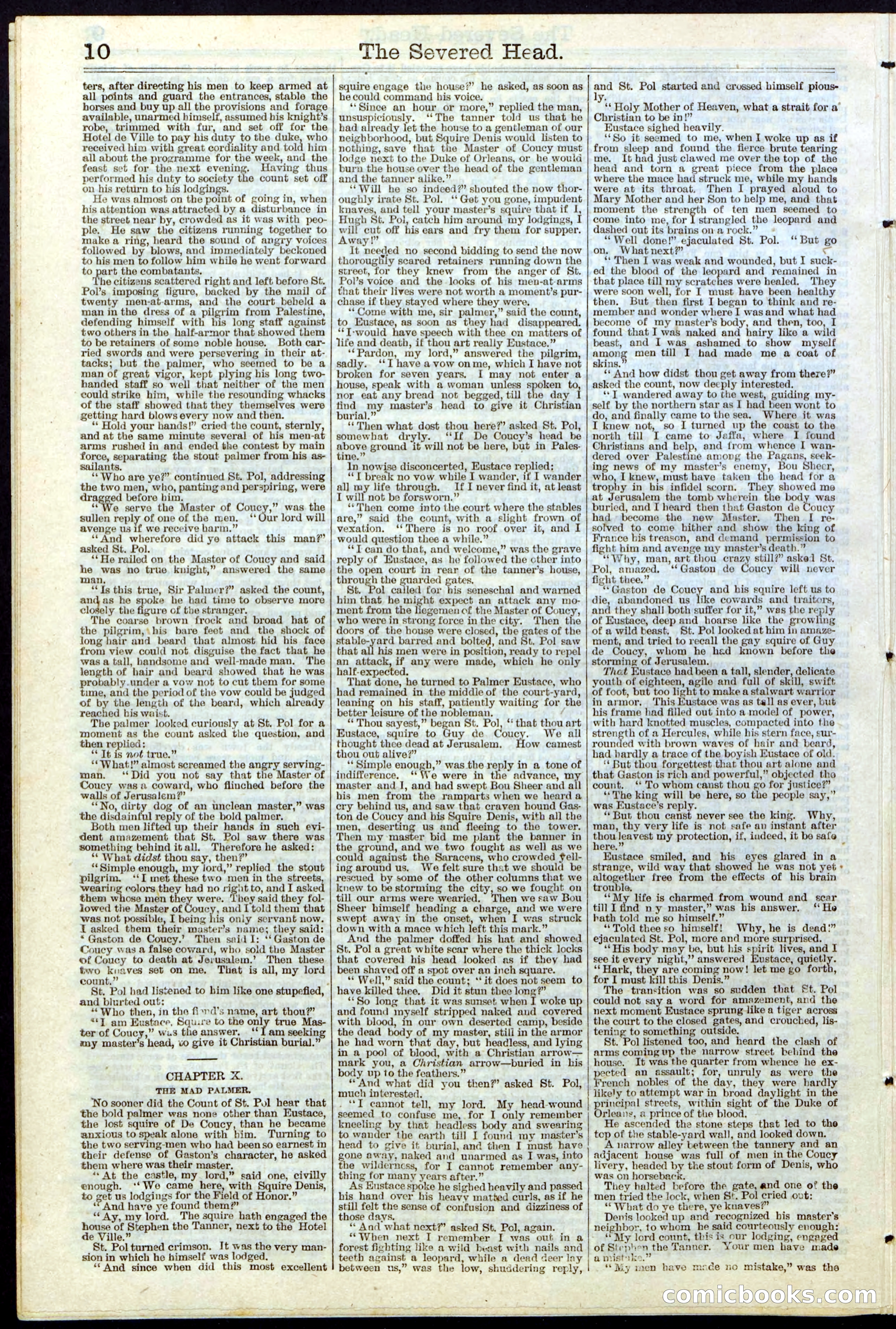
A restored page from Pulp Fiction, 1881. Page through the whole issue in the reader above.
📄 Transcribed text from this page (OCR, searchable)
Machine-transcribed from the original scan — historical spelling and the odd misread are preserved.
| | | : ee Se SS _—— —— ee a a : — 10 ters, after directing his men to keep armed at all points and guard the entrances, stable the horses and buy up all the provisions and forage available, unarmed himself, assumed bis knight’s robe, trimmed with fur, and set off for the Hotel de Ville to pay his duty to the duke, who received him with great cordiality and told him all about the programme for the week, and the feast set for the next evening. Having thus performed his duty to society the count set off on his return to his lodgings. He was almost on the point of going in, when his attention was attracted by a disturbance in the street near by, crowded as it was with peo- ple. He saw the citizens running together to make a ring, heard the sound of angry voices followed by blows, and immediately beckoned to his men to follow him while he went forward to part the combatants. The citizens scattered right and left before St. Pol’s imposing figure, backed by the mail of twenty men-at-arms, and the court beheld a man in the dress of a pilgrim from Palestine, defending himself with his long staff against two others in the half-armor that showed them to be retainers of some noble house. Both car- ried swords and were persevering in their at- tacks; but the palmer, who seemed to be a man of great vigor, kept plying his long two- handed staff so well that neither of the men eould strike him, while the resounding whacks of the staff showed that they themselves were getting hard blows every now and then. ** Hold your hands!” cried the count, sternly and at the same minute several of his men-at arms rushed in and ended the contest by main force, separating the stout palmer from his as- sailants. ‘* Who are ye?” continued St. Pol, addressing the two men, who, panting and perspiring, were dragged before him. ‘We serve the Master of Coucy,” was the sullen reply of one of the men, * Our lord will avenge us if we receive barm.” ‘‘And wherefore did ye attack this man?” asked St. Pol. ‘*He railed on the Master of Coucy and said he was no true knight,” answered the same man, ‘*Is this true, Sir Palmer?” asked the count, ong as he spoke he had time to observe more closely the figure of the stranger. The coarse brown frock and broad hat of the pilgrim,\his bare feet and the shock of long hair and beard that almost hid his face from view could not disguise the fact that he was a tall, handsome and well-made man. The length of hair and beard showed that he was probably.under a vow not to cut them for some time, and the period of the vow could be judged of by the length of the beard, which already reached bis waist. The palmer looked curiously at St. Pol for a moment as the count asked the question, and then replied: “Tt is not true.” “What!” almost screamed the angry serving- man. ‘Did you not say that the Master of Coucy was a coward, who flinched before the walls of Jerusalem?’ “No, dirty dog of an unclean master,” was the disdainful reply of the bold palmer. Both men lifted up their hands in such evi- dent amazement that St. Pol saw there was something behind itall. Therefore he asked: ** What didst thou say, then?’ “Simple enough, my lord,” replied the stout pilgrim. ‘‘I met these two men in the streets, wearing colors they had no right to, and I asked them whose men they were. ‘hey said they fol- lowed the Master of Coucy, and I told them that was not possible, I being his only servant now. L asked them their master’s name; they said: “Gaston de Coucy.’ Then said I: ‘Gaston de Coucy was a false coward, who sold the Master of Coucy to death at Jerusalem.’ Then these tero kuaves set on me, That is all, my lord count,” St. Pol had listened to him like one stupefied, and blurted out: “Who then, in the find’s name, art thou?” “7 am Eustace, Squire to the ny true Mas- ter of Coucy,” wis the answer. ‘‘l am seeking my master’s head, vo give it Christian burial.” CHAPTER X. THE MAD PALMER. ‘No sooner did the Count of St. Pol hear that the bold palmer was none other than Eustace, the lost squire of De Coucy, than he became anxious to speak alone with bim. Turning to the two serving-men who had beenso earnest in their defense of Gaston’s character, he asked them where was their master. ‘*At the castle, my lord,” said one, civilly enough. ‘‘We came here, with Squire Denis, to get us lodgings for the Field of Honor.” ‘° And have ye found them?’ “Ay, my lord. The squire hath engaged the house of Stephen the Tanner, next to the Hotel de Ville.” St. Pol turned crimson. It was the very man- sion in which he himself was lodged. ‘““And since when did this most excellent The Severed Flead. squire engage the house?’ he asked, as soon as he could command bis voice. ‘*Since an hour or more,” replied the man, a ei “The tanner told us that he had already let the house to a gentleman of our neighborhood, but Squire Denis would listen to nothing, save that the Master of Coucy must lodge next to the Duke of Orleans, or he would burn the house over the head of the gentleman and the tanner alike.” ‘* Will he so indeed?’ shouted the now thor- oughly irate St. Pol. ‘‘ Get you gone, impudent knaves, and tell your master’s squire that if 1, Hugh St. Pol, catch him around my lodgings, I will cut off his ears and fry them for supper. Away!” It needed no second bidding to send the now thoroughly scared retainers running down the street, for they knew from the anger of St. Pol’s voice and the looks of his men-at-arms that their lives were not worth a moment’s pur- chase if they stayed where they were. ‘**Come with me, sir palmer,” said the count, to Eustace, as soon as they had disappeared. ‘**[-would have speech with thee on matters of life and death, if thou art really Eustace.” ‘*Pardon, my lord,” answered the pilgrim, sadly. ‘‘I have a vow onme, which I have not broken for seven years. I may not enter a house, speak with a woman unless spoken to, nor eat any bread not begged, till the day I tind my master’s head to give it Christian burial.” ‘Then what dost thou here?’ asked St. Pol, somewhat dryly. ‘If De Coucy’s head be above ground it will not be here, but in Pales- tine.’ In nowise disconcerted, Eustace replied; ““T break no vow while I wander, if I wander al] my life through. If I never find it, at least I will not be forsworn.” ‘Then come into the court where the stables are,” said the count, with a slight frown of vexation. ‘There is no roof over it, and I would question thee a while.” “*T can do that, and welcome,” was the grave reply of Eustace, as he followed the other into the open court in rear of the tanner’s house, through the guarded gates, St. Pol cailed for his seneschal and warned him that he might expect an attack any mo- ment from the liegemen of the Master of Coucy, who were in strong force in the city. Then the doors of the house were closed, the gates of the stable-yard barred and bolted, and St. Pol saw that all his men were in position, ready to repel an attack, if any were made, which he only half-expected. That done, he turned to Palmer Eustace, who had remained in the middle of the court-yard, leaning on his staff, patiently waiting for the better leisure of the nobleman. “Thou sayest,” began St. Pol, ‘‘ that thou art Eustace, squire to Guy de Coucy. We all thought thee dead at Jerusalem. How camest thou out alive?’ ‘‘ Simple enough,” was the reply in a tone of indifference. ‘We were in the advance, my master and I, and had swept Bou Sheer and all bis men from the ramparts when we heard a cry behind us, and saw that craven hound Gas- ton de Coucy and his Squire Denis, with all the men, deserting us and fleeing to the tower. Then my master bid me plant the banner in the ground, and we two fought as well as we could against the Saracens, who crowded fell- ing around us. We felt sure that we should be rescued by some of the other columns that we knew to be storming the city, so we fought on till our arms were wearied. Then we saw Bou Sheer himself heading a charge, and we were swept away in the onset, when I was struck down with a mace which left this mark.” And the palmer doffed his hat and showed St. Pol a great white scar where the thick locks that covered his head looked as if they had been shaved off a spot over an inch square. ‘* Well,” said the count; *‘ it does not seem to have killed thee. Did it stun thee long?” ‘*So long that it was sunset when I woke up and found myself stripped naked and covered with blood, in our own deserted camp, beside the dead body of my master, still in the armor he had worn that day, but headless, and lying in a pool of blood, with a Christian arrow— mark you, a Christian arrow—buried in his body up to the feathers.” “And what did you then?’ asked St. Pol, much interested. . ‘I cannot tell, my lord. My head-wound seemed to confuse me, for I only remember kneeling by that headless body and swearing to wander the earth till I found my master’s head to give if burial, and then I must have gone away, naked and unarmed as I was, into the wilderncss, for I cannot remember any- thing for many years after.” As Eustace spoke he sighed heavily and passed his hand over his heayy matted curls, as if he still felt the sense of confusion and dizziness of those days. ‘** And what next?” asked St. Pol, again. “When next I remember I was out in a forest fighting like a wild beast with nails and teeth against a leopard, while a dead deer lay between us,” was the low, shuddering reply, — - anos. o - . - - — . -—-— es sig St. Pol started and crossed himself pious- ‘* Holy Mother of Heaven, what a strait for a’ Christian to be in!” Eustace sighed heavily. ‘*So it seemed to me, when I woke up as if from sleep and found the fierce brute tearing me. It had just clawed me over the top of the head and torn a great piece from the place where the mace had struck me, while my bands were at its throat. Then I prayed aloud to Mary Mother and her Son to help me, and that moment the strength of ten men seemed to come into me, for I strangled the leopard and dashed out its brains on a rock.” ‘Well done!” ejaculated St. Pol. ‘“ But go on. What next?” . ** Then I was weak and wounded, but I suck- ed the blood of the leopard and remained in that place till my scratches were healed. They were soon well, for I must have been healthy then. But then first I began to think and re- member and wonder where I was and what had become of my master’s body, and then, too, I found that I was naked and hairy like a wild beast, and I was ashamed to show myself among men till I had made me a coat of skins.” ‘* And how didst thou get away from there?” asked the count, now deeply interested. ‘*‘T wandered away to the west, guiding my- self by the northern star as I had been wont to do, and finally came to the sea. Where it was I knew not, so I turned up the coast to the north till I came to Jaffa, where I found Christians and help, and from whence I wan- dered over Palestine among the Pagans, seek- ing news of my master’s enemy, Bou Sheer, who, I knew, must have taken the head for a trophy in his infidel scorn. They showed me at Jerusalem the tomb wherein the body was buried, and I heard then that Gaston de Coucy had become the new Master. Then I re- solved to come hither and show the king of France bis treason, and demand permission to fight him and avenge my master’s death.” “Why, man, art thou crazy still?” asked St. Pol, amazed. ‘Gaston de Coucy will never fight thee.” **Gaston de Coucy and his squire left us to die, abandoned us like cowards and traitors, and they shall both suffer for it,” was the reply of Eustace, deep and hoarse like the growling of a wild beast, St. Pol looked at him in amaze- ment, and tried to recall the gay squire of Guy de Coucy, whom he hed known before the storming of Jerusalem. Thet Eustace had been a tall, slender, delicate youth of eighteen, agile and full of skill, swift of foot, but too light to make a stalwart warrior in armor, ‘This Eustace was as tall as ever, but his frame had filled out into a model of power, with hard knotted muscles, compacted into the strength of a Hercules, while his stern face, sur- rounded with brown waves of hair and beard, had bardly a trace of the boyish Eustace of old. ‘* But thou forgettest that thou art alone and that Gaston is rich and powerful,” objected tho count. ‘* To whom canst thou go for justice?” ‘*The king will be here, so the people say,” was Eustace’s reply. **But thou canst never see the king. Why, man, thy very life is not safe an instant after ee leavest my protection, if, indeed, it be safe ere, Eustace smiled, and his eyes glared in a strange, wild way that showed he was not yet + altogether free from the effects of his brain trouble, ‘*My life is charmed from wound and scar till I find ny master,” was his answer. ‘ He hath told me so himself.” ‘‘Told thee so himself! Why, he is dead’” ejaculated St. Pol, more and more surprised. ‘His body may be, but his spirit lives, and I see it every night,’’ answered Eustace, Nem & ‘Hark, they are coming now! let me go forth, for I must kill this Denis.” The transition was so sudden that ®t. Pol could not say a word for amazement, and the next moment Eustace sprung like a tiger across the court to the closed gates, and crouched, lis- tening to something outside. St. Pol listened too, and heard the clash of arms coming up the narrow street behind the house. It was the quarter from whence he ex- ‘eted an assault; for, unruly as were the ench nobles of the day, they were hardly likely to attempt war in broad daylight in the rincipal streets, within sight of the Duke of Silane. a prince of the blood. He ascended the stone steps that led to the top of the stable-yard wall, and looked down. A narrow alley between the tannery and an adjacent house was full of men in the Coucy livery, headed by the stout form of Denis, who was on horseback. They halted before the gate, and one of the men tried the lock, when St. Pol cried out: “What do ye there, ye knaves?” Denis looked up and recognized his master’s neighbor, to whom he said courteously enough: “My lord count, this is our lodging, engaged of Stephen the Tanner. Your men have made a niistike.” ‘‘My men have mode no mistake,” was the ” comicbooks com) my or - ‘ 2! ‘ <8