
Pulp Fiction, 1880 · page 3 of 32
Beadle's Dime Library No. 111 — page 3: what you’re looking at
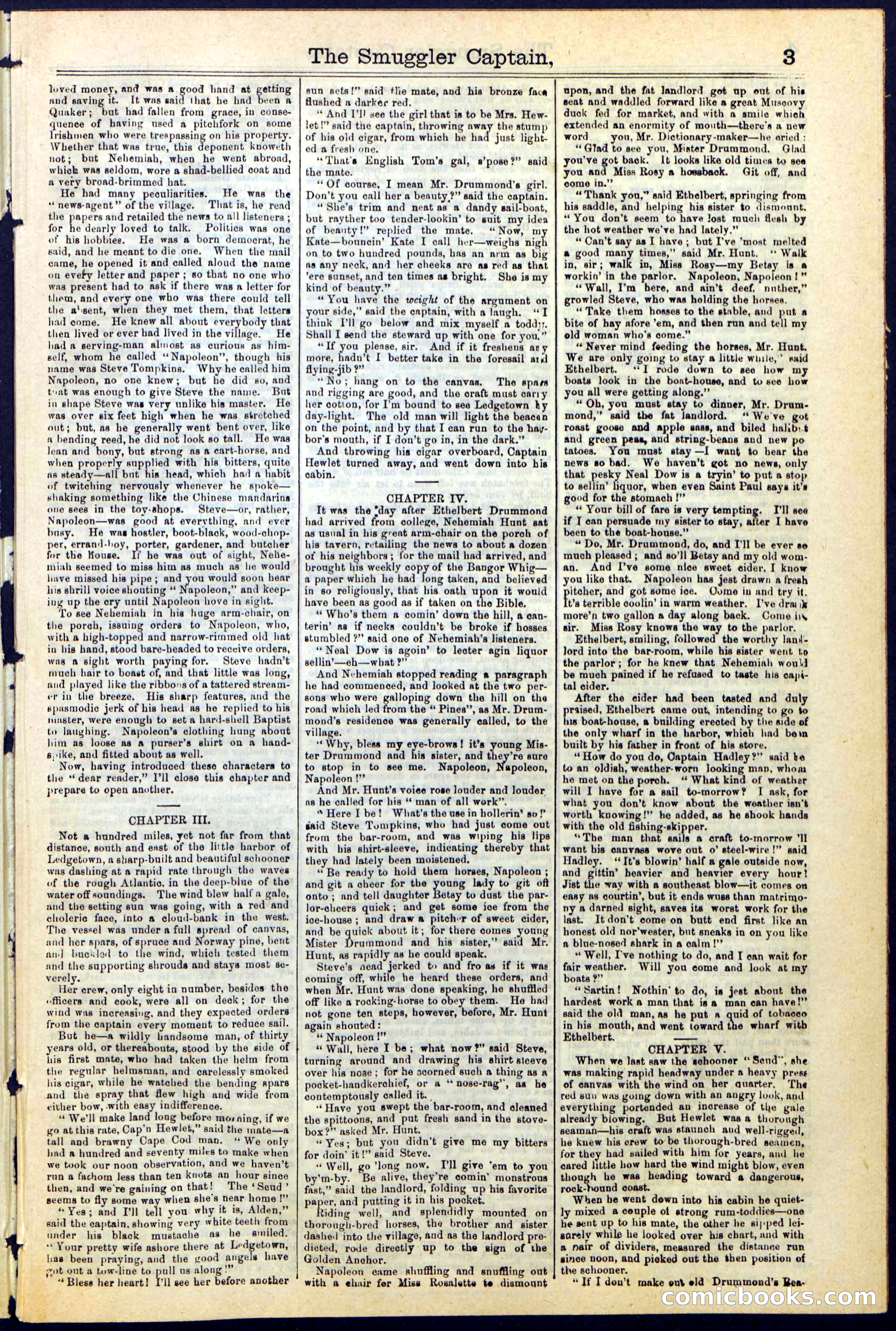
A restored page from Pulp Fiction, 1880. Page through the whole issue in the reader above.
📄 Transcribed text from this page (OCR, searchable)
Machine-transcribed from the original scan — historical spelling and the odd misread are preserved.
= loved money, and was a good hand at getting and saving it. It was said that he had been a Quaker; but had fallen from grace, in conse- quenee of having used a pitchfork on some lrishmen who were trespassing on his property. Whether that was true, this deponent knoweth not; but Nehemiah, when he went abroad, which was seldom, wore a shad-bellied coat and a very broad-brimmed hat. He had many peculiarities. He was the ‘‘news-agent”’ of the village. That is, he read the papers and retailed the news to all listeners ; for Fe dearly loved to talk. Politics was one of his hobbies. He was a born democrat, he said, and he meant to die one. When the mail came, he opened it and called aloud the name on eveFy letter and paper ; so that no one who was present had to ask if there was a letter for them, and every one who was there could tell the absent, when they met them, that letters had come. He knew all about everybody that then lived or ever had lived in the village. He had a serving-man altost as curious as him- self, whom he called “Napoleon”, though his name was Steve Tompkins. Why he called him Napoleon, no one knew; but he did so, and tat was enough to give Steve the name. But in shape Steve was very unlike his master. He was over six feet high when he was stretched out; but, as he generally went bent over, like a bending reed, he did not look so tall. He was lean and bony, but strong as a cart-horse, and when properly gt th with his bitters, quite as steady—all but his head, which had a habit of twitching nervously whenever he spoke— shaking something like the Chinese mandarins one gees in the toy-shops. Steve—or, rather, Napoleon—was good at everything, and ever busy. He was hostler, boot-black, wood-chop- per, erran(-hoy, porter, gardener, and butcher for the House. If he was out of sight, Nele- mish seemed to miss him as much as le would live missed his pipe; and you would soon hear his shrill voice shouting ** Napoleon,” and keep- ing up the ery until Napoleon hove in sight. To see Nehemiah in his huge arm-chair, on the porch, issuing orders to Napoleon, who, with a high-topped and narrow-rimmed old hat in his hand, stood bare-headed to receive orders, was a sight worth paying for. Steve hadn’t much hair to boast of, and that little was long, aud played like the ribbons of a tattered stream- erin the breeze. His sharp features, and the spasmodic jerk of his head as he replied to his muster, were enough to set a hard-shell Baptist to laughing. Napoleon’s clothing hung about him as loose as a purser’s shirt on a hand- 6ike, and fitted about as well. Now, having introduced these characters to the “dear reader,” I'll close this chapter and prepare to open another. CHAPTER III. Not a hundred miles, yet not far from that distance, south and enst of the little harbor of Ledgetown, a sharp-built and beautiful schooner was dashing at a rapid rate through the waves of the rough Atlantic, in the deep-blue of the water off soundings. The wind blew half a gale, and the setting sun was going, with a red and choleric face, into a cloud-bank in the west. The vessel was under a full spread of canvas, and her spars, of spruce and Norway pine, bent andl buekled to the wind, which tested them and the supporting shrouds and stays most se- verely, Her crew, only eight in number, besides the officers and cook, were all on deck; for the wind was increasing, and they expected orders from the captain every moment to reduce sail. But he—a wildly handsome man, of thirty years old, or thereabouts, stood by the side of his first mate, who had taken the helm from the regular helmsman, and carelessly smoked his cigar, while he watched the bending apars and the spray that flew high and wide from either bow, -with easy indifference. “ We'll make land long before mos ning, if we go at this rate, Cap'n Hewlet,” said the mate—a tall and brawny Cape Cod man. “ We only had a hundred and seventy miles to make when we took our noon observation, and we haven’t run a fachom Jess than ten knots an hour since then, and we're gaining on that! The ‘Send’ seems to fly some way when she's near home!” “Yes; and I'll tell you why it is, Alden,” said the captain, showing very white teeth from under his black mustache as he smiled. ‘Your pretty wife ashore there at poe ee has been praying, and the yood angels have vot out a tow-line to pull us along !” “Bless her heart! I’ll see her before another The Smuggler Captain, sun sets!” said tlie mate, and his bronze face flushed a darker red. “And I'l) see the girl that is to be Mrs. Hew- ‘et !” said the captain, throwing away the stump of his old cigar, from which he had just light- ed a fresh one. “That's Mnglish Tom’s gal, s’pose?” said the mate. ‘““Of course, I mean Mr. Drummond’s girl. Don’t you call her a beauty?” said the captain. “She’s trim and neat as a dandy sail-boat, but rayther too tender-lookin’ to suit my idea of beauty!” replied the mate. “Now, m Kate—bounein’ Kate I call her—weighs figh on to two hundred pounds, has an arm as big as any neck, and her cheeks are as red as that ‘ere sunset, and ten times as bright. She is my kind of beauty.” “You have the wetght of the argument on your side,” said the captain, with a laugh. “I think Dll go below and mix myself a todd). Shall I eend the steward up with one for you,” “If you please, sir. And if it freshens any more, hadn’t I better take in the foresail ard flying-jib ?” “No; hang on to the canvas. The spass and rigging are good, and the craft must cariy her cotion, for I’m bound to see Ledgetown hy day-light. The old man will light the beacan on the point, and by that I can run to the hay- bor’s mouth, if I don’t go in, in the dark.” And throwing his cigar overboard, Captain Hewlet turned away, and went down into his cabin. CHAPTER IV. It was the "day after Ethelbert Drummond had arrived from college, Nehemiah Hunt sat as usual in his great arm-chair on the porch of his tavern, retailing the news to about a dozen of his neighbors ; for the mail had arrived, and brought his weekly copy of the Bangor Whig— a paper which he bad long taken, and believed in so religiously, that his oath upon it would have been as good as if taken on the Bible. * Who’s them a comin’ down the hill, a ean- terin’ as if necks couldn’t be broke if hosses stumbled ?” said one of Nehemiah’s listeners. ‘Neal Dow is agoin’ to lecter agin liquor sellin’—eh—what ?”’ And Nehemiah stopped reading a paragraph he had commenced, and looked at the two per- sons who were galloping down the hill on the road which led from the “ Pines’, as Mr. Drum- mond’s residence was generally called, to the village. ‘Why, bless my eye-brows! it’s young Mis- ter Drummond and his sister, and they’re sure to stop in to see me. Napoleon, Mapoledt Napoleon !” And Mr. Hunt’s voiee rose louder and louder ns he called for his “ man of all work’’. * Here I be! What's the use in hollerin’ so!’ aid Steve Tumpkins, who had just come out from the bar-room, and was wiping his lips with his shirt-sleeve, indicating thereby that they had lately been moistened, “Be ready to hold them horses, Napoleon ; and git a cheer for the young lady to git off onto; and tell daughter Betay to dust the par- lor-cheers quick; and get some ice from the ice-house ; and draw a pitcher of sweet cider, and be quick about it; for there comes young Mister Drummond and his sister,” said Mr. Hunt, as rapidly as he could speak, Steve's nead jerked to and fro as if it was coming off, while he heard these orders, and when Mr. Hunt was done speaking, he shuffled off like a rocking-horse to obey them. He had not gone ten steps, however, before, Mr. Hunt again shouted : ** Napoleon !” “ Wall, here I be; what now?” said Steve, turning around and drawing his shirt sleeve over his nose; for he scorned such a thing as a pocket-handkerchief, or a ‘* nose-rag’’, as he contemptously called it. | ‘Have you swept the bar-room, and cleaned the spittoons, and put fresh sand in the stove- box?” asked Mr. Hunt. “Yes; but you didn’t give me my bitters for doin’ it!” said Steve. ; “Well, go long now. Pll give ‘em to you by’m-by. Be alive, they’re comin’ monstrous fast,” said the landlord, folding up his favorite paper, and putting it in his pocket. Riding well, and splendidly mounted on thorough-bred horses, the brother and sister dashed into the village, and as the landlord pre- dieted, rode directly up to the sign of the Golden Anchor. Napoleon eame shuffling and snuffling out with a ehair for Miss Rosalette te dismount =~ upon, and the fat landlord got up out of his seat and waddled forward like a great Muscovy duck fed for market, and with a smile whieh extended an enormity of mouth—there’s a new word _you, Mr. Dictionary-maker—he oried : “Glad to see you, Mister Drummond. Glad you've got back. It looks like old times to see you and Miss Rosy a hossback. come in.’’ “Thank you,” said Ethelbert, springing from his saddle, and helping his sister to dismonnt, “You don’t seem to have Jost much flesh by the hot weather we've had lately.” “ Can’t say as I have; but I've most melted a good many times,” said Mr. Hunt. ‘ Walk in, sir; walk in, Miss Rosy—my Betsy is a workin’ in the parlor. Napoleon, Nanolain ag “Wall, I’m here, and ain’t deef, nuther,” growled Steve, who was holding the horses. “Take them hoases to the stable, and put a bite of hay afore ’em, and then run and tel my old woman who's come.” ‘Never mind feeding the horses, Mr. Hunt. We are only going to stay a little while,” said Ethelbert. ‘‘I rode down to see how my boats look in the boat-house, and to see how you all were getting along.” “Oh, you must stay to dinner, Mr. Drum- mond,” said the fat landlord. “We've got roast goose and apple enss, and biled halib:.t and green peas, and string-beans and new po tatoes. You must stay —I want to bear the news so bad. We haven’t got no news, only that pesky Neal Dow is a tryin’ to put a stop to sellin’ liquor, when even Saint Paul says it’s good for the stomach !” “‘ Your bill of fare is very tempting. I'll see if T can persuade my sister to stay, r I have been to the boat-house.” | “Do, Mr. Drummond, do, and I'll be ever se much pleased ; and so’ll Betsy and my old wom- an. And I’ve some nice sweet cider, I know you like that. Napoleon has jest drawn a fresh itcher, and got some ice. Ovme in and try it. t’s terrible coolin’ in warm weather. I’ve drai ix more’n two gallon a day along back. Come ii, sir. Miss Rosy knows the way to the parlor. Ethelbert, smiling, followed the worthy lani- lord into the bar-room, while his sister went to the parlor; for he knew that Nehemiah would be much pained if he refused to taste his caji- tal cider. After the cider had been tasted and duly ibe oh Ethelbert came out, intending to go to 118 boat-house, a building erected by the side of the only wharf in the harbor, which had beim built by his father in front of his store. “How do you do, Oaptain Hadley?” said he to an oldish, weather-worn looking man, whom he met on the porch. “ What kind of weather will I have for a sail to-morrow? I ask, for what you don’t know about the weather isn’t worth knowing!” he added, as he shook hands with the old fishing-skipper. “The man that sails a craft to-morrow ‘Il want bis canvass wove out o’ steel-wire !” said Hadley. ‘It's blowin’ half a gale outside now, and gittin’ heavier and heavier every hour! Jist the way with a southeast blow—it comes on easy as courtin’, but it ends wuss than matrimo- ny a darned sight, saves its worst work for the last. It don’t come on butt end first like an honest old nor’wester, but sneaks in on you like a blue-nosed shark in a calm!” “ Well, I've nothing to do, and I oan wait for fair weather. Will you come and look at my boats ?” “Sartin! Nothin’ to do, is jest about the hardest work a man that isa man can have!” said the old man, as he put a quid of tobacco in his mouth, and went toward the wharf witb Ethelbert. ——re CHAPTER V. When we last saw the schooner “Send”, she was making rapid headway under a heavy press of canvas with the wind on her quarter. The red sun was going down with an angry look, and everything portended an increase of the gale already blowing. But Hewlet was a thorough seaman—his craft was staunch aud well-rigged, he knew his crew to be thorough-bred seamen, for they had sailed with him for years, and he cared little how hard the wind might blow, even though he was heading toward @ dangerous, rock-hound coast. When be went down into his cabin he quiet- ly mixed a couple of etrong rum-toddies—one he sent up to his mate, the other he sij ped lei- sarelv while he looked over his chart, and with a nair of dividers, measured the distance run since noon, and picked out the then position of the schooner. “If I don’t make out eld Drummond's Bea- Git off, and -Yeomichboo S) Cc °