
Pulp Fiction, 1880 · page 2 of 32
Beadle's Dime Library No. 111 — page 2: what you’re looking at
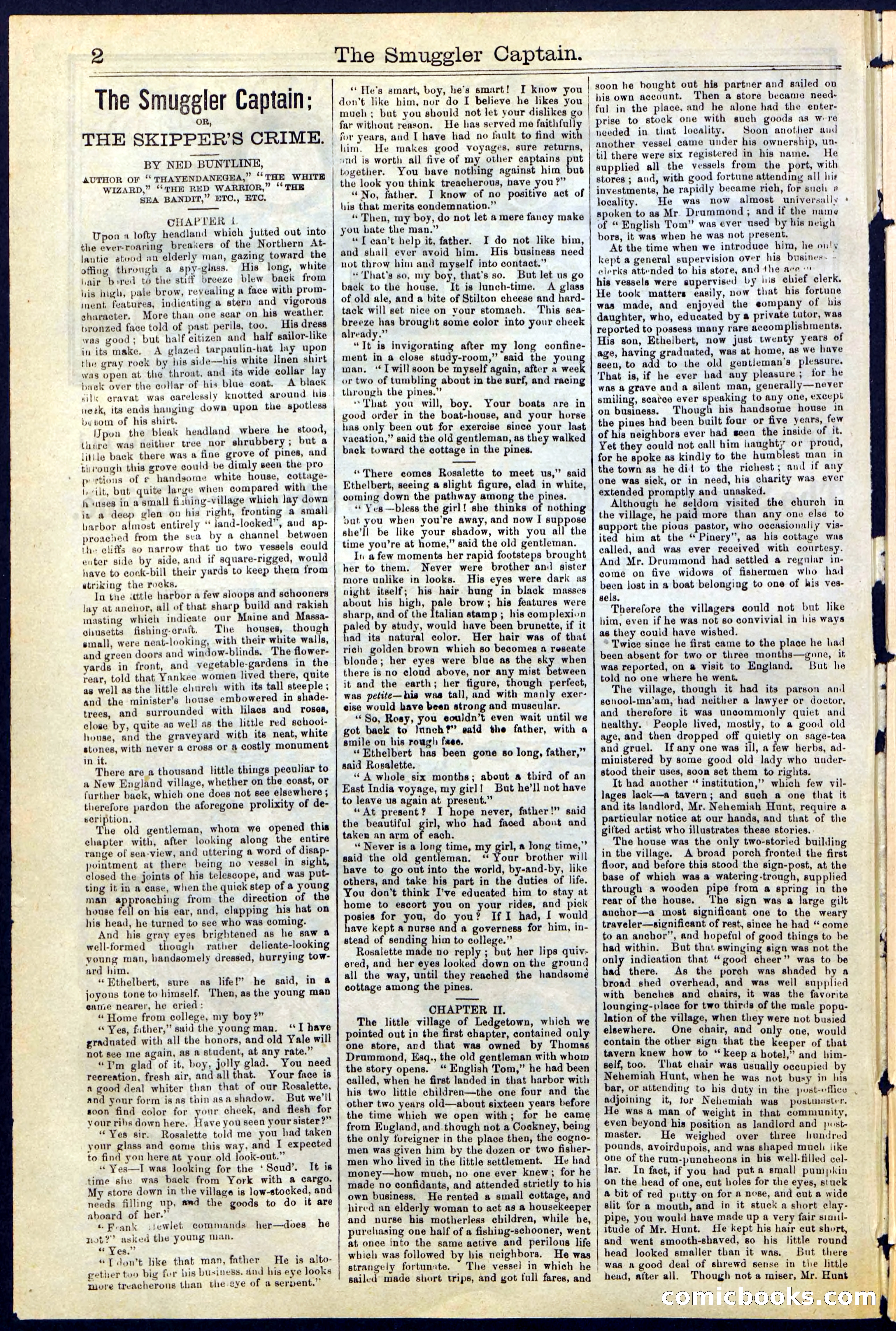
A restored page from Pulp Fiction, 1880. Page through the whole issue in the reader above.
📄 Transcribed text from this page (OCR, searchable)
Machine-transcribed from the original scan — historical spelling and the odd misread are preserved.
2 The Smuggler Captain. —— a neal The Smuggler Captain; THE SKIPPER’S CRIME. BY NED BUNTLINE, AUTHOR or “ THAYENDANEGEA,” “THE WHITE WIZARD,” “‘THE RED WARRIOR,” “ THE SEA BANDIT,” ETC., ETC, CHAPLTER | Upon « lofty headland which jutted out into the ever-roaring breakers of the Northern At- lantie atvod an elderly man, gazing toward the offing through a spy-glass. His long, white Lair bored to the stiff breeze blew back from his high, pale brow, revealing a face with prom- inent features, indicating a stern and vigorous sharacter. More than one sear on his weather, bronzed face told of past perils, too. His dress was good; but half citizen and half sailor-like in its make. A glazed tarpaulin-hat lay upon the gray rock by his side-—his white linen shirt was open at the throat, and its wide collar lay buek over the eollar of his blue coat. A black cil eravat was carelessly knotted around his neek, its ends hanging down upon the spotless buiom of his shirt. Spon the bleak headland where he stood, there was neither tree nor shrubbery ; but a litlle back there was a fine grove of pines, and thivough this grove could be dimly seen the pro portions of ¢ handsome white house, cottage- i ilt, but quite large when compared with the ruses in a small fishing-village which lay down in a deep glen on his right, fronting a small harbor almost entirely ‘ land-locked”, and ap- proached from the sea by a channel between the eliffs so narrow that uo two vessels could enter side by side, and if square-rigged, would have to eock-bill their yards to keep them from striking the rocks. In the ttle harbor a few mh and schooners lay at anchor, all of that sharp build and rakish masting which indicate our Maine and Massa- ohusetts fishing-craft. The houses, though small, were neat-looking, with their white walls, and green doors and window-blinds. The flower- yards in front, and vegetable-gardens in the rear, told that Yankee women lived there, quite ag well as the little church with its tall steeple ; and the minister’s house embowered in shade- trees, and surrounded with lilacs and roses, close by, quite as well a6 the little red school- house, and the graveyard with ita neat, white stones, with never a cross or 4 costly monument in it, There are a thousand little things peculiar to a New England village, whether on the coast, or further back, which one does not see elsewhere ; therefore pardon the aforegone prolixity of de- scription. The old gentleman, whom we opened this chapter with, after looking along the entire range of sea-view, and uttering a word of disap- pointment at there being no vessel in sight, closed the joints of his telescope, and was put- ting it in a case, when the quick step of a young man approach from the direction of the house fell on his ear, and, clapping his hat on his head, he turned to see who was coming. And his gray eyes brightened as he saw a well-formed though rather delicate-looking young man, handsomely dressed, hurrying tow- ard him. “Ethelbert, sure as life!’ he said, in @ joyous tone to himeelf, Then, as the young man eame nearer, he cried: “ Home from college, my boy 9” “ Yes, futher,” suid the young man. “ I have graduated with all the honors, and old Yale will not see me again, as a student, at any rate.” “Tm glad of it, boy, jolly glad. You need reereation, fresh air, and all that. Your face is a good deal whiter than that of our Rosalette, and your form is as thin asa shadow. But we'll soon find color for your cheek, and flesh for your ribs down here. Have you seen your sister?” “Yes sir. Rosalette told me you had taken your glass and come this way, and I expected to find you here at your old look-out.” “ Yes—I was looking for the ‘Scud’. It is time she was back from York with a cargo. My store down in the village is low-stocked, and needs filling up, amd the goods to do it are aboard of her.” © Beank .tewlef commands her—does he not?” asked the young man, “ Yes.” “T don't like that man, father He is alto- gether too big for his business. and his eye Jooks more treacherons than the eye of a serpent.” “Ethelbert has been gone so long, father,” said Rosalette. ‘A whole six months; about a third of an “ He's smart, boy, he’s smart! I know you don't like him, nor do I believe he likes you much; bat you should not let your dislikes go far without reason. He has served me faithful for years, and I have had no fault to find with him. He makes good voyages, sure returns, vnd is worth all five of my other captains put together. You bave nothing against him but the look you think treacherous, have you?” ‘‘No, father. I know of no positive act of lis that merits condemnation.” “ Then, my boy, do not let a mere fancy make you bate the man.” “I can’t help it, father. and shall ever avoid him. I do not like him, His business need not throw him and myself into contact.” “That's so, my boy, that’s so. But let us go back to the house. It is lunch-time. A glass of old ale, and a bite of Stilton cheese and hard- tack will set nice on vour stomach. This sea- breeze has brought some color into your cheek already.” “It is invigorating after my long confine- ment in a close study-room,” said the youn man, ‘* T willsoon be myself again, after » wee or two of tumbling about in the surf, and racing through the pines.” That you will, boy. Your boats are in good order in the boat-house, and your horse has only been out for exercise since your last vacation,” said the old gentleman, as they walked back toward the cottage in the pines. “There eomes Rosalette to meet us,” said Ethelbert, seeing a slight figure, clad in white, coming down the pathway among the pines. ‘“ Yvs —bless the girl! she thinks of nothing bat you when you're away, and now I suppose she'll be like your shadow, with you all the time you’re at home,” said the old gentleman. In a few moments her rapid footsteps brought her to them. Never were brother an sister more unlike in looks. His eyes were dark as night itself; his hair hung in black masses about his high, pale brow; his features were sharp, and of the Italian stamp ; his complexivn aled by study, would have been brunette, if it ad its natural color. Her hair was of that rich golden brown which so becomes a reseate blonde; her eyes were blue as the sky when there is no cloud above, nor any mist between it and the earth; her figure, though perfect, was petite—his was tall, and with manly exer- cise would bave been strong and muscular. ‘So, Rosy, you eouldn’t even wait until we got back to Innch?” eaid the father, with a smile on his rough faee. East India voyage, my gir]! But he’ll not have to leave us again at present.” “At present? I hope never, father!” said the beautiful girl, who had faced abont and taken an arm of each. “ Never is a long time, my girl, a long time,” said the old gentleman. ‘ Your brother will have to go out into the world, by-and-by, like others, and take his part in the duties of life. You don’t think I've educated him to stny at home to escort you on your rides, and pick osies for you, do you? If I had, I would ave kept a nurse bad governess for him, in- stead of sending him to college.” Rosalette made no reply ; but her lips quiv- ered, and her eyes looked down on the ground all the way, until they reached the handsome cottage among the pines. CHAPTER II. The little village of Ledgetown, which we pointed out in the first chapter, contained only one store, and that was owned by Thomas Drummond, Esq., the old gentleman with whom the story opens. ‘ English Tom,” he had been called, when he firat landed in that harbor with his two little children—the one four and the other two years old—about sixteen years before the time which we open with; for he came from England, and though not a Cockney, being the only foreigner in the place then, the cogno- men was Reve him by the dozen or two fisher- men who lived in the little settlement. He had money—how much, no one ever knew; for he made no confidants, and attended strictly to his own business. He rented a small cottage, and hired an elderly woman to act as @ housekeeper and nurse his motherless children, while he, purchasing one half of a fishing-schooner, went at once into the same active and perilous life which was followed by his neighbors. He was strangely fortunate. The vessel in which he sailed made short trips, and got full fares, and | soon he hought out his partner and sailed on his own account. Then a store became need- ful in the place, and he alone had the enter- prise to stock one with such goods as were needed in that locality. Soon another aud another vessel came under his ownership, un. til there were six registered in his name. He supplied all the vessels from the port, with stores ; and, with good fortune attending all his investments, he rapidly became rich, for such » locality. He was now almost universally spoken to as Mr. Drummond; and if the name of “ English Tom” was ever used by his neigh bors, it was whep he was nol eae At the time when we introduce him, he on!y kept a general supervision over his busines. - clerks attended to his store, and the ace « his vessels were supervised by iis cbief clerk. He took matters easily, now that his fortune was made, and enjoyed the eompany of his daughter, who, educated by a private tutor, was reported to possess many rare accomplishments. His son, Ethelbert, now just twenty years of age, having graduated, was at home, as we have seen, to aia to the old gentleman's pleasure. That is, if he ever bad auy pleasure ; for he was a grave and a silent man, generally—never smiling, scatee ever speaking to any one, except on business. Though bis handsome house in the pines had been built four or five years, few of his neighbors ever had seen the inside of it. Yet they could not call him haughty or proud, for he spoke as kindly to the humblest man in the town as he did to the richest; and if any one was sick, or in need, his charity was ever extended promptly and unasked. Although he seldom visited the ehurch in the village, he paid more than any one else to support the pious pastor, who occasionally vis- ited him at the “ Pinery”, as his cottage was called, and was ever received with courtesy. And Mr. Drummond had settled a regular in- come on five widows of fishermen who had been lost in a boat belonging to one of his ves- sels. Therefore the villagers could not but like him, even if he was not so convivial in his ways as they could have wished. Twice since he first came to the place he lad been absent for two or three months—gone, it was reported, on @ visit to England. But he told no one where he went. The village, though it had its parson and schiool-ma’am, had neither a lawyer or doctor, and therefore it was uncommonly quiet and healthy. | People lived, mostly, to a good old aye, and then dropped off quietly on sage-tea and gruel. If any one was ill, a few herbs, ad- ministered by some good old lady who under- stood their uses, soon set them to rights. It had another “ institution,’ which few vil- lages lack—a tavern; and such a one that it and its landlord, Mr. Nehemiah Hunt, require a particular notice at our hands, and that of the gifted artist who illustrates these stories. . The house was the only two-storied building in the village. A broad porch fronted the first floor, and before this stood the sign-post, at the base of which was a watering-trough, supplied through a wooden pipe from a spring in the rear of the house. ‘The sign was a large gilt anchor—a most significant one to the weary traveler—significant of rest, since he had “ come to an anchor’, and hopeful of good things to be had within. But that. swinging sign was not the only indication that “good cheer” was to be had there. As the porch was shaded by a broad shed overhead, and was well supplied with benches and chairs, it was the favorite lounging-place for two thirds of the male popu- lation of the village, when they were not busied elsewhere. One chair, and only one, would contain the other sign that the keeper of that tavern knew how to “ keep a hotel,” and him- self, too. ‘That chair was usually occupied by Nehemiah Hunt, when he was not busy in his bar, or attending to his duty in the post-vflice adjoining it, tor Nehemiah was postmaster. He was a man of weight in that community, even beyond his position as landlord and pust- master. He weighed over three hundred pounds, avoirdupois, and was shaped muel: like one of the rum-puncheons in his well-filled cel- lar. In fact, if you had puta small pumpkin on the head of one, cut holes for the eyes, s!uck a bit of red putty on for a nese, and cut a wide slit for a mouth, and in it stuck a short clay- pipe, you would have made up a very fair simil- itude of Mr. Hunt. He kept his hair cut short, and went smooth-shaved, so his little round head looked smaller than it was. but there was n good denl of shrewd sense in the little head, after all. mie Though not a miser, Mr. Runt e+ “EO 900 —— ee oe 7 pra, 3 sai