
Pulp Fiction, 1884 · page 6 of 100
Beadle's New Dime Novels: The Specter Chief — page 6: what you’re looking at
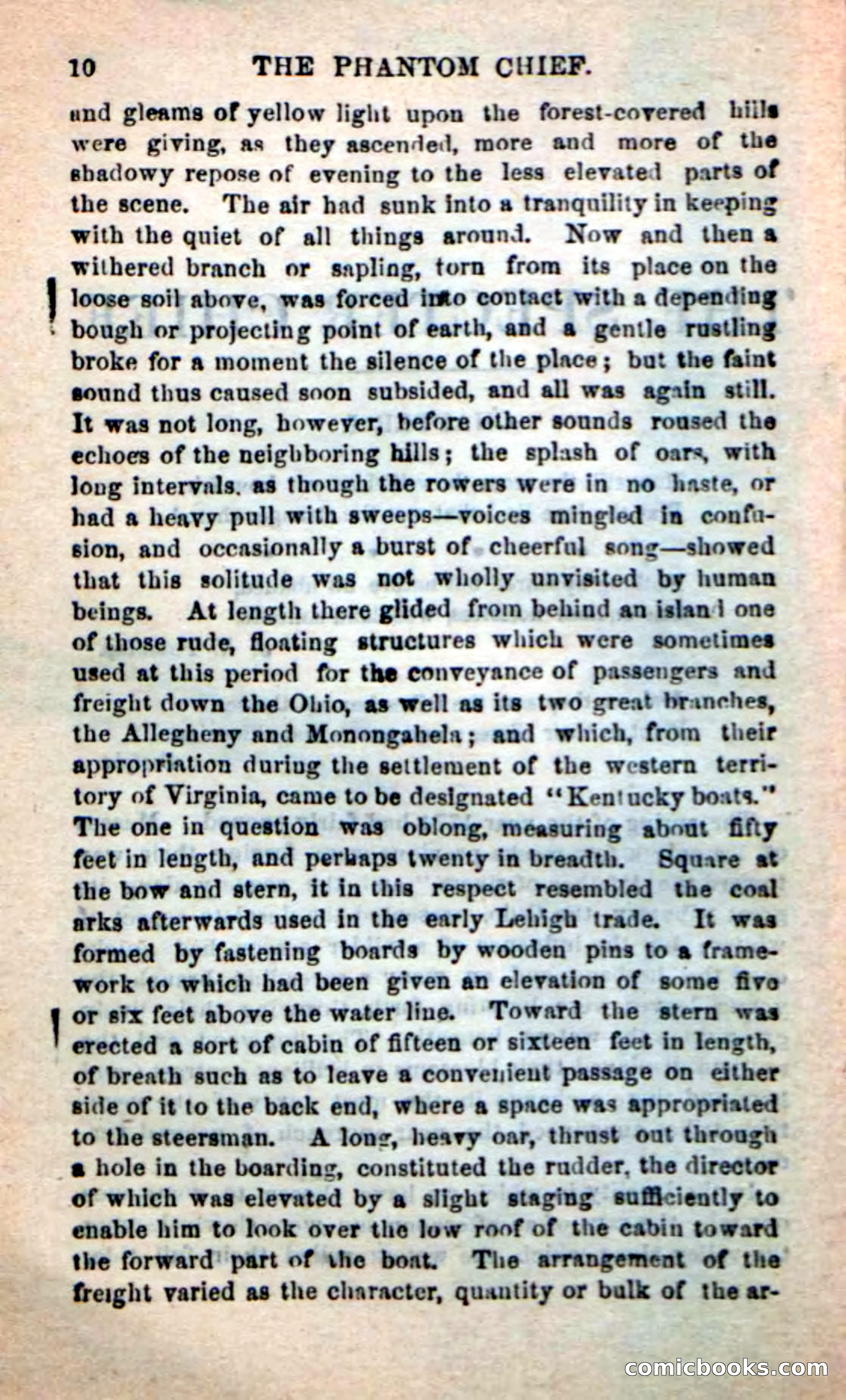
A restored page from Pulp Fiction, 1884. Page through the whole issue in the reader above.
📄 Transcribed text from this page (OCR, searchable)
Machine-transcribed from the original scan — historical spelling and the odd misread are preserved.
. a 10 THE PHANTOM CHIEF. and gleams of yellow light upon the forest-coyered hiils were giving, as they ascended, more and more of the shadowy repose of evening to the less elevated parts of the scene. The air had sunk into a tranquility in keeping with the quiet of all things around. Now and thena withered branch or sapling, torn from its place on the loose soil above, was forced imo contact with a depending bough or projecting point of earth, and a gentle rustling broke for a moment the silence of the place; but the faint sound thus caused soon subsided, and all was again still. It was not long, howeyer, before other sounds roused the echoes of the neighboring hills; the splash of oars, with long intervals, as though the rowers were in no haste, or had a heavy pull with sweeps—voices mingled in confa- sion, and occasionally a burst of. cheerful song—showed that this solitude was not wholly unvisited by human beings. At length there glided from behind an islan one of those rude, floating structures which were sometimes used at this period for the conveyance of passengers and freight down the Ohio, as well as its two great branches, the Allegheny and Monongahela; and which, from their appropriation duriug the settlement of the western terri- tory of Virginia, came to be designated ‘‘ Kentucky boats.” The one in question was oblong, measuring about fifty feet in length, and perkaps twenty in breadth. Square at the bow and stern, it in this respect resembled the coal atks afterwards used in the early Lehigh trade. It was formed by fastening boards by wooden pins to a frame- work to which had been given an elevation of some five or six feet above the water line. ‘Toward the stern was erected a sort of cabin of fifteen or sixteen feet in length, of breath such as to leave a convenient passage on either side of it to the back end, where a space was appropriated to the steersman. A long, heavy oar, thrast out through _@ hole in the boarding, constituted the rudder, the director of which was elevated by a slight staging sufficiently to enable him to look over the low roof of the cabin toward the forward’ part of the boat. The arrangement of the freight varied as the character, quantity or bulk of the ar- comicbooks.com a