
Pulp Fiction, 1896 · page 3 of 16
Beadle's Half Dime Library No. 971 — page 3: what you’re looking at
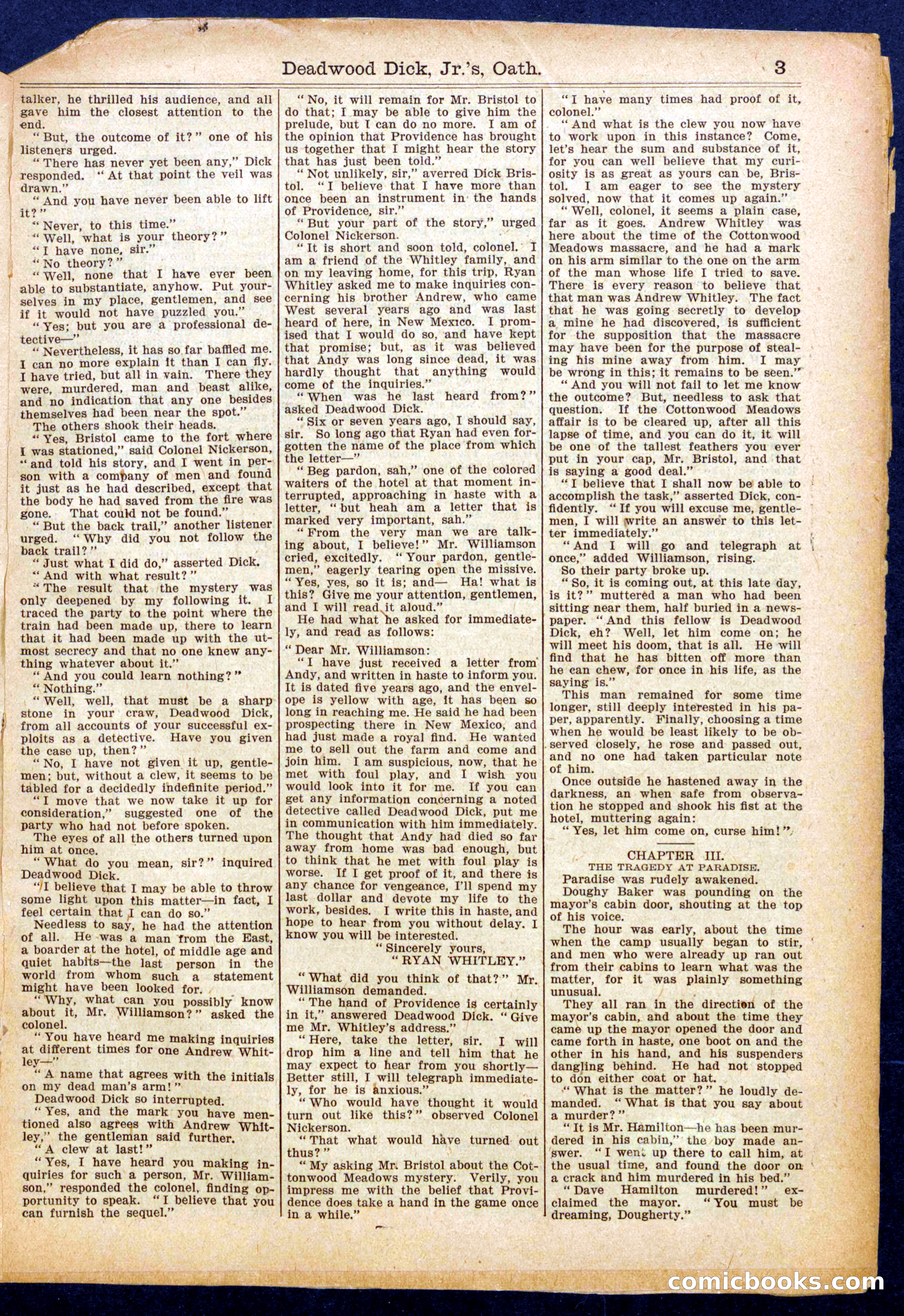
A restored page from Pulp Fiction, 1896. Page through the whole issue in the reader above.
📄 Transcribed text from this page (OCR, searchable)
Machine-transcribed from the original scan — historical spelling and the odd misread are preserved.
a . talker, he thrilled his audience, and all en him the closest attention to the end. “But, the outcome of it?” one of his listeners urged. “There has never yet been any,” Dick responded. ‘ At that point the veil was drawn.” “ And you have never been able to lift “Never, to this time.” “Well, what is your theory?” ‘“‘T have none, sir.” “No theory?” : “Well, none that I have ever been able to substantiate, anyhow. Put your- gelves in my place, gentlemen, and see if it would not have puzzled you.” “Yes: but you are a professional de- tective—” ‘‘ Nevertheless, it has so far baffled me. I can no more explain it than I can fly. I have tried, but all in vain. There they were, murdered, man and beast alike, and no indication that any one besides themselves had been near the spot.” The others shook their heads. | “Yes, Bristol came to the fort where i was stationed,” said Colonel Nickerson, *‘and told his story, and I went in per- ‘gon with a company of men and found - it just as he had described, except that _ the body he had saved from the fire was gone. That could not be found.” “But the back trail,’ another listener urged. “Why did you not follow the back trail? ”’ “ Just what I did do,” asserted Dick. “And with what result?” “The result that the mystery was only deepened by my following it. I traced the party to the point where the train had been made up, there to learn that it had been made up with the ut- most secrecy and that no one knew any- thing whatever about it.” “And you could learn nothing?” “ Nothing.” “Well, well, that must be a sharp stone in your craw, Deadwood Dick, from all accounts of your successful ex- ploits as a detective. Have you given the case up, then?” “No, I have not given it up, gentle- men; but, without a clew, it seems to be tabled for a decidedly indefinite period.” “I move that we now take it up for consideration,” suggested one of the party who had not before spoken. The eyes of all the others turned upon him at once. “What do you mean, sir?” inquired Deadwood Dick. ‘/T believe that I may be able to throw some light upon this matter—in fact, I feel certain that I can do so.” : Needless to say, he had the attention of all. He-was a man from the East, a boarder at the hotel, of middle age and quiet habits—the last person in the world from whom such a_ statement might have been looked for. . “Why, what can you possibly know about it, Mr, Williamson?” asked the | — colonel. jes “You have heard me making inquiries at different times for one Andrew Whit- - ley—” “A name that agrees with the initials on my dead man’s arm!” Deadwood Dick so interrupted. “Yes, and the mark you have men- tioned also agrees with Andrew Whit- ley,’ the gentleman said further. “A clew at last!” “Yes, I have heard you making in- quiries for such a person, Mr. William- son,” responded the colonel, finding op- portunity to speak. “I believe that you can furnish the sequel.” — —— —_ 2 : — = ot « : =a ot hee Es," wie 3 .* 2 ok 3 4 ‘ ae ph _ ~ at 2 * . -\. — . — Deadwood Dick, Jr.’s, Oath. “No, it will remain for Mr. Bristol to do that; I may be able to give him the prelude, but [ can do no more. I am of the opinion that Providence has brought us together that I might hear the story that has just been told.” “ Not unlikely, sir,” averred Dick Bris- tol. “I believe that I have more than once been an instrument in’ the hands of Providence, sir.” “But your part of the story,” Colonel Nickerson. “Tt is short and soon told, colonel.’ I am a friend of the Whitley family, and on my leaving home, for this trip, Ryan Whitley asked me to make inquiries con- cerning his brother Andrew, who came West several years ago and was last heard of here, in New Mexico. I prom- ised that I would do so, and have kept that promise; but, as it was believed that Andy was long since dead, it was hardly thought that anything would come of the inquiries.” “When was he last heard from?” asked Deadwood Dick. “Six or seven years ago, I should say, gir. So long ago that Ryan had even for- gotten the name of the place from which the letter—” “ Beg pardon, sah,” one of the colored waiters of the hotel at that moment in- terrupted, approaching in haste with a letter, “‘“but heah am a letter that is marked very important, sah.” “From the very man we are talk- ing about, I believe!” Mr. Williamson cried, excitedly. ‘“‘ Your pardon, gentle- men,” eagerly tearing open the missive. “Yes, yes, so it is; and— Ha! what is this? Give me your attention, gentlemen, and I will read it aloud.” He had what he asked for immediate- ly, and read as follows: urged “Dear Mr. Williamson: “IT have just received a letter from Andy, and written in haste to inform you. It is dated five years ago, and the envel- ope is yellow with age, it has been so long in reaching me. He said he had been prospecting there in New Mexico, and had just made a royal find. He wanted me to sell out the farm and come and join him. I am suspicious, now, that he met with foul play, and I wish you would look into it for me. If you can get any information concerning a noted detective called Deadwood Dick, put me in communication with him immediately. The thought that Andy had died so far away from home was bad enough, but to think that he met with foul play is worse. If I get proof of it, and there is any chance for vengeance, I’ll spend my last dollar and devote my life to the work, besides. I write this in haste, and hope to hear from you without delay. I know you will be interested. “Sincerely yours, “RYAN WHITLEY.” “What did you think of that?” Mr. Williamson demanded. “The hand of Providence is certainly in it,” answered Deadwood Dick. “ Give me Mr. Whitley’s address.” “Here, take the letter, sir. I wil] drop him a line and tell him that he may expect to hear from you shortly— Better still, I will telegraph immediate- ly, for he is anxious.” “Who would have thought it would turn out like this?” observed Colonel Nickerson. | “That what would have turned: out thus? ” “My asking Mr. Bristol about the Cot- tonwood Meadows mystery. Verily, you impress me with the belief that Provi- dence does take a hand in the game once in a while.” . A o 13 4 c .served closely, he rose and passed out, ‘swer. ; : a ' ry oo .< » sail “T have many times had proof of it, colonel.” “And what is the clew you now have to work upon in this instance? Come, let’s hear the sum and substance of it, for you can well believe that my curi- osity is as great as yours can be, Bris- tol. I am eager to see the mystery | solved, now that it comes up again.” “Well, colonel, it seems a plain case, far as it goes. Andrew Whitley was here about the time of the Cottonwood Meadows massacre, and he had a mark on his arm similar to the one on the arm of the man whose life I tried to save. There is every reason to believe that that man was Andrew Whitley. The fact that he was going secretly to develop a mine he had discovered, is sufficient for the supposition that the massacre may have been for the purpose of steal- ing his mine away from him. I may > be wrong in this; it remains to be seen.’” ‘““And you will not fail to let me know the outcome? But, needless to ask that question. If the Cottonwood Meadows affair is to be cleared up, after all this lapse of time, and you can do it, it. will be one of the tallest feathers you ever put in your cap, Mr. Bristol, and that is saying a good deal.” “TI believe that I shall now be able to accomplish the task,”’ asserted Dick, con- fidently. “‘If you will excuse me, gentle- — men, I will write an answer to this let- ter immediately.” ” “And I will go and telegraph at once,” added Williamson, rising. So their party broke up. * So, it is coming out, at this late day, is it?’’ muttered a man who had been sitting near them, half buried in a news- paper. “And this fellow is Deadwood Dick, eh? Well, let him come on; he will meet his doom, that is all. He will find that he has bitten off more than he ean chew, for once in his life, as the saying is.” This man remained for some time longer, still deeply interested in his pa- per, apparently. Finally, choosing a time when he would be least likely to be ob- and no one had taken particular note of him. Once outside he hastened away in the darkness, an when safe from observa- tion he stopped and shook his fist at the hotel, muttering again: “Yes, let him come on, curse him!’’, CHAPTER III. THE TRAGEDY AT PARADISE. Paradise was rudely awakened. Doughy Baker was pounding on the mayor’s cabin door, shouting at the top of his voice. The hour was early, about the time when the camp usually began to stir, and men who were already up ran out from their cabins to learn what was the matter, for it was plainly something unusual. j They all ran in the direction of the mayor’s cabin, and about the time they came up the mayor opened the door and came forth in haste, one boot on and the other in his hand, and his suspenders dangling behind. He had not stopped to don either coat or hat. | “What is the matter?” he loudly de- manded. “ What is that you say about a murder?” “It is Mr. Hamilton—he has been mur- dered in his cabin,” the boy made an- “T wence up there to call him, at | the usual time, and found the door on a crack and him murdered in his bed.” “Dave Hamilton murdered!” ex- claimed the mayor. “You must be dreaming, Dougherty.” | ‘es b, Anca : -" : ) | 4 ate, re ae s , | eer ~*~ ,* A Se i. ; ‘ie’ } mae Ore t,t ARN = Sg 7 } mrs ‘ i St oon cv fem 3 et - peg , 9 : HIG fe ae i! pS ; ; E | ae? . Pia +f = i< = he d \* « aaa ay" Tie Mis Ara bbe 7" a) vu”