
Pulp Fiction, 1896 · page 2 of 16
Beadle's Half Dime Library No. 971 — page 2: what you’re looking at
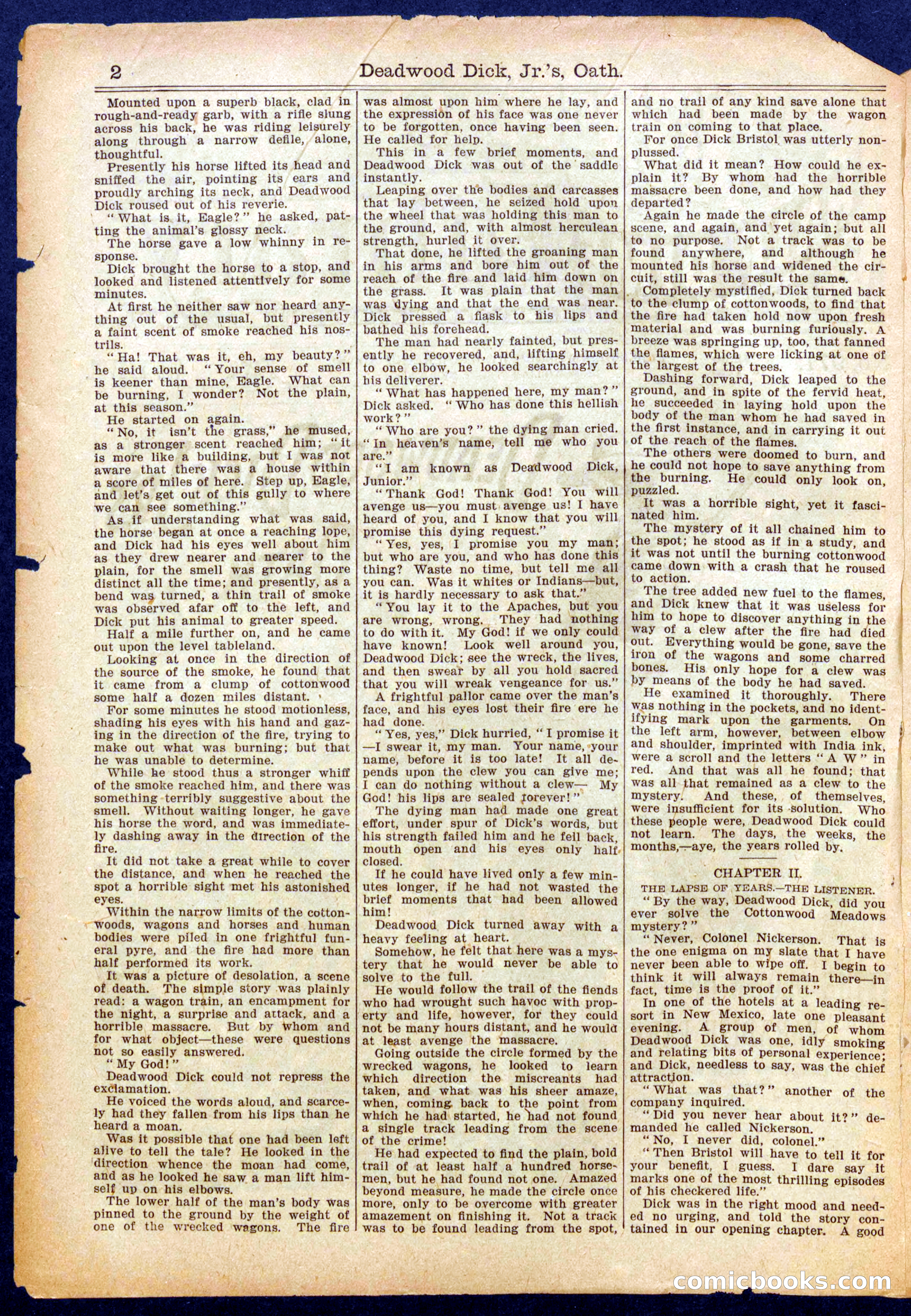
A restored page from Pulp Fiction, 1896. Page through the whole issue in the reader above.
📄 Transcribed text from this page (OCR, searchable)
Machine-transcribed from the original scan — historical spelling and the odd misread are preserved.
+ — “sap ® ide et ep KE if te ee ea ‘is keener than mine, Hagle. 2 Mounted upon a superb black, clad in rough-and-ready garb, with a rifle slung across his back, he was riding leisurely along through a narrow defile, alone, thoughtful. Presently his horse lifted its head and sniffed the air, pointing its ears and proudly arching its neck, and Deadwood Dick roused out of his reverie. “What is. it, Eagle?” he asked, pat- ting the animal’s glossy neck. The horse gave a low whinny in re- sponse. Dick brought the horse to a stop, and looked and listened attentively for some minutes. At first he neither saw nor heard any- thing out of the usual, but presently a faint scent of smoke reached his nos- trils. “Your sense of smell What can be burning, I wonder? Not the plain, at this season.” He started on again. “No, it isn’t the grass,” he mused, as a stronger scent reached him; “it is more like a building, but I was not aware that there was a house within a score of miles of here. Step up, Eagle, and let’s get out of this gully to where we can see something.” | As .if understanding what was said, the horse began at once a reaching lope, and Dick had his eyes well about him as they drew nearer and nearer to the plain, for the smell was growing more distinct all the time; and presently, as a bend was turned, a thin trail of smoke was observed afar off to the left, and Dick put his animal to greater speed. Half a mile further on, and he came out upon the level tableland. Looking at once in the direction of the source of the smoke, he found that it came from a clump of cottonwood some half a dozen miles distant. ° For some minutes he stood motionless, shading his eyes with his hand and gaz- ing in the direction of the fire, trying to make out what was burning; but that he was unable to determine. While he stood thus a stronger whiff of the smoke reached him, and there was something -terribly suggestive about the smell. Without waiting longer, he gave his horse the word, and was immediate- iy dashing away in the direction of the re. It did not take a great while to cover the distance, and when he reached the spot a horrible sight met his astonished eyes. | Within the narrow limits of the cotton- he said aloud. «Woods, wagons and horses and human bodies were piled in one frightful fun- eral pyre, and the fire had more than half performed its work. It was a picture of desolation, a scene of death. The simple story was plainly read: a wagon train, an encampment for the night, a surprise and attack, and a horrible massacre. But by Whom and for what object—these were questions not so easily answered. “My God!” Deadwood Dick could not repress the exclamation. He voiced the words aloud, and scarce- ly had they fallen from his lips than he heard a moan. Was it possible that one had been left alive to tell the tale? He looked in the direction whence the moan had come, and as he looked he saw a man lift him- self up on his elbows. The lower half of the man’s body was pinned to the ground by the weight of one of the wrecked wagons. The fire “Ha! That was it, eh, my beauty?” amazement on finishing it. was to be found leading from the spot, ' 5 lng - vf & . a my ~ 1 " : : ' a , a #. f Deadwood Dick, Jr.’s, Oath. a ————SEeSeEeSeEeSSeeeeeSeSsSsS! —_ ee so > ee re was almost upon him where he lay, and the expression of his face was one never to be forgotten, once having been seen. He called for help. This in a few brief moments, and Deadwood Dick was out of the saddle instantly. Leaping over the bodies and carcasses that lay between, he seized hold upon the wheel that was holding this man to the ground, and, with almost herculean strength, hurled it over. That done, he lifted the groaning man in his arms and bore him out of the reach of the fire and laid him down on the grass. was dying and that the end was near. Dick pressed a flask to his lips and bathed his forehead. The man had nearly fainted, but pres- ently he recovered, and, lifting himself to one elbow, he looked searchingly at his deliverer. ‘“ What has happened here, my man?” Dick asked. ‘‘ Who has done this hellish work?” “Who are you?” the dying man cried. “In heaven’s name, tell me who you are.” “T am known as Deadwood Dick, Junior.” . 4 “Thank God! Thank God! You will avenge us—you must, avenge us! I have heard of you, and I know that you will promise this dying request.”’ “Yes, yes, I promise you my man, but who are you, and who has done this thing? Waste no time, but tell me all you can. Was it whites or Indians—but, it is hardly necessary to ask that.” | “You lay it to the Apaches, but you are wrong, wrong. They had nothing to do withit. My God! if we only could have known! Look well around you, Deadwood Dick; see the wreck, the lives, and then swear by all you hold sacred that you will wreak vengeance for us.” A frightful pallor came over the man’s face, and his eyes lost their fire ere he had done. “Yes, yes,”’ Dick hurried, “ I promise it —I swear it, my man. Your name,-»*your name, before it is too late! It all de- pends upon the clew you can give me; I can do nothing without a clew— My God! his lips are sealed forever!” The dying man had made one great effort, under spur of Dick’s words, but his strength failed him and he fell back, mouth open and his eyes only half, closed. If he could have lived only a few min- utes longer, if he had not wasted the Seat; moments that had been allowed m! Deadwood Dick turned away with a heavy feeling at heart. — Somehow, he felt that here was a mys- tery that he would never be able to solve to the full. He would follow the trail of the fiends who had wrought such havoc with prop- ‘erty and life, however, for they could not be many hours distant, and he woulda at least avenge the massacre. Going outside the circle formed by the wrecked wagons, he looked to learn which direction the miscreants had taken, and what was his sheer amaze, when, coming. back to the point from which he had started, he had not found a single track leading from the scene of the crime! He had expected to find the plain, bold trail of at least half a hundred horse- men, but he had found not one. Amazed beyond measure, he made the circle once more, only to be overcome with greater Not a track It was plain that the man}. —_—_— and no trail of any kind save alone that which had been made by the wagon train on coming to that place. , For once Dick Bristol was utterly non- plussed. What did it mean? How could he ex- plain it? By whom had the horrible massacre been done, and how had they departed? Again he made the circle of the camp scene, and again, and yet again; but all to no purpose. Not a track was to be found anywhere, and although he mounted his horse and widened the cir- cuit, still was the result the same. Completely mystified, Dick turned back to the clump of cottonwoods, to find that the fire had taken hold now upon fresh material and was burning furiously. A breeze was springing up, too, that fanned the flames, which were licking at one of the largest of the trees. | | Dashing forward, Dick leaped to the ground, and in spite of the fervid heat, he succeeded in laying hold upon the body of the man whom he had saved in the first instance, and in carrying it out of the reach of the flames. The others were doomed to burn, and he could not hope to save anything from the burning. He could only look on, puzzled. It was a horrible sight, yet it fasci- nated him. The mystery of it all chained him to the spot; he stood as if in a study, and it was not until the burning cottonwood came down with a crash that he roused to action. The tree added new fuel to the flames, and Dick knew that it was useless for him to hope to discover anything in the way of a clew after the fire had died out. Everything would be gone, save the iron of the wagons and some charred bones. His only hope for a clew was by means of the body he had saved. He examined it thoroughly. There was nothing in the pockets, and no ident- ifying mark upon the garments, On the left arm, however, between elbow and shoulder, imprinted with India ink, were a scroll and the letters “A W” in red. And that was all he found; that was all that remained as a clew to the mystery. And these, of themselves, were insufficient for its -solution. Who these people were, Deadwood Dick could not learn. The days, the weeks, the months,—aye, the years rolled by, - CHAPTER II. THE LAPSB OF YEARS.—THE LISTENER. * “By the way, Deadwood Dick, did you ever solve the Cottonwood Meadows mystery?” “ Never, Colonel Nickerson. That is the one enigma on et Slate that I have never been able to wip think it will always remain there—in fact, time is the proof of it.” In one of the hotels at a leading re- sort in New Mexico, late one pleasant ~ hip px a Dick Dead woo cK Was one, idly gs and relating bits of personal Aiinantent and Dick, needless to say, was the chief attraction. “What was that?” another of the company inquired. “Did you never hear about it?” de- manded he called Nickerson. “No, I never did, colonel.” “Then Bristol will have to tell it for aont hae age guess. I dare gay it marks one 0 e most thrillin of his checkered life.’’ cette Dick was in the right mood and need- — ed no urging, and told the story con- | A good — tained in our opening chapter. ’ Fd : om t . 7 | | . ae * % 4 eee JOO i ee ee a ~ e off. I begin to © A group of men, of whom. « a ee - ‘But . ad a ie Se eee - a - —