
Pulp Fiction, 1895 · page 3 of 16
Beadle's Half Dime Library No. 961 — page 3: what you’re looking at
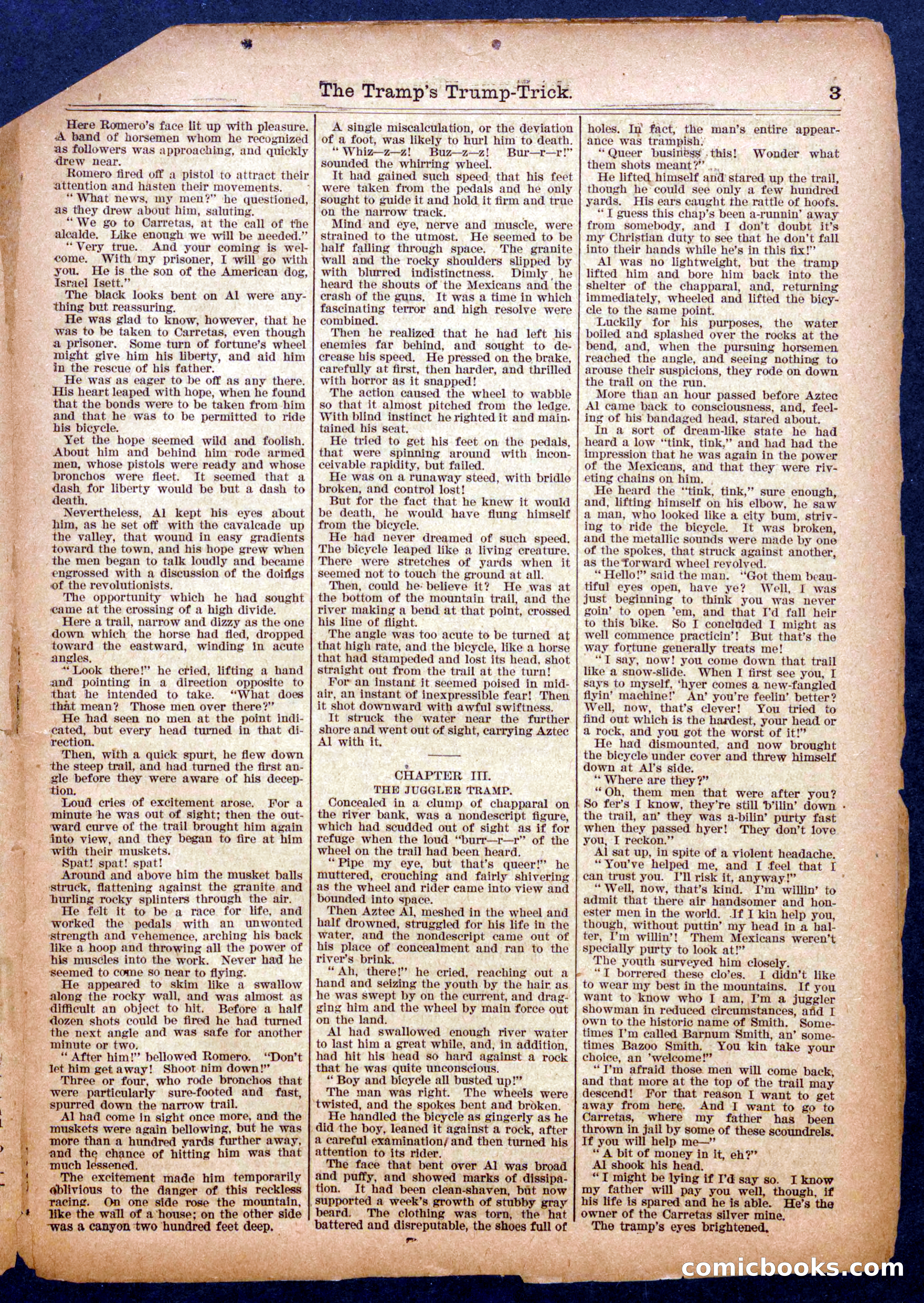
A restored page from Pulp Fiction, 1895. Page through the whole issue in the reader above.
📄 Transcribed text from this page (OCR, searchable)
Machine-transcribed from the original scan — historical spelling and the odd misread are preserved.
a : “ 7 _ Here Romero’s face lit up with pleasure. ‘A band of horsemen whom he recognized as followers was approaching, and quickly drew near. Romero fired off a pistol to attract their attention and hasten their movements. “What news, my men?” he questioned, as they drew about him, saluting. “We go to Carretas, at the eall of the alealde. Like enough we will be needed.” ‘Very true. And your coming is wel- come. With my prisoner, I will go with you. He is the son of the American dog, Israel Isett.” The black looks bent on Al were any- thing but reassuring. He was glad to know, however, that he was to be taken to Carretas, even though a prisoner. Some turn of fortune’s wheel might give him his liberty, and aid him in the rescue of his father. He was as eager to be off as any there. His heart leaped with hope, when he found that the bonds were to be taken from him and that he was to be permitted to ride his bicycle. Yet the hope seemed wild and foolish. About him and behind him rode armed men, whose pistols were ready and whose bronchos were fleet. It seemed that a dash for liberty would be but a dash to death. Nevertheless, Al kept his eyes about him, as he set off with the cavalcade up the valley, that wound in easy gradients toward the town, and his hope grew when the men began to talk loudly and became engrossed with a discussion of the doitigs of the revolutionists. The opportunity which he had sought came at the crossing of a high divide. Here a trail, narrow and dizzy as the one down which the horse had fled, dropped toward the eastward, winding in acute angles, “Look there!” he eried, lifting a hand and pointing in a direetion opposite to that he intended to take. “What does that mean? Those men over there?” He had seen no men at the point indi- eated, but every head turned in that di- rection. Then, with a quick spurt, he flew down the steep trail, and had turned the first an- gle before they were aware of his decep- tion. Loud cries of excitement arose. For a minute he was out of sight; then the out- ward curve of the trail brought him again into view, and they began to fire at him with their muskets. Spat! spat! spat! Around and above him the musket balls struck, flattening against the granite and hurling rocky splinters through the air. He felt it to be a race for life, and worked the pedals with an unwonted strength and vehemence, arching his back like a hoop and throwing all the power of his muscles into the work. Never had he seemed to come so near to flying. He appeared to skim like a swallow along the rocky wall, and was almost as difficult an object to hit. Before a half dozen shots could be fired he had turned the next angle and was safe for another minute or two. “ After him!’ bellowed Romero. “Don’t let him get away! Shoot him down!” Three or four, who rode bronchos that were particularly sure-footed and fast, spurred down the narrow trail. Al had come in sight once more, and the muskets were again bellowing, but he was more than a hundred yards further away, and the chance of hitting him was that much lessened. The excitement made him temporarily a@blivious to the danger of this reckless racing. On one side rose the mountain, like the wall of a ‘house; on the other side |) "was @ canyon two hundred feet deep, The Tramp’s Trump-Trick. STE A single miscalculation, or the deviation of a foot, was likely to hurl him to death. “ Whiz—z—z! Buz—z—z! Bur—r—r!” Sounded the whirring wheel. It had gained such speed that his feet were taken from the pedals and he only sought to guide it and hold it firm and true on the narrow track. Mind and eye, nerve and muscle, were strained to the utmost. He seemed to be half falling through space. The granite wall and the rocky shoulders slipped by with blurred indistinctness. Dimly he heard the shouts of the Mexicans and the crash of the guns, It was a time in which fascinating terror and high resolye were combined. Then he realized that he had left his enemies far behind, and sought to de- crease his speed. He pressed on the brake, carefully at first, then harder, and thrilled with horror as it snapped! The action caused the wheel to wabble so that it almost pitched from the ledge. With blind instinct he righted it and main. tained his seat. He tried to get his feet on the pedals, that were spinning around with incon- ceivable rapidity, but failed. He was on a runaway steed, with bridle broken, and control lost! But for the fact that he knew it would be death, he would have flung himself from the bicycle. He had never dreamed of such speed. The bicycle leaped like a living creature. There were stretches of yards when it seemed not to touch the ground at all. Then, could he: believe it? He was at the bottom of the mountain trail, and the river making a bend at that point, crossed. his line of flight. The angle was too acute to be turned at that high rate, and the bicycle, like a horse that had stampeded and lost its head, shot straight out from the trail at the turn! For an instant it seemed poised in mid- air, an instant of inexpressible fear! Then it shot downward with awful swiftness. It struck the water near the further shore and went out of sight, carrying Aztec Al with it. _—----- CCT CHAPTER ITI. THE JUGGLER TRAMP. Concealed in a clump of chapparal on the river bank, was a nondescript figure, which had scudded out of sight as if for refuge when the loud “burr—r—r” of the wheel on the trail had been heard. “Pipe my eye, but that’s queer!” he muttered, crouching and fairly shivering as the wheel and rider came into view and bounded into space. Then Aztee Al, meshed in the wheel and half drowned, struggled for his life in the water, and the nondescript came out of his place of concealment and ran to the river’s. brink, “ Ah, there!’ he cried, reaching out a hand and seizing the youth by the hair as he was swept by on the current, and drag- ging him and the wheel by main force out on the land. Al had swallowed enough river water to last him a great while, and, in addition, had hit his head so hard against a rock that he was quite unconscious. “Boy and bicycle all busted up!” The man was right. The wheels were twisted, and the spokes bent and brdken. He handled the bicycle as gingerly as he did the boy, leaned it against a rock, after a careful examination/ and then turned his attention to its rider. The face that bent over Al was broad and puffy, and showed marks of dissipa- tion. It had been clean-shaven, but now supported a week’s growth of stubby gray beard. The clothing was torn, the hat battered and disreputable, the shoes full of Mh a Loe ae aL Sr - a) i ee ‘ 7 ° . Ws ald 3. a ee I holes. In’ fact, the man’s entire appear- ance was trampish, “Queer businésy . this! them shots meant?’ .. He lifted himself and stared up the trail, though he could see only a few hundred yards. His ears caught the rattle of hoofs. “I guess this chap’s been a-runnin’ away from somebody, and I don’t doubt it’s my Christian duty to see that he don’t fall into their hands while he’s in this fix!” Al was no lightweight, but the tramp lifted him and bore him back into the shelter of the chapparal, and, returning immediately, wheeled and lifted the biey- cle to the same point. Luckily for his purposes, the water boiled and splashed over the rocks at the bend, and, when the pursuing horsemen reached the angle, and seeing nothing to arouse their suspicions, they rode on down the trail on the run. More than an hour passed before Aztec Al came back to consciousness, and, feel- ing of his bandaged head, stared about. In a sort of dream-like state he had heard a low “tink, tink,’’ and had had the impression that he was again in the power of the Mexicans, and that they were riy- eting chains on him. He heard the ‘tink, tink,’ sure enough, and, lifting himself on his elbow, he saw a man, who looked like a city bum, striy- ing to ride the bicycle. It was broken, and the metallic sounds were made by one of the spokes, that struck against another, as the forward wheel revolved. ‘“ Hello!” said the man. “Got them beau- tiful eyes open, have ye? Well, I was just beginning to think you was never goin’ to open ’em, and that I'd fall heir to this bike. So I coneluded I might as well commence practicin’! But that’s the way fortune generally treats me! “| say, now! you come down that trail like a snow-slide. When I first see you, I says to myself, ‘hyer comes a new-fangled flyin’ machine! An’ you’re feelin’ better? Well, now, that’s clever! You tried to find out which is the hardest, your head or 4 rock, and you got the worst of it!” He had dismounted, and now brought the bicycle under cover and threw himself down at Al’s side. * Where are they?’ “Oh, them men that were after you? Wonder what So fer’s I know, they’re still D’ilin’ down - the trail, an’ they was a-bilin’ purty fast when they passed hyer! They don’t love you, I reckon.” Al sat up, in spite of a violent headache. ‘You've helped me, and I feel that IT can trust you. I'll risk it, anyway!” “ Well, now, that’s kind. I’m willin’ to admit that there air handsomer and hon- ester men in the world. If I kin help you, though, without puttin’ my head in a hal- ter, I’m willin’! Them Mexicans weren’t specially purty to look at!” The youth surveyed him closely. “I borrered these clo’es. I didn’t like to wear my best in the mountains. If you want to know who I am, I’m a juggler showman in reduced circumstances, and I Own to the historic name of Smith. Some- times I’m called Barnum Smith, an’ some- times Bazoo Smith. You kin take your choice, an ’welcome!”’ “I’m afraid those men will come back, and that more at the top of the trail may descend! For that reason I want to get away from here, And I want to go to Carretas, where my father has been thrown in jail by some of these scoundrels. If you will help me—” “A bit of money in it, eh?” Al shook his head, “T might be lying if ’'d say so. I know my father will pay you well, though, if his life is spared and he is able. He’s the owner of the Carretas silver mine, The tramp’s eyes brightened, | a ' = ” Mm ! >» ot Coe. bs - * . = a = , weve sop ee Se : ‘soe ») =X